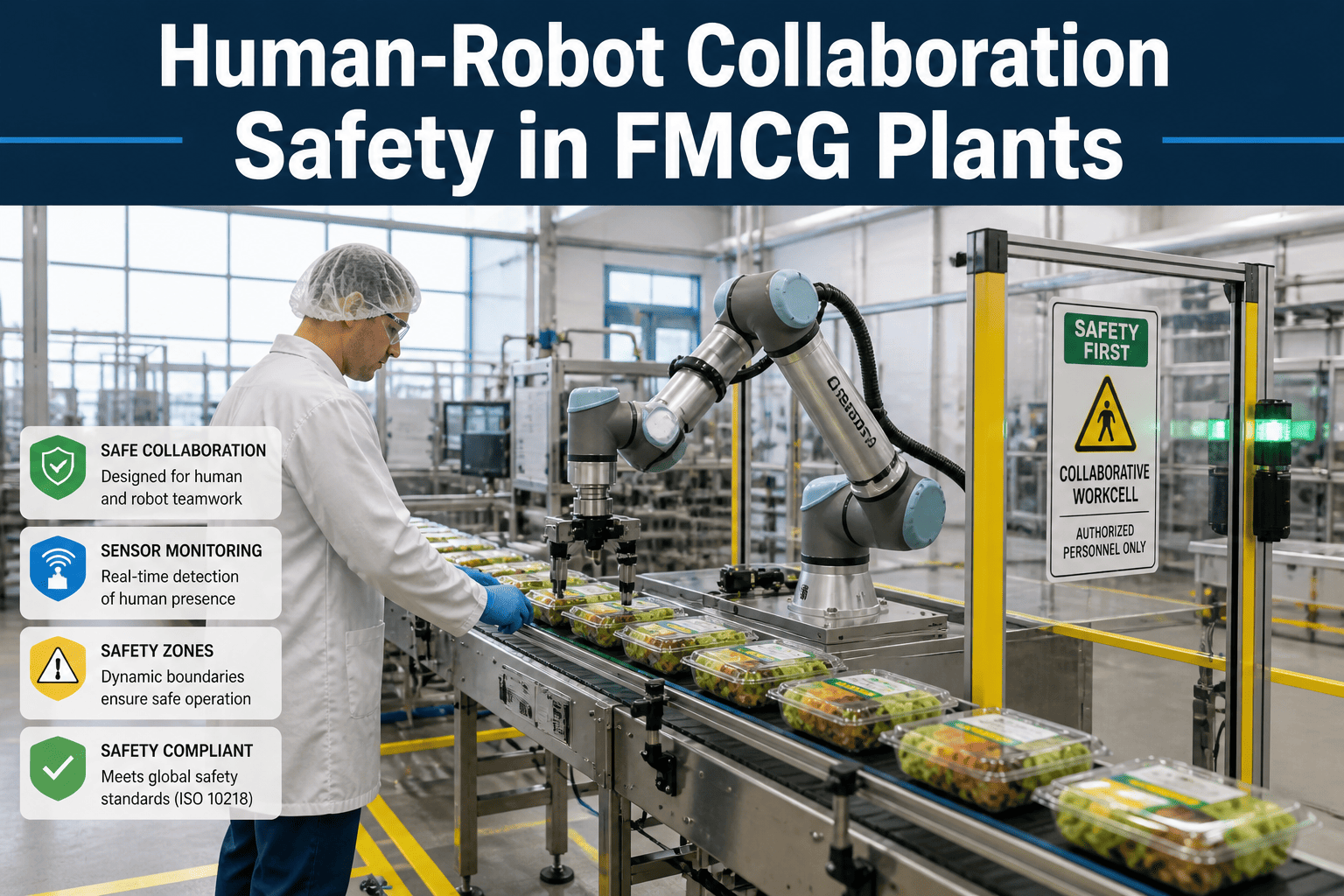
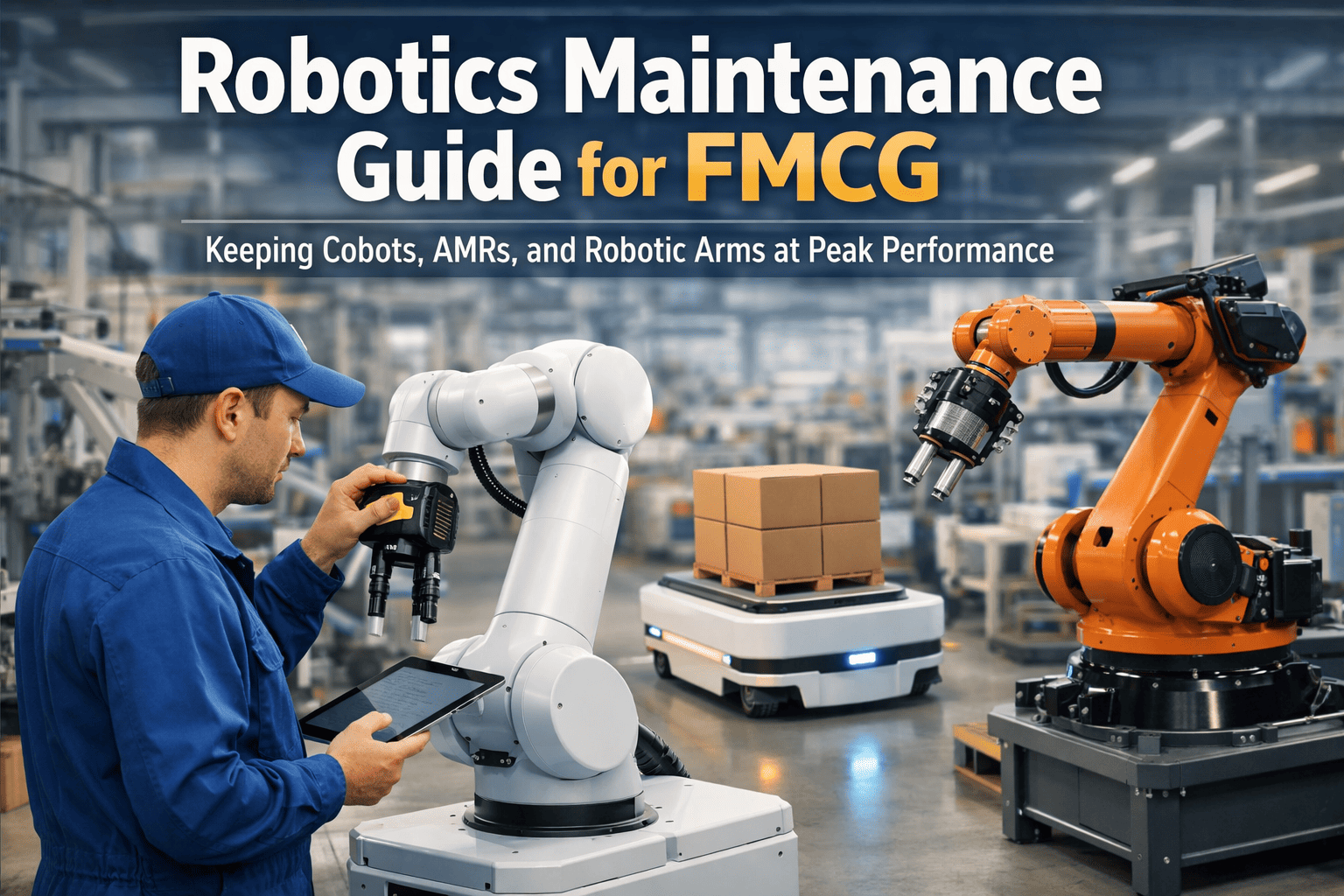
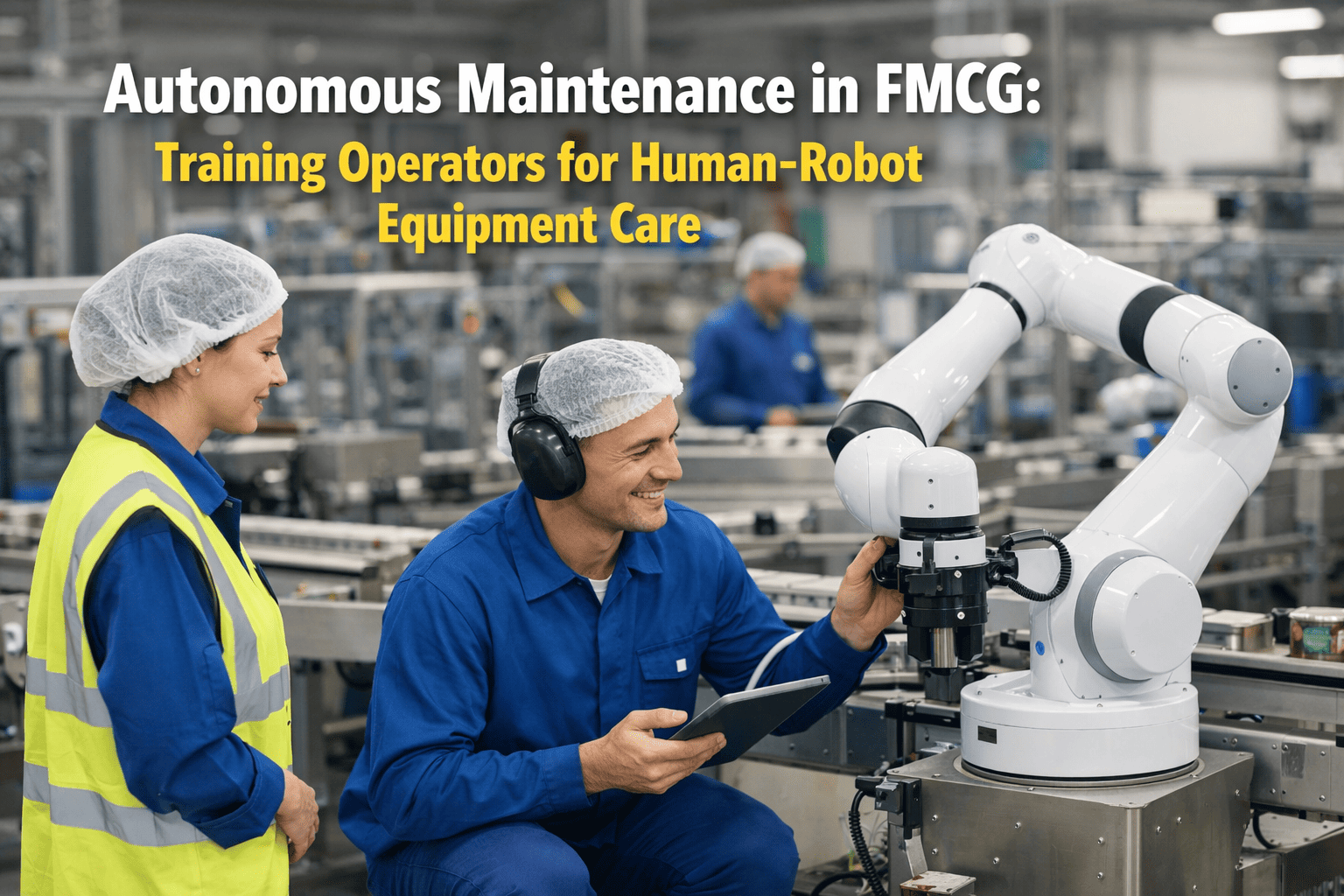
A snack foods manufacturer outside Indianapolis was running three packing lines with six operators per shift dedicated to case packing, lid placement, and visual defect inspection. Turnover on those positions averaged 68% annually — the jobs were repetitive, physically taxing, and the first roles new hires quit. When the plant deployed four cobots across those same lines — two for case packing, one for palletizing, one for inline quality inspection — throughput increased 31%, defect escape rate dropped from 2.4% to 0.3%, and ergonomic injury incidents on the packing floor went to zero. But the operational insight that changed the maintenance director's approach came during shift handover: the previous system relied on verbal pass-downs and a clipboard. Missed handover notes had caused three quality holds in the prior year. With cobots integrated into a CMMS, every shift change now auto-generates a status report — cobot cycle counts, safety interlock verifications, torque sensor calibration status, and open maintenance flags — digitally signed by both outgoing and incoming operators. No clipboard. No missed notes. No quality holds since deployment.
This guide examines how collaborative robots are transforming FMCG packing, palletizing, and quality control operations — and why the maintenance infrastructure behind the cobot matters as much as the cobot itself. Sign Up — register your cobot cells as trackable assets with cycle-based maintenance from day one.
31%
throughput increase on packing lines after cobot deployment
0.3%
defect escape rate with cobot vision QC vs. 2.4% manual inspection
8–12 mo
typical ROI payback period for FMCG cobot cells
Zero
safety fencing required — cobots operate alongside human workers
Where Cobots Fit in FMCG Operations
Cobots are not replacements for high-speed industrial robots. They fill a different gap: the medium-speed, high-flexibility, operator-adjacent tasks where traditional automation is too rigid and manual labor is too inconsistent, too injury-prone, or too hard to staff. In FMCG plants, three application zones deliver the fastest return.
Cycle Rate
12–18 picks/min
Payload
5–16 kg typical
Changeover
Recipe change in <2 min
Key advantage: handles 20+ SKU formats on a single line without tooling swaps or crew retraining
Cycle Rate
8–14 cases/min
Payload
Up to 20 kg per pick
Footprint
No safety fencing needed
Key advantage: deploys in days, not weeks — fits into existing end-of-line without layout redesign
Inspection Rate
100% inline at line speed
Defect Detection
Label, seal, fill, foreign object
False Reject Rate
<0.1% after training
Key advantage: consistent accuracy that does not degrade with fatigue, shift length, or operator experience
Book a Demo — see how Oxmaint tracks cycle counts, EOAT wear, and vision calibration across all three cobot application types.
Cobot Maintenance: What Breaks and When
Cobots are marketed as low-maintenance. They are — compared to full industrial robots. But FMCG cobots running 16–20 hours per day accumulate wear on specific subsystems that require disciplined tracking to prevent the unplanned downtime that erases the productivity gains. The plants holding 98%+ cobot uptime track these components against operating hours and cycle counts, not calendar dates.
End-of-Arm Tooling
Grip force decline, vacuum leak, suction cup wear
2,000–5,000 hrs
$2K–$8K
Cycle count threshold
Joint Servo Motors
Torque variance, positioning drift, thermal rise
10,000–15,000 hrs
$4K–$15K
Operating hours
Force/Torque Sensors
Calibration drift, false contact triggers
Quarterly calibration
$1K–$5K
Calendar + cycle hybrid
Safety Systems
Speed/force limit validation, E-stop response delay
Monthly verification
$10K–$50K (OSHA)
Compliance schedule
Vision Camera System
Calibration drift, lighting degradation, lens contamination
Monthly calibration
$3K–$12K (missed defects)
Reject rate anomaly
Cable Harness / Teach Pendant
Cable fatigue at joint flex points, pendant connector wear
6,000–10,000 hrs
$1K–$4K
Operating hours
Swipe to see more →
Sign Up — configure cycle-count and hour-based PM triggers for every cobot subsystem in your fleet.
Shift Handover: Where Cobot Operations Fail Without a System
FMCG plants run cobots across two or three shifts. Every shift change is a failure point: an outgoing operator notices a gripper wearing unevenly but does not document it. An incoming operator resets a safety fault without understanding the root cause. A vision system calibration check gets skipped because it was "done yesterday." These gaps do not show up until a quality hold, a safety incident, or an unplanned stop.
Shift Change: Outgoing Operator Completes Handover in CMMS
Are there open maintenance flags, safety alerts, or calibration items?
YES — Action Required
Flagged Handover Protocol
1. Open items auto-populate incoming operator's shift checklist
2. Safety interlock status verified with digital sign-off
3. Supervisor notified if critical items remain unresolved
4. Cobot cannot resume production until sign-off complete
NO — Standard Handover
Clean Shift Start
1. Auto-generated shift report: cycle counts, reject rates, uptime %
2. Incoming operator reviews and digitally signs
3. Pre-shift safety checklist completed on mobile device
4. Cobot resumes production with documented handover trail
Book a Demo — see digital shift handover with mandatory sign-off running on a live cobot cell.
Every Shift Change Documented. Every Safety Check Verified.
Oxmaint auto-generates digital shift handover reports for every cobot cell — cycle counts, safety interlock status, calibration checks, and open maintenance flags — with mandatory sign-off before production resumes. No more verbal pass-downs. No more clipboards lost between shifts. Every handover is timestamped, digitally signed, and stored for audit — so when the quality team or OSHA auditor asks for records, your documentation is already complete.
Human-Robot Safety Compliance
Cobots operate without safety fencing — that is their defining advantage. But "no fence" does not mean "no safety requirements." ISO 10218-2 and ISO/TS 15066 mandate documented risk assessments, validated speed and force limits, and ongoing verification that safety functions remain within specification. OSHA enforces these standards, and the penalty for a willful violation in 2026 is $161,323 per instance.
01
Speed & Force Limit Validation
Requirement: Cobot speed and force limits must be verified against the documented risk assessment parameters at scheduled intervals. Drift beyond limits = noncompliant operation.
CMMS Action: Monthly verification work orders with pass/fail checklist, force gauge readings documented with photo evidence, and automatic escalation if readings exceed threshold.
02
Emergency Stop Function Testing
Requirement: Every E-stop on the cobot cell and associated conveyors must be tested at documented intervals. Response time must be within manufacturer specification.
CMMS Action: Weekly E-stop verification auto-generated as a work order. Digital checklist captures response time measurement and technician sign-off.
03
Risk Assessment Documentation
Requirement: ISO 10218-2 requires a documented risk assessment for every cobot application, updated whenever the application changes — new EOAT, new product, new layout.
CMMS Action: Risk assessment linked to cobot asset record. Any configuration change triggers a review flag. Annual reassessment auto-scheduled with audit-ready documentation.
04
Operator Training Records
Requirement: Every operator working alongside a cobot must have documented training on the specific application, including hazard awareness, E-stop locations, and safe interaction procedures.
CMMS Action: Training records linked to operator profiles. Skill matrix ensures only qualified operators are assigned to cobot cells. Expiry alerts trigger retraining before certifications lapse.
Sign Up — build your ISO 10218 compliance schedule and operator skill matrix before your next audit.
Cobot CMMS Integration: From Alerts to Action
The cobot OEM dashboard tells you what the robot is doing. A CMMS tells you what needs to happen next — and tracks whether it did. The gap between those two capabilities is where unplanned downtime, missed safety checks, and quality escapes live.
Cobot OEM Dashboard Only
X
Shows robot status but no maintenance workflow
X
No spare parts tracking or reorder automation
X
Safety compliance checks not scheduled or documented
X
Shift handover data not captured or signed off
Oxmaint CMMS Integration
✓
Cycle-count work orders with parts, procedures, and scheduling
✓
Min/max spare parts with predicted consumption and auto-POs
✓
ISO 10218 and OSHA compliance work orders auto-generated
✓
Digital shift handover with mandatory sign-off and audit trail
01
Cycle-Based Preventive Maintenance
Work orders trigger by actual gripper cycles, joint operating hours, and vision system inspections — not calendar intervals. Every subsystem gets serviced at the right time.
02
Operator Skill Matrix & Training
Track which operators are certified for which cobot cells. The system blocks unqualified operators from being assigned and alerts before training certifications expire.
03
QC Reject Rate Monitoring
When vision system reject rates drift above baseline, the CMMS auto-generates a calibration work order — catching camera drift before it becomes a quality hold.
04
Multi-Cell Fleet Dashboard
Real-time view of every cobot's maintenance status, safety compliance, and operating metrics — across every line and every shift — in one screen.
98%+
cobot uptime with CMMS-integrated preventive maintenance
100%
shift handover documentation rate with digital sign-off
0
quality holds from missed handover notes since deployment
Book a Demo — walk through the multi-cell fleet dashboard with your actual cobot lineup.
Implementation Roadmap
FMCG cobot deployments that build maintenance and safety infrastructure in parallel with cell installation reach full production in 10–14 weeks. Plants that bolt on maintenance tracking later spend months chasing compliance gaps and unplanned stops.
1. Application Assessment
Weeks 1–3
Identify packing, palletizing, QC tasks for cobot deployment
Map asset hierarchy and spare parts requirements
Cell spec and maintenance plan defined
2. Cell Install & Safety Validation
Weeks 4–8
Deploy cobots, integrate conveyors, commission safety systems
Register assets, configure PMs, build safety checklists
ISO 10218 risk assessment documented
3. Operator Training & Handover Setup
Weeks 6–10
Train operators; configure shift handover workflows
Skill matrix, training records, digital handover templates
All operators certified and tracked
4. Production Ramp & Optimization
Weeks 10–14
Validate throughput, calibrate PM intervals against actual wear
Refine cycle-count thresholds, activate QC reject monitoring
98%+ uptime, zero quality holds
Swipe to see more →
Sign Up — start Phase 1 by mapping your asset hierarchy and spare parts requirements today.
Frequently Asked Questions
Can cobots really operate without safety fencing in an FMCG plant?
Yes — cobots are specifically designed for fenceless operation under ISO/TS 15066 power and force limiting requirements. The cobot continuously monitors contact force and stops within milliseconds if it detects unexpected resistance. However, "no fence" does not mean "no safety program." You need a documented risk assessment, validated speed/force limits for your specific application, and ongoing verification that safety functions remain within specification. Oxmaint auto-schedules these verification work orders and maintains the audit trail that OSHA and ISO auditors require.
Book a Demo — see how safety verification work orders auto-generate on a compliance schedule.
How does Oxmaint handle shift handover for cobot cells?
At every shift change, Oxmaint auto-generates a digital handover report for each cobot cell: cycle counts since last service, safety interlock verification status, vision system calibration check, reject rate trend, and any open maintenance flags. The outgoing operator digitally signs the report. The incoming operator reviews, acknowledges open items, and completes a pre-shift safety checklist before production resumes. Every handover is timestamped and stored for audit.
Sign Up — set up digital shift handover templates for your cobot cells in minutes.
What ROI should we expect from FMCG cobot deployment?
Most FMCG operations see payback in 8–12 months based on labor cost reduction, injury elimination, throughput increase, and quality improvement. Plants running two or three shifts see faster payback because the cobot operates continuously without overtime premiums or fatigue-related defects. The variable that most affects payback timeline is unplanned downtime — plants with CMMS-integrated maintenance consistently hit the 8–12 month range while plants without it see payback stretch to 16–20 months.
Can a cobot handle multiple SKU formats without retooling?
Yes — this is one of the primary advantages over traditional automation. Cobot recipe changes execute via software in under two minutes. A single cobot with the right end-of-arm tooling can handle 20+ SKU configurations for case packing and palletizing. Vision-based QC cobots adapt to new product appearances through software training rather than hardware changes. The maintenance consideration is that multi-SKU operations stress the EOAT more than single-product runs, requiring tighter cycle-count-based service intervals.
Book a Demo — we will show you how cycle-count triggers adapt to multi-SKU wear patterns.
Your Cobots Run Three Shifts. Your Maintenance System Should Cover All of Them.
Oxmaint manages every cobot cycle count, safety verification, operator certification, and shift handover across your entire fleet — with predictive work orders, compliance documentation, and quality analytics that keep cobots producing instead of grounded. From the first gripper cycle to the last pallet of the night shift, every maintenance event is tracked, every safety check is verified, and every handover is documented. That is how FMCG plants hold 98%+ cobot uptime and zero quality holds.