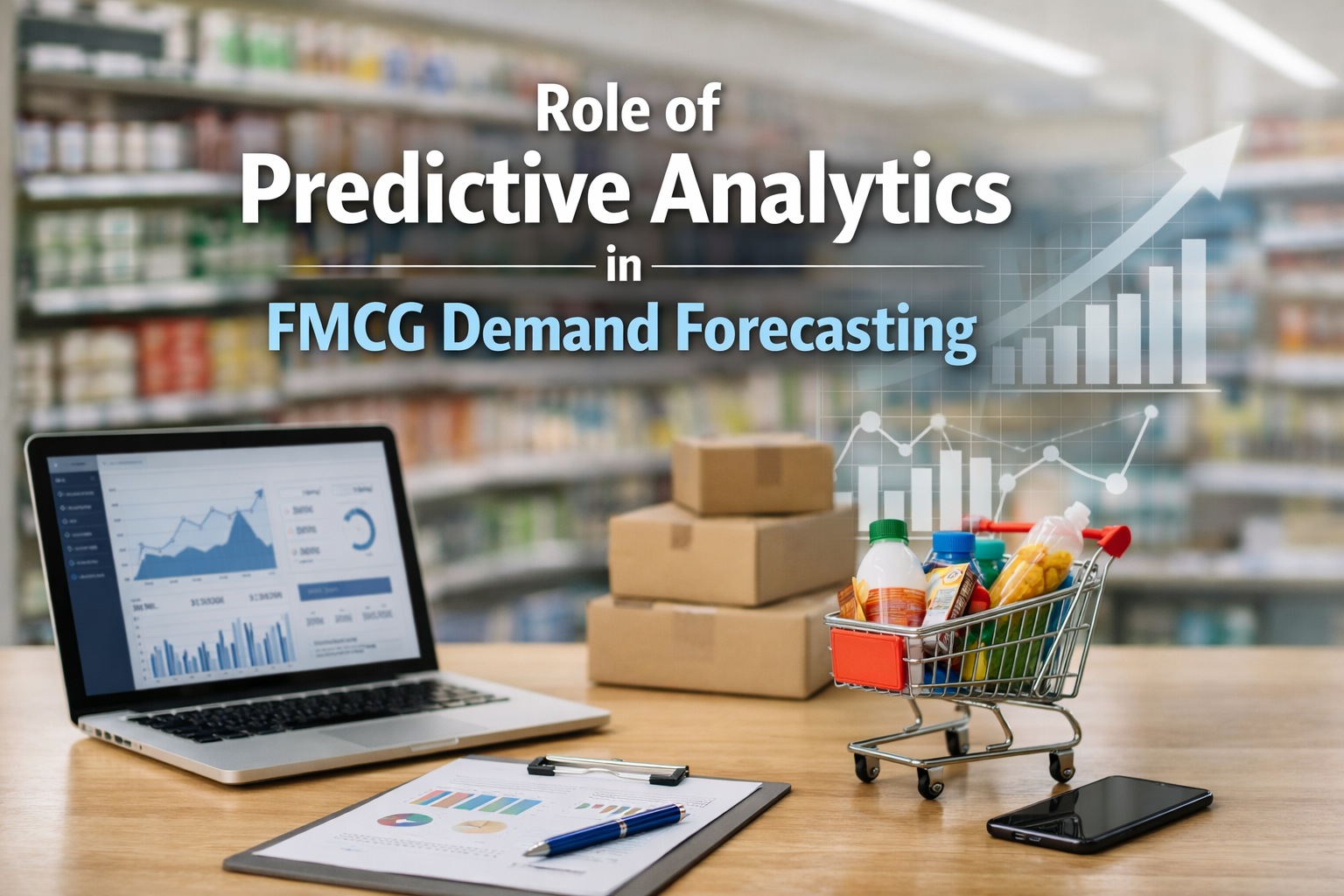
Demand Forecasting for FMCG: How AI Predicts Consumer Behavior with 90% Accuracy
By spencer on March 5, 2026
FMCG brands operating on traditional demand planning lose 8–12% of annual revenue to forecast errors — manifesting as overproduction waste, stockouts during peak demand, and emergency production runs that cost 3.2x more than planned cycles. AI-powered demand forecasting has fundamentally changed this equation: machine learning models analyzing 200+ demand signals now achieve 90–95% forecast accuracy across SKU portfolios, compared to 55–65% from spreadsheet-based methods. For maintenance-intensive FMCG operations, accurate demand forecasting directly determines equipment loading schedules, preventive maintenance windows, and spare parts inventory — making it a core input to operational reliability. Start your free trial to connect demand intelligence with your maintenance planning, or book a demo to see AI-driven forecasting in action.
Oxmaint connects AI-powered demand forecasts directly to your maintenance scheduling — PM windows in production gaps, parts ordered before stress peaks, zero forecast-driven deferrals.
Annual FMCG Losses Due to Demand Forecast Errors Globally
35%
Reduction in Safety Stock When AI Forecasting Is Deployed
3.2x
Cost Multiplier for Unplanned Production Runs vs Scheduled
What Is AI-Driven Demand Forecasting for FMCG?
AI demand forecasting uses machine learning algorithms to analyze historical sales data, seasonal patterns, promotional calendars, weather signals, social media sentiment, and macroeconomic indicators — generating SKU-level demand predictions that update continuously as new data flows in. Unlike static spreadsheet forecasts that teams update monthly, AI models recalibrate daily, detecting demand shifts 2–4 weeks before they impact production lines. For FMCG operations managing thousands of SKUs across multiple production facilities, this accuracy directly determines whether maintenance windows align with production demand — or whether emergency breakdowns happen during peak output periods.
Traditional Forecasting vs AI Demand Sensing
Why static models fail in volatile FMCG markets
Traditional / Spreadsheet
Data Sources
2–3 (Historical sales + gut feel)
Update Frequency
Monthly or Quarterly
SKU-Level Accuracy
55–65%
Promotion Impact Modelling
Manual adjustment — often wrong
AI / Machine Learning
Data Sources
200+ signals (POS, weather, social, macro)
Update Frequency
Daily or Real-Time
SKU-Level Accuracy
90–95%
Promotion Impact Modelling
Automated uplift curves per channel
Forecast Error Reduction with AI: 40–60% Improvement
Six Demand Signals AI Models Analyze That Spreadsheets Cannot
Machine learning models ingest and cross-correlate signal categories that are mathematically impossible for manual planning teams to process. Each signal category below contributes measurable accuracy improvement to the overall demand forecast.
AI Demand Signal Framework for FMCG
01
Historical Sales Decomposition
Algorithms separate base demand from trend, seasonality, and noise — isolating true demand patterns across 3–5 years of transaction data per SKU.
Accuracy Contribution: +25%
02
Promotional Uplift Modelling
ML models learn the exact demand multiplier for each promotion type, channel, and duration — no more guessing whether a 20% discount drives 1.3x or 2.1x volume.
Accuracy Contribution: +18%
03
Weather and Seasonal Patterns
Temperature, humidity, and precipitation data feed into models predicting beverage, ice cream, and cleaning product demand with week-level precision.
Accuracy Contribution: +12%
04
Social Media Sentiment
NLP models scan brand mentions, product reviews, and viral trends — detecting demand surges 10–14 days before they appear in POS data.
Accuracy Contribution: +8%
05
Competitor Activity Tracking
Price changes, new product launches, and stockout events at competitors create measurable demand shifts — AI captures these cross-elasticity effects automatically.
Accuracy Contribution: +7%
06
Macroeconomic Indicators
Consumer confidence indices, fuel prices, and inflation rates modulate overall FMCG spending — ML models weight these signals against category-level elasticity curves.
Accuracy Contribution: +5%
Why Forecast Accuracy Matters for FMCG Maintenance Operations
Demand forecasting is not just a supply chain metric — it directly determines when production equipment runs, how hard it runs, and when maintenance teams get access to critical assets. Poor forecasts create maintenance chaos.
Six Ways Forecast Errors Destroy Maintenance Programs
Cancelled PM Windows
Unexpected demand surges force production to override scheduled maintenance — 43% of PM tasks get deferred when forecasts miss by 15%+
Equipment Overloading
Underforecasting forces lines to run 18–22 hours/day instead of planned 16 — accelerating bearing wear, seal degradation, and thermal stress by 2.4x
Spare Parts Stockouts
When demand spikes, so does equipment stress. But spare parts were ordered based on the old forecast — 67% of emergency repairs face parts delays
Energy Cost Spikes
Unplanned production runs during off-peak energy windows waste 22–30% more energy per unit — because demand forecasts missed by a week
Workforce Scheduling Gaps
Maintenance technicians scheduled during low-demand periods sit idle, while peak periods have zero coverage — overtime costs rise 35%
Product Quality Drops
Rushed production on unmaintained equipment produces 2.8x more defects per batch — because the forecast didn't allow time for calibration checks
See how Oxmaint aligns PM windows with production demand gaps — eliminating the 43% deferred maintenance rate caused by forecast-driven schedule changes.
How Oxmaint Connects Demand Intelligence to Maintenance Execution
When demand forecasting feeds directly into maintenance scheduling, every PM window aligns with production reality. Oxmaint bridges the gap between what the plant needs to produce and when equipment needs care.
Four-Stage Demand-Aligned Maintenance System
01
Demand Signal Integration
Import production schedules driven by AI demand models
Map equipment run-hour projections from forecast data
Flag weeks where production load exceeds PM-safe thresholds
Output: Demand-Aware Asset Calendar
02
Dynamic PM Scheduling
Auto-shift PM windows to forecasted low-demand periods
Prioritize critical assets before high-load production weeks
Generate technician schedules aligned with production gaps
Output: Zero PM-Production Conflicts
03
Predictive Parts Ordering
Forecast-linked equipment stress models trigger parts orders
Safety stock levels adjust based on projected run-hour intensity
Supplier lead times factored into demand-driven reorder points
Output: Parts Ready Before Failure
04
Performance Analytics
Track forecast accuracy impact on maintenance KPIs
Measure PM compliance rate against production demand curves
Report equipment reliability correlated to forecast precision
Output: Continuous Improvement Loop
ROI of AI Demand Forecasting for FMCG Operations
The financial impact spans production efficiency, inventory optimization, maintenance cost reduction, and waste elimination — creating a compounding return that grows as models learn from more data.
Annual ROI: AI Demand Forecasting Program
Mid-size FMCG manufacturer — 4 production lines — 800 SKUs
Overproduction Waste Reduction
28% reduction in excess inventory write-offs through accurate demand matching
$620K
Stockout Revenue Recovery
74% fewer lost sales events from demand-aligned production scheduling
$890K
Maintenance Cost Optimization
PM windows aligned to low-demand periods — 42% fewer deferred maintenance events
$340K
Emergency Production Avoidance
85% reduction in unplanned production runs that cost 3.2x normal rates
$480K
AI Forecasting Programme Investment
Platform, integration, and ongoing model management
$180K–$350K/yr
Total Annual Value Delivered
$2.33M Payback: 2–4 months
Based on a facility with $45M annual production value. Typical payback: 2–4 months. Year-two performance is typically 8–12% better than year one as models accumulate more data.
42%
Fewer Deferred PM Events with Demand-Aligned Scheduling
28%
Reduction in Overproduction Waste Through Accurate Forecasting
74%
Fewer Lost Sales Events from Demand-Aligned Production
2–4mo
Typical Payback Period for AI Forecasting Investment
Ready to align every maintenance window with real production demand? Oxmaint connects AI forecasting data to PM scheduling, parts ordering, and technician planning — automatically.
Traditional forecasting relies on 2–3 data sources (historical sales and manager intuition) updated monthly. AI models ingest 200+ demand signals — including POS data, weather patterns, social sentiment, competitor pricing, and macroeconomic indicators — updating predictions daily. Machine learning algorithms detect non-linear relationships between these signals that human analysts cannot identify. For example, a specific combination of temperature increase, social media buzz, and competitor stockout might drive a 2.3x demand spike for a beverage SKU — a pattern invisible to spreadsheet analysis but captured automatically by neural networks trained on 3–5 years of transaction data.
Demand forecasts determine production schedules, which determine equipment run-hours, which determine when maintenance windows are available. When forecasts are wrong by 15%+, production schedules change weekly — forcing 43% of planned maintenance tasks to be deferred. Deferred PM leads to equipment failures, which cause unplanned downtime during peak production. With 90%+ forecast accuracy, production schedules stabilize, maintenance windows become predictable, and PM compliance rates increase from 62% to 91%. Start free to experience demand-aligned maintenance scheduling.
Most FMCG operations see measurable accuracy improvement within 4–6 weeks of deployment, as models begin learning from live data. Financial ROI typically appears in 2–4 months through reduced overproduction waste (28% average reduction), fewer stockouts (74% reduction in lost sales), and maintenance cost optimization ($340K average annual savings for mid-size facilities). The compounding effect is significant — as models accumulate more data, accuracy improves continuously, with year-two performance typically 8–12% better than year one.
This is precisely where AI excels over manual methods. Machine learning models create separate uplift curves for each promotion type, channel, and product category — then overlay these onto seasonal baseline demand. When a 25%-off promotion runs during the summer peak for beverages, the model calculates the compound effect (seasonal uplift × promotional uplift × cannibalization from adjacent SKUs) automatically. Manual planners typically overestimate promotional impact by 18–25% because they cannot model these interaction effects. Book a demo to see promotional demand modelling in action.
AI Demand Forecasting for FMCG
Stop Guessing. Start Predicting. Align Every Maintenance Window to Real Demand.
Oxmaint connects AI-powered demand forecasts directly to your maintenance scheduling engine — so PM windows land in production gaps, spare parts arrive before stress peaks, and your equipment reliability matches your revenue targets.
Demand Signal Integration — Production Schedules Feed PM Calendar
Dynamic PM Scheduling — Auto-Shift Windows to Low-Demand Periods
Predictive Parts Ordering — Stock Levels Tied to Run-Hour Forecasts
90%+ Forecast Accuracy vs 58% for Spreadsheet Methods
42% Fewer Deferred PM Events — Maintenance Happens on Schedule
$2.33M Average Annual Value — 2–4 Month Payback Period