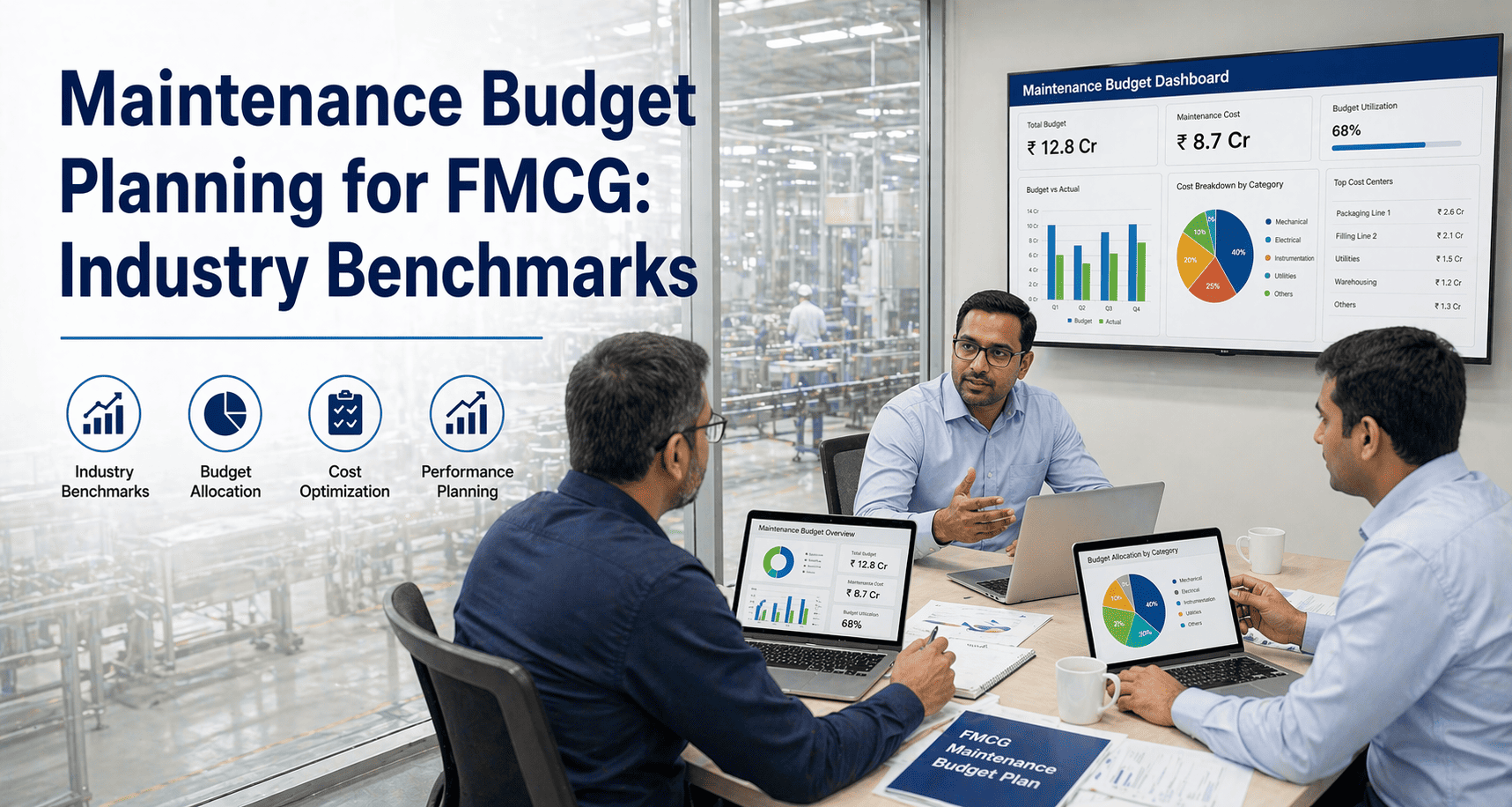
Most FMCG plants treat maintenance budgeting as an afterthought — a number derived by adding 10% to last year's spend and hoping nothing major breaks. The result is predictable: reactive maintenance consumes 70–80% of the budget, capital replacements arrive as emergencies rather than planned investments, and every unplanned breakdown triggers a scramble for funds that were never allocated. A structured annual maintenance budget built on industry benchmarks, equipment age curves, and failure probability data transforms maintenance from a cost centre into a controlled investment with measurable returns. Plants using Oxmaint for budget forecasting and cost reporting reduce unplanned maintenance spend by 38% in the first year by replacing reactive allocation with data-driven planning. Start your free trial to build your FMCG maintenance budget on real equipment data. Schedule a 30-minute demo with our maintenance planning specialists.
Reactive Budgeting
Budget MethodPrior year + % markup
Unplanned Spend Share70–80% of total budget
Emergency Purchases35–50% cost premium
Budget Accuracy±40% variance typical
Capital PlanningCrisis-driven, no visibility
Planned Budgeting
Budget MethodFailure probability + asset data
Unplanned Spend Share15–25% of total budget
Emergency PurchasesMinimised through PM scheduling
Budget Accuracy±8–12% variance achievable
Capital Planning3–5 year asset replacement roadmap
FMCG Maintenance Budget Benchmarks by Plant Type
Industry benchmarks provide the foundation for setting defensible budget targets. Maintenance spend as a percentage of Replacement Asset Value (RAV) is the most reliable cross-plant metric — it normalises for plant size, equipment age, and production volume. FMCG plants below the benchmark are typically under-maintaining; those above are usually over-investing in reactive repairs. Use these benchmarks as your starting point, then adjust for equipment age, criticality mix, and sustainability transition status.
FMCG Segment
% of RAV
Typical Plant RAV
Annual Budget Range
Food Processing (Ambient)
2.5–4.0%
$6M–$18M
$150K–$720K
Beverage (Carbonated / Juice)
3.0–5.0%
$10M–$30M
$300K–$1.5M
Snacks & Confectionery
2.8–4.5%
$8M–$22M
$224K–$990K
Personal Care & Toiletries
2.0–3.5%
$5M–$15M
$100K–$525K
Home Care & Cleaning Products
2.2–3.8%
$4M–$12M
$88K–$456K
Dairy & Chilled Products
3.5–6.0%
$12M–$35M
$420K–$2.1M
World-class target: 2.0–2.5% of RAV with 85%+ planned maintenance ratio. Plants above 5% RAV are typically running reactive maintenance programs with significant hidden costs from unplanned failures and emergency procurement premiums.
Maintenance Budget Allocation: The Five Budget Categories
A well-structured FMCG maintenance budget distributes spend across five categories — each serving a distinct function in the reliability program. The allocation ratios below reflect world-class plants; plants earlier in their reliability journey will show higher reactive and lower predictive percentages. The goal is to migrate spend from reactive to preventive and predictive over a 2–3 year planning horizon.
35–40%
Preventive Maintenance
Scheduled PMs, lubrication, filter changes, belt replacements, seal inspections. The engine of reliability — prevents failures before they occur.
PM labour (in-house technicians)
Consumable parts and lubricants
Inspection instruments and gauges
20–25%
Predictive Maintenance
Vibration analysis, thermography, ultrasonic testing, oil analysis. Detects developing failures months before breakdown — highest ROI maintenance category.
Condition monitoring technology
Specialist contractor services
Data analysis software and CMMS
15–20%
Corrective / Reactive
Unplanned repairs, emergency call-outs, breakdown response. Cannot be eliminated entirely but should be actively minimised through PM and PdM investment.
Emergency repair labour
Expedited spare parts procurement
Third-party emergency contractors
15–18%
Capital Replacement
Planned asset replacements, major overhauls, end-of-life equipment upgrades. Should be driven by a rolling 3–5 year asset lifecycle plan, not crisis.
End-of-life asset replacement
Major overhaul projects
Technology upgrade investments
8–10%
Training & Systems
Technician training, CMMS subscriptions, maintenance management tools, compliance audits. The capability investment that makes all other budget categories more effective.
Technician skills development
CMMS and digital maintenance tools
Safety and compliance certification
Build Your Maintenance Budget on Real Equipment Data
Oxmaint's Budget Forecasting module uses your actual work order history, asset age, and failure patterns to generate defensible budget numbers — not industry averages applied to your plant.
Equipment Age and the Maintenance Budget Multiplier
Equipment age is the single largest driver of maintenance budget variance between plants. A packaging line in its first three years of operation requires 1.5–2.0% of RAV annually; the same line at 12–15 years requires 4.5–6.0%. Most FMCG plants under-budget for aging equipment because they apply a flat percentage across all assets regardless of age profile. The age multiplier approach corrects this by adjusting budget allocation to match the actual failure probability curve of each major asset.
0–3 Years
New Equipment
0.7×
Low failure probability, warranty coverage active, mostly PM and commissioning costs. Budget at 70% of standard RAV%.
4–8 Years
Prime Performance
1.0×
Baseline maintenance period. Equipment runs at designed reliability. Apply standard RAV% benchmark without adjustment.
9–14 Years
Aging Phase
1.4×
Wear patterns emerging, component failure rates rising. Budget at 140% of standard RAV% — plan first major overhaul.
15+ Years
End-of-Life Zone
2.0–2.5×
High failure probability, parts availability declining. Budget doubles. Begin capital replacement planning immediately.
Spare Parts Inventory: The Hidden Budget Drain
Spare parts inventory is one of the most mismanaged components of the FMCG maintenance budget. Over-stocking ties up capital in slow-moving or obsolete parts; under-stocking creates emergency procurement premiums of 35–60% above standard cost when critical components fail unexpectedly. World-class FMCG plants target a spare parts inventory value of 0.5–1.2% of RAV, with an 85%+ fill rate on critical spares and under 5% obsolescence ratio. The goal is stocking what actually fails — not everything that might fail.
0.5–1.2%
of RAV
Target spare parts inventory value as percentage of total plant Replacement Asset Value
85%+
Fill Rate
Critical spare availability rate — percentage of emergency requests fulfilled from stock without expedited ordering
35–60%
Emergency Premium
Cost premium paid when ordering critical parts under emergency conditions versus planned procurement
<5%
Obsolescence Rate
Maximum acceptable percentage of inventory value in parts that are slow-moving, superseded, or no longer applicable to current equipment
ROI Justification: Building the Budget Business Case
Maintenance budgets compete for capital against production expansion, marketing spend, and new product development. Finance teams require rigorous ROI justification — not anecdotal arguments about reliability. The most effective maintenance budget business cases quantify three financial impacts: avoided failure costs, recovered production capacity, and deferred capital replacement. Together, these typically demonstrate a 4–8x return on incremental maintenance investment.
Avoided Breakdown Costs
Reducing unplanned downtime from 14% to 3% of production time × $8,400/hour production loss × 6,200 annual operating hours
$573,000
Emergency Procurement Savings
Shifting 65% of parts spend from emergency to planned procurement eliminates 40% cost premium on $280K parts budget
$72,800
Deferred Capital Replacement
Proper PM extends average equipment life by 3–5 years — deferring $1.2M equipment replacement by 4 years = NPV savings
$180,000
Quality Defect Reduction
PM-driven equipment stability reduces batch rejection from 3.8% to 0.9% — fewer rework cycles and material waste
$96,000
Energy Efficiency Gains
Well-maintained equipment runs 8–15% more efficiently — optimised motors, clean heat exchangers, calibrated controls
$42,000
Total Annual Value of Planned Maintenance Investment
$963,800
Incremental budget investment to shift from reactive to planned: $120K–$180K/year in additional PM, PdM, and CMMS costs. Net annual return: $783K–$843K. Return: 4.7–7.0x on incremental investment within 18 months.
Three-Year Maintenance Budget Planning Model
Single-year maintenance budgets create short-term thinking and miss the compounding benefits of reliability improvement. A three-year planning model captures the budget migration from reactive to planned, accounts for equipment age progression, and builds a defensible capital replacement pipeline. The goal is not to reduce the maintenance budget — it is to restructure it so every dollar delivers measurable reliability and production value.
Year 1
Foundation & Baseline
Conduct full asset inventory and RAV assessment
Establish OEE and MTBF baselines per line
Deploy CMMS for work order and cost tracking
Build criticality matrix for all 50+ assets
Outcome: Budget Visibility
Implement risk-based PM schedules on critical assets
Launch predictive maintenance on top 10 failure costs
Optimise spare parts inventory using failure history
Target: reactive spend below 30% of total budget
Outcome: 22% Cost Reduction
Year 3
Optimise & Sustain
Expand PdM to all high-criticality equipment
Execute 5-year capital replacement plan — Year 1 assets
Achieve 85%+ planned maintenance ratio
Target: reactive spend below 18% of total budget
Outcome: World-Class OEE
Stop Guessing Your Maintenance Budget. Start Forecasting It.
Oxmaint's Cost Reports give you real-time visibility into spend by asset, category, and line — so your next budget is built on what actually happened, not what you hoped would happen.
Common Maintenance Budget Mistakes in FMCG
Budget planning failures in FMCG maintenance follow predictable patterns. Understanding these mistakes and their financial consequences allows plants to build budgets that are both accurate and defensible to finance teams and plant leadership.
01
Flat % Budgeting
Applying the same maintenance % to all assets regardless of age, criticality, or failure history ignores the actual cost drivers and creates chronic under-funding of aging equipment.
Fix: Apply age multipliers and criticality weighting to each asset category.
02
No Capital Reserve
Treating every major repair as a maintenance expense rather than capitalising planned asset replacements creates budget shocks and prevents multi-year lifecycle planning.
Fix: Build a dedicated 15–18% capital replacement allocation funded by a rolling asset lifecycle model.
03
Under-Budgeting Spare Parts
Setting spare parts budgets by gut feel rather than failure history data leads to emergency procurement at 35–60% premium when critical components fail unexpectedly.
Fix: Size spare parts inventory to 0.5–1.2% of RAV based on actual failure frequency data.
04
Cutting PM in Downturns
Reducing preventive maintenance spend during cost-cutting cycles is the most expensive short-term saving in manufacturing — deferred PM creates exponentially higher breakdown costs within 6–18 months.
Fix: Protect PM budget as a non-negotiable reliability investment with documented ROI evidence.
05
Ignoring Contractor Inflation
Specialist maintenance contractors — electricians, hydraulic engineers, PLC programmers — have seen 15–25% annual rate increases. Budgets built on prior-year contractor costs are systematically under-funded.
Fix: Index contractor budget lines to trade labour inflation data, not general CPI.
06
No CMMS Cost Tracking
Without work order cost capture in a CMMS, maintenance budgets are based on invoices and estimates — not actual per-asset spend. This makes accurate forecasting impossible and budget variance inevitable.
Fix: Implement CMMS with mandatory cost codes on every work order to build 12-month spend history per asset.
Frequently Asked Questions
What percentage of revenue should FMCG plants spend on maintenance?
FMCG plants typically spend 1.5–4.5% of annual revenue on maintenance, with the range driven by product category, equipment intensity, and plant age. Asset-heavy categories like dairy and beverage sit at the higher end; personal care and ambient food processing at the lower end. The more reliable benchmark is maintenance spend as a percentage of Replacement Asset Value (RAV) — world-class plants target 2.0–2.5% of RAV with an 85%+ planned maintenance ratio. Plants above 5% of RAV are typically carrying excessive reactive maintenance costs that structured PM would eliminate within 18–24 months.
Sign up free to benchmark your plant's maintenance spend against industry data.
How do I build a maintenance budget justification for finance approval?
The most effective maintenance budget justifications quantify three financial impacts: avoided failure costs (downtime hours × production loss per hour × failure probability), avoided emergency procurement premiums (parts spend × expedited cost premium × emergency frequency), and deferred capital replacement (asset replacement cost × years of life extension from PM × cost of capital). Combined, these typically demonstrate a 4–8x return on incremental PM investment — a far stronger business case than reliability arguments alone. Finance teams respond to production loss economics far more readily than maintenance theory. Oxmaint's Cost Reports module generates the spend-per-asset data needed to build this case from real numbers.
How should we account for aging equipment in the maintenance budget?
Apply an age multiplier to your baseline RAV% for each major asset: 0.7× for equipment under 3 years, 1.0× for years 4–8, 1.4× for years 9–14, and 2.0–2.5× for equipment over 15 years. Calculate the weighted average across your entire asset base to arrive at an age-adjusted maintenance budget. Plants with a large proportion of aging equipment (15+ years) should also initiate a capital replacement pipeline — budgeting replacement costs over a 3–5 year horizon rather than treating them as emergency capital requests. Failure to account for equipment age is the most common cause of structural maintenance budget under-funding in FMCG.
Book a demo to see how Oxmaint tracks asset age and forecasts age-adjusted maintenance costs.
What is the right spare parts budget for an FMCG plant?
Target spare parts inventory at 0.5–1.2% of total plant Replacement Asset Value, with critical spares achieving an 85%+ fill rate and total obsolescence below 5% of inventory value. The exact figure depends on supplier lead times, equipment criticality mix, and failure frequency data. Plants with long lead-time imported components should stock at the higher end of the range; plants with local supply chains and fast-moving parts availability can target the lower end. The key metric is not inventory value but emergency procurement rate — if more than 15% of your parts are being sourced under emergency conditions, your spare parts budget needs rebalancing toward pre-positioning critical items.
How does a CMMS improve maintenance budget accuracy?
A CMMS improves budget accuracy by capturing actual spend at the work order level — labour hours, parts consumed, and contractor costs per asset per job. Over 12 months, this builds a spend-per-asset history that makes next-year budgeting a data exercise rather than a guessing exercise. Plants using Oxmaint for cost tracking typically achieve ±8–12% budget variance versus ±35–45% variance for plants budgeting from spreadsheets and memory. The CMMS also identifies the 20% of assets responsible for 80% of maintenance spend — allowing targeted investment in PM or PdM where it delivers the highest return rather than spreading budget uniformly across all equipment.
Oxmaint Budget Forecasting & Cost Reports
Your Maintenance Budget Deserves Better Than a Spreadsheet
Oxmaint gives FMCG maintenance managers real-time cost visibility, per-asset spend tracking, and budget forecasting tools that turn annual planning from guesswork into precision — backed by your actual work order data.
Real-time cost reports by asset, line, and category
Budget vs actual tracking across all maintenance types
Automated capital replacement forecasting
Spare parts spend and emergency procurement alerts