Total Productive Maintenance was developed in Japan in the 1970s to solve a problem that FMCG manufacturers still face today: the false boundary between production and maintenance that turns equipment reliability into someone else's problem. In plants where operators run machines and maintenance teams fix them — with no overlap, no shared accountability, and no structured framework — OEE stays stuck between 55 and 68 percent regardless of how much is spent on spare parts and technicians. TPM's 8 pillars eliminate that boundary, creating a system where equipment reliability is a shared operational discipline — and where the measurable result is 15 to 25 OEE points of sustained improvement when the framework is implemented with rigor. Start a free trial and deploy digital TPM support across your FMCG plant from day one, or book a demo to see how Oxmaint supports all 8 TPM pillars in a single platform.
15–25pts
OEE Improvement from TPM
sustained OEE gain in full TPM deployment — food and beverage sector
8 Pillars
TPM Framework
interconnected disciplines that together eliminate the 6 Big Losses
50%
Breakdown Reduction
typical reduction in equipment failures within 12 months of Autonomous Maintenance activation
3–5 years
Full TPM Maturity
to embed all 8 pillars across an FMCG plant — but OEE gains begin within months
TPM only works when you can measure and track all 8 pillars in real time
Oxmaint's FMCG platform supports Autonomous Maintenance inspections, Planned Maintenance scheduling, OEE tracking, changeover management, and GMP compliance documentation — all 8 TPM pillars connected in one digital system.
What Is TPM and Why Is It Uniquely Suited to FMCG?
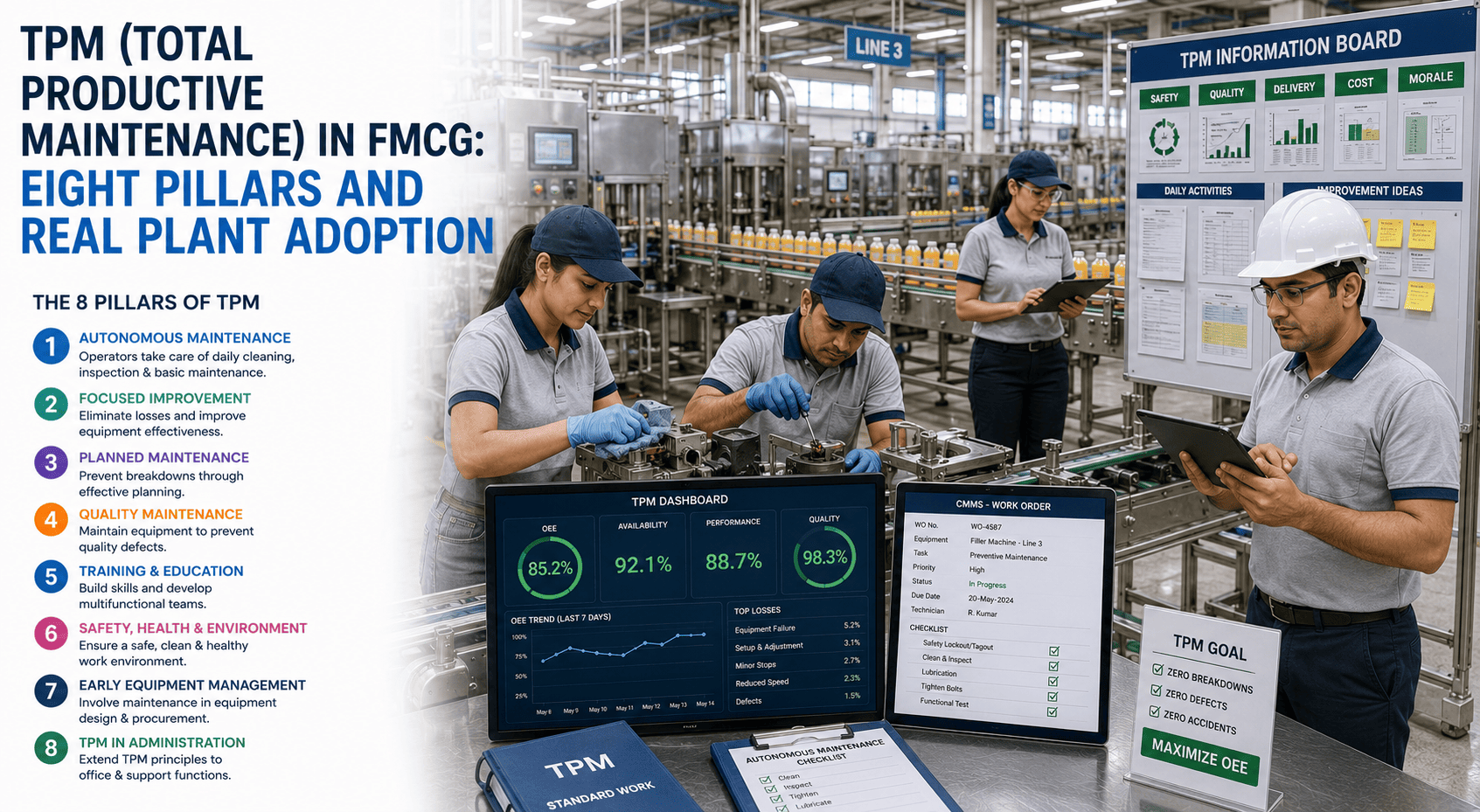
Total Productive Maintenance is a company-wide equipment management philosophy that aims for zero breakdowns, zero defects, and zero accidents — by making equipment reliability the shared responsibility of operators, technicians, engineers, and management rather than a siloed maintenance function. In FMCG manufacturing, TPM's focus on operator-led basic maintenance, structured inspection programs, and production-linked improvement cycles directly addresses the sector's specific challenges: high changeover frequency, strict hygiene requirements, GMP compliance documentation, and the need to sustain high OEE across dozens of SKUs and multiple production shifts.
The 8 Pillars of TPM — Applied to FMCG Manufacturing
Each TPM pillar targets a specific category of production loss. In FMCG, each pillar also has a food-safety and compliance dimension that makes it more complex to implement than in other manufacturing sectors — but also more valuable when done correctly. Start a free trial and begin implementing these pillars digitally today, or book a demo to see how each pillar maps to Oxmaint features.
01
Autonomous Maintenance
Operators take ownership of basic equipment care — cleaning, inspection, lubrication, and minor adjustments — through structured daily and weekly routines. In FMCG, this is the foundation of both reliability and GMP compliance, as operator-led inspections are the earliest detection point for developing faults.
Impact: 30–50% reduction in minor stoppages within 90 days
02
Planned Maintenance
Maintenance department moves from reactive repair to a structured program of scheduled preventive, condition-based, and predictive maintenance tasks. In FMCG, PM schedules are triggered by production counts and run hours — not calendar dates — ensuring maintenance occurs at the correct interval regardless of seasonal production variation.
Impact: 80%+ planned work ratio achievable within 12 months
03
Quality Maintenance
Links equipment condition directly to product quality outcomes — identifying which machine states cause quality deviations, establishing acceptable tolerances, and implementing error-proofing (poka-yoke) to make defect conditions physically impossible or immediately detectable. In food manufacturing, this pillar directly supports HACCP critical control point management.
Impact: 60–75% reduction in quality defects attributable to equipment condition
04
Focused Improvement (Kaizen)
Cross-functional teams systematically target and eliminate specific recurring losses using a structured Kaizen improvement cycle. In FMCG, focus teams typically address the top 3 to 5 downtime causes per line — working through root cause analysis, countermeasure testing, and standardization to permanently eliminate each loss category.
Impact: 8–15 OEE points recoverable from the top 5 loss causes per line
05
Early Equipment Management
Maintenance and production teams contribute maintenance requirements, accessibility constraints, and reliability standards into new equipment specifications during the purchasing and commissioning process — preventing the design-in of future maintenance problems. Hospitals FMCG plants installing new filling or packaging equipment use this pillar to ensure maintainability, sanitation compliance, and data connectivity are built in from day one.
Impact: Reduces new equipment commissioning issues by 40–60%
06
Training and Education
Structured competency development programs ensure operators can perform Autonomous Maintenance tasks correctly, and technicians can execute both routine PM and complex diagnostic work on all line equipment types. In high-turnover FMCG environments, digital work instructions embedded in the CMMS ensure procedure knowledge survives beyond individual technicians.
Impact: 35–50% faster MTTR when technicians have embedded digital procedures
07
Safety, Health, and Environment
TPM's safety pillar integrates equipment risk assessment, lockout-tagout procedures, and environmental compliance into every maintenance activity — targeting zero accidents. In FMCG food plants, this pillar also covers food safety risk management: ensuring maintenance activities do not introduce contamination or allergen transfer risks during equipment intervention.
Impact: Measurable reduction in maintenance-related safety incidents
08
TPM in Administration
Extends TPM improvement thinking to administrative processes that support production — work order processing, spare parts procurement, maintenance scheduling, and compliance documentation. Reducing administrative waste in the maintenance support process directly accelerates response time and reduces the cost overhead of the maintenance function.
Impact: 25–40% reduction in administrative work order processing time
TPM Implementation Stages: From Launch to Sustained Results
Phase 1
Preparation and Launch — Months 1–3
Establish the TPM steering committee, conduct initial OEE baseline measurement, identify pilot production line, and deploy Autonomous Maintenance Step 0 (cleaning to inspect). Set KPI baselines for OEE, MTBF, MTTR, and PM compliance across the pilot line. Most plants see the first OEE visibility gains within 30 days simply from accurate measurement.
Phase 2
Pillar Activation — Months 3–12
Activate Autonomous Maintenance through Steps 1–3 (cleaning and inspection standards, abnormality elimination, general inspection standards). Launch Planned Maintenance with production-triggered PM schedules and CMMS work order automation. Begin Focused Improvement cycles on the top 3 downtime causes on the pilot line. Expect 8–12 OEE points improvement on the pilot line by month 12.
Phase 3
Line Rollout — Months 12–30
Expand TPM implementation to remaining production lines using the standardized procedures, digital checklists, and improvement cycle structures developed on the pilot. Activate Quality Maintenance and SMED-linked changeover improvement. Begin building the cross-line OEE and KPI comparison infrastructure that enables portfolio-level improvement management.
Phase 4
Sustained Excellence — Year 3+
Full 8-pillar TPM operating across all lines, with continuous improvement cycles running quarterly per line. OEE in the 78–85% range. PM compliance above 92%. Planned work ratio above 80%. The final phase is not an endpoint — it is the operating standard that compounds year over year as the improvement muscle deepens.
How Oxmaint Digitally Supports All 8 TPM Pillars
TPM generates enormous amounts of inspection data, work order records, OEE measurements, and improvement cycle documentation. Without a digital platform to capture, analyze, and act on this data, TPM programs stall because the overhead of managing paper-based systems undermines the time available for improvement work. Oxmaint provides the digital infrastructure that makes TPM scalable and sustainable.
Pillars 1 + 2
Digital Inspection and PM Scheduling
Mobile operator inspection checklists for Autonomous Maintenance routines and automated PM scheduling by production count, run hours, and cycles for Planned Maintenance. Every inspection timestamped, geo-tagged, and linked to the asset record.
Pillars 3 + 4
OEE and Quality Loss Tracking
Real-time OEE dashboards per line linked to asset condition scores for Quality Maintenance. Automated Pareto analysis of downtime and quality loss causes to support Focused Improvement Kaizen cycle prioritization with data, not instinct.
Pillars 6 + 8
Work Instructions and Admin Automation
Digital work instructions embedded in work orders for Training and Education pillar. Automated work order creation, routing, and closure eliminates administrative overhead — directly supporting the TPM in Administration pillar by removing process waste from the work order flow.
Pillar 7
GMP and Safety Compliance Documentation
Audit-ready digital records with digital signatures for all safety-critical maintenance activities. GMP-compliant inspection records for food safety compliance. Lockout-tagout procedure documentation linked to work orders for Safety, Health, and Environment pillar adherence.
TPM Results in FMCG: What the Numbers Show
15–25pts
OEE Improvement
Sustained OEE gain from full TPM implementation across FMCG food and beverage production lines
50%
Breakdown Reduction
Typical equipment failure frequency reduction within 12 months of Autonomous Maintenance program activation
30%
Maintenance Cost Reduction
Total maintenance spend reduction from eliminating reactive repair premiums through preventive maintenance maturity
Zero
Accident Target
TPM's zero-accident target, supported by structured lockout-tagout and safety inspection compliance documentation
Frequently Asked Questions
What are the 8 pillars of TPM and which ones matter most for FMCG?
The 8 TPM pillars are: Autonomous Maintenance, Planned Maintenance, Quality Maintenance, Focused Improvement (Kaizen), Early Equipment Management, Training and Education, Safety Health and Environment, and TPM in Administration. For FMCG plants, the four highest-impact pillars to implement first are Autonomous Maintenance (operators owning basic equipment care), Planned Maintenance (production-triggered PM scheduling), Focused Improvement (data-driven loss elimination), and Quality Maintenance (linking asset condition to product quality outcomes).
How long does TPM take to show results in a food manufacturing plant?
The first measurable OEE improvements from TPM typically appear within 30 to 60 days of Autonomous Maintenance activation on a pilot line — primarily from improved cleaning-to-inspect discipline that catches developing faults before they become breakdowns. Meaningful OEE improvement of 8 to 12 points is typically achieved by month 12 on the pilot line. Sustained 15 to 25 point OEE improvement across all lines requires 3 to 5 years of consistent program execution — but the compounding value from earlier years funds itself.
How does Autonomous Maintenance work in a GMP food plant?
In GMP-regulated food plants, Autonomous Maintenance operator routines must be documented, verified, and traceable — creating a compliance challenge that paper-based TPM programs struggle to meet. Digital mobile inspection checklists solve this by capturing operator cleaning and inspection activities with timestamps, digital sign-off, and auto-escalation for failed inspection checks. The result is a GMP-compliant Autonomous Maintenance program that satisfies both the TPM discipline and the food safety audit trail requirement simultaneously.
What is the most common reason TPM programs fail in FMCG plants?
The most common reason TPM programs stall or fail in FMCG food plants is the absence of digital infrastructure to sustain the data collection and analysis that TPM requires. Paper-based inspection records, manual downtime logs, and spreadsheet OEE tracking create administrative overhead that overwhelms improvement teams and leads to program abandonment after the initial pilot enthusiasm fades. Successful TPM programs are supported by digital platforms that automate data capture, maintenance scheduling, OEE calculation, and improvement cycle documentation — removing the manual overhead that historically kills TPM momentum.
Start your TPM journey with a digital platform built for FMCG — not adapted from general manufacturing
Oxmaint supports all 8 TPM pillars with mobile operator inspections, production-triggered PM scheduling, real-time OEE dashboards, SMED changeover tracking, GMP compliance documentation, and automated work order management — in one unified platform designed specifically for FMCG production environments. Deploy in days, sustain for years.



-for-fmcg-implementing-the-8-pillars.png)