A biscuit plant in Maharashtra reduced unplanned downtime by 38% in 18 months without a single capital investment. No new equipment. No automation upgrade. No external consultants. They implemented Total Productive Maintenance — and the results came entirely from changing how operators, technicians, and managers related to the equipment they already owned. TPM is not a software tool, not a certification programme, and not a one-time project. It is a fundamental shift in manufacturing culture that transfers ownership of equipment health from the maintenance department to every person who touches the production line. In FMCG manufacturing — where margins are thin, line speeds are high, and equipment downtime directly translates to lost product output — TPM delivers compounding returns that no capital equipment purchase can match. This guide covers all eight TPM pillars adapted for FMCG environments, a realistic implementation roadmap that avoids the most common failure modes, and the CMMS infrastructure that makes TPM sustainable beyond the initial enthusiasm phase. Start your free trial to build your TPM programme in Oxmaint, or book a demo to see how Oxmaint structures all eight pillars in one platform.
All Platform Features — Oxmaint TPM
One Platform for All Eight TPM Pillars — From Autonomous Maintenance to Safety.
Oxmaint structures every TPM pillar into actionable work orders, checklists, KPI dashboards, and audit records — giving your programme the digital backbone that sustains TPM beyond the pilot phase.
38%
reduction in unplanned downtime achieved in 18 months at a biscuit plant with no capital investment
15–25%
OEE improvement in the first year of TPM implementation at FMCG facilities with structured rollout
8 pillars
of TPM — each targeting a distinct loss category that compounds into total manufacturing performance
3–5 yrs
to full TPM maturity — but significant financial returns appear within the first 6 months of implementation
What TPM Is — and What It Is Not
Total Productive Maintenance is a manufacturing improvement methodology that aims for perfect production — zero breakdowns, zero defects, zero accidents — by engaging every person in the facility in equipment care. The "Total" in TPM means total participation (operators, technicians, engineers, managers), total equipment effectiveness, and total lifecycle management. It was developed by Seiichi Nakajima at the Japan Institute of Plant Maintenance in the 1970s and has been refined across five decades of manufacturing application worldwide.
TPM Is NOT
✗A software implementation project
✗A one-time maintenance improvement blitz
✗The maintenance department's responsibility alone
✗A programme that delivers results in 90 days
✗A substitute for capital equipment investment
✗A certification exercise that ends with a plaque
TPM IS
✓A cultural transformation in equipment ownership
✓A systematic, multi-year improvement programme
✓A whole-workforce discipline — operators included
✓A compounding return — results grow over 3–5 years
✓The highest-ROI maintenance investment available
✓A permanent operating standard, not a project
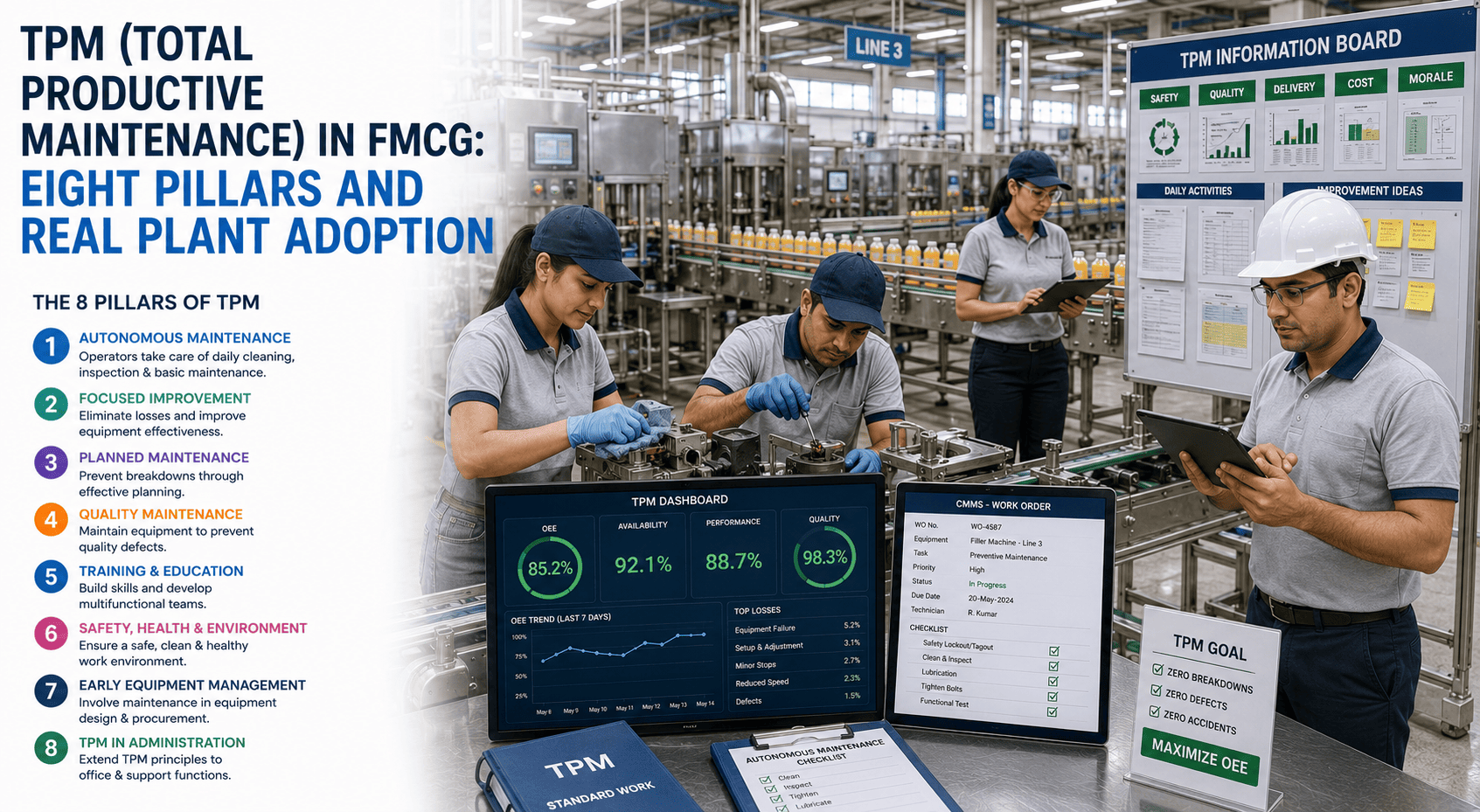
The 8 Pillars of TPM — Adapted for FMCG Manufacturing
Each of the eight TPM pillars targets a specific loss category in manufacturing performance. In FMCG environments, each pillar has specific adaptations required by the sector's regulatory requirements, food safety obligations, and the scale of operator involvement across three-shift production operations.
01
Autonomous Maintenance
Jishu Hozen
Foundation Pillar
What it means
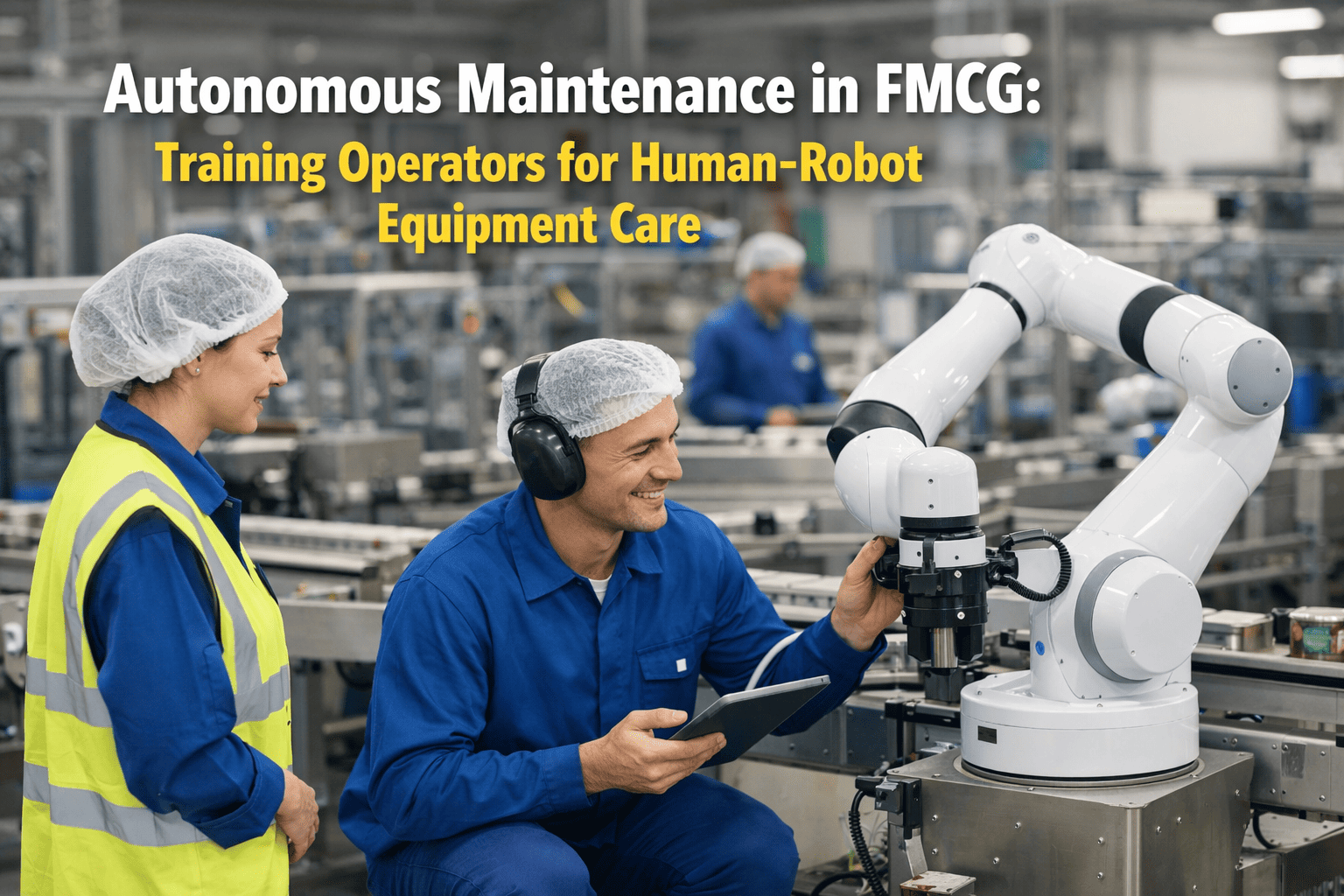
Operators take responsibility for basic equipment care — cleaning, inspection, lubrication, and minor adjustments — freeing maintenance technicians for skilled work. The goal is not to make operators into technicians but to develop equipment ownership: operators who notice abnormalities, understand normal vs abnormal conditions, and take pride in the condition of their machines.
FMCG Adaptation
In food and beverage plants, operator cleaning already occurs as a GMP requirement — TPM integrates inspection into the sanitation routine rather than adding a separate activity. Operators learn to identify: unusual sounds, abnormal heat, vibration changes, fluid leaks, and seal wear during their cleaning rounds. Cleaning standards become inspection standards.
1Initial deep clean — restore equipment to baseline condition
2Eliminate contamination sources and difficult-to-clean areas
3Establish provisional cleaning and inspection standards
4General inspection training for operators
5Autonomous inspection — operators own the standards
6Standardise and visualise — one-point lessons at each machine
7Full autonomous management — continuous improvement
02
Planned Maintenance
Keikaku Hozen
Reliability Pillar
What it means
Planned maintenance shifts the maintenance team from reactive firefighting to proactive scheduling — using failure history, MTBF data, and condition monitoring to predict and prevent failures before they occur. The maintenance department becomes a strategic function that plans its work rather than reacting to breakdowns.
FMCG Adaptation
FMCG planned maintenance must accommodate 24/7 production schedules with limited planned downtime windows. PM scheduling integrates with production planning — maintenance windows carved from changeover time, scheduled maintenance during planned product transitions, and shift-based minor maintenance tasks that don't require line stops. Oxmaint automates PM generation and ensures no interval is missed across multiple lines.
Target KPIPM Compliance Rate ≥95%
Target KPIMTBF increase ≥30% yr 1
Target KPIReactive maintenance <20% of total
03
Quality Maintenance
Hinshitsu Hozen
Quality Pillar
What it means
Quality maintenance establishes equipment conditions that make defect production impossible — not just unlikely. Rather than detecting and rejecting defects after production, quality maintenance identifies which equipment parameters cause which defects and maintains those parameters within the ranges that guarantee zero defects at source.
FMCG Adaptation
In FMCG, quality maintenance is directly linked to food safety — equipment conditions that cause defects also cause contamination risk. Sealing jaw temperature that causes underfilled seals is also the sealing jaw temperature that causes seal channel leaks. Filler nozzle condition that causes overfill also causes product splash contamination. Quality maintenance parameters become food safety control parameters — a single maintenance action prevents both quality failures and food safety incidents.
Target KPICustomer complaints ↓40% yr 1
Target KPIIn-process defect rate ↓60%
Target KPIZero food safety incidents from equipment
04
Focused Improvement
Kobetsu Kaizen
Loss Elimination
What it means
Focused improvement is the systematic elimination of the six big losses in manufacturing: breakdowns, setup and adjustment losses, minor stoppages, reduced speed, quality defects and rework, and startup losses. Cross-functional teams use structured problem-solving tools (Why-Why analysis, P-M Analysis, SMED) to permanently eliminate recurring losses rather than repeatedly managing their symptoms.
FMCG Adaptation
In FMCG, the highest-value Kaizen targets are typically: minor stoppages on high-speed packaging lines (accumulation of micro-stops that don't trigger alarms but reduce OEE by 8–15%), changeover time reduction on multi-SKU lines (SMED applied to format changes), and speed loss from conservative operating parameters set at commissioning and never reviewed. Each Kaizen team needs CMMS data to identify which losses are largest and validate that improvements are sustained.
Target KPIOEE ≥75% (world class: ≥85%)
Target KPIChangeover time ↓30–50%
Target KPIMinor stoppages ↓50% yr 1
05
Early Equipment Management
Sho-ki Kanri
Design Pillar
What it means
Early equipment management applies maintenance knowledge to the design and procurement of new equipment — ensuring that machines are easy to maintain, easy to clean, easy to inspect, and designed to prevent the failure modes that are costly in production. Maintenance engineers contribute to equipment specifications, factory acceptance tests, and commissioning — rather than inheriting poorly designed equipment that is expensive to maintain.
FMCG Adaptation
FMCG early equipment management focuses on hygienic design — ensuring that new equipment has no dead legs, no product traps, no inaccessible surfaces that create contamination harborage points. The maintenance engineer's checklist for new equipment procurement includes: cleanability (can all surfaces be reached for CIP?), inspectability (can all wear points be checked without disassembly?), and maintainability (can PM tasks be performed within a standard changeover window?).
Target KPIZero design-related failures in yr 1
Target KPICommissioning time ↓25%
Target KPINew equipment PM cost ↓30% vs previous
06
Training and Education
Kyoiku Kunren
People Pillar
What it means
TPM requires skills that most FMCG workforces do not currently have — operators who can perform meaningful equipment inspections, maintenance technicians who can interpret condition monitoring data, and team leaders who can facilitate structured problem-solving. Training and education is the pillar that builds these capabilities systematically rather than assuming they will develop through experience alone.
FMCG Adaptation
FMCG training programmes must address high operator turnover — the most persistent barrier to autonomous maintenance sustainability. One-point lessons (OPLs) — single A4 sheets covering one skill, one maintenance task, or one abnormality identification — are the most effective training format for FMCG shift workers because they can be delivered in 5 minutes at the machine, at any time, in any language with appropriate visuals. Oxmaint stores OPLs as digital work instruction cards attached to each asset.
Target KPI100% operators trained on their equipment
Target KPISkills matrix coverage ≥80% of required competencies
Target KPIOPL library: ≥5 lessons per major asset
07
Safety, Health and Environment
Anzen Kanri
Safety Pillar
What it means
The safety pillar aims for zero accidents across all maintenance and production activities. TPM's approach to safety is proactive — identifying and eliminating hazard conditions rather than relying on personal protective equipment and procedural compliance to manage existing hazards. Equipment that is clean, properly maintained, and correctly operated is inherently safer than neglected equipment.
FMCG Adaptation
FMCG safety TPM addresses the specific hazard profile of food manufacturing: chemical handling (cleaning agents, sanitisers, allergen control chemicals), confined space entry for tank and vessel cleaning, energy isolation (LOTO) for equipment maintenance, and the interaction between maintenance activities and food safety — a maintenance error that introduces a physical contaminant (tools, fasteners, wire) into the product stream is simultaneously a safety incident and a food safety incident.
Target KPIZero LTI (Lost Time Injuries)
Target KPINear-miss reporting rate ↑ (leading indicator)
Target KPI100% LOTO compliance on all maintenance tasks
08
TPM in Administration
Jimusho TPM
Support Pillar
What it means
TPM in administration eliminates waste and losses in the support functions that serve production — procurement, planning, HR, quality, and IT. Just as manufacturing TPM eliminates the six big losses on the production floor, administrative TPM eliminates the equivalent losses in office processes: information delays, procurement lead time waste, approval bottlenecks, and planning errors that create production problems.
FMCG Adaptation
In FMCG, the highest-impact administrative TPM targets are: MRO procurement (spare parts ordered reactively at 3–6× premium vs planned orders), maintenance planning (technician time wasted searching for parts and information rather than performing maintenance), and quality documentation (manual record assembly before audits vs real-time digital records in Oxmaint). Administrative TPM in FMCG typically unlocks $150K–$400K in annual value without touching a single machine.
Target KPIEmergency parts orders ↓65%
Target KPITechnician wrench time ≥55% of shift
Target KPIAudit preparation time ↓80%
Planned Maintenance + Autonomous Maintenance — Oxmaint
Pillars 1 and 2 in Oxmaint From Day One — PM Schedules, Operator Checklists, and OPL Libraries.
Oxmaint structures the two foundation TPM pillars immediately — automated PM work orders for planned maintenance and mobile operator checklists for autonomous maintenance — giving your programme measurable results within the first 90 days.
The Six Big Losses: What TPM Is Eliminating
TPM targets six specific loss categories that collectively define the gap between theoretical maximum production capacity and actual output. Measuring and naming these losses is the foundation of focused improvement — you cannot eliminate what you cannot see.
Availability Losses
Loss 1
Breakdowns
Avg 72% of total downtime in reactive FMCG plants
Pillar 1 (AM) + Pillar 2 (PM) eliminate the equipment neglect that causes 70%+ of breakdowns
Loss 2
Setup and Adjustments
15–25% of available time lost on high-SKU FMCG lines during product changeovers
Pillar 4 (Kaizen/SMED) targets changeover time with structured reduction methodology
Performance Losses
Loss 3
Minor Stoppages
Most invisible loss — individually small (<5 min) but accumulate to 8–15% OEE reduction
Pillar 1 (AM) operator ownership detects and prevents the jams, misfeeds, and sensor triggers that cause micro-stops
Loss 4
Reduced Speed
Lines running 10–20% below design speed due to conservative parameters set at commissioning
Pillar 4 Kaizen reviews design vs actual speed and restores original parameters after AM establishes equipment baseline
Quality Losses
Loss 5
Defects and Rework
2–4% defect rate in manually inspected FMCG lines — each defect is also a potential food safety event
Pillar 3 (Quality Maintenance) links equipment conditions to defect causes and maintains the parameters that guarantee zero defects
Loss 6
Startup Losses
Scrap and off-spec product during startup after maintenance, changeover, or shift change
Pillar 2 (PM) ensures equipment is returned to validated condition after maintenance — reducing startup waste to near zero
TPM Implementation Roadmap: The 12-Month Foundation
TPM implementation fails most often because it tries to do everything at once. The proven approach is phased — starting with the two highest-impact pillars on the highest-loss equipment, proving value, and expanding from a position of demonstrated results rather than theoretical promise.
Month 1–2
Launch and Baseline
TPM kick-off event — plant manager commitment communicated to all staff
Select 1–2 pilot lines — highest OEE loss, most willing operators
Establish current state baseline — OEE, downtime, defect rate, MTBF
Deploy Oxmaint — import asset register, build PM schedules for pilot lines
Form cross-functional TPM team — maintenance, operations, quality, engineering
Output: Baseline data + pilot line selected
Month 3–5
Pillars 1 and 2 — Pilot
Initial clean: restore pilot line equipment to "like new" condition
Train operators on cleaning-inspection standards for their machines
Launch PM work orders in Oxmaint — all planned tasks on mobile for technicians
Build first OPLs — 3–5 per major asset covering most common abnormalities
Weekly KPI review — track PM compliance, downtime events, operator findings
Output: First measurable OEE improvement
Month 6–8
Kaizen + Quality Pillar
Identify top 3 recurring losses from Oxmaint data — Why-Why analysis on each
Launch first Kaizen projects — changeover time and top micro-stop causes
Map quality defects to equipment conditions — establish quality maintenance parameters
Expand AM to second pilot line — use lessons from first deployment
First TPM results presentation to plant leadership — documented ROI from pilot
Output: Proven ROI + expansion approval
Month 9–12
Expand and Sustain
Roll out Pillars 1 and 2 to all production lines
Launch Pillar 6 (Training) — skills matrix built and competency gaps addressed
Launch Pillar 7 (Safety) — LOTO audit, near-miss programme, SHE KPIs
Administrative TPM — MRO inventory optimised, emergency orders tracked and reduced
Annual TPM audit — score each pillar, set Year 2 targets
Output: Plant-wide TPM programme live
Why TPM Programmes Fail — and How to Prevent It
✗
Management Declares TPM Without Committing Time
TPM requires operators to spend 10–20 minutes per shift on equipment care activities. If production targets don't account for this time, operators are forced to choose between TPM and output — and output wins every time. Plant management must explicitly protect TPM time in production scheduling, or the programme dies within 90 days of launch when production pressure returns.
✗
Starting with All Eight Pillars Simultaneously
TPM programmes that try to launch all eight pillars in the first quarter overwhelm maintenance teams, confuse operators, and produce no measurable results — killing momentum before it builds. Start with Pillars 1 and 2 on one or two pilot lines. Prove value with data. Expand from strength. Plants that follow the phased approach consistently outperform those that launch comprehensively.
✗
No CMMS to Make Improvements Visible and Sustainable
TPM without a CMMS is like a fitness programme without a scale — you cannot prove progress and you cannot sustain what you cannot measure. Paper-based TPM programmes consistently revert to baseline within 12–18 months because there is no system enforcing PM schedules, tracking operator inspection completion, or generating the KPI data that keeps management attention and investment on the programme.
✗
Treating Autonomous Maintenance as Additional Work for Operators
The single most common reason operators reject autonomous maintenance is that it is introduced as additional work on top of their existing responsibilities. The correct framing: AM replaces the random, unstructured cleaning operators already do with a purposeful, equipment-focused routine that also happens to clean. Operators who understand why they are doing each inspection step — what failure it prevents, what it costs when missed — adopt the routine. Those given a checklist without context do not.
TPM KPI Dashboard: What to Measure at Each Stage
TPM Performance Metrics by Implementation Stage
Track these KPIs in Oxmaint from Month 1 — they form the evidence base that funds TPM expansion
| KPI |
Reactive Baseline |
6-Month Target |
12-Month Target |
TPM Pillar |
| Overall Equipment Effectiveness (OEE) | 55–65% | 65–72% | 75–82% | Pillars 1, 2, 4 |
| PM Compliance Rate | 40–60% | 85% | ≥95% | Pillar 2 |
| Unplanned Downtime (hrs/month) | Baseline | ↓20% | ↓35–40% | Pillars 1, 2 |
| Mean Time Between Failures (MTBF) | Baseline | ↑20% | ↑30–45% | Pillars 1, 2 |
| Reactive vs Planned Maintenance Ratio | 70:30 | 50:50 | 25:75 | Pillar 2 |
| Operator Autonomous Inspection Completion | 0% | 70% | ≥90% | Pillar 1 |
| In-Process Defect Rate | Baseline | ↓25% | ↓50–60% | Pillar 3 |
| Emergency MRO Orders | Baseline | ↓30% | ↓60–65% | Pillars 2, 8 |
TPM KPI Tracking — Oxmaint
Every TPM KPI Live in One Dashboard. OEE, PM Compliance, MTBF — Updated in Real Time.
Oxmaint tracks all eight TPM pillar KPIs automatically from work order and checklist completion data — giving you the evidence to prove programme value to plant leadership and keep investment coming.
Frequently Asked Questions
All Platform Features — Oxmaint TPM
Build Your TPM Programme on Oxmaint. All Eight Pillars. One Platform.
38%
downtime reduction yr 1
$2.4M
12-month value potential
8 pillars
all supported in one platform
✓Mobile operator AM checklists — offline capable, photo capture, instant maintenance escalation
✓Automated PM scheduling — time, runtime, and meter-based triggers with mobile work orders
✓OEE dashboard — real-time availability, performance, and quality metrics per line
✓OPL library — one-point lessons stored per asset, scannable by QR code on the plant floor
✓MRO inventory — spare parts linked to assets, min-max reorder, emergency order tracking
✓Compliance audit trail — food safety records, LOTO documentation, PM history for inspectors



-for-fmcg-implementing-the-8-pillars.png)