A mid-size dairy processor in Minnesota replaced their paper-based line inspection process with an AI-powered vision system in 2023. Within the first production quarter, it flagged 1,200 packaging defects their manual QC team had passed, traced four of them to a single miscalibrated fill nozzle, and prevented a partial brand recall estimated at $380,000. That is what AI adoption in food manufacturing looks like at operational scale — not a pilot project, but a production-line reality. Sign up for Oxmaint's AI-powered maintenance platform and start your adoption journey today.
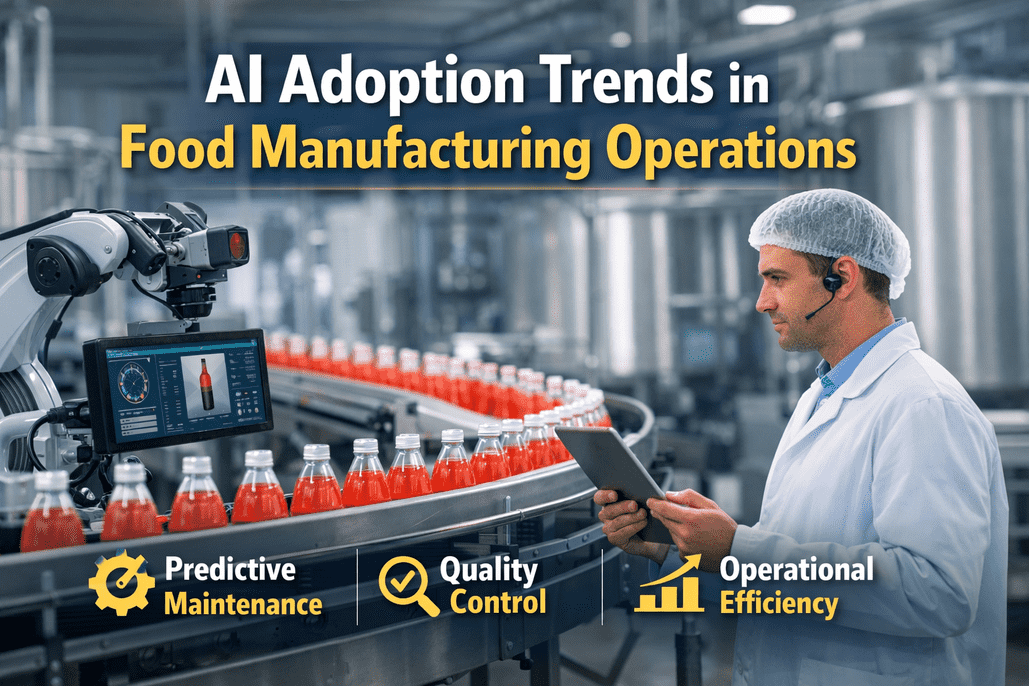
AI Adoption Trends in Food Manufacturing Operations
Food manufacturers embracing AI for predictive maintenance, quality control, and supply chain optimisation are pulling measurably ahead of competitors still operating on reactive strategies. Here is where adoption is accelerating — and what it means for your plant.
Where AI Adoption Is Accelerating in Food Manufacturing
AI adoption across food manufacturing is not uniform. It is concentrated in the highest-pain operational areas — where failures are costliest and where data already exists to train effective models. Understanding the adoption curve helps plant operators prioritise their own AI investment roadmap. Sign up for Oxmaint to access the predictive maintenance AI capabilities already used by food manufacturers across the US.
The single highest AI adoption area in food manufacturing. Sensor-fed ML models identify equipment degradation before failure — catching compressor bearing wear, boiler tube scaling, and CIP pump seal failure weeks ahead of breakdown.
AI vision systems inspect product at line speed — detecting foreign bodies, surface defects, fill deviations, and packaging failures at detection rates that manual QC teams cannot match during sustained production runs.
AI optimises cook times, pasteurisation parameters, retort cycle settings, and CIP chemical concentrations in real time — maximising throughput while maintaining CCP compliance, reducing energy consumption, and cutting product waste.
ML models trained on sales histories, weather data, promotional calendars, and supplier lead times produce demand forecasts that reduce raw material overstocking, prevent stockouts during peak production, and cut inventory carrying costs.
of food manufacturers that implemented AI predictive maintenance in the past two years report measurable reduction in unplanned downtime within their first production quarter. The fastest results consistently come from plants that connected sensor data directly to a CMMS work order system — exactly the integration that Oxmaint's AI maintenance platform delivers out of the box.
The Three AI Capabilities Reshaping Food Plant Maintenance
Maintenance is where AI delivers its fastest and most measurable returns in food manufacturing. Three distinct AI capabilities are now mature enough for production deployment — each addressing a different layer of the maintenance challenge.
Failure Pattern Recognition & Early Warning
AI models trained on historical sensor readings, work order records, and failure event logs learn the unique degradation signatures of each asset in your plant. When live sensor data begins matching a known failure pattern — even at a stage invisible to standard threshold alerts — the system generates an early warning with confidence score, estimated days to failure, and a recommended maintenance action.
- Failure predictions 14–45 days ahead of breakdown for most rotating equipment
- Confidence scoring prevents alert fatigue from false-positive predictions
- Work orders auto-generated with diagnosis notes and recommended parts
- Accuracy improves continuously as the model accumulates more plant-specific data
AI-Optimised PM Scheduling
Traditional PM schedules are built on manufacturer recommendations and calendar intervals that ignore actual equipment condition and operating environment. AI maintenance platforms analyse real utilisation patterns, environmental stress factors, and historical failure data to calculate the optimal service interval for each individual asset — extending intervals for healthy equipment and tightening them for assets showing stress indicators.
- Asset-specific PM intervals replace blanket calendar schedules across the fleet
- Reduces unnecessary maintenance labour by 20–35% without increasing failure risk
- Dynamic rescheduling when production changes alter equipment utilisation
- Parts consumption optimised alongside labour for integrated cost reduction
Autonomous Compliance Documentation
AI platforms generate FSMA preventive controls records, HACCP deviation reports, calibration certificates, and corrective action documentation continuously and automatically from operational data — eliminating the manual paperwork burden that consumes QA and maintenance team hours without adding operational value. Book a demo to see how Oxmaint's AI generates your compliance trail automatically.
- Every sensor reading, work order, and inspection timestamped and stored automatically
- FDA 21 CFR Part 117 and GFSI scheme documentation always current and exportable
- AI flags documentation anomalies — missed sign-offs, out-of-spec readings — before audits
- Natural language summaries of maintenance events for non-technical stakeholders
AI Adoption Outcomes Across Food Manufacturing Segments
These results come from verified deployments across food processing categories — not theoretical projections. The pattern is consistent: AI maintenance and quality platforms return measurable value within the first production quarter, with compounding gains as models accumulate plant-specific data.
AI predictive models on chiller compressors and evisceration line motors caught 14 bearing failures in year one before production impact. Cold storage incidents dropped 80%.
Autonomous compliance documentation eliminated the documentation gaps that had generated three corrective actions in consecutive annual SQF audits. Zero documentation citations in year two.
AI-optimised PM intervals replaced a legacy calendar-based schedule. Unnecessary preventive work dropped 34%, freeing 62 technician hours per month for higher-value corrective activities.
What the Data Says About AI in Food Manufacturing
AI adoption in food manufacturing is backed by a growing body of independently verified research. These figures come from Deloitte, McKinsey, the US Department of Energy, and food industry surveys conducted between 2023 and 2025.
Reduction in overall maintenance costs for food manufacturers deploying AI predictive strategies
Decrease in unplanned downtime events in the first year of AI maintenance deployment
Return on AI predictive maintenance investment — the highest ROI lever in manufacturing technology
Lower maintenance spend vs. reactive-only operations, with superior equipment reliability outcomes
Reduction in defect escape rate with AI computer vision vs. manual QC inspection programs
Of food manufacturers deploying AI achieve full platform payback within 12 months of go-live
Your 90-Day AI Adoption Roadmap for Food Manufacturing
AI adoption in food manufacturing does not require a multi-year transformation programme. The highest-impact capabilities — predictive maintenance alerts, automated work orders, and compliance documentation — can be operational within weeks. Start your free Oxmaint trial and follow this proven phased approach used by food manufacturers across the US.
Build your digital asset register in Oxmaint. Install wireless IoT sensors on your highest-criticality equipment — refrigeration compressors, CIP pumps, boilers, and packaging line drives. Establish baseline sensor readings that the AI will use as its normal-condition reference for anomaly detection.
Configure AI anomaly thresholds based on your plant's actual operational patterns — distinct from manufacturer defaults. Enable automatic work order generation from alert triggers. Connect compliance documentation workflows so every maintenance event generates the FSMA and GFSI records your auditors require automatically.
With 60 days of asset data, the AI can begin optimising PM intervals away from calendar schedules toward condition-based triggers. Activate the maintenance analytics dashboard to identify which assets generate the most corrective work, measure MTBF trends, and report your first-quarter impact to plant leadership.
Roll out sensor coverage to secondary equipment. Add multi-site dashboards if operating across multiple facilities. Introduce AI quality monitoring and supply chain integration as capabilities mature. The AI model improves continuously — the longer it runs, the more accurately it predicts your specific plant's failure patterns.
We spent two years telling ourselves AI was too complex and too expensive for a plant our size. When we finally deployed Oxmaint's predictive maintenance across our twelve critical motors, the first bearing failure alert came in 22 days. The motor would have seized during peak production week. That one catch paid for the entire platform cost for three years. The hesitation was the expensive decision, not the adoption.
Frequently Asked Questions
Is AI predictive maintenance only viable for large food manufacturing plants?
How much historical data does AI need before it starts generating useful predictions?
How does AI in food manufacturing handle FSMA and food safety compliance requirements?
What is the difference between AI predictive maintenance and traditional preventive maintenance?
Can AI maintenance platforms integrate with existing SCADA, MES, or ERP systems in food plants?
Your Competitors Are Already Deploying AI Maintenance
Food manufacturers that adopt AI predictive maintenance now are building a compounding operational advantage — lower costs, fewer failures, faster audits, and better-quality product. Oxmaint makes that adoption practical, fast, and affordable for plants of any size.