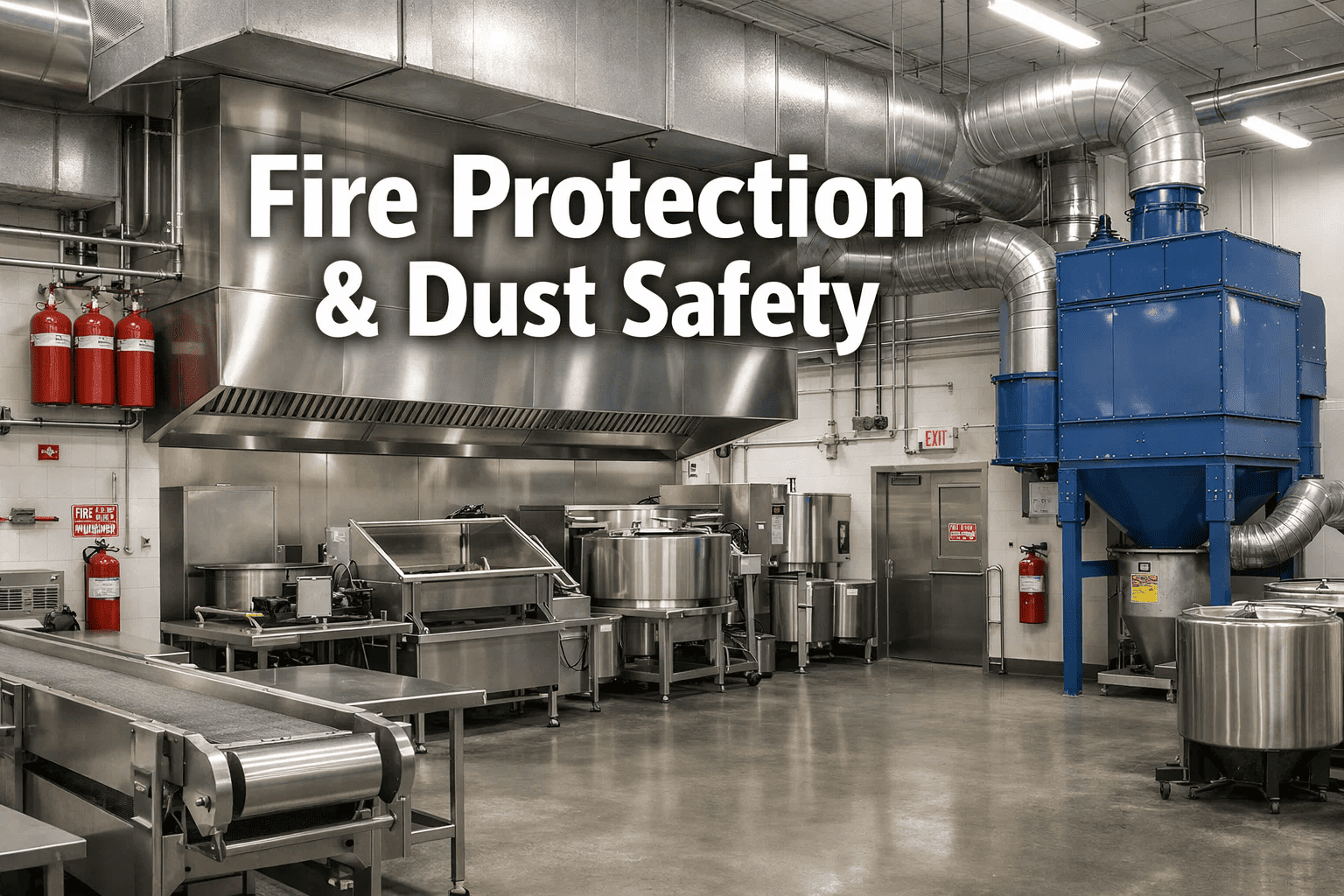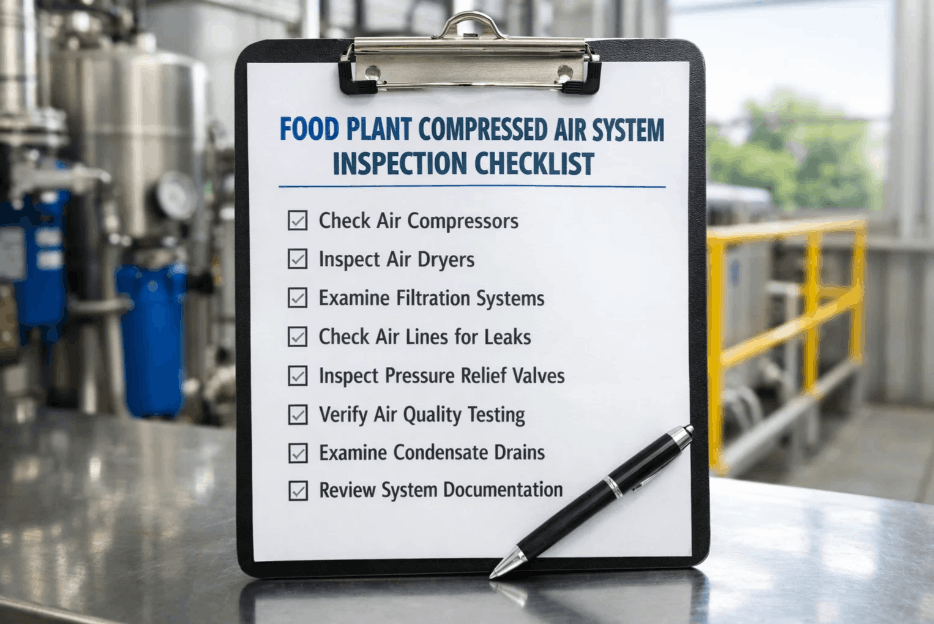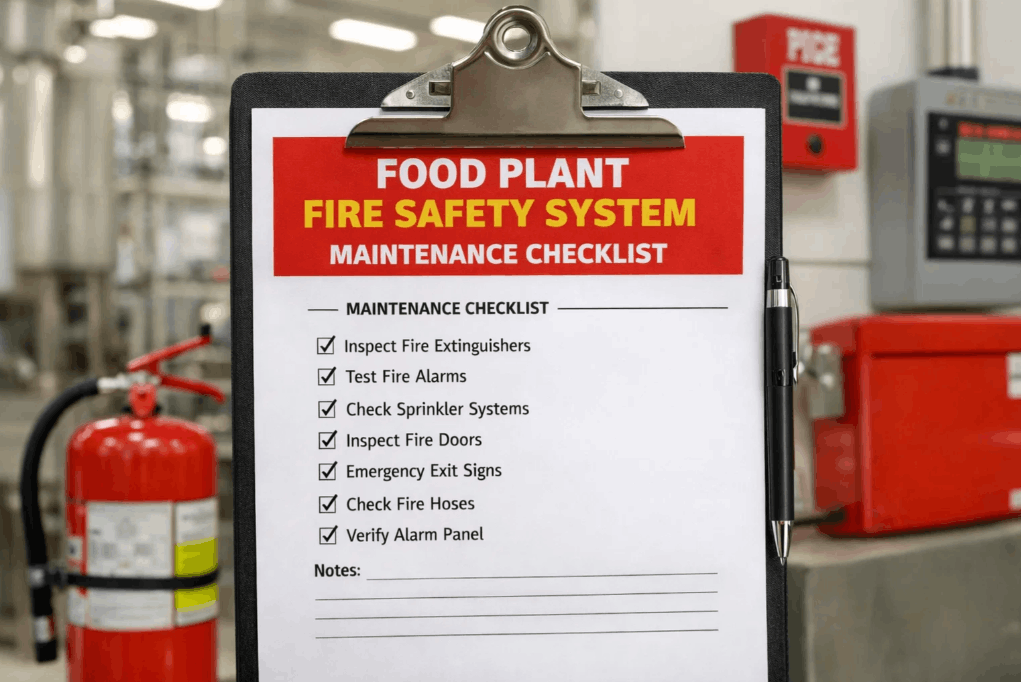
Fire safety system failures in food manufacturing facilities carry consequences far beyond regulatory citations — a compromised sprinkler head, a blocked fire door, or an uninspected hood suppression canister can mean the difference between a contained incident and a catastrophic plant loss. This food plant fire safety system maintenance checklist gives safety managers, facilities teams, and EHS professionals a structured framework covering fire alarm systems, automatic sprinkler inspections, commercial kitchen hood suppression, portable extinguisher compliance, emergency lighting verification, and fire door integrity — every critical control aligned with NFPA 1, NFPA 13, NFPA 17A, NFPA 72, and NFPA 101 requirements and built for the operational realities of food processing and packaging environments. Manage fire safety inspections and compliance records with OxMaint.
1. Fire Alarm System Inspection Checklist
Food processing environments present unique challenges for fire detection — steam, airborne flour dust, smoke from cooking operations, and high-humidity conditions can cause nuisance alarms or mask genuine detection failures. Per NFPA 72, fire alarm control panels, initiating devices, and notification appliances require scheduled inspection and testing to confirm they will perform when needed. Every food plant fire alarm system component must be verified at defined intervals regardless of production demands — sign up free on OxMaint to schedule and track all fire alarm inspections in one place.
Inspect Fire Alarm Control Panel (FACP) for Trouble and Fault Conditions
Visually check the fire alarm control panel for any active trouble, supervisory, or alarm signals. Confirm the panel display shows a normal operating state, the AC power indicator is illuminated, and the backup battery condition indicator shows no fault. Document panel status, firmware version, and date of inspection in the maintenance log.
Test All Smoke Detectors in Processing and Packaging Zones
Functionally test every smoke detector within the facility using a listed aerosol test agent or the detector manufacturer's approved test method. Confirm each activated detector initiates an alarm signal at the FACP. Replace any detector that fails to respond within the manufacturer's specified threshold. Record test results by detector address and zone.
Test Heat Detectors in High-Temperature and Cooking Areas
Verify heat detectors installed in ovens, fryers, smokers, and high-heat processing areas are tested per NFPA 72 intervals using a listed heat source. Confirm fixed-temperature and rate-of-rise units respond correctly and initiate the appropriate alarm or suppression output. Replace any unit that fails the thermal sensitivity test immediately.
Inspect and Test Manual Pull Stations Throughout the Facility
Physically inspect each manual pull station for physical damage, paint overspray obstruction, or unauthorized reset. Confirm each station is unobstructed and accessible within the NFPA 72 maximum travel distance requirements. Perform an annual functional test to verify pull stations transmit the correct signal to the FACP without delay.
Verify Notification Appliances Audibility and Visibility in All Occupied Areas
Test all horn/strobe and speaker/strobe notification appliances to confirm audibility meets NFPA 72 minimum sound pressure levels across every occupied area, including walk-in coolers, mechanical rooms, and high-noise processing floors. Confirm strobe flash rates are within the NFPA 72 listed ranges. Document any areas where ambient noise may compromise audibility.
Test Fire Alarm System Backup Battery Under Load Conditions
Conduct a battery load test per NFPA 72 requirements to verify the backup power supply can sustain the system in standby for 24 hours followed by 5 minutes of full alarm operation. Replace batteries that fail the load test or have reached their manufacturer-specified replacement interval. Document battery model, installation date, and test results.
2. Automatic Sprinkler System Inspection Checklist
Automatic fire sprinkler systems are the primary life safety and property protection layer in food manufacturing facilities. NFPA 25 mandates quarterly, annual, and 5-year inspection, testing, and maintenance cycles for wet, dry, pre-action, and deluge systems. In food plants, the sanitary environment — corrosive cleaning chemicals, steam, and temperature cycling — creates unique degradation risks that require disciplined inspection beyond the minimum NFPA 25 schedule. Use OxMaint to book a demo and see how your team can automate sprinkler inspection scheduling across every system in your facility.
Inspect All Sprinkler Heads for Corrosion, Physical Damage, and Obstructions
Visually inspect every sprinkler head for corrosion, paint overspray, physical impact damage, leakage, or loading from food debris and sanitizing chemical residue. Replace any sprinkler showing signs of corrosion, mechanical damage, or unauthorized coating. Confirm no storage or equipment has been placed within 18 inches of any sprinkler deflector.
Confirm Sprinkler Control Valves Are Open and Supervision Is Active
Verify that all sectional and main sprinkler system control valves are in the fully open position and are electrically supervised or sealed per NFPA 25 requirements. Confirm tamper switches on supervised valves transmit a supervisory signal to the FACP when operated. Document valve positions, supervision status, and date of verification.
Perform Quarterly Main Drain Test and Record Static and Residual Pressures
Conduct a main drain test per NFPA 25 by fully opening the main drain valve and recording both the static pressure before the test and the residual pressure during full flow. Compare results to the previous quarterly test record. A significant pressure drop compared to the historical baseline may indicate a partially closed valve or water supply deficiency requiring investigation.
Test Waterflow Alarm Devices and Confirm Signal Transmission to FACP
Open the inspector's test valve at the most remote point of the sprinkler system and confirm the waterflow alarm activates within 60 seconds and transmits a waterflow signal to the FACP and monitoring station. Time and document the alarm response. Reset the system and confirm the alarm clears without residual trouble indications.
Inspect Dry-Pipe and Pre-Action System Air Pressure and Compressor Operation
For dry-pipe and pre-action systems installed in freezers or unheated spaces, verify the supervisory air pressure is within the system's specified operating range. Confirm the air compressor or nitrogen supply operates correctly and maintains pressure within acceptable limits. Check for air leaks at fittings, valves, and sprinkler heads and correct all leaks found.
3. Commercial Kitchen Hood Suppression System Checklist
Kitchen hood suppression systems protecting fryers, griddles, ranges, and conveyor ovens in food plant cafeterias and production cooking areas require semi-annual inspection and maintenance per NFPA 17A and UL 300 listing requirements. Grease accumulation, nozzle blockage, and improper fusible link replacement are the most common deficiencies found during inspection — each of which can cause system failure at the exact moment suppression is needed most. Food plant EHS teams can get started free with OxMaint to build semi-annual hood suppression inspection workflows that ensure no step is missed.
Inspect All Suppression Nozzles for Grease Blockage and Proper Coverage
Remove and inspect every suppression nozzle for grease buildup, nozzle cap condition, and correct positioning relative to the protected cooking appliance. Confirm nozzles are aimed within the manufacturer-specified coverage geometry for each appliance type. Replace any nozzle with confirmed blockage, improper aim, or a damaged tip that could compromise agent distribution.
Replace All Fusible Links on the Specified Semi-Annual Schedule
Replace all fusible links in the hood suppression system's detection and mechanical actuation network per the manufacturer's required semi-annual replacement interval regardless of apparent condition. Confirm replacement fusible links are the correct temperature rating and model number as specified in the system design drawings. Document the replacement with date, technician name, and link specifications.
Verify Agent Cylinder Pressure and Weight Are Within Specified Range
Check the suppression agent cylinder pressure gauge reading against the manufacturer's temperature-corrected pressure chart for the current ambient temperature. Weigh the cylinder and compare to the minimum agent weight specified on the system nameplate. Remove and recharge any cylinder with low pressure or insufficient agent weight before returning the system to service.
Test Automatic Gas Valve Shut-Off and Fuel Interlock Operation
Confirm the system's automatic gas shut-off valve and cooking appliance fuel interlock function correctly by simulating system actuation per the manufacturer's test procedure. Verify the gas supply valve closes and all cooking appliances de-energize upon system activation. Restore all interlocks and document the test results with date and technician signature.
Inspect Hood Plenum, Filters, and Duct for Grease Accumulation Levels
Evaluate grease accumulation levels in the hood plenum, grease filters, and exhaust duct per NFPA 96 requirements. Schedule duct cleaning if grease deposits exceed the NFPA 96 maximum depth thresholds. Excessive grease accumulation outside the suppression system's design parameters can cause uncontrolled fire spread that exceeds the system's designed agent application capability.
4. Portable Fire Extinguisher Inspection Checklist
Portable fire extinguishers in food manufacturing facilities must be inspected monthly and maintained annually per NFPA 10. The combination of wet environments, corrosive cleaning agents, and temperature extremes in food plants accelerates extinguisher body corrosion and valve degradation — making visual inspection and proper placement documentation critical between formal annual maintenance cycles. Facilities that book a free OxMaint demo can see how digital monthly inspection checklists eliminate missed extinguisher checks across large plant footprints.
Confirm All Extinguishers Are in Their Designated Locations and Properly Mounted
Physically verify every extinguisher is present at its NFPA 10 required location, mounted at the correct height, and unobstructed with a clear path of access. Confirm extinguisher locations match the facility's fire extinguisher placement map. Document any extinguisher found missing, relocated, or obstructed and correct the deficiency immediately.
Inspect Pressure Gauge Reading and Confirm Needle Is in the Green Zone
Check the pressure gauge on every stored-pressure extinguisher to confirm the needle is within the manufacturer's specified operating range (green zone). Remove from service any extinguisher with a gauge reading outside the acceptable range — including overcharged units, which indicate potential valve or internal component failure. Document gauge readings on the monthly inspection tag.
Verify Safety Pin and Tamper Seal Are Intact on Every Unit
Confirm the pull pin is correctly installed and the tamper-evident plastic seal is unbroken on each extinguisher. A missing or broken seal indicates the extinguisher may have been partially or fully discharged and requires immediate removal for inspection and recharge. Never return an extinguisher with a broken seal to service without a full maintenance check.
Inspect Cylinder Body, Handle, and Nozzle for Corrosion and Physical Damage
Examine the extinguisher cylinder exterior for dents, corrosion pitting, weld defects, or chemical damage from cleaning agent exposure. Inspect the operating handle and nozzle assembly for cracks, blockage, or deformation. Any extinguisher with corrosion penetrating the cylinder wall or structural deformation of the handle must be removed from service and replaced.
Confirm Extinguisher Type Is Appropriate for Hazards Present at Each Location
Verify that the extinguisher class at each location matches the fire hazard classification of that area — Class K wet chemical extinguishers at cooking equipment, ABC dry chemical at general production areas, and CO2 or clean agent extinguishers at electrical panel and control equipment locations. Mismatched extinguisher types are a compliance deficiency and an operational safety risk.
5. Emergency Lighting and Exit Sign Inspection Checklist
Emergency lighting and illuminated exit signs are the life safety navigation systems that guide personnel to exits during fire events when normal power is lost. NFPA 101 and OSHA 1910.37 require monthly 30-second functional tests and annual 90-minute full-discharge tests for all emergency lighting units. In food manufacturing facilities with large floor plates, multiple mezzanine levels, and restricted-visibility processing areas, exit path illumination failures during a fire event are directly life-threatening — sign up free on OxMaint to automate monthly and annual emergency lighting test reminders for every unit in your facility.
Perform Monthly 30-Second Emergency Lighting Functional Test on All Units
Activate the test function on each emergency lighting unit using the integral test button and verify the unit illuminates immediately from battery power and remains lit for the full 30-second test duration. Record each unit's test result, physical location, and date on the monthly inspection log. Flag any unit that fails to illuminate or dims significantly during the test for immediate battery or lamp replacement.
Conduct Annual 90-Minute Full Battery Discharge Test Per NFPA 101
Perform the annual 90-minute emergency lighting battery discharge test by interrupting normal AC power and confirming every emergency unit maintains adequate illumination of the means of egress for the full 90-minute period. Any unit that fails before 90 minutes requires battery replacement. Document test start time, end time, pass/fail result, and technician name for each unit tested.
Inspect All Exit Signs for Illumination, Visibility, and Directional Accuracy
Visually confirm every exit sign is illuminated, legible, and visible from the required approach distance. Verify directional chevrons on directional exit signs correctly indicate the path to the nearest exit. Replace any exit sign with a burnt-out lamp, failed LED module, or damaged housing. Confirm battery-backed exit signs test correctly on the same schedule as emergency lighting units.
Verify Emergency Lighting Coverage Along All Egress Paths and at Exit Discharge Points
Walk each designated egress route from production areas to exit discharge points and confirm emergency lighting provides a minimum of 1 foot-candle at the walking surface throughout the entire path per NFPA 101. Identify any dark zones caused by burned-out units, moved equipment blocking fixtures, or egress path modifications and correct coverage deficiencies before the next scheduled inspection.
6. Fire Door and Passive Fire Protection Inspection Checklist
Passive fire protection systems — fire-rated doors, dampers, penetration seals, and compartmentalization barriers — are the structural containment layer that limits fire and smoke spread between production areas, storage spaces, and occupied zones. NFPA 80 requires annual inspections of fire doors and frames. In food manufacturing, fire doors are frequently propped open for material flow, damaged by forklift traffic, or modified in ways that void their fire rating — making regular inspection and documented correction essential.
Inspect All Fire Doors for Self-Closing and Positive Latching Operation
Test every fire door by releasing it from the open position and confirming it self-closes fully and latches without manual assistance from any position in its swing range. A fire door that fails to close or latch from any open position provides no rated separation during a fire event. Adjust, repair, or replace any closer, latch hardware, or door frame that prevents proper operation.
Confirm No Fire Doors Are Being Propped Open with Unauthorized Hold-Open Devices
Physically check every fire door location to confirm no wedges, chains, hooks, or unauthorized hold-open devices are in use. If operational needs require fire doors to remain open during production, confirm compliant magnetic hold-open devices connected to the fire alarm system are installed and functioning — releasing the door upon alarm activation. Document and correct all unauthorized propping immediately.
Inspect Fire Door Frames, Hardware, and Glazing for Physical Damage and Integrity
Examine each fire door assembly for forklift impact damage to the door face, frame, or threshold; broken or missing intumescent seals around the door perimeter; cracked or missing fire-rated glazing; and loose or missing hinge hardware. Any damage that compromises the door assembly's ability to maintain the rated separation must be repaired by a qualified door specialist using listed components.
Inspect Fire-Rated Wall and Floor Penetration Seals for Integrity
Inspect all through-penetrations in fire-rated walls and floors — conduit, pipe, cable tray, and duct penetrations — to confirm listed firestop systems are intact and undamaged. Identify any new or modified penetrations that lack a compliant firestop installation and arrange for correction using a UL-classified firestop system rated for the specific penetration type and wall assembly.
Test Fire Dampers in HVAC Ductwork Penetrating Rated Assemblies
Test all fire dampers and combination fire/smoke dampers installed in HVAC ductwork passing through rated walls and floor-ceiling assemblies per NFPA 80 inspection requirements — at 4-year intervals for buildings with sprinkler systems and annually for unsprinklered facilities. Confirm each damper blade closes fully when the fusible link is triggered or upon receipt of a signal from the fire alarm system.
Looking for a smarter way to manage fire safety inspection schedules, track deficiency corrections, and maintain NFPA-aligned compliance records across every fire protection system in your food plant? Book a free OxMaint demo and see how food manufacturing safety teams digitize their entire fire protection maintenance program in one connected platform.
Frequently Asked Questions
Common questions from safety managers, facilities teams, and EHS professionals about food plant fire safety system maintenance, NFPA compliance requirements, and inspection documentation practices. For a full compliance management solution, book a free OxMaint demo to see how food plant teams centralize all fire safety records in one platform.
NFPA 25 requires that fire sprinkler systems in food manufacturing facilities undergo quarterly inspections of control valves, gauges, and waterflow devices; annual inspections of all sprinkler heads, pipe hangers, and alarm components; and 5-year internal pipe inspections. Facilities with dry-pipe or pre-action systems have additional quarterly requirements for air pressure monitoring. All inspection results must be documented and retained for the period required by the authority having jurisdiction.
Yes — NFPA 96 and NFPA 17A require automatic suppression systems for commercial cooking equipment producing grease-laden vapors, including fryers, griddles, char broilers, and conveyor ovens used in food production and plant cafeteria settings. Systems must be inspected and maintained semi-annually by a qualified technician, and all cooking equipment changes that affect hood geometry or appliance placement require a suppression system review to confirm continued coverage compliance.
Class K portable fire extinguishers are required by NFPA 10 for use in commercial cooking areas involving vegetable oils and animal fats. Standard dry chemical ABC extinguishers are not effective on high-temperature cooking oil fires and can cause grease splatter that spreads the fire. Class K extinguishers must be positioned within 30 feet of the cooking equipment and inspected monthly, with annual maintenance performed by a qualified technician.
A CMMS like OxMaint centralizes all fire safety inspection schedules, attaches NFPA-required inspection forms directly to each fire protection asset record, generates automatic work orders at the required inspection intervals, tracks open deficiencies from identification through corrective action completion, and stores all completed inspection records in a retrievable audit log. This eliminates the paper-based documentation gaps — missed inspection dates, unfiled reports, uncorrected deficiencies — that create citation exposure during insurance, authority having jurisdiction, and OSHA inspections of food manufacturing facilities.
The most frequently cited fire safety deficiencies in food plant inspections include sprinkler heads obstructed by new racking or equipment installations, fire doors propped open with unauthorized devices, missing or overdue portable extinguisher annual maintenance, hood suppression systems with expired fusible links or low agent cylinder weight, and penetrations in fire-rated walls created during facility modifications without compliant firestop installations. Each of these deficiencies is preventable with a structured, scheduled maintenance program aligned to NFPA inspection intervals.