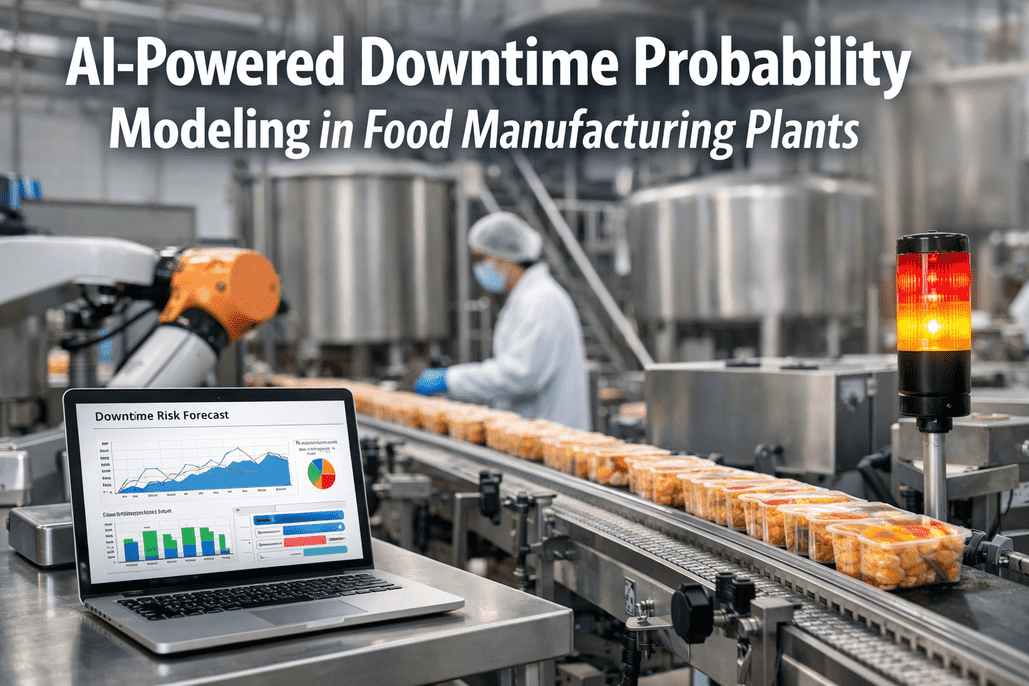
A frozen vegetable processor calculated their true cost of downtime at $847 per minute—not just lost production, but
spoiled product in the pipeline, overtime to catch up, expedited shipping to meet customer commitments, and the
ripple effects on scheduling for days afterward. Their largest packaging line averaged 23 hours of unplanned
downtime monthly, costing over $1.1 million annually from a single production line. After implementing systematic
preventive maintenance scheduling by Signing Up to Oxmaint, unplanned downtime dropped to under 4 hours monthly—a 83% reduction that
recovered the equivalent of 19 production hours every month.
Equipment downtime is the silent profit killer in food processing. Every minute a production line sits idle, costs
accumulate—labor standing by, product at risk, schedules disrupted, and customers waiting. Yet many facilities
accept high downtime as inevitable, not realizing that systematic approaches can dramatically reduce unplanned
stops. This guide covers proven strategies for minimizing equipment downtime in food manufacturing environments. Book a demo to see how Oxmaint's Preventive
Maintenance Scheduling helps food processors maximize uptime.
Maintenance Strategy / Reliability
Reducing Equipment Downtime in Food Processing Plants
Proven strategies to minimize unplanned stops, protect production schedules, and improve equipment reliability.
$847
Average Cost Per Minute of Downtime
80%
Downtime Reduction Achievable
3-6 Mo
Typical ROI Timeline
Understanding Downtime in Food Processing
Before implementing solutions, understand your downtime sources. Food processing facilities experience both
planned downtime (maintenance windows, changeovers, sanitation) and unplanned downtime (equipment failures,
quality holds, supply issues). The goal isn't zero downtime—it's minimizing unplanned stops while optimizing
planned activities.
Preventive maintenance windows
Product changeovers
Sanitation cycles (CIP/COP)
Scheduled equipment upgrades
Calibration and verification
Goal: Optimize efficiency, don't eliminate
Equipment breakdowns
Quality holds and rejects
Raw material issues
Utility failures
Staffing gaps
Goal: Minimize aggressively
Eight Strategies to Reduce Equipment Downtime
These proven approaches systematically reduce unplanned downtime in food processing environments. Most facilities
benefit from implementing multiple strategies simultaneously. Sign Up and start with Oxmaint's preventive maintenance
tools.
01
Implement Preventive Maintenance
Replace reactive firefighting with scheduled maintenance based on time,
usage, or condition triggers. PM programs typically reduce unplanned downtime by 25-50% within the
first year.
Create PM schedules for critical equipment
Define inspection checklists
Track completion rates
02
Prioritize Critical Equipment
Not all equipment deserves equal attention. Focus resources on assets
where failure stops production, threatens food safety, or creates the highest financial impact.
Identify single points of failure
Calculate downtime cost by asset
Allocate PM resources accordingly
03
Stock Critical Spare Parts
Emergency parts procurement extends downtime significantly. Identify
parts that frequently fail or have long lead times, and maintain appropriate inventory levels.
Analyze failure history for parts usage
Set min/max levels for critical spares
Establish vendor relationships
04
Train Operators on Basic Maintenance
Operators can catch problems early and perform basic tasks. Autonomous
maintenance—cleaning, inspection, lubrication, and minor adjustments—prevents many failures.
Develop operator inspection checklists
Train on abnormality recognition
Create escalation procedures
05
Analyze Failure Patterns
Track every breakdown to identify patterns. Root cause analysis reveals
systemic issues—wrong PM intervals, inadequate training, design weaknesses—that cause repeated
failures.
Log all equipment failures
Conduct root cause analysis
Implement corrective actions
06
Optimize Changeover Processes
Changeovers are necessary but often take longer than required. SMED
(Single-Minute Exchange of Die) principles can dramatically reduce changeover time and associated
downtime.
Document current changeover steps
Separate internal vs external tasks
Standardize and practice procedures
07
Implement Condition Monitoring
Install sensors on critical equipment
Establish baseline measurements
Set alert thresholds
08
Use CMMS for Coordination
Computerized Maintenance Management Systems organize work orders, track
equipment history, schedule PMs, and provide data for continuous improvement. Paper systems can't
scale.
Centralize maintenance data
Automate PM scheduling
Track KPIs and trends
Start Reducing Downtime Today
Oxmaint's Preventive Maintenance Scheduling helps food processors implement these strategies with automated
scheduling, mobile work orders, and performance tracking.
Top Causes of Equipment Downtime in Food Processing
Understanding common failure causes helps prioritize prevention efforts. These issues account for the majority of
unplanned downtime in food manufacturing.
1
Bearing Failures
Motors, pumps, conveyors, and mixers all rely on bearings. Inadequate
lubrication, contamination, and misalignment cause premature failure.
Prevention: Regular lubrication, vibration monitoring, proper
installation
2
Electrical Issues
Motor burnouts, control failures, and wiring problems. Often caused by
voltage fluctuations, moisture ingress, or age-related degradation.
Prevention: Thermal imaging, motor current analysis, connection
inspection
3
Seal & Gasket Failures
Pumps, valves, and processing equipment depend on seals. Wear, chemical
attack, and temperature cycling cause leaks and contamination risks.
Prevention: Scheduled replacement, proper material selection, condition
monitoring
4
Belt & Chain Wear
Drive systems transfer power throughout processing lines. Worn belts slip,
stretched chains jump, causing quality issues before complete failure.
Prevention: Tension checks, visual inspection, scheduled replacement
5
Sensor & Control Failures
Temperature, pressure, level, and flow sensors control critical processes.
Drift or failure causes quality problems and safety shutdowns.
Prevention: Regular calibration, redundant sensors on critical systems
6
Pneumatic System Issues
Air cylinders, valves, and actuators power much of food processing. Air
leaks, moisture contamination, and valve failures cause erratic operation.
Prevention: Leak detection, air dryer maintenance, valve inspection
Measuring Downtime Reduction Progress
Track these metrics to measure improvement and identify areas needing attention. Schedule a consultation to discuss KPI
benchmarking for your facility.
Overall Equipment Effectiveness (OEE)
Availability × Performance × Quality
Target: 85%+ for world-class
Mean Time Between Failures (MTBF)
Operating Time ÷ Number of Failures
Target: Increasing trend
Mean Time To Repair (MTTR)
Total Repair Time ÷ Number of Repairs
Target: Decreasing trend
PM Completion Rate
Completed PMs ÷ Scheduled PMs × 100
Target: 95%+ completion
Planned vs Unplanned Ratio
Planned Work Hours ÷ Total Work Hours
Target: 80%+ planned
Downtime Cost Per Month
Downtime Hours × Cost Per Hour
Target: Decreasing trend
Track Your Downtime Metrics
Oxmaint automatically calculates OEE, MTBF, MTTR, and other KPIs from your maintenance data—no spreadsheets
required.
Quick Wins: Actions You Can Take This Week
Start improving reliability immediately with these practical actions that require minimal investment.
List your top 10 problem equipment
Identify which assets cause the most downtime. Focus improvement efforts here
first.
Create PM checklists for critical assets
Even simple inspection lists catch problems before failure. Start with your
problem equipment.
Audit spare parts for critical equipment
Identify parts that would extend downtime if not available. Order critical
spares now.
Brief operators on early warning signs
Train operators what abnormal sounds, smells, and vibrations mean. Create
reporting procedures.
Frequently Asked Questions
How much can we realistically reduce downtime?
Most food processing facilities can reduce unplanned downtime by 50-80% with
systematic preventive maintenance and condition monitoring. The exact improvement depends on your
current state—facilities with minimal PM programs often see the largest gains.
Start
your free trial to begin tracking and improving.
How do we calculate downtime cost?
Include lost production value, labor costs during downtime, spoiled product,
expedited shipping, overtime to catch up, and potential customer penalties. Most facilities
underestimate true downtime cost by 50% or more when they only count direct repair costs.
Should we do PM on all equipment?
No—prioritize based on failure consequences. Critical equipment (refrigeration,
single points of failure, food safety related) deserves rigorous PM. Non-critical equipment with low
failure impact may be appropriate for run-to-failure strategies.
Book a consultation for
equipment criticality assessment guidance.
How do we get operators engaged in maintenance?
Start simple—basic cleaning, inspection, and lubrication tasks. Provide training on
what abnormalities look like and make reporting easy. Recognize operators who catch problems early.
Autonomous maintenance builds ownership and catches issues maintenance teams would miss.
Maximize Your Production Uptime
Join food manufacturers using Oxmaint to reduce equipment downtime with preventive maintenance scheduling,
failure tracking, and performance analytics.