A BIA IDIQ contract does not authorise a single project — it authorises years of individual task orders, each one carrying its own scope, its own funding, and its own delivery deadline against a shared ceiling that the whole contract cannot exceed. Managing that structure on a spreadsheet works for the first few task orders, then quietly breaks down as the contract stretches across option years, funding sources change, and nobody has a single view of how much of the ceiling has actually been committed. A task order issued without confirmed funding, or a delivery deadline tracked only in someone's inbox, is how a well-structured multi-year contract turns into a compliance problem. Sign in to OxMaint to see how task order issuance, funding attach, and delivery tracking come together in one system built for multi-year contract vehicles.
Federal Contract Management · IDIQ Task Orders · BIA Facilities & Infrastructure · OxMaint
One IDIQ Contract. Dozens of Task Orders. One Ceiling You Cannot Afford to Lose Track Of.
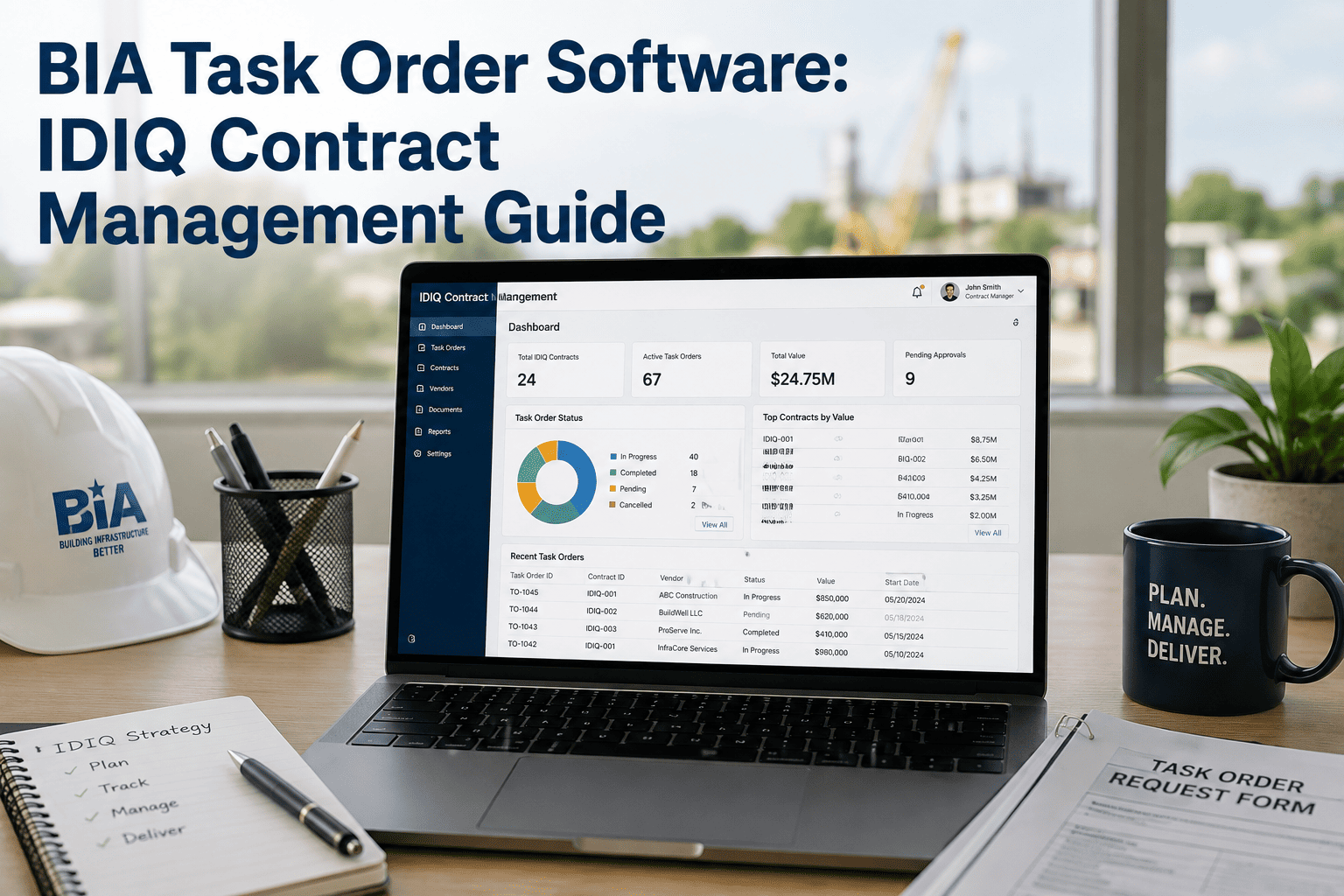
OxMaint tracks every task order issued under a BIA IDIQ contract — scope, funding attach, ceiling consumption, ordering period, and delivery status — in one system, so a multi-year contract vehicle stays visible instead of scattered across emails and spreadsheets.
2 numbers
every IDIQ must state — a guaranteed minimum and a maximum ceiling — and every task order issued has to fit inside both
5 yrs
typical maximum ordering period for a federal IDIQ contract including option periods, unless a specific statute allows longer
1 ceiling
shared across every task order issued on the contract — track it per order, not per year, or the whole vehicle is at risk of a breach
Ordering ≠ Performance
The ordering period and the period of performance on an IDIQ contract are not the same window, and confusing them is one of the most common mistakes in multi-year contract administration. A task order placed before the ordering period closes can still be performed after it closes, as long as the order itself allows it. Losing track of which deadline applies to which task order is exactly the kind of detail that gets lost when task orders live in separate email threads instead of one structured record tied back to the base contract.
The Life of a Task Order Under a BIA IDIQ Contract
1
Base IDIQ Established
Scope, ordering period, minimum guarantee, and maximum ceiling are set at contract award, defining the boundaries every future task order has to stay inside.
2
Task Order Drafted
A specific project — a road repair, a facility upgrade, an irrigation system repair — is scoped against the base contract's authorised work categories and pricing structure.
3
Funding Attached and Verified
The task order is matched to an obligated funding source before issuance, confirming the dollar amount is actually available and correctly charged to the right fiscal year.
4
Task Order Issued
The contracting officer issues the order with a defined scope, period of performance, and funded amount, and the ceiling consumption for the whole contract updates immediately.
5
Delivery Tracked to Closeout
Performance milestones, inspections, and final delivery are tracked against the period of performance, closing the order out with documentation tied back to the original scope and funding.
OxMaint · Task Order Management for Multi-Year Contracts
Every Task Order Traced Back to the Contract, the Funding, and the Deadline
Stop reconstructing ceiling consumption from old emails. OxMaint keeps every task order tied to its base IDIQ contract, its funding source, and its delivery status in one place.
Three Places a Multi-Year Contract Actually Breaks Down
ISSUE — Task Order Issuance
Issuing an Order Without Checking It Against the Base Contract
Every task order has to clearly describe the work, stay within the scope authorised by the base IDIQ, and fit inside the remaining ceiling. When task orders are drafted in a separate document from the contract record, it is easy to issue an order that technically falls outside the authorised scope, or that pushes cumulative spending closer to the ceiling than anyone realised. OxMaint keeps every task order linked directly to its base contract record, so scope and remaining ceiling are visible the moment a new order is drafted, not discovered after it is already issued.
What OxMaint Checks at Issuance
Task order scope compared against the base contract's authorised categories
Remaining ceiling calculated automatically before the order is finalised
Ordering period status confirmed so the order is placed within the valid window
FUND — Funding Attach
Starting Work Before Funding Is Actually Confirmed
A task order that begins performance before its funding is properly obligated creates exactly the kind of accounting problem that shows up in an audit years later — funds charged to the wrong fiscal year, or a task order that was never fully funded to the amount of work authorised. OxMaint requires a funding source to be attached and verified against the task order amount before the order status can move to issued, closing the gap between authorisation and actual obligated funds.
What Funding Attach Confirms
Funding source and fiscal year matched to the task order amount before issuance
Partial funding flagged clearly rather than treated as fully funded by default
Funding history retained per task order for later financial reconciliation
TRACK — Delivery Tracking
Losing Visibility Once the Order Is Issued
Issuing a task order is the easy part — tracking it through performance to a documented closeout is where most contract files fall apart, especially across a portfolio of dozens of active orders at different stages. OxMaint tracks each task order's period of performance, milestone status, and closeout documentation in one dashboard, so a contract administrator can see which orders are on schedule, which are approaching their performance deadline, and which are ready for closeout without opening a single file folder.
What Delivery Tracking Covers
Milestone and performance status for every active task order in one view
Alerts for orders approaching the end of their period of performance
Closeout documentation tied directly back to the original task order record
What OxMaint Tracks Against Every BIA IDIQ Contract
Where an Untracked Task Order Portfolio Creates Risk
High Risk
Ceiling Breach Across Cumulative Task Orders
No single task order looks alarming on its own, but without a running total across the whole contract, cumulative orders can approach or exceed the ceiling before anyone notices — a problem that is far easier to prevent than to unwind after the fact.
High Risk
Work Started Before Funding Is Obligated
A task order performed ahead of confirmed funding creates a funding gap that surfaces during financial reconciliation, often long after the work is already complete and much harder to correct.
Elevated
Missed Ordering Period Deadline
A task order that needs to be placed before the ordering period closes can slip past that deadline entirely if nobody is tracking the window separately from the contract's overall period of performance.
Elevated
Incomplete Closeout Documentation
A task order that finishes performance without a documented closeout leaves a gap in the contract file — exactly the kind of gap a contract audit or a follow-on procurement review is likely to flag.
Why Multi-Year Funding Makes This Harder Than a Single Project
A BIA IDIQ contract supporting facilities, roads, irrigation systems, or dam safety work rarely draws from a single, simple funding line. Task orders issued across different fiscal years can carry different appropriations, different program funding sources, and different obligation deadlines, even though they are all issued against the same base contract. Tracking that complexity in a spreadsheet means someone has to manually reconcile which task order drew from which funding source every time a report is needed — a process that is slow even when it is done carefully, and easy to get wrong when it is not.
The practical effect of losing that visibility is not usually a single dramatic failure. It is a slow accumulation of small gaps — a task order funded slightly short of its full scope, a closeout document that never got filed, a ceiling calculation that was accurate six months ago but has not been updated since three new orders were issued. Individually, each gap looks minor. Collected across a multi-year contract with dozens of task orders, they add up to a contract file that cannot answer a straightforward question during an audit: exactly how much of the ceiling has been committed, and against what funding.
Centralising task order issuance, funding attach, and delivery tracking in one system does not remove the underlying complexity of multi-year federal funding — it just makes that complexity visible and current instead of something that has to be reconstructed from scratch every time someone asks. A contract administrator managing several active IDIQ vehicles at once benefits the most, since the alternative is keeping that reconciliation current across every contract manually, at the same time.
We were managing task orders across three active IDIQ contracts using a shared spreadsheet and a lot of institutional memory about who funded what. When a new contract administrator joined, it took weeks just to get them oriented to the current ceiling status on each contract. Since moving task order tracking into OxMaint, funding attach happens before an order is ever issued, and pulling a full status report across all three contracts takes minutes instead of a week of cross-checking old emails.
— Contract Administrator, Tribal Infrastructure Program · OxMaint user
Frequently Asked Questions — BIA Task Order and IDIQ Contract Management
Can OxMaint track multiple IDIQ contracts with different ceilings and ordering periods at the same time?
Yes, each base contract is tracked separately with its own minimum, ceiling, and ordering period, and every task order issued rolls up into that specific contract's running totals.
Sign in to OxMaint to set up your active IDIQ contracts.
Does OxMaint prevent a task order from being issued if funding has not been confirmed?
A funding source has to be attached and verified against the task order amount before its status can move to issued, so work is not authorised ahead of confirmed, obligated funding.
How does OxMaint distinguish between the ordering period and a task order's period of performance?
Both windows are tracked separately on the contract and on each individual task order, since a task order placed before the ordering period closes can still be performed after that window ends, as long as the order allows it.
Can a contract administrator see how much of the ceiling has been used at any point in time?
Yes, cumulative ceiling consumption updates automatically with every new task order issued, giving a current running total instead of a figure that needs to be manually recalculated.
Book a demo to see the ceiling tracking view.
What happens to task order records once performance is complete?
Closeout documentation is attached directly to the task order record, keeping the full history — scope, funding, performance, and closeout — together for future reference or audit review.
A Multi-Year IDIQ Contract Deserves a Record That Stays Current, Not One Rebuilt Every Time Someone Asks.
Task order issuance tied to contract scope, funding attach verified before work begins, and delivery tracked to a documented closeout — all in one system built for the way BIA task order contracts actually run across years and fiscal cycles.