Bridge programs rarely lose track of a finding because nobody cared. They lose track of it because the finding lives in one subscription tool, the inspection schedule lives in another, the load rating sits in a spreadsheet on someone's desktop, and the critical-finding follow-up gets tracked in email. Each tool does its own job well. None of them talk to each other, and that gap is where overdue National Bridge Inspection Standards findings quietly accumulate until an FHWA compliance review finds them first. A connected system closes that gap; you can see how at Oxmaint.
NBIS COMPLIANCE · CRITICAL FINDINGS · MULTI-TOOL BRIDGE PROGRAMS
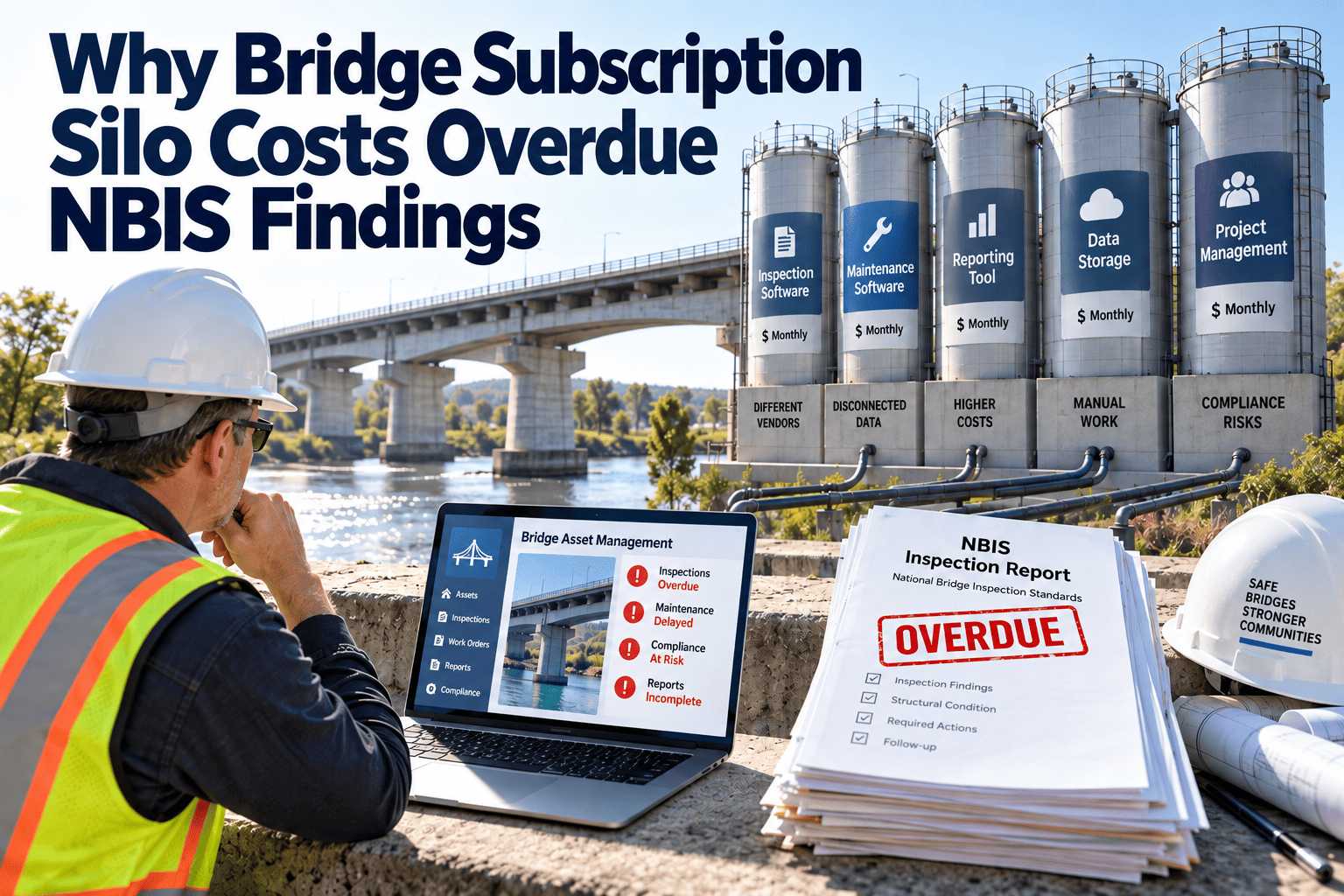
Why A Bridge Subscription Silo Is Costing You Overdue NBIS Findings
Inspection software, GIS mapping, load rating tools, and spreadsheets each hold a piece of your bridge record. When they don't reconcile automatically, critical findings age past their required follow-up window without anyone noticing until the audit.
Inspection AppElement ratings, photos
GIS PlatformLocation, route data
Load Rating ToolPosting, permits
SpreadsheetFindings tracker
No shared record between systems
The National Bridge Inventory Is Too Large For Manual Reconciliation
There are more than 623,000 bridges in the U.S. National Bridge Inventory, and every one of them carries a federally mandated inspection cycle under the National Bridge Inspection Standards, a mandate that has governed public highway bridges since 1971. The 2022 NBIS update tightened that further with risk-based intervals, national inspector certification, and mandatory Specifications for the National Bridge Inventory (SNBI) element-level reporting that took effect in 2024.
623K+Bridges under NBIS mandate nationwide
24 moMaximum routine inspection interval
23FHWA compliance metrics reviewed per state program
5 yrUnderwater inspection cycle for submerged piers
FHWA evaluates every state bridge inspection program annually against those 23 metrics. A program that fails enough of them faces a Plan of Corrective Action, closer federal oversight, and in persistent cases the risk of federal-aid funding penalties — not because inspectors missed bridges, but because the paperwork behind a critical finding couldn't be produced on demand.
The pattern shows up the same way in review after review: the inspection itself happened on schedule, the finding was accurate, and the deterioration was real. What failed was the record trail connecting the finding to a documented resolution — a gap that a fragmented set of subscriptions makes almost inevitable once an inventory grows past a few dozen structures.
See Every Finding, Every Bridge, One Record
Oxmaint ties inspection scheduling, element ratings, critical finding follow-up, and load rating status into one auditable bridge record, replacing the tool-to-tool handoff where findings go stale.
How A Subscription Silo Actually Forms In A Bridge Program
No bridge program sets out to fragment its own data. It happens tool by tool, each one solving an immediate problem without anyone stepping back to ask what happens when a finding has to move between them. By the time the fragmentation is visible, it's rarely one bad decision — it's five reasonable ones that never got reconciled against each other.
01
The Inspection App Owns The Finding, Not The Follow-Up
Most field inspection software captures element ratings and photos cleanly, but critical finding follow-up — the immediate-action items that must be resolved and reported to the FHWA Division Office — often gets logged as a note rather than a tracked task with an owner and a due date.
02
Load Rating Lives In A Separate Engineering Tool
When an inspection reveals section loss or deterioration that could affect capacity, the load rating recalculation happens in engineering software that was never connected to the inspection record that triggered it, so posting decisions lag behind the finding that justified them.
03
The Master Tracker Becomes A Spreadsheet By Default
Somebody, somewhere, ends up maintaining the "real" list of open findings in a spreadsheet because it's the only place that can hold data from every other system. That spreadsheet is accurate the day it's built and stale within a week.
04
Multi-Agency Bridges Multiply The Problem
NBIS applies to tribally owned, federally owned, and state-owned bridges alike, and joint-ownership structures crossing county or agency lines mean the same bridge record can exist in two subscription systems that never reconcile with each other.
05
Inspector Certification Records Sit Outside The Bridge Record
The 2022 NBIS update introduced national certification requirements for team leaders and program managers, but certification status is frequently tracked in an HR system or a separate credentialing spreadsheet, disconnected from the inspection it's meant to qualify someone to perform. When a reviewer asks whether the inspector who logged a given finding was properly certified at the time, that answer often takes longer to produce than it should.
Where A Critical Finding Goes Overdue
1
Inspector Logs Finding
Element rated, photo attached, severity noted in field app.
→
2
Manual Handoff To Tracker
Someone must remember to copy the finding into the master list.
→
3
Engineering Review Queued
Load rating or repair scope sits in a separate inbox, unlinked to due date.
→
4
Resolution Or Overdue
Without a shared due-date alert, the finding ages silently past its window.
Steps 2 and 3 are where nearly every overdue finding actually goes missing — not at inspection, and not at resolution.
Subscription Silo vs. A Connected Bridge Record
Laid side by side, the difference between the two approaches isn't about which tools are "better" — it's about how many hands and how many logins a single finding has to pass through before it's considered resolved.
| Workflow Element | Siloed Subscriptions | Oxmaint Connected Record |
|---|
| Critical Finding Tracking | Noted in inspection app, re-entered in spreadsheet | Logged once, tracked to resolution with owner and due date |
| Load Rating Trigger | Manual referral to engineering, no linked deadline | Auto-flagged from the finding, status visible to program manager |
| Inspection Scheduling | Calendar reminders per bridge, per inspector | Risk-based interval scheduling across the full inventory |
| SNBI Element Data | Exported and reformatted between systems | Captured in the field, structured for SNBI reporting |
| Audit Preparation | Days assembling records from multiple logins | Complete bridge record exported in one pass |
What An Overdue Critical Finding Actually Costs A Bridge Program
A finding that ages past its required follow-up window is not just a paperwork problem. It changes the risk profile of the bridge, the liability exposure of the owning agency, and the standing of the entire inspection program with FHWA. The four costs below rarely show up on a single line item, which is exactly why they're easy to underestimate until they land all at once.
Funding Risk
Persistent non-compliance against the FHWA's 23 program metrics can escalate from a Plan of Corrective Action to increased federal oversight, and in sustained cases, withheld federal-aid highway funds tied to the program.
Liability Exposure
If a documented critical finding sat unresolved past its required follow-up and the condition worsens, the agency's own inspection record becomes the evidence used against it, rather than proof of due diligence.
Posting And Detour Costs
A delayed load rating update means a bridge that should carry a weight restriction keeps carrying full traffic, or a bridge that could stay open gets closed unnecessarily while engineering catches up on a backlog.
Compounding Deterioration
Section loss, deck cracking, and bearing deterioration rarely stay static. A finding that should have triggered a follow-up inspection in weeks instead ages for months, and the repair scope grows with it.
Making The Case Internally: What To Show Your Bridge Program Director
The hardest part of fixing a subscription silo is rarely technical — it's organizational. Each tool in the stack has a champion who fought to get it approved, and nobody wants to be the one who suggests it isn't working. The case for consolidation is strongest when it's framed around the audit trail, not the tools themselves.
Start with a single question a program director should be able to answer in under a minute: how many critical findings are currently open across the full inventory, and how long has the oldest one been waiting? If that answer requires opening more than one system, the silo is already costing time every single week, whether or not it has caused an overdue finding yet.
1 Pull the current open-finding count from every existing tool and compare the totals — mismatches reveal exactly where records diverge.
2 Time how long a full audit export currently takes to assemble from scratch, including logins, exports, and manual reconciliation.
3 Identify which findings triggered a load rating referral and confirm whether that referral has a documented due date anywhere.
Signs Your Bridge Program Already Has A Subscription Silo Problem
These patterns rarely announce themselves as a crisis. They show up as small friction points that a program manager routes around week after week, until an audit or a near-miss forces the underlying gap into view.
✓
More than one tool holds part of a single bridge's inspection history
✓
A finding's status depends on someone remembering to update a spreadsheet
✓
Load rating updates lag behind the inspection that triggered them
✓
No single report shows every open critical finding across the whole inventory
✓
Audit prep means logging into three or more systems to reconstruct a timeline
✓
Different subscriptions were purchased by different people at different times, with no shared data model
What A Coordinated Bridge Record Changes
None of these outcomes require replacing the engineering expertise behind load ratings or the field discipline behind a good inspection. They require the data those steps produce to land in one place automatically, instead of depending on someone remembering the handoff.
1
Source Of Truth
Per bridge, replacing four partial records with one complete one
100%
Findings With An Owner
Every critical finding assigned, dated, and tracked to close-out
0
Manual Re-Entry Steps
Between field capture and the record FHWA reviews
1-click
Audit Export
Complete inspection and finding history, ready for review
A Realistic Path Off The Spreadsheet, One Step At A Time
Consolidating a bridge program's records doesn't have to mean ripping out every existing tool on day one. Programs that succeed at this usually sequence the change so the inspection cycle never stops running while the underlying system changes underneath it.
Week 1–2
Load The Existing Inventory
Bridge list, current condition ratings, and every open finding get imported from wherever they currently live, so nothing has to be re-typed from scratch.
Week 3–4
Run Field Inspections In Parallel
Inspectors capture the next cycle's element ratings directly into the connected system while the old tool stays available as a reference until it's fully retired.
Week 5–6
Connect The Load Rating Handoff
Findings that trigger a rating review get a due date and an owner automatically, closing the gap where referrals previously sat unlinked in a separate inbox.
Ongoing
Retire The Spreadsheet
Once the connected record is the trusted source for open findings, the manual tracker that used to exist "just in case" stops being maintained, because nobody needs it anymore.
Most bridge programs that follow this sequence have their next inspection cycle running through the connected system within the first month, with historical findings imported and current on day one rather than being backfilled months later. The old spreadsheet stays untouched in the background as a fallback, but it stops being the record anyone actually trusts once the connected system is producing the same numbers faster and with a clear owner attached to every open item.
Bridge Subscription Silo Questions
Does consolidating tools mean giving up specialized load rating software?+
No. The goal is connecting the finding that triggers a load rating review to the engineering workflow with a tracked due date, not replacing specialized engineering software.
Start a free trial to see how the handoff works in practice.
How does a connected record help with SNBI element-level reporting?+
Element data is captured once in the field, structured the way SNBI reporting requires, instead of being exported from an inspection app and reformatted by hand for a separate submission.
Can this work across state-owned, tribally owned, and locally owned bridges in the same program?+
Yes. NBIS applies uniformly across ownership types, including tribally and federally owned structures, and a connected record can be configured per agency while still rolling up to one inventory view.
How long does it take to migrate an existing bridge inventory?+
Most programs load their existing inventory, condition history, and open findings within the first two to four weeks of a trial.
Book a demo to scope the timeline for your specific inventory size.
Does this replace the FHWA compliance review process?+
No. It does not replace the review itself — it produces the documented, auditable record that the review depends on, so nothing has to be reconstructed from scattered systems under deadline pressure.
Stop Losing Findings Between Systems
Every subscription in your bridge program was purchased to solve a real problem. The gap between them is what's putting NBIS findings at risk. Bring the whole bridge record into one place and see every finding before it goes overdue.