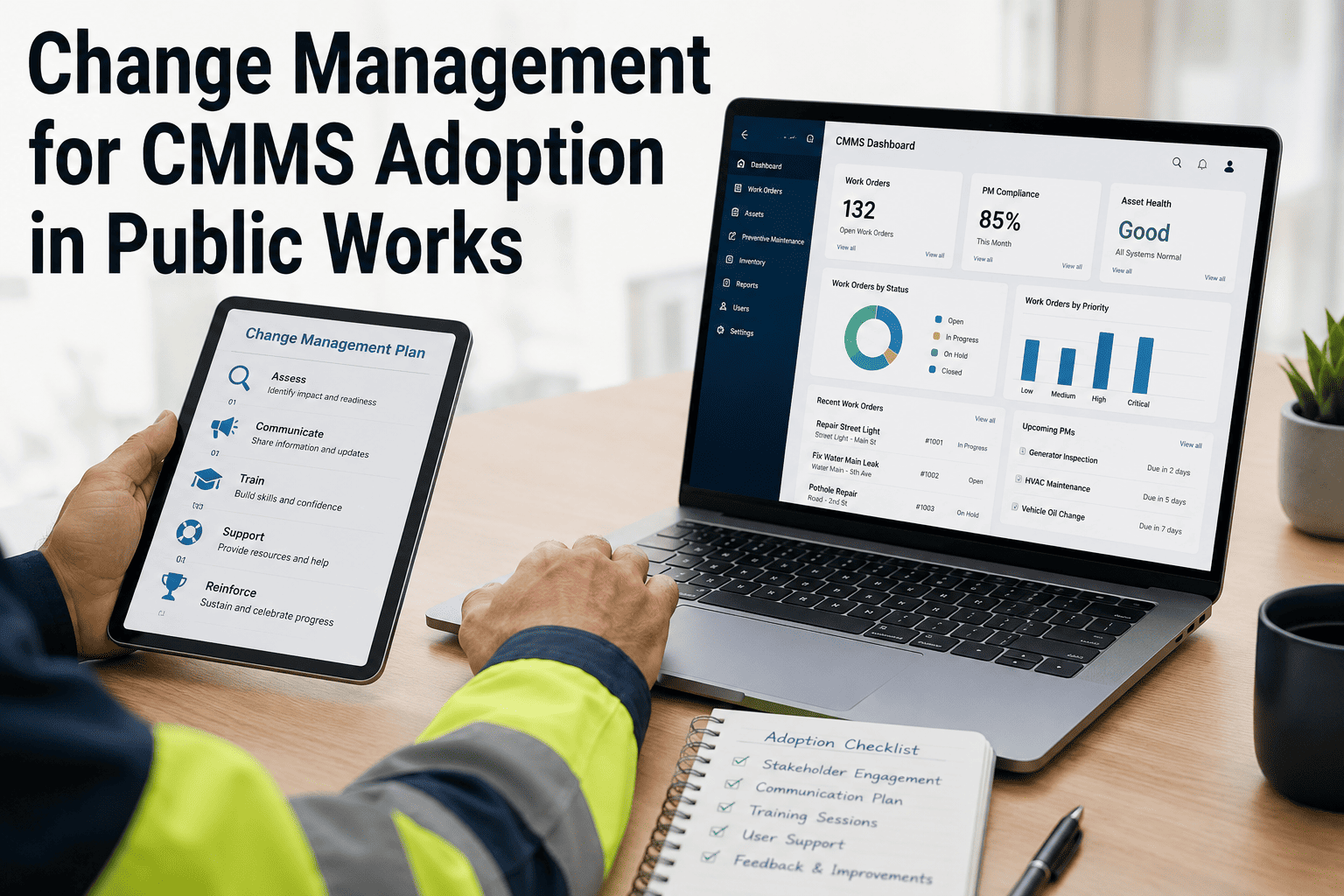
CMMS adoption in public works fails more often than it succeeds, and the root cause is almost never the software — it is user resistance, poor change management, and lack of crew buy-in that limit agencies to just 30–40% of the expected benefit. Municipal maintenance teams deploying a new CMMS without a structured change management plan see work-order compliance stall, preventive maintenance schedules slip, and asset data degrade within months. This guide lays out a proven change management framework for government CMMS adoption, covering user engagement, training design, and the phased rollout approach that gets public works staff actually using the system every shift — the same methodology supported by OxMaint's AI-powered platform, which you can explore when you Start Free Trial or book a personalized walkthrough.
CHANGE MANAGEMENT FOR GOVERNMENT CMMS
60–70% of public works CMMS value is lost to poor adoption — not bad software.
When crews resist the new system, agencies capture only 30–40% of projected savings. A structured change management plan flips that ratio — driving municipal CMMS adoption above 85% within the first 90 days.
85%+
Crew adoption rate with structured change management
30–40%
Of projected CMMS benefit captured without a plan
THE COST OF INACTION
Why CMMS implementation in public works stalls without change management
Public works departments invest $45K–$120K in CMMS software, training and integration — then watch utilization plateau at 30–40% because the technology rollout outpaced the people rollout.
30–40%
Of expected CMMS benefit captured by agencies with no formal change management plan
8–14 mo
Average time before a municipal CMMS is labelled "a failure" and staff revert to paper
$42K
Annual productivity loss for a mid-sized public works team running a CMMS at 35% adoption
3.2×
Higher work-order completion rate at agencies that ran structured change management
REAL-WORLD SCENARIO
A 180-asset municipal fleet department deployed a CMMS expecting $58K in annual maintenance savings. Eighteen months later, only 31% of preventive maintenance work orders were being closed in the system — crews preferred their old paper routes. The agency re-launched with a 90-day change management plan, trained 22 technicians in role-based sessions, and hit 88% PM compliance within one quarter. The difference was not the software — it was the adoption strategy.
FRAMEWORK
A 4-phase change management framework for government CMMS adoption
Municipal CMMS adoption succeeds when agencies follow a phased framework — each phase builds crew trust before the next layer is added. Skipping phases is the #1 predictor of failure.
Assess & Align
Map every stakeholder group — supervisors, mechanics, operators, clerks. Identify current pain points (lost work orders, missing PMs, no spare-parts visibility) and tie each to a measurable CMMS fix. Secure an executive sponsor at the director or deputy level.
Outcome: Stakeholder map + executive charter signed
Design & Configure
Configure the CMMS around real crew workflows — not the vendor's default template. Build asset hierarchies from existing data, set up PM triggers, and design mobile work-order forms that mirror the paper routes crews already know. Pilot with one crew before broad rollout.
Outcome: Configured system + 1 pilot crew live
Train & Launch
Role-based training is non-negotiable. Mechanics learn mobile work-order close-out; supervisors learn scheduling and KPI dashboards; clerks learn parts receiving. Keep sessions under 90 minutes, use real agency assets, and provide quick-reference cards — not 200-page manuals.
Outcome: 90% of staff trained + full department go-live
Reinforce & Sustain
Adoption decays without reinforcement. Run weekly adoption audits — track login rates, work-order closure within 24 hours, and PM compliance. Recognize crews hitting targets. Address resistance with coaching, not mandates. Adjust the system based on crew feedback.
Outcome: 85%+ sustained adoption at 90 days
USER ENGAGEMENT
How to build CMMS buy-in across public works crews
Government software adoption lives or dies on frontline trust. Crews need to see the system as something that makes their day easier — not another compliance burden layered on top of an already demanding shift.
Solve a real crew pain point first
Before asking crews to log every action, use the CMMS to eliminate their biggest headache — lost paper work orders, missing spare parts, or unclear PM schedules. When the system solves a daily frustration, adoption follows naturally.
Recruit crew champions — not just supervisors
Identify 2–3 respected mechanics or operators per shift to serve as CMMS champions. Peers trust peers. When a champion demonstrates mobile work-order close-out in the field, adoption spreads faster than any top-down mandate.
Replace paper — don't run parallel systems
The moment crews sense paper is an acceptable fallback, dual-system habits form and the CMMS becomes optional. Set a firm cutover date, remove paper routes, and make the CMMS the single source of truth — even if it means short-term friction.
Show crews their own data within 2 weeks
Put a dashboard in the break room showing PM compliance, work-order turnaround, and equipment uptime — updated daily. When crews see their work reflected in real metrics, the system shifts from "management's tool" to "our tool."
SOLUTION
How OxMaint drives public sector CMMS adoption
OxMaint is built to remove the friction that kills municipal CMMS adoption — paper-based work orders, clunky mobile interfaces, and dashboards nobody understands. Every feature is designed so crews adopt it within days, not months.
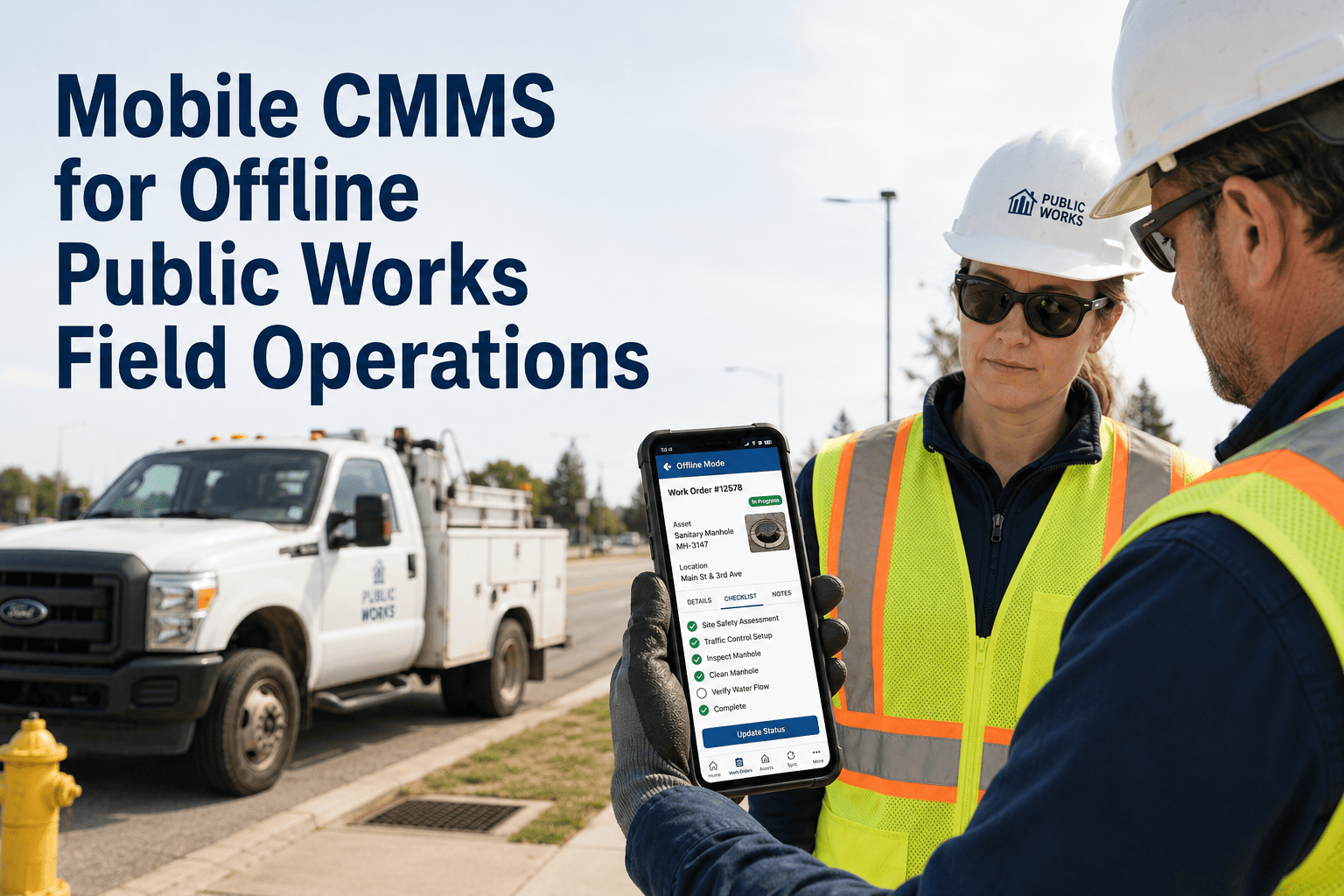
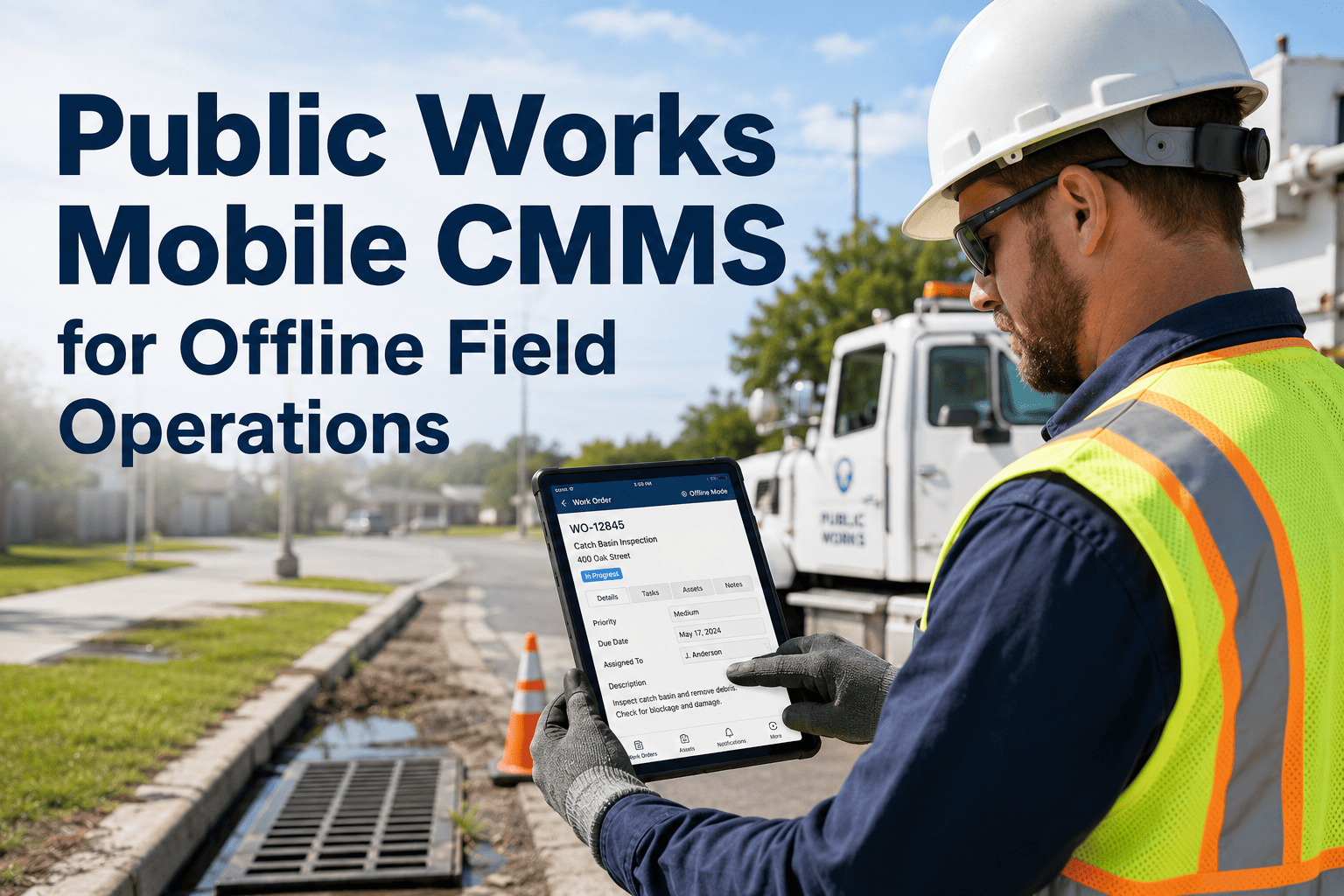
Mobile work orders crews actually use
OxMaint's mobile app lets technicians close work orders, attach photos, and log parts from the field in under 60 seconds — eliminating the paper that kills adoption and cutting work-order lag by 70%.
Eliminates paper work orders within 1 pay period
AI-guided preventive maintenance
OxMaint auto-generates PM schedules from asset history and usage data, so supervisors spend less time planning and crews spend less time chasing missed maintenance. PM compliance typically reaches 90%+ in the first quarter.
Cuts unplanned downtime 30–50%
Dashboards crews and directors both understand
Role-based dashboards show mechanics their day's work, supervisors their crew's KPIs, and directors their agency's compliance — all in plain language. No 200-page training manual required.
Drives 85%+ adoption within 90 days
Spare-parts inventory that prevents stockouts
OxMaint tracks parts usage against work orders automatically and flags low stock before a job is delayed — removing the "I couldn't finish the PM because we had no filters" excuse that erodes system trust.
Reduces parts-related work delays by 45%
TRAINING DESIGN
Training design that sticks: role-based, hands-on, and short
Generic "click-here" training fails in public works because every role interacts with the CMMS differently. Role-based sessions — kept under 90 minutes, using real agency assets — drive 2.5× higher retention than classroom-style vendor demos.
| Role | Training Focus | Session Length | Key Outcome |
|---|---|---|---|
| Mechanics / Technicians | Mobile work-order close-out, photo capture, parts logging | 60 min | Close 90% of WOs in-system within 24 hrs |
| Crew Supervisors | PM scheduling, work assignment, KPI dashboards | 90 min | Manage 100% of daily assignments in CMMS |
| Parts / Store Room Clerks | Inventory receipt, issue to WOs, reorder triggers | 45 min | Eliminate manual stockout tracking |
| Operations Director | Compliance reporting, cost analytics, audit readiness | 60 min | Generate FMCSA / state audit reports in 1 click |
| Admin / IT | Asset hierarchy, user roles, integrations, data import | 120 min | Self-sufficient system administration |
See OxMaint on your assets — book a 30-minute demo
Watch how public works teams configure role-based dashboards, launch mobile work orders, and hit 85% adoption in the first 90 days — without the change-management headaches that derail most municipal CMMS rollouts.
ADOPTION METRICS
Measuring CMMS adoption: the KPIs that predict success
If you are not measuring adoption weekly, you are not managing it. These five KPIs — tracked in OxMaint's analytics module from day one — separate agencies that capture full CMMS value from those stuck at 35%.
85%+
Daily Login Rate
% of active users logging in each shift — the baseline signal of adoption.
<24 hrs
Work-Order Closure Lag
Time from job completion to WO closed in system — targets under 24 hours.
90%+
PM Compliance
% of scheduled PMs completed on time — the core ROI driver for any CMMS.
0
Paper Work Orders
The single strongest indicator that adoption has taken hold across the department.
“
Agencies that track these four KPIs weekly and share them publicly with crews reach 85% adoption in 90 days. Agencies that don't track them plateau at 35% — and usually replace their CMMS within 18 months.
FAQ
CMMS adoption in public works: common questions
Why does CMMS adoption fail in public works departments?
CMMS adoption fails in public works because agencies focus on the technology rollout and neglect the people side — no executive sponsor, no crew champions, no role-based training, and no removal of paper fallbacks. When crews perceive the system as extra work with no personal benefit, utilization drops to 30–40% and the investment is written off within 18 months. OxMaint's mobile-first design and role-based dashboards directly address this by making the system faster than paper for frontline crews.
How long does it take to achieve full CMMS adoption in government?
With a structured change management plan, public works agencies typically reach 85%+ adoption within 90 days of go-live. Without a plan, adoption often plateaus at 30–40% indefinitely. The 90-day target assumes role-based training, a firm paper cutover, weekly adoption audits, and visible crew dashboards — all supported out of the box by OxMaint. To see the 90-day roadmap on your own assets, book a 30-minute demo with our public works team.
What is the best change management framework for municipal CMMS adoption?
The most effective framework follows four phases: Assess & Align (stakeholder mapping and executive sponsorship), Design & Configure (system built around real crew workflows), Train & Launch (role-based sessions under 90 minutes with one pilot crew first), and Reinforce & Sustain (weekly KPI audits and crew recognition). Skipping any phase — especially the reinforcement phase — is the top predictor of failed public sector CMMS adoption.
How much does poor CMMS adoption cost a public works agency?
A mid-sized public works team running a CMMS at 35% adoption typically loses $35K–$55K per year in unrealized maintenance savings, plus the cost of avoidable equipment failures, overtime from reactive repairs, and duplicate parts purchases. Over a 5-year cycle, that is $175K–$275K in stranded value — often more than the original software investment. You can calculate your agency's specific gap by starting a free 14-day OxMaint trial and benchmarking current PM compliance and work-order closure rates.
Can OxMaint help if our agency already failed a previous CMMS rollout?
Yes. OxMaint is designed for agencies re-launching after a failed deployment. The platform's mobile-first work orders, AI-guided PM scheduling, and role-based dashboards remove the friction that caused the previous failure, while our implementation team provides the change management playbook — stakeholder mapping, crew-champion identification, role-based training, and 90-day adoption KPIs — to ensure the second rollout succeeds where the first stalled.
READY TO DRIVE ADOPTION?
Stop losing 60% of your CMMS investment to poor adoption.
Join public works agencies using OxMaint to hit 85%+ crew adoption, eliminate paper work orders, and cut unplanned downtime 30–50% — all within the first 90 days. Book a 30-minute demo on your assets, or start a free trial today.
Free 14-day trial · No credit card