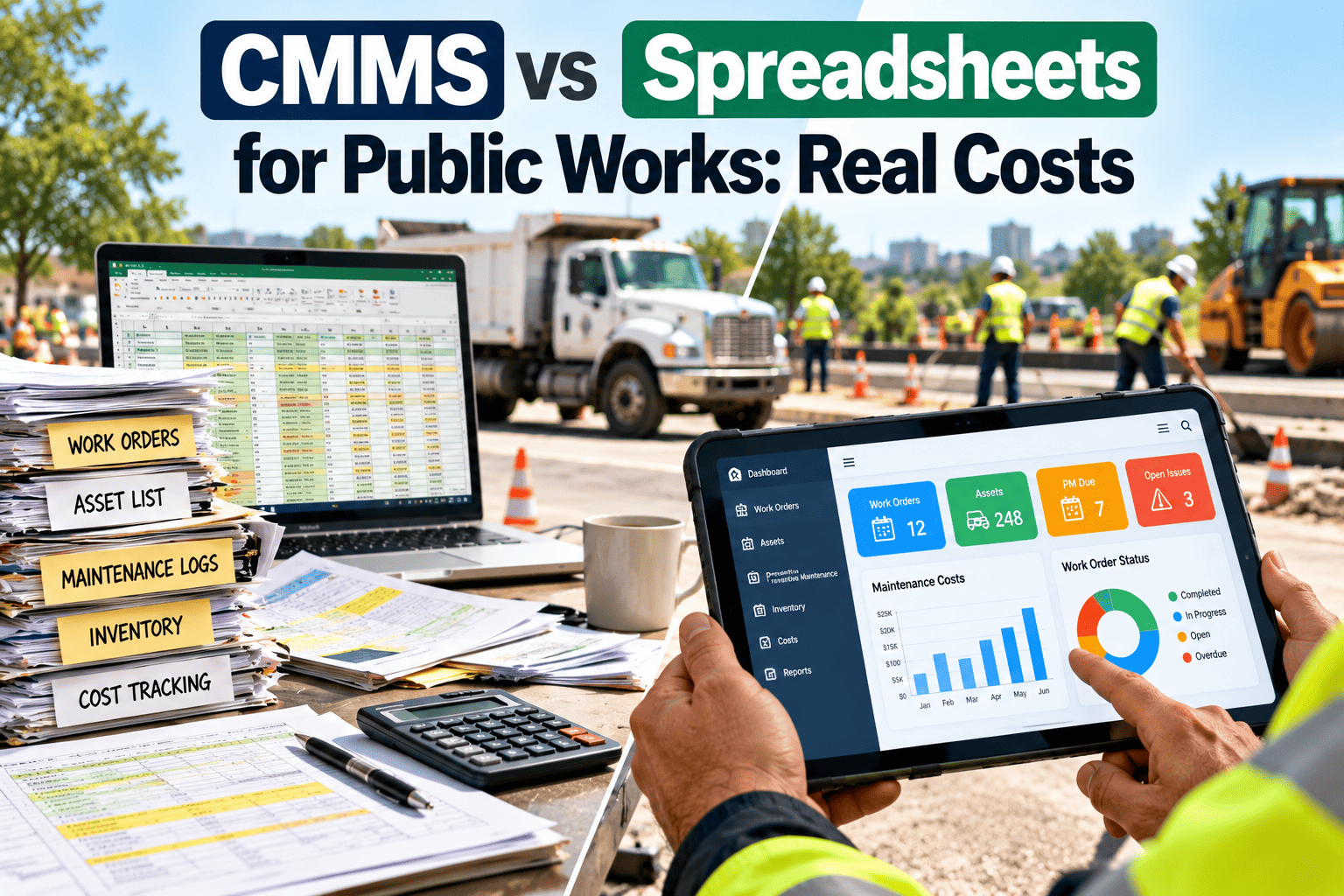
Nearly every public works department starts the same way: a shared spreadsheet listing assets, service dates, and a column that says when the next inspection is due. It costs nothing to open, everyone already knows how to use it, and for a small operation it genuinely works. The trouble begins quietly — a stale odometer reading, a missed calibration, a version conflict between two field supervisors editing the same file — and by the time anyone connects the dots, the failure has already happened somewhere downstream. The question is not whether spreadsheets can hold maintenance data. They can. The question is what that "free" tool actually costs a public agency once audits, backlogs, and lost institutional knowledge are counted. OxMaint exists to make that comparison honest by giving public works teams a single system of record that spreadsheets were never built to be.
Public Works · CMMS Implementation · Cost Analysis
CMMS vs Spreadsheets for Public Works: The Real Costs
Spreadsheets feel free because the license is already paid for. The real bill arrives later — in missed PMs, failed audits, emergency overtime, and data that walks out the door when a supervisor retires. Here is the full ledger, side by side.
The Spreadsheet "Price"
Software license$0
What leadership sees$0
What it actually costs?
The CMMS Investment
Licenses + setupKnown
Payback window6–14 mo
Documented return4–8x
Why "Free" Is the Most Expensive Word in a Maintenance Budget
A spreadsheet is a static organizer. A public works operation is a live, multi-crew, audit-exposed system running water, roads, fleet, parks, and buildings at once. The mismatch is structural, not a matter of discipline — and it shows up as cost in places the finance office rarely traces back to the tracking method.
Error rate
Research consistently finds up to 88% of spreadsheets contain errors. In maintenance, one wrong date is a missed calibration; one wrong cell reference is a PM frequency off by a factor of two.
PM compliance
Manual programs typically miss 15–25% of preventive tasks, and reported compliance runs 15–25% higher than reality — crews complete the easy ones and skip the hard ones, and no one can tell.
Emergency ratio
Municipalities without structured PM run roughly 42% of maintenance as reactive — the most expensive possible way to keep assets running, at 3–5x the cost of the planned repair it replaced.
Knowledge loss
When the logic lives in one supervisor's head and a backup tab, retirement is a data breach. The asset history leaves with the person, and the department rebuilds from memory.
The Cost Iceberg: What Leadership Sees vs What the Agency Pays
The reason spreadsheet costs survive budget scrutiny is simple — they sit below the waterline. The license fee is visible and zero. Everything that makes the tool expensive is invisible until it surfaces as an emergency, a failed audit, or a damage claim.
Visible — what shows up in the budget
$0 software license
the waterline
Hidden — what the agency actually absorbs
Emergency repairs at 3–5x planned cost
Overtime from reactive callouts
Staff hours lost to manual reconciliation
Compliance penalties & audit findings
Consultant fees to rebuild asset records
Deferred backlog compounding yearly
Shortened asset life from skipped PMs
Liability & damage claims with no proof-of-work
Where the Spreadsheet Breaks — and When It Costs You
Public works teams hit the same failure points in a predictable order as the operation scales. Each one is structural — it happens because a spreadsheet was never built to run a live maintenance operation, not because anyone was careless.
1
Version conflict across crews
Two supervisors edit the same file; the roads tab and the fleet tab disagree. Decisions get made on stale data, and the original error stays invisible because it surfaces weeks later as rework.
2
No field enforcement
A calendar note says "hydrant flush every 90 days," but nothing forces it. A tech works on something else, never sees the note, and the PM silently lapses with no flag raised.
3
No audit trail
When a regulator or council asks for proof a system was serviced, the file shows a date typed by someone — not who did the work, when, with what parts, or a before/after photo. Scattered records become an incomplete audit trail.
4
Reactive by design
A spreadsheet records the failure date and nothing before it. A bearing running hot for three weeks leaves a clear trail in any system that trends condition — and no trail at all in a static file.
5
Single point of failure
The file lives on one drive, maintained by one person. A corrupted formula, a deleted tab, or a departure takes years of asset history with it — no backup, no recovery, no version history.
See Your Own Numbers Before You Switch
OxMaint maps your current spreadsheet workflow — assets, PM frequencies, work history — into a live system you can audit in seconds. Start with your highest-risk asset class and watch the hidden costs become visible line items.
Total Cost of Ownership: A Line-by-Line Comparison
Set the two approaches against each other on the dimensions that actually move a public works budget. The spreadsheet wins exactly one row — the sticker price — and loses every row that follows it.
| Cost Dimension |
Spreadsheet |
OxMaint CMMS |
| Upfront license |
$0 — included with office suite |
Per-seat subscription, known in advance |
| PM compliance |
15–25% of tasks missed; compliance overstated |
Enforced schedules with automated reminders |
| Emergency repair exposure |
High — reactive by design, 3–5x planned cost |
Reduced as reactive work shifts to planned |
| Audit readiness |
Manual assembly; incomplete trail |
One-click export with full work history |
| Data loss risk |
High — single file, single point of failure |
Centralized, backed up, version-tracked |
| Field data capture |
Re-keyed later from paper or memory |
Mobile entry with photos at point of work |
| Knowledge retention |
Lives in one person's head |
Asset history survives staff turnover |
| Documented payback |
None — cost is invisible, not recovered |
6–14 month payback; 4–8x return typical |
How OxMaint Replaces the Spreadsheet — One Capability at a Time
Switching does not mean ripping out your process overnight. Each spreadsheet column maps to a CMMS capability that enforces what the cell could only suggest. The migration is additive — start with the assets that carry the most risk and expand as confidence builds.
Spreadsheet column: "Next service due"
Preventive maintenance scheduling that triggers the work order automatically and flags it when it lapses.
Spreadsheet tab: "Request log"
Work order management with status, assignee, parts, and a timestamped history on every job.
Spreadsheet sheet: "Asset list"
Asset management with condition, replacement value, and service history attached to each record.
Spreadsheet note: "Inspected — ok"
Mobile inspections with checklists and before/after photos as defensible proof of work.
Spreadsheet column: "Parts used"
Inventory tracking with reorder triggers so a stockout never stalls a repair mid-job.
Spreadsheet pivot you rebuild monthly
Dashboards and reporting that assemble council-ready numbers from live data, not manual tabs.
When a Spreadsheet Is Still the Right Call
Honesty cuts both ways. A spreadsheet is not a villain — it is a tool with a ceiling. Below that ceiling it is genuinely fine, and a CMMS would be overkill. The switch is about crossing the line where the hidden costs overtake the convenience.
Spreadsheet still works when
- A handful of assets one person tracks
- No regulatory audit exposure
- Single editor, no crew handoffs
- Failure of an asset is low-consequence
- No proof-of-work or liability requirement
Time to switch when
- Multiple crews edit the same records
- Audits or compliance reports are routine
- PMs are slipping and no one notices
- Emergency repairs keep blowing the budget
- Asset history lives in one person's memory
Expert Perspective
The spreadsheet never looked expensive on any budget line, and that was exactly the problem. The cost was real — we just paid it in overtime, in a water main we flushed late, in an auditor's finding that took three staff a week to answer — and none of it ever traced back to the tool. What changed when we moved to a work order system was not that maintenance got cheaper overnight. It was that the cost finally became visible. I could stand in front of the council and show them, line by line, what reactive spending was costing against what prevention would. You cannot make that argument from a spreadsheet, because the spreadsheet is the thing hiding the number.
Frequently Asked Questions
Isn't a spreadsheet genuinely free compared to CMMS licensing?
The license is free; the operation is not. Missed PMs, reactive repairs at 3–5x planned cost, audit prep hours, and lost asset history are the real bill. A CMMS makes those costs visible and recoverable — typical payback is 6–14 months.
Start a free trial and compare against your own current spend.
How hard is migrating years of spreadsheet data into OxMaint?
You don't migrate everything at once. Start with your highest-risk asset class, load assets with condition and PM frequencies, and expand as crews get comfortable. The work history builds itself as orders accumulate.
Book a demo to see a phased rollout for your portfolio.
Will a CMMS actually improve audit readiness for a public agency?
Yes. Every work order carries who did the work, when, with what parts, and photo proof. Reports export in seconds instead of being assembled by hand across tabs — which is where incomplete audit trails come from.
See the reporting suite in a live walkthrough.
We tried a CMMS before and it didn't stick. Why would this be different?
Failed deployments are almost always an implementation problem, not a platform one — too much scope, too fast. OxMaint supports phased rollout and mobile-first field use so crews adopt it rather than route around it.
Start free with one asset class and prove it before expanding.
Does moving off spreadsheets mean more work for field technicians?
It's less. Instead of re-keying notes into a file after their shift, technicians capture work, parts, and photos on a phone at the point of work. Manual reconciliation disappears, which is where most of the hidden staff-hour cost hides.
Book a demo to see the mobile workflow.
Stop Paying for a Spreadsheet You Thought Was Free
OxMaint gives public works departments the work orders, preventive scheduling, mobile inspections, and audit-ready reporting that turn invisible spreadsheet costs into a measurable, defensible maintenance program. Talk to our public sector team about your asset portfolio.