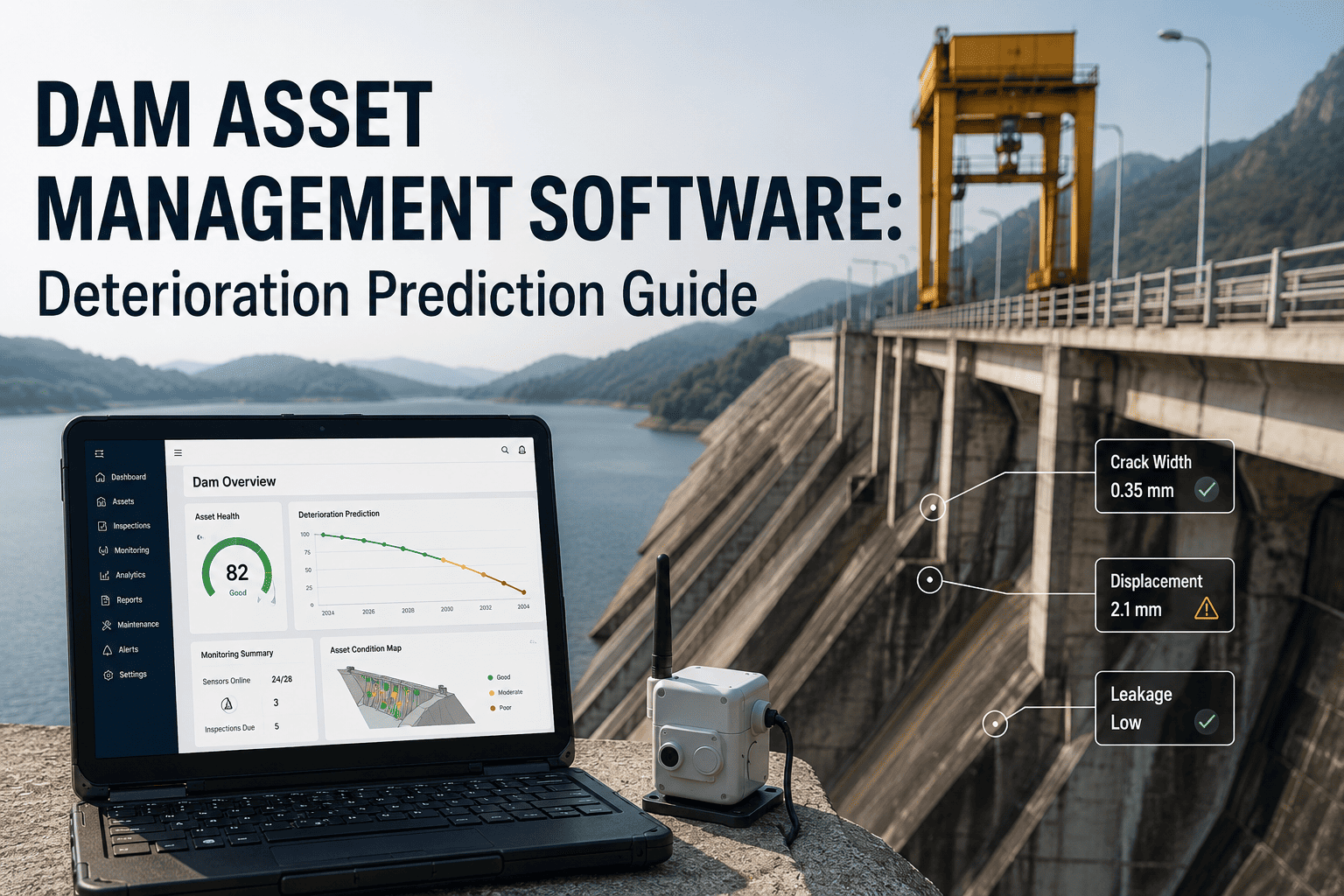
Every dam in the United States is getting older, and a periodic inspection report alone can no longer tell an owner how much time a structure has left before deterioration turns into a safety concern. The National Inventory of Dams lists more than 92,000 structures with an average age of 65 years, and close to 17,000 are rated high-hazard potential, meaning a failure could threaten lives downstream. USACE and the Bureau of Reclamation have spent decades building condition indexing and risk classification systems to answer exactly that question, and dam owners of every size are now adopting the same discipline through dedicated asset management software. This guide walks through how deterioration prediction actually works, what the federal agencies already measure, and what a modern platform needs to deliver — see it applied to a real structure when you start a free trial.
The State of America's Dams, By the Numbers
Dam deterioration is not a hypothetical risk sitting somewhere in a future budget cycle — it is a measurable, worsening trend documented across every major infrastructure assessment of the last decade. The figures below explain why condition scoring, risk categorization, and lifecycle cost forecasting have moved from a nice-to-have to a required discipline for anyone responsible for a dam.
From Reactive Inspection to Predictive Asset Management
For most of the last century, dam safety meant a periodic inspection, a written report, and a maintenance list that competed against every other capital priority for funding. That model catches problems only after they surface — which is exactly the gap that periodic risk reviews performed by Reclamation, USACE, the Bureau of Indian Affairs, the National Park Service, and the Tennessee Valley Authority were built to close, evaluating failure modes and their likelihood before a visible defect ever appears. USACE guidance is explicit that some critical flaws in design, construction, or deterioration are not visible during a standard condition inspection at all, which is why the agency also runs formal Operational Condition Assessments that assign a letter-grade rating to individual components and require reassessment within twelve months whenever a rating drops below a C-.
Reclamation has pushed the same logic further with concrete deterioration modeling — research aimed at predicting how a structure's material properties change over time so engineers can estimate failure likelihood years in advance instead of reacting to a crack once it appears. Dam asset management software brings that same forward-looking model down to the CMMS level: instead of one point-in-time inspection score, the system tracks condition trend, risk category, and criticality together, then projects when each asset is likely to cross a threshold that requires action.
The Four Scores Behind Every Deterioration Forecast
Federal dam safety programs never rely on a single number to describe a structure's health. Condition, risk, criticality, and lifecycle cost each answer a different question, and a dam asset management platform has to calculate and connect all four before a forecast becomes something a team can actually act on.
Score Your Dam Portfolio's Condition, Risk, and Lifecycle Cost
Reading about condition indexing and risk categorization is one thing — watching it run against your dam's actual gates, spillway, and embankment components is another. Oxmaint's asset management tools let you build a condition score, risk category, and lifecycle cost forecast for a real structure in a single working session, with no spreadsheet rebuild required.
How USACE and Reclamation Already Score Condition and Risk
Any dam asset management platform serious about deterioration prediction has to speak the same language as the agencies that pioneered this discipline. The table below summarizes the core rating systems referenced throughout USACE and Reclamation dam safety policy.
| Program | Owning Agency | What It Measures | What It Triggers |
|---|---|---|---|
| Condition Index (CI) | USACE Civil Works | Physical deterioration and functional performance of a structure or component | Prioritizes O&M spending across a portfolio of structures |
| Operational Condition Assessment | USACE Civil Works | A component's current ability to perform its designed function | Reassessment required within 12 months of a sub-C- rating or repair |
| Dam Safety Action Classification | USACE Dam Safety Program | Overall risk category from a periodic risk review | Sets urgency for risk reduction studies and interim measures |
| Dam Safety Priority Rating | Bureau of Reclamation | Risk-based prioritization across Reclamation's portfolio | Directs dam safety modification funding decisions |
Reference basis: USACE EP 1130-2-553 and EC 11-2-218 on Operational Condition Assessments, USACE ER 1110-2-1156 on the Dam Safety Program, and the joint federal risk category framework used across Reclamation, USACE, BIA, NPS, and TVA periodic risk reviews.
How a Deterioration Forecast Actually Gets Built
Turning an inspection walk into a usable forecast is a repeatable process inside a properly configured dam asset management platform — five steps that connect field data to a capital decision.
What a Dam Asset Management Platform Needs to Deliver
Not every CMMS built for buildings or vehicle fleets translates cleanly to dam infrastructure. Confirm these six capabilities before your program depends on one.
What's at Stake in the Numbers
Frequently Asked Questions
What is the difference between a Condition Index and a risk classification like DSAC or DSPR?
Can a CMMS actually predict dam deterioration, or only record inspection history?
Do USACE and Reclamation use the same rating scale?
How often should condition data be updated for the forecast to stay accurate?
What does it cost to skip predictive asset management for a dam portfolio?
Bring USACE-Grade Condition Scoring to Your Own Portfolio
Oxmaint's asset management tools give dam owners the same condition indexing, risk categorization, and lifecycle cost forecasting discipline USACE and Reclamation built their programs around, without months of custom configuration. Walk through your own component hierarchy, risk framework, and inspection workflow in a live session with our team.