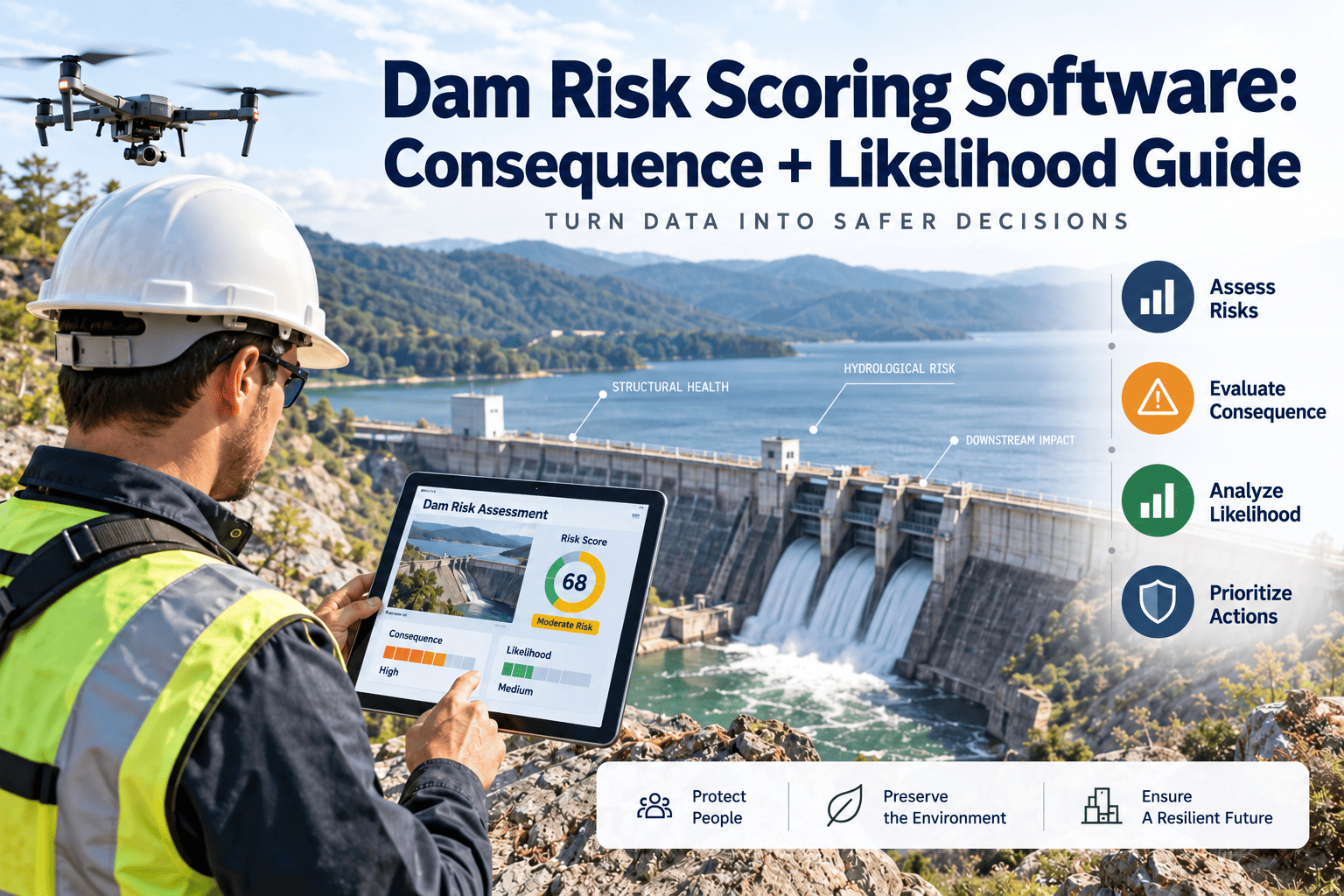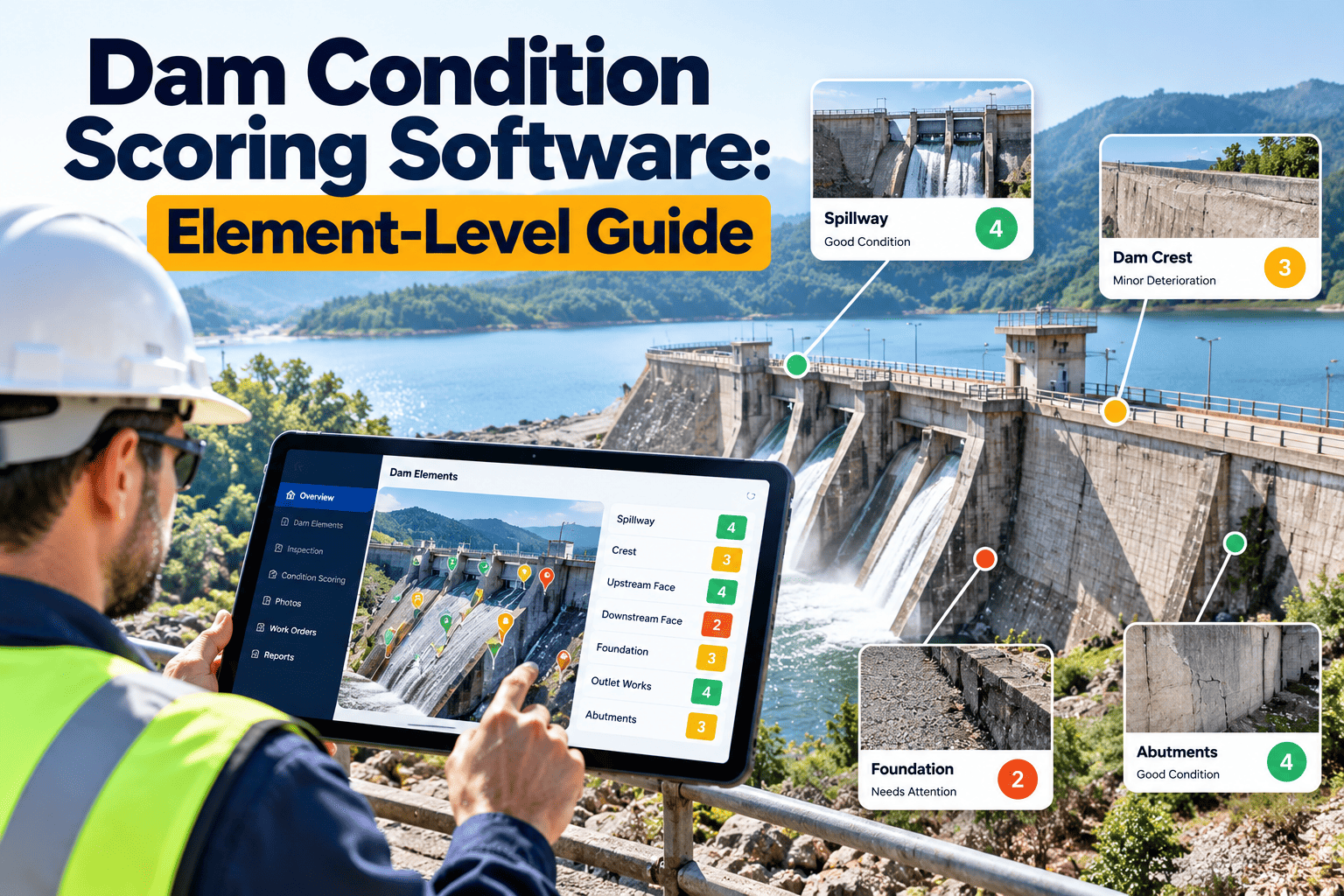
A dam is not one asset. It is an embankment, a spillway, a set of gates, an outlet works, and an instrumentation system, each aging in its own way. A single overall rating hides which part is slipping. This guide explains element-level condition scoring for dams and how dam condition scoring software supports the inspection discipline that USACE-style dam safety programs expect, using a maintenance system such as Oxmaint's CMMS as the working record.
Dam Condition Scoring Software: Element-Level Guide
Score the embankment, spillway, gates, and outlet works separately, keep the evidence beside each score, and turn deficiencies into tracked work.
- Crest and slopes
- Toe and abutments
- Seepage areas
- Approach and crest
- Chute and joints
- Stilling basin
- Gate leaf and seals
- Hoists and cables
- Controls and power
- Intake and conduit
- Valves and controls
- Energy dissipation
Why Element-Level Scoring Beats One Overall Grade
A dam that is rated satisfactory overall can still have a gate with a failing hoist or an outlet conduit with a serious defect. Scoring each element exposes those hidden weak points before they become incidents.
One overall rating
- Strong elements mask weak ones
- Maintenance priorities are unclear
- Changes between inspections are hard to see
- Budget requests lack specific evidence
Element-level scores
- Each element carries its own condition and evidence
- Deficiencies map to specific work orders
- Year-over-year change is visible by component
- Funding requests cite the exact element at risk
The Condition Language Dam Programs Already Use
The National Inventory of Dams records a condition assessment for each dam as satisfactory, fair, poor, unsatisfactory, or not rated. USACE also uses Dam Safety Action Classification (DSAC) levels from I to V to express urgency across its portfolio.
Dam-level classifications and element-level scores are different things. Element scores explain why a dam sits where it does, and they give maintenance teams something concrete to fix.
Building an Element Scorecard
Your own program defines the scale, but the structure is consistent. Each element has a defined set of observations, a score, and a required follow-up.
| Element | What inspectors look for | Evidence to attach |
|---|---|---|
| Embankment | Cracking, settlement, slides, erosion, animal burrows, tree growth, seepage, slope protection condition | Photos, locations, survey references, seepage notes |
| Spillway | Concrete deterioration, joint and drain condition, erosion downstream, debris, training wall movement, stilling basin damage | Photos, crack maps, flow path notes |
| Gates | Corrosion, seal leakage, trunnion and pin wear, wire rope condition, hoist function, operation test results, standby power | Operation test records, lubrication logs, photos |
| Outlet works | Intake blockage, conduit condition, joint leakage, valve operation, downstream erosion, control system function | Operation tests, camera inspection results, photos |
| Instrumentation | Weirs, piezometers, survey monuments, and loggers working and readable | Reading history, calibration and repair records |
A Score Is a Claim That Needs Evidence
A condition score without supporting information is just an opinion. The strongest programs make evidence a required part of scoring.
- Every score above a defined threshold requires at least one photo
- Every deficiency has a location, extent, and date first observed
- Every score change from the prior inspection requires a short explanation
- Every deficiency is linked to a work order, a monitoring action, or an engineering review
- Every score is signed by the inspector and reviewed by a responsible engineer
Score Every Dam Element With Evidence Behind It
Bring embankment, spillway, gate, and outlet works condition into one record that links scores to photos, deficiencies, and completed work.
Embankment: Slow Change, High Consequence
Embankment problems rarely announce themselves. Cracks, settlement, and seepage evolve over seasons, so repeat observations at the same locations are the most useful data.
- Fix reference locations for photos and measurements so each visit is comparable.
- Record vegetation, burrows, and erosion on slopes, since they can hide or create seepage paths.
- Link seepage observations to weir readings and piezometer data in the same dam record.
- Track crest and slope survey data against known benchmarks.
- Escalate cracking, sinkholes, or slides to engineering review rather than treating them as routine maintenance.
Spillway: Capacity You Cannot Test in Advance
The spillway must work during the rare event that matters most. Its condition affects whether flood flows pass safely or damage the dam.
Structural concerns
- Cracking and spalling in concrete
- Failed joints and water stops
- Undermining below slabs
- Movement of training walls
Hydraulic concerns
- Debris or vegetation in approach channels
- Erosion in unlined sections
- Stilling basin damage
- Blocked drains and relief systems
Gates: Condition Is Also Reliability
Gates are mechanical equipment, so their condition is not just visual. A gate that looks fine but fails to open under load is a dam safety deficiency.
| Gate component | Typical checks | Maintenance link |
|---|---|---|
| Gate leaf and seals | Corrosion, coating loss, seal leakage, deformation | Painting, seal replacement, repair work orders |
| Trunnions and pins | Wear, lubrication, binding | Scheduled lubrication, inspection, replacement |
| Hoists and cables | Wire rope wear, brake function, gearbox condition | Preventive inspections, load or function tests |
| Controls and power | Control response, limit switches, standby generator test | Electrical checks, generator exercise logs |
Operation tests belong in the same record as condition scores. A gate scored acceptable without a recent documented test is a weaker claim than it looks.
Outlet Works: Hidden Components, Real Consequences
Outlet conduits often run through or beneath the embankment, which makes their condition especially important. Defects in a conduit can allow water to move along or into the fill.
- Record intake structure condition and debris accumulation
- Store conduit inspection results, including camera surveys when performed
- Track joint leakage, cracking, and corrosion by location along the conduit
- Document valve exercise and operation tests with dates and outcomes
- Note downstream erosion and stilling basin condition at the outlet
The Inspection Cycle That Feeds the Score
Condition scores come from a rhythm of inspections, not a single event. Organize the cycle so each type of inspection feeds the same record.
From Score to Work: Closing the Loop
The most common failure in dam condition programs is not a missed deficiency. It is a recorded deficiency that never turns into action.
What Oxmaint Provides for Dam Condition Programs
Oxmaint is a maintenance management system. It supports condition programs by organizing assets, inspections, and follow-up work, while engineers retain control of scoring criteria and decisions.
| Capability | Dam use |
|---|---|
| Asset management | Dam, element, and component hierarchy with condition history |
| Inspections | Mobile scorecards with required photos, notes, and locations |
| Preventive maintenance | Gate lubrication, valve exercise, spillway clearing, and instrument checks |
| Work orders | Deficiency repairs with cost, labor, and closure evidence |
| Inventory | Seals, cables, lubricants, and other critical spares |
| Reporting | Condition trends, overdue items, and inspection packages |
Reporting for Portfolio Owners
Agencies and utilities with many dams need to compare conditions and direct limited funds. Element-level data makes that comparison fair.
An Illustrative Element Scoring Scale
Programs define their own scales and criteria. This example shows how a simple five-level scale can tie each score to a required response.
| Score | Meaning | Typical required response |
|---|---|---|
| 1 Good | No significant deficiencies; element performs as designed | Routine inspection and preventive maintenance |
| 2 Satisfactory | Minor deficiencies that do not affect performance | Monitor and plan routine repair |
| 3 Fair | Deficiencies that may affect performance if unaddressed | Scheduled corrective work and closer monitoring |
| 4 Poor | Significant deficiencies affecting performance or reliability | Engineer review and prioritized repair |
| 5 Critical | Deficiency that threatens safe operation of the dam | Immediate engineering response and notification as required |
Why Condition Programs Stall
Aging infrastructure, limited budgets, and staff turnover make element-level programs difficult to sustain. Knowing the common stall points helps you design around them.
Where programs stall
- Scoring criteria interpreted differently by each inspector
- Reports written as documents, not structured data
- Deficiencies listed but never assigned
- Gate and valve tests tracked separately from condition
- History lost when staff change roles
How structure helps
- Pick lists and criteria keep scoring consistent
- Data fields allow trend and comparison reporting
- Every deficiency opens a task with an owner
- Tests and scores share one asset history
- Records stay with the dam, not the person
Connecting Condition to Instrumentation
Visual condition and instrument readings should reinforce each other. When both point the same way, confidence rises. When they disagree, that disagreement deserves attention.
- A wet area noted on the embankment is cross-checked against nearby weir and piezometer data
- A spillway drain flow change is compared with reservoir level and recent rainfall
- A gate leakage observation is compared with outlet flow records
- Survey monument movement is reviewed alongside cracking or settlement observations
Preparing for the Big Inspection
Periodic inspections and external reviews go faster when the record is already organized. Prepare continuously instead of scrambling in the weeks before.
Roles in an Element-Level Program
Clear responsibilities keep scoring consistent. Software supports the handoffs, but people make the judgments.
Operators and inspectors
- Capture observations and photos
- Perform operation tests
- Propose initial scores
Dam safety engineers
- Set scoring criteria
- Review and approve scores
- Define urgency and response
Maintenance and management
- Complete corrective work
- Manage spares and budgets
- Report portfolio status
Data Governance Checklist
A condition record is only valuable if people trust it. A few rules protect that trust over many years.
- Lock scoring criteria and version them when policy changes
- Require reviewer approval before scores become official
- Preserve prior inspection data without overwriting it
- Control who can edit asset hierarchies and element definitions
- Back up records and keep a defined retention period
Trends Shaping Dam Condition Assessment
Drone imagery, remote sensing, and improved instrumentation give inspectors better views of hard-to-reach elements. Climate-driven changes in flood patterns also raise the importance of spillway and outlet works reliability.
Common Deficiencies and Where They Belong in the Record
Naming deficiencies consistently makes trends searchable across dams. Use a controlled list instead of free text wherever possible.
| Deficiency | Element | Usual follow-up |
|---|---|---|
| Longitudinal or transverse cracking | Embankment crest | Mapping, monitoring, engineer review |
| Animal burrows and tree roots | Embankment slopes | Removal plan and repair work order |
| Spalled or cracked concrete | Spillway chute or walls | Repair scope and scheduled work |
| Seal leakage or corrosion | Gate leaf | Seal replacement, coating, operation test |
| Wire rope wear or broken strands | Gate hoist | Inspection, replacement, test after repair |
| Joint leakage or cracking | Outlet conduit | Camera inspection and engineering assessment |
Budget Conversations Backed by Element Data
Owners must justify spending on assets that seem fine until they fail. Element-level data turns a vague request into a specific one.
The bars illustrate one way to order spending and are not measured data. Your engineers decide the real order using condition, consequence, and risk.
Getting Started Without Rebuilding Everything
You do not need a full portfolio rollout to benefit. Pick one dam and prove the workflow.
- Create the dam with its four main elements and instrumentation.
- Load the most recent inspection findings as the baseline scores.
- Convert open deficiencies into work orders or monitoring tasks.
- Set preventive tasks for gate operation, lubrication, and drain checks.
- Run the next inspection on the mobile scorecard and compare it with the baseline.
Frequently Asked Questions
What is element-level dam scoring?
Does it replace the dam safety inspection?
Who sets the scoring scale?
How do gate tests fit in?
Can we start with a single dam?
Turn Dam Condition Scores Into Documented Action
Keep element scores, evidence, and follow-up work in one record, and show exactly how each dam component is being managed.