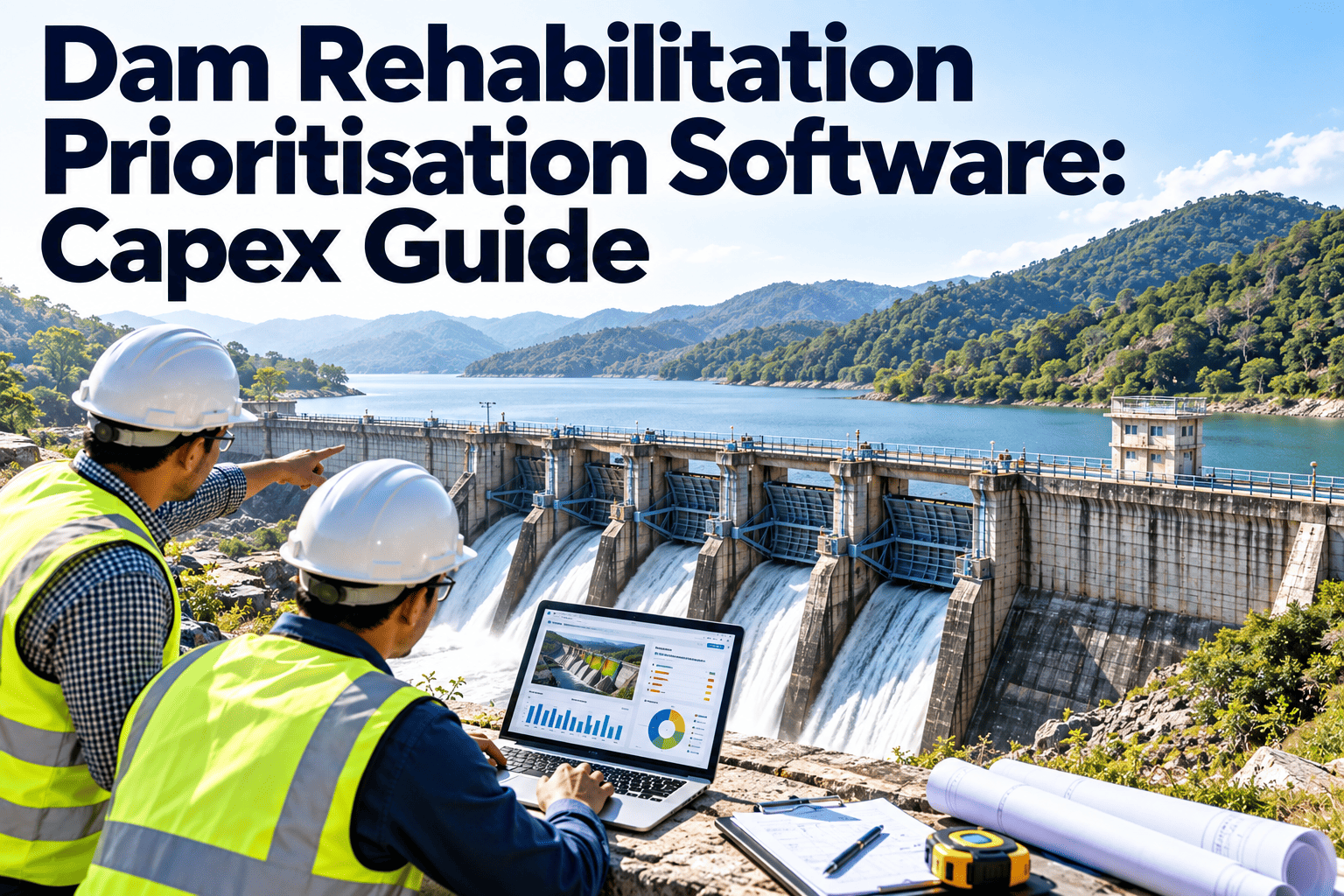
Dam owners rarely lack rehabilitation needs. They lack a defensible order in which to fund them. Embankment seepage, spillway concrete deterioration, gate and hoist wear, and ageing outlet works all compete for the same limited capital budget. When priorities live in inspection reports, engineering memos, and spreadsheets, decisions drift toward whoever argues loudest. A capex-aware maintenance system such as Oxmaint CMMS keeps findings, condition history, and costs together so rehabilitation can be sequenced by risk instead of habit.
Dam Rehabilitation Prioritisation Software
Rank embankment, spillway, gate, and outlet works rehabilitation by risk, condition, and consequence, then carry each decision from inspection finding to funded work order.
Why dam rehabilitation priorities go wrong
What usually drives the list
- The most recent inspection finding, not the most serious one
- Components that already have a design package ready
- Budget cycles that favour small, easy projects
- Institutional memory held by one or two engineers
What should drive the list
- Likelihood of a credible failure mode progressing
- Consequence to downstream population and infrastructure
- Rate of deterioration shown in monitoring trends
- Cost of deferral versus cost of intervention today
The long-range capital problem
Dams are long-lived assets, so rehabilitation is planned over decades while budgets are approved yearly. Without a structured register, a deferred spillway repair reappears as an emergency years later, often at a much higher cost.
A risk-informed way to rank rehabilitation
Modern dam safety practice, including guidance from FEMA, USACE, and ICOLD, favours risk-informed decisions built on potential failure modes, condition, and consequence. The matrix below shows how a simple likelihood and consequence view can group work into funding tiers.
| Likelihood / Consequence | Low consequence | Moderate consequence | High consequence |
|---|---|---|---|
| Likely to progress | Plan within 3 years | Fund next cycle | Immediate action |
| Possible | Monitor and inspect | Plan within 3 years | Fund next cycle |
| Unlikely | Monitor and inspect | Monitor and inspect | Plan within 3 years |
Turning the matrix into a working register
- Log each deficiency against the specific dam component
- Attach the failure mode it relates to and the evidence behind it
- Record a cost estimate and the year it is proposed for
- Re-score whenever an inspection or instrument reading changes
Component-by-component rehabilitation drivers
Seepage, piping, and slope stability
Embankment rehabilitation is often driven by increasing seepage, new wet areas, cloudy drain discharge, settlement, or cracking. Piezometer and weir readings matter most when read as trends, not single values.
Capacity, concrete, and erosion resistance
Spillway work may be triggered by updated hydrology, cracked or spalled chute slabs, failed joints, drain problems, or scour risk at the toe. Changes in design flood estimates can raise priority even when the structure looks unchanged.
Reliability of operation when it counts
Gate rehabilitation focuses on corrosion, seal condition, hoist and motor wear, wire ropes, control systems, and backup power. A gate that cannot open on demand is a safety issue, not only a maintenance issue.
Conduits, valves, and controlled release
Outlet works need attention for conduit joint leakage, valve operability, corrosion, and cavitation damage. They are also the main tool for lowering the reservoir in an emergency, which raises their priority.
From inspection finding to funded project
Capture
Field staff record findings with photos and location on mobile.
Classify
Engineers tag the component, failure mode, and severity.
Score
Risk score and cost estimate are attached to each item.
Sequence
Items are grouped into annual and multi-year capital plans.
Deliver
Approved projects become work orders with tracked completion.
Where the flow usually breaks
- Findings sit in a report appendix and never reach a register
- Cost estimates are not updated after scope changes
- Completed work is not linked back to the original deficiency
Give every rehabilitation decision a clear record
Set up a deficiency register, risk scoring, and capex plan for your dams in Oxmaint.
Where dam rehabilitation CMMS software fits
A CMMS does not replace engineering judgement or a formal risk analysis. It gives that judgement a reliable data foundation and keeps decisions traceable over many years.
| Rehabilitation need | Oxmaint capability | Result |
|---|---|---|
| Track condition by component | Asset management with a dam component hierarchy | History stays with the embankment, spillway, gate, or outlet |
| Capture routine findings | Mobile inspections and checklists | Consistent evidence from every dam inspection |
| Deliver approved repairs | Corrective work orders and scheduling | Funded projects tracked to completion |
| Reduce gate failures | Preventive maintenance for hoists, seals, and controls | Fewer surprises during operation |
| Support reviews and audits | Compliance records and reporting | Documented actions for regulators and boards |
| Plan parts and materials | Inventory management | Critical spares identified before outages |
Preventive maintenance is the cheapest rehabilitation
Deferred and reactive
- Minor joint leakage grows into structural repair
- Drain blockages hide rising pore pressure
- Gate corrosion is found during an emergency operation
- Capital requests arrive as urgent exceptions
Planned and condition-based
- Drains cleared and tested on a fixed schedule
- Instrument trends reviewed against action levels
- Gates exercised and lubricated with recorded results
- Capital requests supported by documented history
Condition-based workflows
Where piezometer, seepage weir, or reservoir level data is available, teams can review readings against thresholds and raise inspection work orders when trends change. This supports earlier intervention without claiming automatic failure prediction.
KPIs that keep the capital plan honest
Open deficiencies by risk tier
Shows whether high-risk items are shrinking.
Age of unresolved findings
Reveals items quietly deferred year after year.
Planned versus actual capex
Tests whether estimates are realistic.
Gate exercise completion
Confirms operability checks are actually done.
Instrument review compliance
Ensures monitoring data is read on time.
Emergency versus planned work
A falling ratio suggests planning is working.
Compliance and documentation expectations
Requirements vary by country and state, but regulators generally expect periodic inspections, dam safety evaluations, emergency action plans, and evidence that identified deficiencies are being addressed.
Routine
Frequent visual checks, instrument readings, and operational tests.
Periodic
Formal inspections and engineer-led reviews of condition and performance.
Long range
Comprehensive safety evaluations that feed multi-year rehabilitation plans.
Records worth keeping together
- Inspection reports linked to the deficiencies they created
- Decisions on deferral, including who approved them and why
- Completion evidence such as photos, test results, and sign-off
Prioritisation checklist for your next capital cycle
Dam rehabilitation prioritisation FAQs
How do you prioritise dam rehabilitation projects?
Rank items by failure mode likelihood, downstream consequence, and deterioration trend, then sequence them against budget.
Can a CMMS support dam capex planning?
Yes. A CMMS such as Oxmaint stores deficiencies, costs, and history that feed the capital plan.
Does software replace engineering judgement?
No. It organises evidence so engineers and owners can decide consistently and document why.
What should be tracked for gates and outlet works?
Exercise results, seal and hoist condition, corrosion, and backup power tests, all tied to preventive tasks.
Can it handle several dams?
Yes. You can compare risk and capex across a portfolio; book a walkthrough to see it.
Sequence your dam rehabilitation with confidence
Bring inspections, risk, and capital planning into one maintenance system built for long-lived assets.