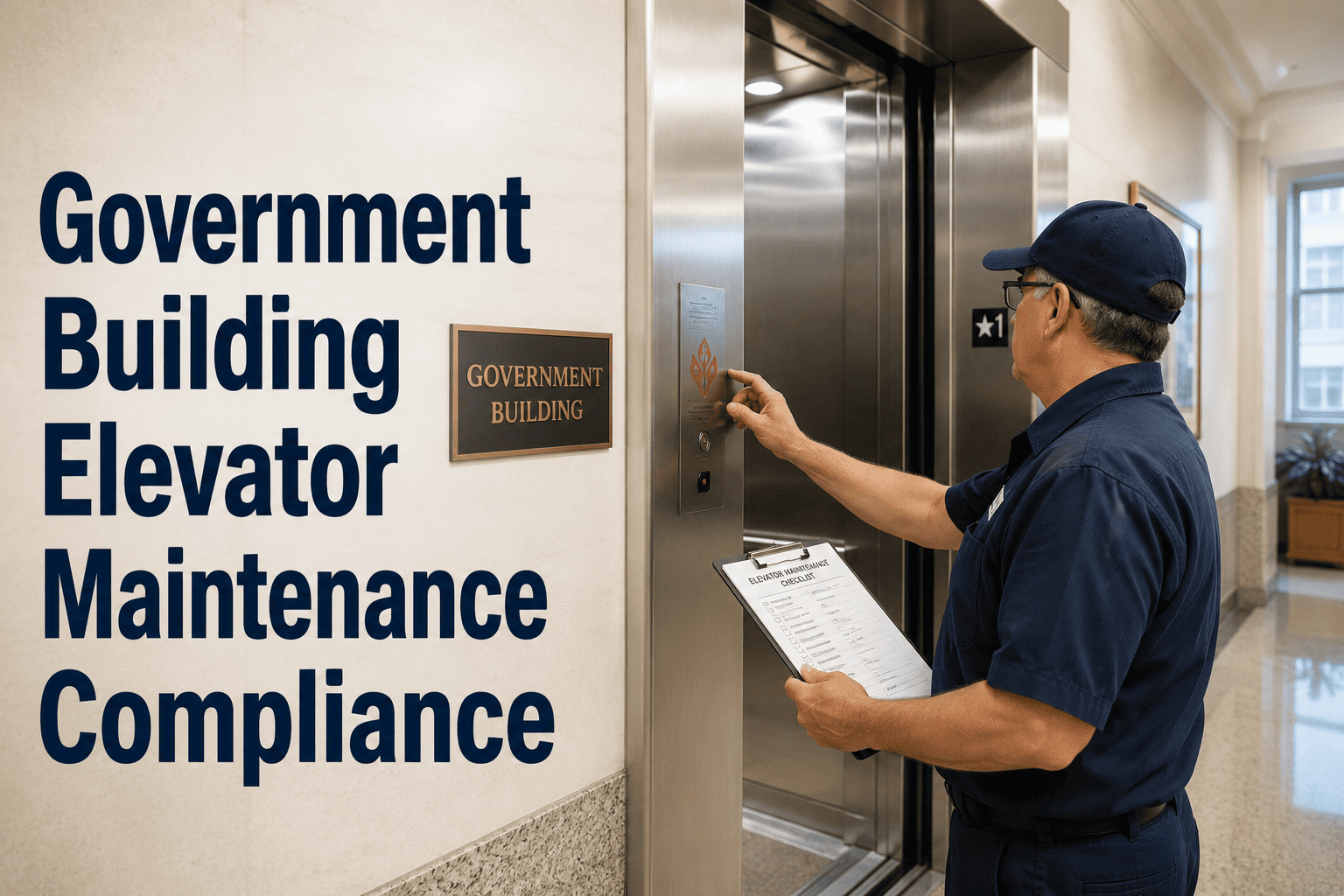
Government buildings across the United States operate an estimated 900,000 elevator and escalator units in public-access facilities — courthouses, municipal offices, transit hubs, libraries, and schools — the majority installed between 1960 and 1990, now subject to simultaneous oversight by state elevator safety boards, OSHA General Duty requirements, and ADA Title II accessibility mandates. State elevator boards issue stop-operation orders on units with expired inspection certificates, regardless of whether they are government-owned. Without a structured compliance program, facility managers replace reactive emergency calls with regulatory enforcement actions, ADA complaints, and premises liability exposure in the event of passenger injury. Schedule a demo to see how Oxmaint structures elevator compliance calendars, certification tracking, and vendor management for government facility portfolios.
Government building elevator and escalator compliance maintenance requires annual third-party QEI inspections, 5-year full-load safety tests, monthly documented PM visits, ADA Title II program accessibility management, certified vendor oversight, and centralized certificate tracking across all units in the facility portfolio — using a compliance calendar rather than paper-based certificate management to eliminate the documentation gaps that trigger state elevator board enforcement actions and ADA complaints.
Why Government Elevator Compliance Requires a Dedicated Program
Unlike commercial building owners who manage elevator liability under a single regulatory framework, government entities face three simultaneous compliance obligations: state elevator board jurisdiction (inspection certificates and safety code), OSHA General Duty (machine room and pit worker safety), and ADA Title II (continuous program accessibility for persons with disabilities). A single unit going out of service without an ADA accommodation plan constitutes a program accessibility violation — independent of the maintenance reason. See how Oxmaint structures preventive maintenance programs across all government building mechanical systems including HVAC.
Every state operates an elevator safety board with statutory authority to issue stop-operation orders on units with expired inspection certificates or unresolved safety deficiencies. Government buildings are not exempt — and in most states face heightened scrutiny as high-occupancy public-use facilities. Missed annual inspection windows result in mandatory out-of-service orders, triggering immediate ADA program accessibility obligations for every floor the unit serves.
Municipal portfolios operating 10 to 200+ elevator units typically manage inspection certificates across three to eight different elevator service contractors, filed by individual building managers rather than tracked centrally. When a state inspector requests current certificates across the portfolio, the documentation gap is exposed — triggering a full portfolio audit. See how Oxmaint structures contractor credential management across all government facility maintenance trades.
Under ADA Title II, government entities must ensure that programs, services, and activities remain accessible even when facilities are under maintenance. See how elevator fire recall requirements integrate with government building fire safety maintenance programs.
Government elevator PM budgets are routinely deferred in constrained fiscal years. ASME A17.1 requires documented PM at intervals based on equipment type and usage — and facilities skipping two consecutive annual PM cycles on high-traffic public elevators accumulate wear on safety components (safeties, buffers, interlocks) that creates not just code violations but actuarial liability in a passenger incident. Undocumented PM creates negligence exposure in personal injury claims regardless of actual equipment condition. Review emergency preparedness requirements for backup power systems supporting elevator operations during utility outages.
Centralize Elevator Compliance Across Your Government Facility Portfolio
Oxmaint's Elevator Compliance Calendar tracks certification expiry, inspection schedules, contractor assignments, and ADA accommodation plans across every unit in your municipal portfolio — visible in a single compliance dashboard.
The Government Elevator Compliance Framework: Five Core Components
A complete government elevator and escalator compliance program addresses five interdependent components — from unit inventory through capital modernization planning. All five are required to satisfy state elevator board inspections, ADA enforcement reviews, and OSHA General Duty compliance simultaneously.
A complete inventory of every elevator, escalator, dumbwaiter, and platform lift — including unit ID, state equipment registration number, installation year, manufacturer, controller type, last modernization date, maintenance contract assignment, and ADA compliance status. Oxmaint structures the registry at six levels (Portfolio → Department → Facility → System → Asset → Component) matching how government entities report to elected officials. GIS integration without a linked work order system omits the operational data that makes condition scoring and certificate currency tracking possible.
A rolling compliance calendar tracking all mandatory inspection intervals per unit — annual QEI periodic inspection, 5-year full-load safety test, monthly PM visits, quarterly escalator checks, and state-specific supplemental tests — with automated 90, 60, and 30-day expiry alerts to facility managers and portfolio directors. Inspection certificates are stored digitally per unit with expiry dates, QEI inspector credentials, and deficiency report attachments. Certificate currency rate targets 100% — any gap triggers immediate escalation in Oxmaint's compliance dashboard. Schedule a demo to see how Oxmaint configures compliance calendars for your state elevator board jurisdiction.
Structured PM templates for monthly elevator service visits and quarterly escalator inspections — capturing all ASME A17.1 Appendix N items with photo documentation, GPS check-in, and licensed mechanic digital signature. Every PM visit creates a permanent record linked to the originating work order. Monthly emergency phone tests log call-completion evidence per cab — satisfying both ASME A17.1 and ADA communication accessibility requirements in a single documented workflow. When a PM work order closes in Oxmaint, the unit condition record updates automatically. See the complete OSHA compliance maintenance framework covering machine room and pit safety requirements.
ADA accommodation plan generation for planned outages, accessibility compliance status tracking per unit, accessible route impact assessment when units go out of service, and public notification documentation — satisfying Title II requirements during all maintenance windows. Oxmaint auto-generates an ADA impact checklist when a government elevator work order is created as an emergency, prompting the facility manager through the accommodation documentation workflow before work proceeds. Outage records include alternative accommodation provided, duration, and ADA coordinator sign-off. Elevator modernization projects also trigger asbestos and lead paint survey requirements in pre-1980 government buildings.
Centralized contractor registry tracking elevator service vendor license status, insurance certificates, contract coverage scope, response time SLA compliance, and work order history per unit and per vendor. Capital modernization planning converts unit condition scores and maintenance history into 5 and 10-year replacement forecasts with controller, cab, and hydraulic component age tracking — formatted for council CIP submissions. Oxmaint's CIP dashboard produces the asset condition documentation required for GSA, CDBG, and state capital grant applications. Facilities using condition-backed modernization requests report a 340% improvement in capital approval rates versus age-estimate submissions.
Mandatory Inspection and Testing Requirements Under ASME A17.1
ASME A17.1 (Safety Code for Elevators and Escalators) establishes minimum inspection and testing intervals adopted by all 50 states. Government facilities must track each inspection type as a distinct compliance event with its own documentation trail — a single certificate covers the annual periodic inspection only; the 5-year load test, monthly PM visits, and quarterly escalator checks each require separate documented records.
Performed by a state-licensed QEI inspector. Covers safety devices, machine room, car, hoistway, pit, and control systems. Output is a posted inspection certificate plus a deficiency report. Missing this inspection triggers a mandatory stop-operation order — government buildings are not exempt.
Performed by a licensed elevator mechanic with QEI witness. Tests governor/safety, buffers, emergency stop, and counterweight safeties at full rated load. Witnessed test report filed with the state elevator board. Major liability exposure if missed and a passenger safety incident occurs during the gap period.
Performed by a licensed elevator contractor under a full maintenance contract. Covers lubrication, door operation, leveling, lighting, emergency phone test with call-completion evidence, and cab condition per ASME A17.1 Appendix N. Undocumented PM creates negligence exposure in personal injury claims regardless of actual equipment condition.
Performed by a licensed escalator mechanic under a PM contract. Covers step chain tension, comb plates, handrail speed differential, safety device tests, cleating, and lighting per ASME A17.1 Part 6. Escalator falls are the highest-liability incident type in public buildings — quarterly documented checks are the minimum defensible PM frequency for high-traffic government facilities.
Government building elevators must have ASME A17.1 Phase I (lobby recall on smoke detection) and Phase II (firefighter in-car manual control) tested annually as part of the fire service key switch test program. Annual inspection must include a witnessed fire service test with documented pass/fail per NFPA 72 requirements. See how Oxmaint integrates elevator fire recall testing into the government building fire safety maintenance program.
Every elevator cab must have a two-way emergency communication system tested monthly — ASME A17.1 requires it, and ADA requires the system be usable by persons with hearing disabilities. A single undocumented monthly test creates both an ASME code violation and an ADA communication accessibility gap. Oxmaint logs call-completion evidence per test event against the unit record.
Reactive vs. Planned Elevator Intervention: Government Cost Analysis
The financial case for structured elevator compliance is built on the cost differential between planned interventions and emergency failures — compounded by the regulatory and liability penalties that government entities face beyond private building owners. Benchmarks from ASME, NAEC, and GSA facility management studies.
| Unit / Intervention | Condition | Planned Intervention Cost | Emergency Failure Cost |
|---|---|---|---|
| Hydraulic elevator motor — aging insulation | Fair — declining motor insulation resistance, elevated temperature readings | $8,500 planned motor replacement in scheduled 8-hour outage with ADA accommodation plan filed | $38,000–$65,000 emergency contractor call-out premium + passenger rescue + fire department response + regulatory incident report + ADA complaint response + extended out-of-service period |
| Escalator step chain — high-traffic government lobby | Poor — elongation above ASME A17.1 tolerance, comb plate contact detected | $12,000 planned step chain replacement in scheduled overnight outage window | $55,000–$120,000 for passenger fall event including emergency response, regulatory notification, personal injury claim defense, and ASME incident investigation |
| Elevator controller — aging solid-state relay | Fair — intermittent door hold faults logged over 6 months | $18,000 planned relay board replacement in coordination with service contractor | $42,000–$85,000 emergency replacement including unplanned entrapment rescue, emergency overtime, regulatory reporting, and ADA notification documentation |
| Platform lift — government court facility | High risk — annual inspection certificate expired, unit still operating | $3,500 inspection + $4,200 deficiency remediation in planned outage | $10,000–$75,000 in state elevator board fines per day + DOJ ADA enforcement action if unit failure results in program inaccessibility documented in a complaint |
| Cab modernization — pre-1980 government building | Poor — cab interior, lighting, and control panel below current ADA standards | $65,000–$120,000 planned cab modernization with ADA compliance upgrade and asbestos survey pre-work | ADA Title II enforcement action + consent agreement requiring full modernization on DOJ timeline + attorney fees + public notification costs — deferred programs face compounding penalty exposure annually. Pre-1980 elevator shaft work requires asbestos and lead paint surveys before modernization begins. |
Structure Your Elevator Compliance Program for State Elevator Board and ADA Audit Readiness
Oxmaint produces the certificate records, PM documentation, ADA accommodation plans, and vendor credential tracking that government elevator compliance audits require — built automatically from daily maintenance operations. Schedule a demo to see how Oxmaint structures compliance documentation for your state jurisdiction.
Oxmaint Platform Capabilities for Government Elevator Compliance
Each capability is purpose-built for the regulatory structures, ADA obligations, and capital planning workflows of government elevator programs — not adapted from generic commercial building CMMS tools.
Every elevator and escalator unit registered with all mandatory inspection intervals — annual QEI, 5-year load test, monthly PM, quarterly escalator check, and fire service recall test — tracked in a rolling compliance calendar with automated 90, 60, and 30-day alerts to facility managers and portfolio directors. Certificate currency rate displayed portfolio-wide in real time. State-specific inspection interval rules configurable per jurisdiction for multi-state government portfolios.
Inspection certificates stored digitally per unit with QEI inspector credentials, expiry dates, and deficiency report attachments — accessible to facility managers, ADA coordinators, and state inspectors on demand. Deficiency reports generate corrective work orders automatically with assignment to licensed contractor and close-out deadline. Deficiency close-out rate tracked per unit and per portfolio — facilities maintaining 90%+ close-out within 30 days satisfy state elevator board compliance scoring requirements.
Every elevator service contractor registered with license expiry dates, certificate of insurance expiry, contract coverage scope (full maintenance vs. oil and grease), and response time SLA commitments — tracked against actual work order response times per unit and per vendor.Facilities using the Vendor Management Portal report 60% reduction in contract compliance gaps identified at audit. See the complete contractor credential management framework for government facility maintenance programs.
Planned and emergency outage workflows generate ADA accommodation plans automatically — identifying affected accessible routes, required public notifications, alternative accommodation options, and ADA coordinator sign-off requirements before work proceeds. Outage records include actual vs. planned duration, accommodation provided, and public notification posting evidence. Emergency outage ADA checklists prompt facility managers through documentation requirements immediately upon work order creation. Government facilities using Oxmaint's ADA outage management module report zero unresolved ADA complaints related to elevator outages in their first compliance year. Elevator shaft modernization projects trigger asbestos and lead paint survey requirements managed through the same work order system.
KPI Benchmarks: What Good Government Elevator Compliance Looks Like
Frequently Asked Questions: Government Elevator and Escalator Compliance Maintenance
Continue Reading: Government Facility Safety and Compliance
Stop Tracking Elevator Certificates on Spreadsheets. Start Running a Defensible Compliance Program.
Oxmaint's Elevator Compliance Calendar, Certification Tracking, and Vendor Management Portal give government facility teams the infrastructure to manage every unit, every certificate, and every contractor relationship — portfolio-wide, audit-ready, and always current.