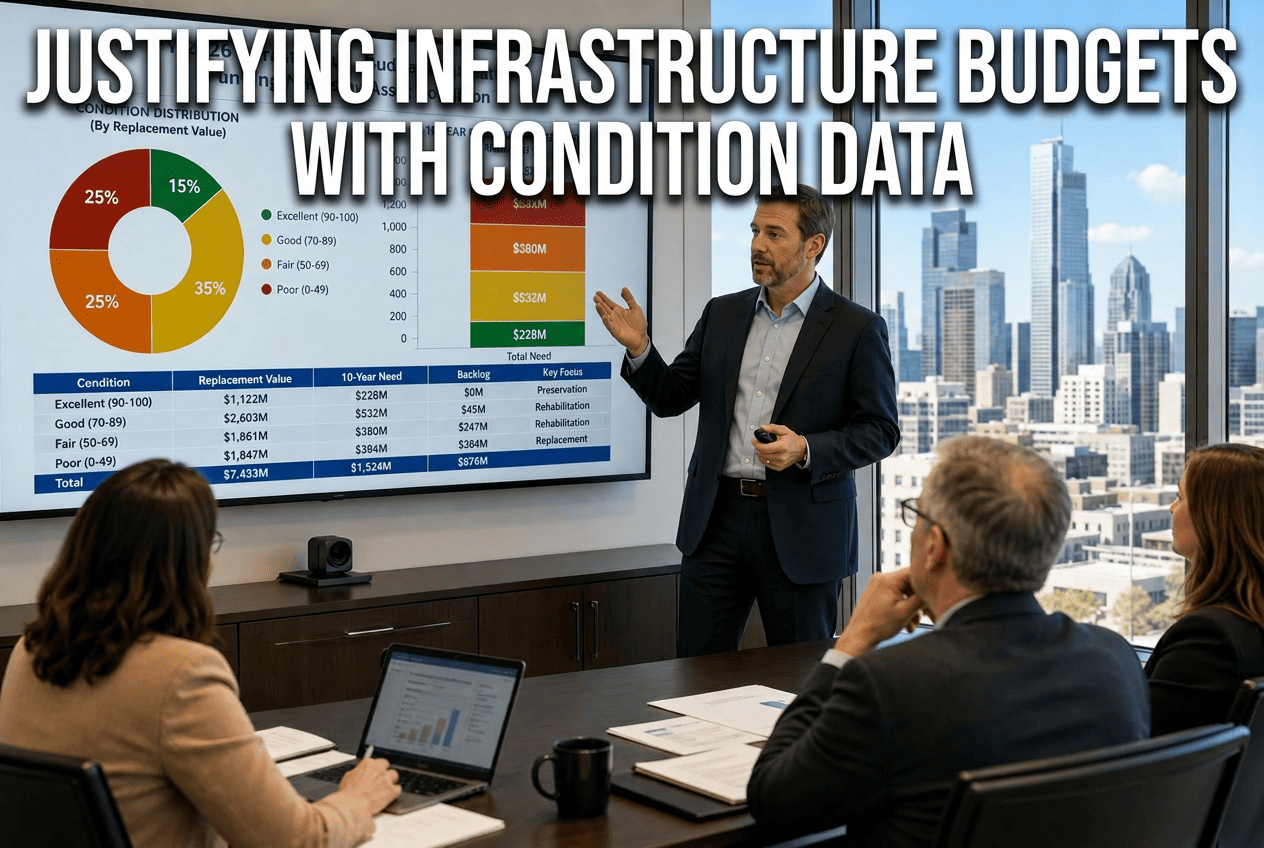
Estimates get cut; evidence gets funded. A budget request built on "roughly $2 million for road repair" competes for attention with requests from every other department, and it rarely wins. A request built on documented condition scores, a ranked project list, and a multi-year trend line reads differently to a council or CFO — it reads like a plan instead of a guess. Finance officers who manage infrastructure budgets already know this gap exists between what engineering teams need and what gets approved. What changes the outcome is not asking for more, it is asking with better evidence, and that evidence starts with consistent asset condition data your team can start tracking today.
Infrastructure Asset Management · Budget & Finance
Justifying Infrastructure Budgets With Condition Data
Councils and CFOs approve requests they can verify. Condition data turns "we need funding" into a ranked, documented case — showing exactly which assets are at risk, what happens if funding is delayed, and where every dollar goes.
3 yrs
recommended maximum interval for reporting asset condition to elected officials, per GFOA guidance
5-yr Plan
the multi-year capital plan format finance offices increasingly use to rank and justify requests
Ranked, Not Requested
the shift from a flat wish list to a scored, prioritized project list leadership can compare
Why Infrastructure Requests Get Cut First
01
The request states a dollar figure without showing the condition data behind it, so reviewers cannot tell urgent need from routine upkeep.
02
Every department submits a similar ask, and infrastructure competes against visible services without a way to prove relative risk.
03
Past requests were approved and the money was spent, but no report ever came back showing what the spending changed.
04
Projects are listed individually with no ranking, forcing the council to guess which one actually protects public safety first.
Record, Rank, Request: Turning Data Into a Funding Case
1
Record Condition
Log inspection results by asset, on a consistent scale, so every structure and system is comparable.
2
Rank by Risk
Score projects against shared criteria — condition, risk, cost, compliance — instead of submitting them individually.
3
Request With Evidence
Present the ranked list with condition trends attached, so leadership sees the case, not just the ask.
What a Council or CFO Actually Checks Before Approving
Current, Dated Condition Scores
A rating with a recent inspection date behind it, not a figure carried forward from years ago.
A Multi-Year Trend
Whether the asset is stable, improving, or declining across several reporting periods, not a single snapshot.
Consequence of Delay
What the cost or risk becomes if the project is deferred another budget cycle instead of funded now.
A Ranking Against Other Requests
Where this project sits relative to every other request competing for the same limited funding pool.
A Sample Scoring Model for Ranking Capital Requests
Many finance offices score competing requests against shared weighted criteria rather than reviewing each project in isolation. The example below illustrates a common structure — the exact weights vary by agency and asset type.
| Scoring Criteria |
What It Measures |
Example Weight |
| Condition Score |
Current inspected condition of the asset |
30% |
| Risk of Failure |
Likelihood and consequence of asset failure |
25% |
| Cost per Unit of Service |
Repair or replacement cost relative to service delivered |
20% |
| Regulatory or Compliance Need |
Whether the project addresses a mandated requirement |
15% |
| Community Impact |
Population or service area affected by the asset |
10% |
Turn inspection records into a ranked, board-ready budget case.
OxMaint logs condition by asset, tracks the trend over time, and gives finance teams a exportable, scored project list instead of a spreadsheet stitched together every budget season.
Estimate-Based Ask vs. Data-Backed Ask
The Estimate-Based Ask
"We estimate the water main network needs about three million dollars in repairs this year." No condition source, no ranking, no way for a reviewer to verify the figure or compare it to competing requests.
The Data-Backed Ask
Twelve segments rated poor or worse, ranked by failure risk, with repair cost per segment and the cost of deferral attached. The council sees exactly what it is funding and why it is ranked first.
Expert Perspective
Councils rarely reject infrastructure spending outright. They reject requests they cannot verify. The moment a finance team can show condition data, a trend, and a ranked list, the conversation moves from whether to fund it to how to sequence it. That shift alone changes how infrastructure competes for the general fund.
Municipal Finance Advisor, Government Budgeting Practice
Frequently Asked Questions
What condition data should a budget request actually include?
Include the asset's current condition rating, the date of the inspection it came from, and how that rating has changed over the past few cycles. A single number without a trend or a date is easy for reviewers to question.
How do we rank projects across different asset types like roads, water, and facilities?
Use shared scoring criteria — condition, risk, cost, and compliance need — so a bridge project and a facility roof project can be compared on the same scale rather than argued separately.
Book a demo to see a cross-asset scoring view.
Does condition-based budgeting actually satisfy accounting or audit requirements?
Governments using the modified approach for infrastructure reporting are required to document assessed condition against a chosen standard, so consistent condition tracking supports both the budget case and the underlying financial reporting.
How often should condition data be refreshed before the next budget cycle?
Guidance from public finance associations points to reporting asset condition to elected officials at least every three years, though annual or rolling updates give a stronger, more current case for any single budget cycle.
What is the fastest way to start building this kind of budget case?
Centralize existing inspection records into one system, apply a consistent condition scale across asset types, and generate a ranked list before the next budget cycle opens.
Start a free trial to set this up without rebuilding your records from scratch.
The next budget cycle will ask the same question it always does: why this project, and why now.
OxMaint keeps condition data, trends, and rankings in one place, so the answer is already documented before the meeting starts.