Transitioning Government Maintenance from Spreadsheets to CMMS: Implementation Roadmap
By Taylor on March 2, 2026
When public works departments rely on disconnected manual processes, the financial drain is staggering. Studies show that Government agencies lose $1.3M annually from maintenance inefficiency. This loss extends far beyond direct repair costs—it impacts public trust, safety, and the reliable delivery of critical community services. This scenario is increasingly common in municipalities where legacy infrastructure is managed through scattered Excel files, leading to missed preventive maintenance and reactive, expensive emergency repairs.
Transitioning Government Maintenance from Spreadsheets to CMMS (Computerized Maintenance Management System) requires a clear Implementation Roadmap. This guide covers the essential pillars of success: change management, data migration, training, stakeholder buy-in, and phased deployment. Agencies ready to embark on successful government CMMS adoption can start their free trial today.
Operational Reality
The Cost of Spreadsheet Reliance
60%
of municipal agencies still rely on fragmented spreadsheets for maintenance
35%
increase in asset lifespan following a government CMMS implementation
80%
reduction in lost work orders after migrating to a centralized digital platform
Source: Public Sector Asset Management Reports 2025-2026
Effective government maintenance modernization requires more than simply buying software. It demands rigorous control over asset data, clear workflows, and proactive public sector digital leadership. By adopting a modern CMMS, municipalities can protect critical services from disruption and ensure tax dollars are spent efficiently.
The CMMS Implementation Lifecycle
A flawless government CMMS rollout follows a structured lifecycle. Each phase—from cleaning up legacy data to training field crews—requires specific management activities and documentation. Skipping steps or managing the transition in silos creates user resistance and data integrity issues that derail municipal CMMS adoption.
Implementation Roadmap Framework
From spreadsheets to operational excellence
01
Stakeholder Buy-in
Secure funding, designate champions, and align departmental goals for government digital transformation maintenance.
02
Data Migration
Cleanse legacy data, establish naming conventions, and securely transfer asset histories to the new system.
03
Phased Deployment
Configure workflows, set up preventive maintenance triggers, and execute a controlled CMMS deployment by department.
04
Training & Support
Execute comprehensive change management, field technician training, and continuous feedback loops for adoption.
Implementing a unified maintenance platform allows public works teams to track every asset, work order, and inventory part in a single system of record. Automated workflows streamline request management, ensuring that critical safety issues don't languish. Digital documentation provides the exact audit trail needed for state compliance and budget justification. Book a Demo.
Maintenance Strategies: Spreadsheets vs. CMMS
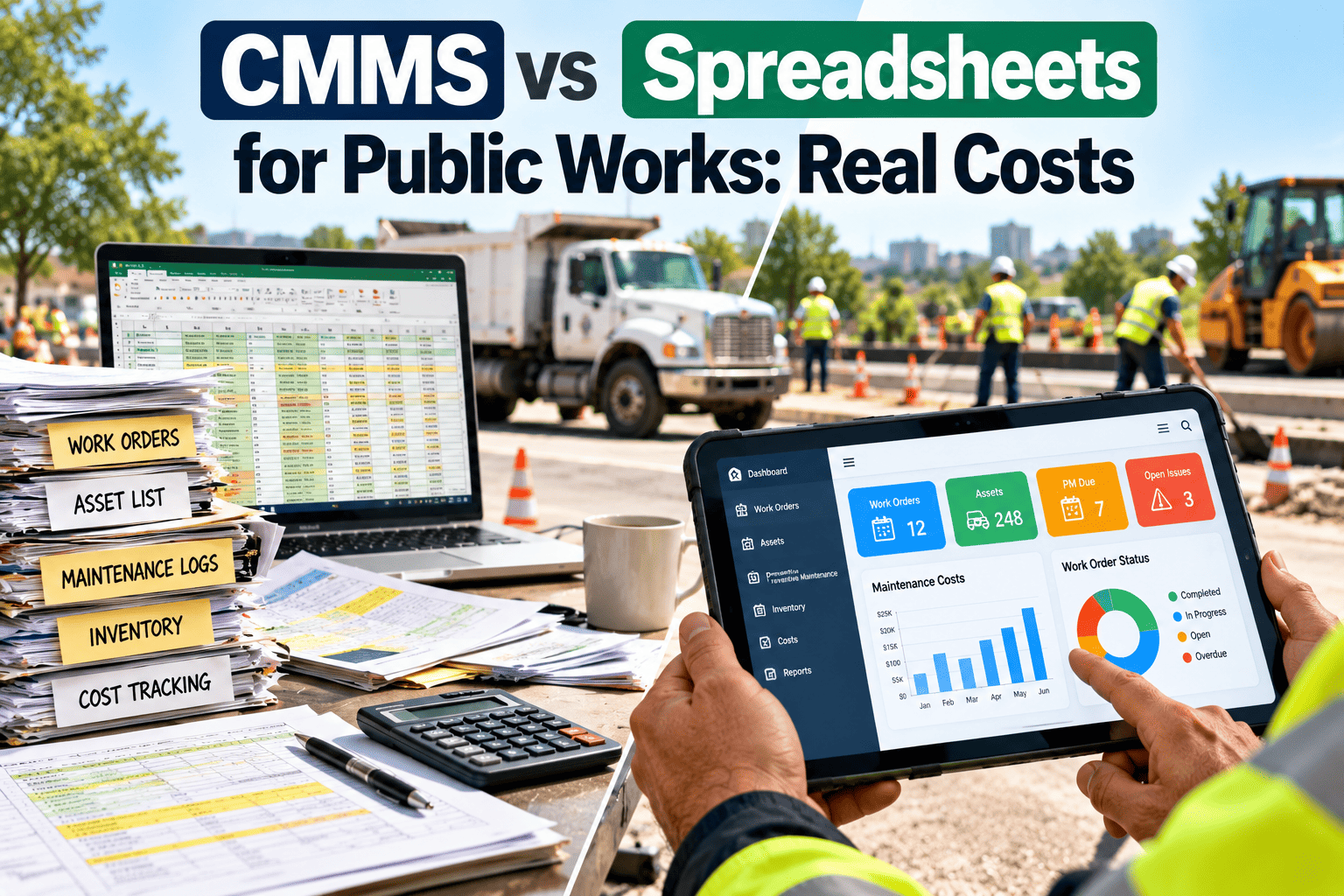
Public works departments must select the appropriate operational strategy for their infrastructure. While spreadsheets were once the standard for tracking basic data, modern compliance and reporting requirements have rendered them largely obsolete. Understanding the tradeoffs of migrating from a spreadsheet to CMMS government system is critical for successful risk and budget mitigation.
Operational Strategy Comparison
1
Spreadsheet Management (Legacy)
Relies on manual data entry and email threads
Disconnected data silos across departments
Reactive break-fix maintenance cycles
High risk of lost work orders and forgotten PMs
No real-time mobile access for field crews
Impossible to track accurate labor and part costs
Fails modern audit and compliance standards
Inefficient & Costly
2
CMMS Platform (Modern)
Centralized, cloud-based asset database
Automated preventive maintenance scheduling
Real-time mobile updates from the field
Instant barcode scanning for inventory
Data-driven budgeting and capital planning
Strict compliance tracking and audit trails
Best for government maintenance technology scaling
Optimized & Compliant
Choosing the right maintenance posture is a strategic decision. Integrated software supports modern city operations by providing flexible workflows for request portals, inventory management, and labor tracking, regardless of the underlying legacy processes.
Digital Transformation Impact
Measured improvements from successful government CMMS adoption
40%
Productivity Boost
Automated Workflows
30%
Cost Reduction
Lower Overtime Spends
100%
Compliance
Instant Audit Trails
24/7
Visibility
Real-Time Dashboards
Core Pillars of CMMS Adoption
Securing public infrastructure reliability requires rigorous operational practices. Effective change management involves communicating the "why" to your team, preventing field staff from reverting back to paper. Proper data migration is equally critical; ensuring clean data enters the new system allows for accurate reporting before financial damage occurs. Book a Demo.
Essential Focus Areas for Deployment
Stakeholder Buy-In
Aligning IT, operations, and finance teams to ensure the project has the executive sponsorship required for long-term municipal technology adoption.
Data Cleanse & Migration
Standardizing asset hierarchies and scrubbing outdated spreadsheet data before import. You cannot optimize what is inaccurately recorded.
Phased Deployment
Rolling out the system department by department (e.g., Parks first, then Water) to manage risk and identify workflow anomalies early.
User Training
Providing role-specific training (mobile app for technicians, dashboards for managers) to ensure high adoption of government IT modernization tools.
The Value of Government Maintenance Technology
Investing in professional CMMS platforms delivers substantial returns. It prevents the operational downtime that drains budgets, ensures infrastructure reliability, and protects civic assets. Integrated systems allow facility managers to focus on mitigating risks rather than manually correlating email requests.
ROI Calculator: Government CMMS Implementation
Based on average annual municipal operating costs
Vulnerable / Manual Spreadsheets
Wasted Labor & Overtime$400,000
Premature Asset Replacement$500,000
Compliance & Audit Penalties$250,000
Inventory & Part Shortages$150,000
Annual Loss: $1,300,000
VS
Integrated CMMS Software
CMMS Platform Licensing$50,000
Onboarding & Training$30,000
Data Migration Support$20,000
Efficiency Cost Savings($600,000)
Net Savings: $500,000+
Municipalities that implement robust change management practices see immediate benefits: fewer emergency calls, better vendor accountability, and higher public confidence. The data generated provides valuable insights for future capacity planning and capital budgets.
Modernize Your Civic Infrastructure
Stop managing millions of dollars in public assets with spreadsheets and hope. Oxmaint delivers the integrated government maintenance modernization tools public works departments need to deliver safe, reliable services. Schedule a consultation to see the platform in action.
Building operational maturity is a journey. It starts with standardizing processes and implementing a central inventory. From there, agencies can advance to sophisticated preventive routing, predictive maintenance, and automated capital planning.
City CMMS Implementation Model
Phase 1
Foundation (Months 1-3)
Stakeholder AlignmentData MigrationAsset Hierarchy SetupBasic Work Orders
Public works maintenance spans diverse disciplines—from vertical infrastructure (facilities) to distributed assets (pumping stations). A unified CMMS framework ensures consistent service standards across all municipal departments.
Unified Maintenance Across Public Works
Consistent operational tracking for every infrastructure type
Water & Wastewater
Parks & Recreation
Streets & Traffic
Fleet & Vehicles
Public Buildings
Sanitation
Public Safety (Fire/Police)
Public Transit
Public Sector Digital Reporting
Consistent compliance reports and KPI dashboards across all departments for executive visibility.
Municipal Technology Adoption
Empower field crews with mobile apps to log hours, parts, and photos right at the job site.
Government IT Modernization
Track maintenance funding (grants, bonds) across the entire portfolio to prioritize capital budgets.
Deliver efficient services for your communityGet Started →
By standardizing digital practices, municipalities gain portfolio-level visibility. This enables better resource allocation, improved asset forecasting, and the ability to demonstrate fiscal due diligence to the public and elected officials. Book a Demo.
Transform Your Public Works
Join the forward-thinking municipalities using Oxmaint to protect critical infrastructure and tax dollars with confidence. Gain control over work orders, inventory, and budgets. Start your digital transition today.
Why is stakeholder buy-in critical for government digital transformation maintenance?
Transitioning from legacy tools requires cultural change. If leadership and field supervisors aren't fully committed to the new system, users will revert to familiar spreadsheets. Stakeholder buy-in ensures that adequate training resources are allocated and that the new CMMS becomes the mandatory system of record across all departments.
How difficult is data migration during public sector CMMS deployment?
Data migration is often the most time-consuming phase, but it is highly manageable with a structured approach. It involves extracting data from spreadsheets, scrubbing it for duplicates or errors, standardizing asset naming conventions, and utilizing bulk-import templates provided by your new CMMS vendor. Clean data ensures accurate reporting from day one.
What is the advantage of phased deployment in government maintenance modernization?
A "big bang" rollout across an entire city can overwhelm IT and support staff. Phased deployment—such as rolling the system out to the Parks Department first, followed by Water and Facilities—allows you to learn from initial challenges, refine training materials, and build internal champions before expanding to more complex departments.
Will my older field technicians struggle with government CMMS implementation?
User resistance is common, but modern CMMS platforms are designed with intuitive, mobile-first interfaces that mimic apps users already use daily (like modern banking or social apps). Paired with hands-on training and clear communication about how the software eliminates frustrating paperwork, adoption rates typically exceed 90% within the first few months.
How long does a typical city CMMS implementation take?
Depending on the size of the municipality and the cleanliness of legacy data, a standard deployment takes between 3 to 6 months to reach full operational capacity. Phase 1 (basic work orders and asset tracking) can often be launched in as little as 30 days, while advanced features like predictive maintenance and ERP integrations roll out over subsequent quarters.