A water or wastewater utility can own thousands of assets, but only a fraction of them can actually put the plant out of service, interrupt supply to a service area, or create a public health event if they fail without warning. Most utilities know this intuitively, yet very few can point to a documented, defensible criticality ranking that says exactly which pump, valve, or basin sits at the top of that list and why. Without that ranking, maintenance budgets, spare parts inventory, and inspection frequency all get spread evenly across assets that are nowhere near equally important — which means the truly critical ones are often under-protected while low-consequence assets absorb attention they do not need. Book a demo to see how a structured criticality score reorders where your maintenance effort actually goes.
Water Utility Asset Management · Criticality Ranking · OxMaint
Not Every Asset Deserves the Same Attention. Rank Them Like It Matters — Because It Does.
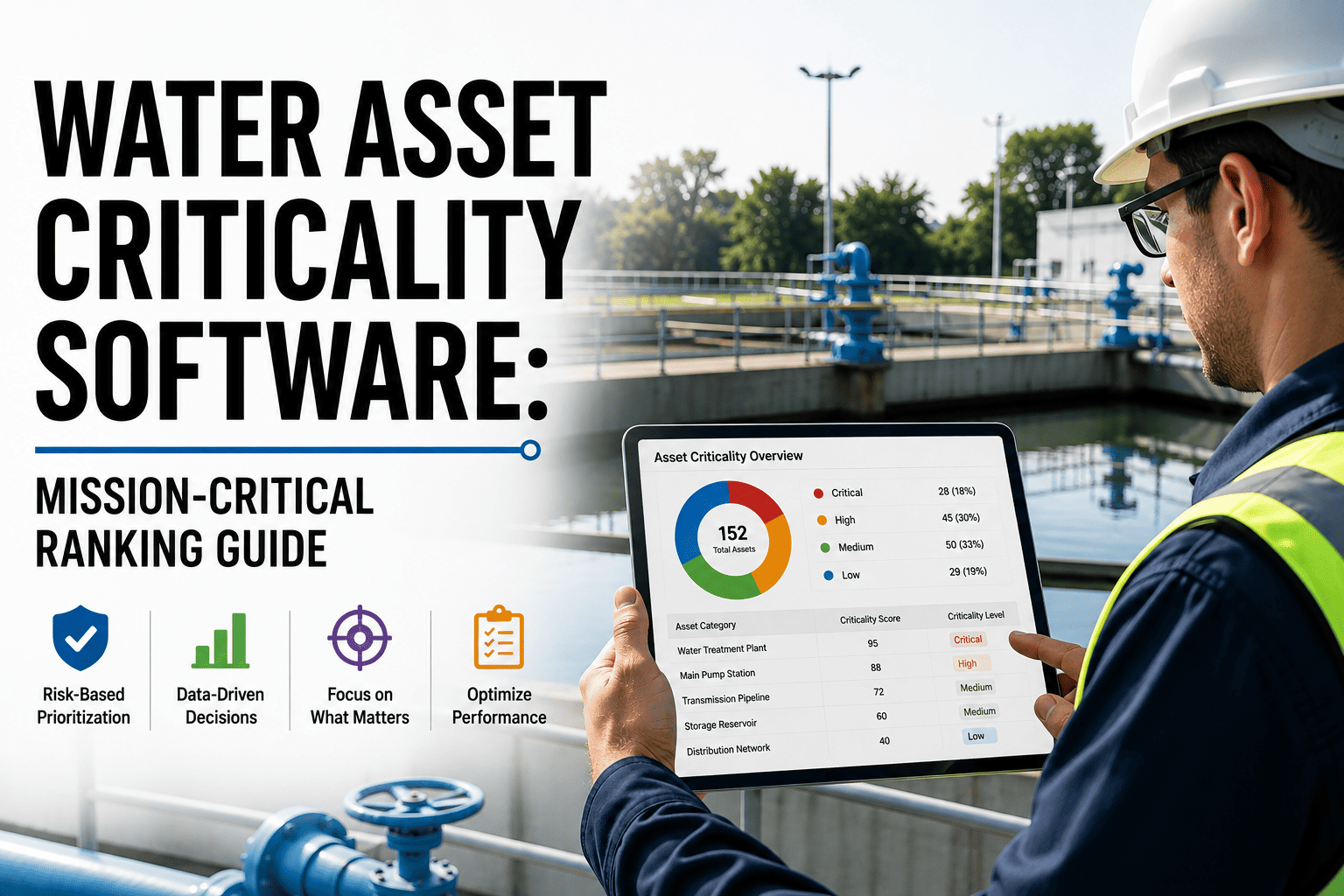
OxMaint scores every water and wastewater asset on service population impact, redundancy, and consequence of failure, then turns that score into inspection frequency, spare parts priority, and budget allocation that actually match risk.
The Criticality Question Most Utilities Cannot Answer Consistently
Without a Ranking
A high-lift pump and a landscaping irrigation valve can end up on the same generic PM schedule, competing for the same technician hours, because nothing in the maintenance system distinguishes how much each one actually matters if it fails.
With OxMaint Criticality Scoring
Every asset carries a documented score built from service population, redundancy, and failure consequence — so inspection frequency, spare parts priority, and capital planning follow risk instead of habit or whoever asked last.
Three Factors Behind Every OxMaint Criticality Score
A
Service Population Impact
How many customers, and which facilities, lose service if this asset fails — a single well feeding a small zone scores very differently from the plant's only high-service pump station.
B
Redundancy
Is there a backup unit that picks up load automatically, a manual bypass that takes an hour to configure, or no redundancy at all — redundancy level moves the score up or down more than almost any other input.
C
Consequence of Failure
What actually happens if this asset fails right now — a nuisance alarm, a boil-water notice, a sanitary sewer overflow, or a regulatory reportable event — scored on severity, not just likelihood.
OxMaint · Water Asset Criticality Software
Turn a Gut-Feel Priority List Into a Documented, Repeatable Score
OxMaint applies the same three-factor scoring model across every asset in your registry, so criticality is calculated consistently instead of depending on which engineer last touched the spreadsheet.
Criticality Tiers — How OxMaint Groups the Score Into Action
Tier 1 — Mission Critical
No Redundancy, High Population Impact, Severe Consequence
Assets where failure interrupts service to a large population immediately, with no automatic backup. These get the shortest inspection interval, guaranteed spare parts on hand, and the first call when budget is being allocated.
Tier 2 — High Priority
Partial Redundancy or Moderate Population Impact
A backup exists but requires manual intervention, or the population affected is meaningful but not plant-wide. These assets get a compressed but not maximum inspection interval and priority spare parts stocking.
Tier 3 — Standard
Full Redundancy, Limited or Localised Impact
Automatic backup exists and failure affects a small area or a non-essential function. Standard PM interval applies, and spare parts are stocked on a normal reorder cycle rather than held permanently on hand.
Tier 4 — Low Priority
Minimal Consequence, Easily Replaced
Assets where failure is a minor inconvenience with no service, safety, or compliance consequence. Run-to-failure or extended PM intervals are appropriate, freeing up technician time for higher-tier assets.
How the Score Changes What Happens Next
Where a Missing Criticality Score Creates Risk
High Risk
Single Point of Failure Treated Like Any Other Asset
A pump or valve with no backup gets the same PM interval as everything else, so a slow-developing failure is caught at the regular schedule instead of the tighter interval its lack of redundancy actually calls for.
High Risk
Spare Parts Budget Spread Evenly Instead of by Consequence
Without a criticality score guiding inventory decisions, spare parts budget often follows purchase history rather than actual risk, leaving a mission-critical component without a spare while low-impact parts sit overstocked.
Elevated
Capital Planning Disconnected From Failure Consequence
Replacement and rehabilitation projects tend to get prioritised by asset age or complaint volume rather than by what actually happens if the asset fails, which can push a genuinely critical asset down the capital list.
Elevated
New Staff Have No Reference for What Matters Most
Institutional knowledge about which assets are truly critical often lives with a few senior operators — when that knowledge is not documented, new staff have no consistent way to know where to focus attention.
3 factors
service population, redundancy, and consequence combine into one consistent score per asset
4 tiers
every asset lands in a clear tier that drives inspection frequency and spend automatically
1 registry
one scored asset list shared across maintenance, capital planning, and operations teams
Ongoing
scores are revisited as redundancy changes, such as a new backup unit coming online
We had a criticality spreadsheet that hadn't been touched since a consultant built it years earlier. Half the scores didn't reflect equipment we had already replaced. Rebuilding it in OxMaint with the same three factors, tied to the live asset registry, meant the score actually stays current. Our Tier 1 list now drives spare parts stocking directly, and that alone caught a single point of failure on a lift station pump that had been sitting on a standard PM schedule for years.
— Asset Management Lead, Municipal Water Utility · OxMaint user
How OxMaint Builds a Criticality Score From Your Asset Registry
1
Start From the Asset Registry You Already Have
Criticality scoring builds directly on the asset records already in OxMaint, so there is no separate spreadsheet to maintain in parallel — every pump, valve, basin, and lift station already has a home for its score.
2
Score Each Asset on the Three Factors
Engineering and operations staff score each asset on service population impact, redundancy, and consequence of failure, using a consistent scale so the same input always means the same thing across the registry.
3
OxMaint Calculates the Tier Automatically
The three factor scores combine into a single tier — Mission Critical through Low Priority — calculated the same way for every asset, removing the inconsistency that comes from different people applying their own judgment differently.
4
Tier Connects to Inspection and Spare Parts Settings
Once an asset has a tier, its recommended inspection frequency and spare parts stocking policy are visible right alongside it, giving maintenance planners a starting point instead of a blank decision every time.
5
Scores Are Reviewed as the System Changes
When a new backup unit is installed, a service area grows, or a consequence changes, the score can be updated in minutes, keeping the ranking accurate instead of letting it quietly go stale over the years.
Who Should Be Involved in Scoring, and Why It Should Not Be One Person's Judgment
A criticality score built by a single engineer, however experienced, tends to reflect one perspective on risk. An engineer may weigh redundancy and equipment condition heavily, while an operator who has actually worked the plant floor may have a much sharper sense of which failures create genuine chaos versus which ones are routine and manageable. A finance or compliance lead, meanwhile, often has the clearest view of which failures carry regulatory or reputational consequence beyond the mechanical impact. None of these perspectives alone produces a complete picture.
The most reliable criticality rankings come from a short structured review involving operations, maintenance, and engineering together, scoring assets against the same three factors and discussing any asset where opinions diverge significantly. That disagreement is not a sign the process is broken — it is usually the moment where the most useful insight about an asset surfaces, because it means the risk is not as obvious as it first appeared.
This is also why criticality scoring works better as a periodic review than a one-time workshop. New assets get added to the registry, old assets get decommissioned, and system conditions change gradually enough that nobody notices day to day. A utility that revisits its Tier 1 and Tier 2 list once or twice a year, even briefly, catches the drift before it becomes a blind spot — the same kind of blind spot that a missing or outdated criticality score creates in the first place.
For utilities just getting started, the fastest path is not attempting to score every asset in the registry on day one. Beginning with the assets most likely to be Tier 1 — anything with no redundancy that serves a large population, or anything tied directly to a regulatory limit — gives a utility a usable list within days rather than months, with the remaining assets scored progressively as time allows.
Building the Criticality Model the Right Way
Most utilities that attempt a criticality ranking start with good intentions and a spreadsheet, and both tend to run into the same problem: the score is built once, by one person, using whatever information was easiest to gather at the time, and it is never revisited. A pump that was genuinely a single point of failure five years ago may now have a backup unit installed down the line. A valve that used to serve a small subdivision may now sit upstream of a much larger service area after a system expansion. A criticality score that does not get updated as the system changes slowly drifts from useful to misleading, and nobody notices until an incident exposes the gap.
The fix is not a more elaborate scoring formula — it is treating criticality as a living attribute of the asset registry rather than a one-time project. When redundancy, service population, or consequence changes, the score should change with it, and that update should take minutes rather than requiring someone to reopen an old spreadsheet and remember the original methodology. This is the practical difference between a criticality exercise that produces a report once and a criticality system that stays accurate for as long as the utility uses it.
It also matters who can see the score once it exists. A ranking that lives only with the asset management team rarely changes behaviour on the ground. The value shows up when the same tier a planning engineer sees is also visible to the maintenance supervisor scheduling next month's PM work, the warehouse manager deciding what spare parts to keep on the shelf, and the operator responding to an alarm at two in the morning who needs to know immediately whether this is a Tier 1 asset or a Tier 4 one. Criticality only earns its keep when it is shared infrastructure, not a document that lives in one department.
Finally, a criticality model has to survive contact with disagreement. Engineers, operators, and finance staff will not always agree on how severe a given consequence really is, and that is a healthy sign the factors are being taken seriously rather than rubber-stamped. A documented, three-factor structure gives those conversations a shared starting point — the debate becomes about how redundant a specific pump actually is, not about whether criticality scoring is worth doing in the first place.
Why Criticality Scoring Pairs Directly With Preventive Maintenance
A criticality score on its own is just information — the value shows up when it actually changes how maintenance work gets scheduled and prioritised week to week. Utilities that stop at the ranking exercise, without connecting the tiers to their preventive maintenance program, often end up with an accurate document that nobody's daily workflow actually touches. The tier list becomes something referenced during an annual review rather than something that shapes Monday morning's work order queue.
Connecting criticality directly to preventive maintenance means a Tier 1 asset's inspection interval is not just a recommendation sitting in a separate report — it is the interval that actually generates the work order in the maintenance system. It means a technician choosing between two competing PM tasks on a busy day has a clear, documented reason to prioritise the one tied to a mission-critical asset over the one tied to a low-priority asset, rather than defaulting to whichever job was scheduled first or is easiest to reach.
It also changes how a maintenance team responds when resources are tight. Budget cuts, staffing shortages, and parts backorders are a reality every utility deals with at some point, and when they hit, something has to give. A documented criticality tier gives a maintenance manager a defensible basis for those trade-off decisions — deferring a Tier 4 inspection is a reasonable response to a resource constraint, while deferring a Tier 1 inspection on the same logic is a risk decision that deserves to be made deliberately, not by accident because nobody distinguished between the two.
Frequently Asked Questions — Water Asset Criticality Scoring
How does OxMaint calculate a criticality score for each asset?
OxMaint combines service population impact, redundancy level, and consequence of failure into a single weighted score per asset.
Sign in to OxMaint to configure the scoring weights for your utility.
Can criticality scores be updated as infrastructure changes, like a new backup pump being installed?
Yes, scores are tied to the live asset registry, so redundancy or condition changes can be updated and the tier recalculated, rather than the score staying frozen from when it was first entered.
Does a higher criticality tier automatically change the PM schedule for that asset?
Tier assignment informs recommended inspection frequency and spare parts policy, giving maintenance planners a consistent starting point that can be applied directly to the PM schedule for that asset.
Can OxMaint criticality scoring cover both water treatment and wastewater collection assets?
Yes, the same three-factor model applies across treatment, distribution, collection, and lift station assets, since redundancy and consequence of failure are relevant in every part of a water or wastewater system.
How does a documented criticality list help during a capital improvement planning cycle?
A ranked list gives capital planning a defensible starting point for prioritising replacement projects.
Book a demo to see how the tier list feeds into capital planning views.
Common Mistakes Utilities Make When Scoring Criticality
Watch For
Confusing Asset Cost With Asset Criticality
An expensive asset is not automatically a critical one, and an inexpensive valve can be a genuine single point of failure. Scoring by consequence and redundancy, rather than replacement cost, keeps the ranking focused on what actually matters if the asset fails.
Watch For
Scoring Redundancy at the System Level, Not the Asset Level
A treatment train with two pumps is not automatically low risk if both pumps are aging and prone to simultaneous failure modes. Redundancy should reflect whether the backup can genuinely take over in practice, not just whether a second unit exists on paper.
Every Asset in Your Registry Already Has a Criticality Level. The Question Is Whether It Is Written Down.
Service population impact, redundancy, and consequence of failure — scored consistently, tiered clearly, and connected directly to inspection frequency, spare parts, and capital planning across your entire water or wastewater system.