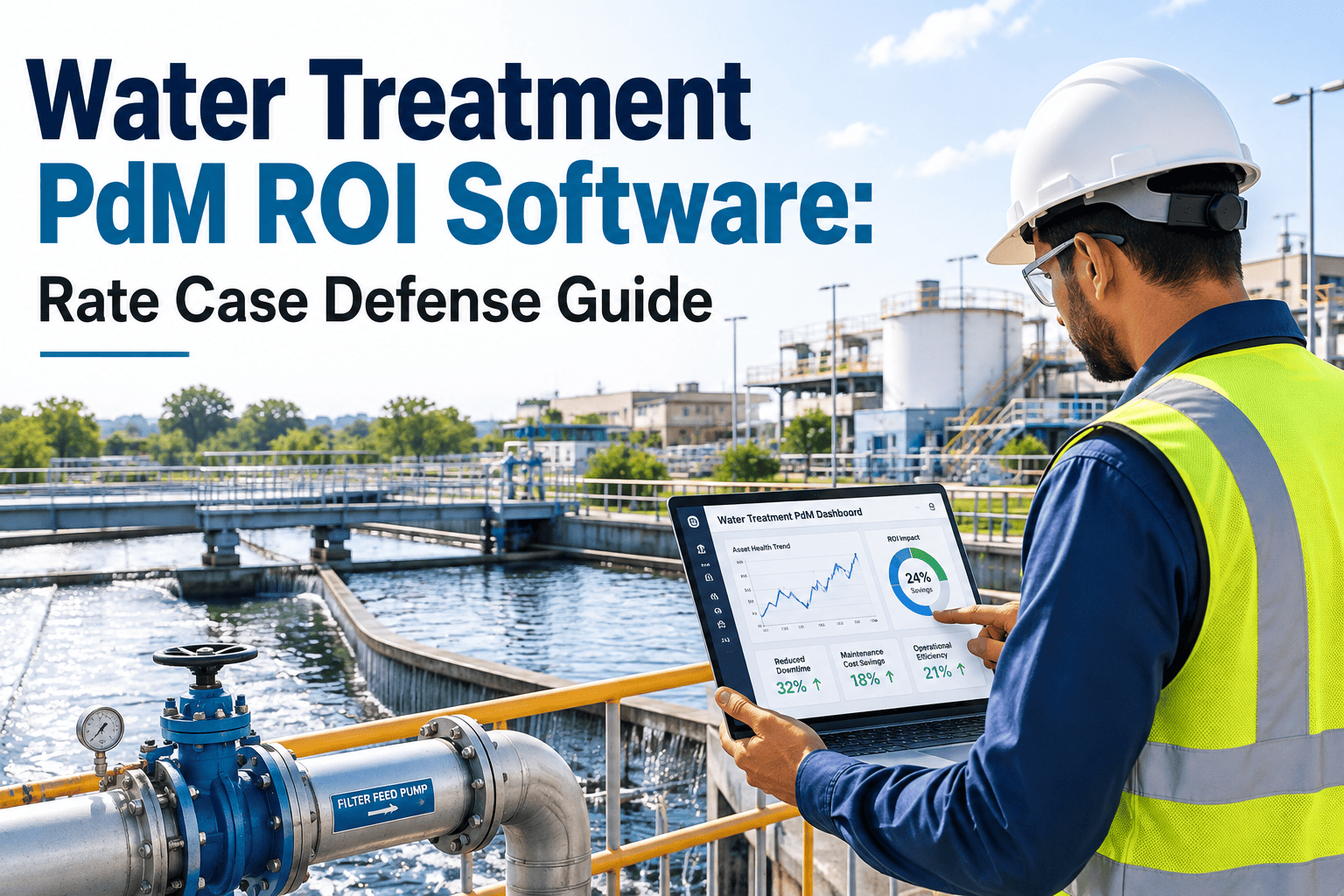
Every water utility capital request eventually lands in front of a rate case, where commission staff will ask the same blunt question: what happens if you do nothing. Utilities running calendar-based PM and relying on the memory of senior operators struggle to answer that with numbers a regulator will accept, because an avoided failure is invisible unless someone documented it before it happened. Predictive maintenance software changes that by turning sensor trends, work order histories, and failure predictions into an avoided-cost ledger finance can hand straight to legal counsel. Utilities that build this evidence trail months before a filing, rather than scrambling during discovery, consistently see faster commission review and fewer contested line items. Sign up to start building the avoided-cost record your next rate case will need.
Water Treatment PdM ROI Software: Build a Rate Case Your Commission Will Approve
Oxmaint turns pump vibration trends, valve degradation alerts, and prevented-failure work orders into a hard-dollar avoided-cost record that survives commission staff review and cross-examination. Instead of reconstructing history during discovery, your finance and engineering teams work from a single running ledger that has been building since day one of deployment, asset by asset and event by event, so nothing gets lost between the operations floor and the hearing room.
Most Utilities Can Describe a Risk. Few Can Price It.
Roughly seven in ten mid-sized water treatment plants still track maintenance on paper logs, spreadsheets, or a work order system that was never designed to capture avoided-cost evidence. When a rate case examiner asks what a deferred pump overhaul would have cost the ratepayer base, the honest answer is usually a guess dressed up as an estimate, and guesses get struck from testimony. The plants that clear this bar are not necessarily running newer equipment or spending more on maintenance; they are simply capturing the right data at the moment a failure is prevented, rather than trying to reconstruct the story from memory eighteen months later when a filing deadline is already close.
What Commission Staff Push Back On, and What Answers It
Rate case testimony around maintenance spending gets challenged in predictable ways. Knowing the objection in advance lets a utility build the evidence that answers it before the hearing, not during it. Most of these objections trace back to the same root problem: a number without a traceable source behind it, which is precisely what a connected PdM record is built to fix.
A prediction logged with a timestamp, the sensor reading that triggered it, and the work order that resolved it is not speculation, it is a documented event with a clear causal chain that staff can trace end to end.
Once twelve months of prevented-failure data exists in the platform, the utility can cite its own emergency repair cost history instead of a generic benchmark, which is a materially stronger evidentiary position.
Because the platform logs the prediction and the intervention automatically as part of the normal maintenance workflow, there is no separate documentation step to forget or skip under operational pressure.
Model confidence scores, historical failure rates for the same asset class, and the specific sensor trend that triggered the alert together form a reasoned basis rather than a bare assertion of risk.
Four Avoided-Cost Categories Commission Staff Actually Credit
Highest-Impact Assets for Rate Case Evidence
Not every asset produces evidence a commission will find persuasive. Start with the assets that already carry a documented failure history, a clear regulatory consequence, and a repair cost significant enough to matter in a filing.
- Raw and high service pumps — the highest-frequency emergency repair category at most plants, with well-documented historical failure costs already sitting in your work order history.
- Filter backwash and media systems — failures here carry direct water quality and reportable-event risk, which strengthens the regulatory penalty avoidance argument.
- Disinfection feed equipment — chlorine, chloramine, or UV system downtime is one of the fastest paths to a reportable compliance event, making prevented failures here easy to justify.
- Clarifier and sedimentation drives — mechanical failures are expensive to repair and slow to diagnose without sensor data, which is exactly where a documented catch shows the clearest avoided cost.
- SCADA-connected valves and actuators — degradation here often precedes a larger downstream failure, so early detection data supports both an avoided-cost claim and a broader reliability narrative.
Give Your Rate Case Team a Number They Can Defend Under Cross-Examination
Oxmaint logs every sensor reading, prediction, and prevented failure with a full audit trail, so your avoided-cost figures are traceable back to the exact asset and event.
What Changes When Maintenance Data Becomes Rate Case Evidence
The underlying maintenance work is often similar between a reactive shop and a documented PdM program. What differs is whether the evidence of that work exists in a form a commission attorney can actually use, and that difference is what separates an approved line item from a contested one, sometimes worth six or seven figures across a multi-year rate plan.
| Dimension | Reactive Maintenance Record | PdM-Documented Record |
|---|---|---|
| Failure Evidence | Work order created after the asset already failed | Sensor trend and prediction logged before failure occurred |
| Cost Basis | Industry benchmark or engineer estimate | Utility's own historical emergency repair cost data |
| Audit Trail | Paper log or disconnected spreadsheet | Timestamped digital record tied to asset ID |
| Regulatory Framing | General prudency argument | Asset-specific avoided-violation calculation |
| Commission Response | Frequently contested or reduced | Fewer discovery requests, faster staff sign-off |
Three Phases to Build the Record Before You File
A rate case evidence file is not built in the weeks before a filing, it is built over the operating period the filing covers. Utilities that treat evidence-building as a continuous byproduct of normal maintenance work, rather than a special project, arrive at the filing deadline with a record already in hand instead of a scramble against the clock and a legal team asking questions operations cannot answer on short notice.
Measured Outcomes From Documented PdM Programs
These figures come from utilities that instrumented their highest-consequence assets first and let the evidence accumulate over a full operating cycle, rather than trying to compress the record into a single quarter ahead of a filing. The pattern holds across plant sizes: the earlier the program starts relative to the filing date, the stronger and more credible the resulting evidence file tends to be.
Water Treatment PdM ROI and Rate Case Defense — Common Questions
Staff attorneys are far more receptive to avoided-cost figures that are traceable to a specific asset, sensor reading, and timestamped prevented event than to a generic industry benchmark, since the traceability itself answers the standard speculation objection. Sign up to see how the audit trail is structured for exhibit use.
Most utilities start twelve to eighteen months before a planned filing so the evidence file has enough prevented-failure events to be statistically credible rather than anecdotal, and so the baseline period overlaps cleanly with the test year the filing will reference. Book a demo to plan a timeline against your own filing cycle.
No, the platform produces the underlying evidence and audit trail that a rate case consultant or in-house counsel still needs to frame as testimony and present within the specific procedural rules of your commission. It replaces guesswork with data, not the expert judgment a filing still requires.
High-consequence, high-frequency-failure assets such as raw water pumps, filter backwash systems, and disinfection feed equipment typically produce the clearest avoided-cost evidence within the first year, because their failure history already gives you a strong cost baseline to measure against. Start a free trial to prioritize your own asset list.
Yes, the same asset condition and avoided-cost history feeds directly into capital improvement prioritization, so a single data set supports both the operating and capital sides of a filing, and finance stops maintaining two separate spreadsheets that never quite agree with each other.
Why This Matters Beyond the Next Filing
A rate case is a single event, but the evidence discipline behind it is a permanent operating advantage. Once a utility has built the habit of logging condition data, predictions, and prevented failures as a normal part of the maintenance workflow, every future filing gets easier rather than harder, because the record simply keeps growing instead of needing to be rebuilt from scratch. Commissions increasingly expect this level of documentation from utilities requesting rate relief, and the utilities that build it early are the ones setting the standard other filers get measured against. The gap between a utility that can price its risk and one that can only describe it is exactly the gap a documented PdM program closes.
There is also a quieter benefit that shows up outside the hearing room. Engineering, finance, and operations teams stop arguing over whose number is correct because everyone is working from the same asset-linked record, and budget planning conversations shift from defending past spending to prioritizing the next twelve months of risk. That alignment tends to outlast any single rate case, and it is often the reason utilities that adopt this discipline for one filing keep using it long after the case is closed. The maintenance data was always being generated somewhere in the plant; the difference is whether it is captured in a form that finance, legal, and the commission can actually use when it matters most, and whether that capture happens automatically or depends on someone remembering to write it down.
Every Rate Cycle Without a Documented PdM Record Is Another Contested Line Item.
Oxmaint builds the avoided-cost audit trail your finance and legal teams need before the next filing deadline, not during it, so the next rate case starts with a record instead of a scramble.