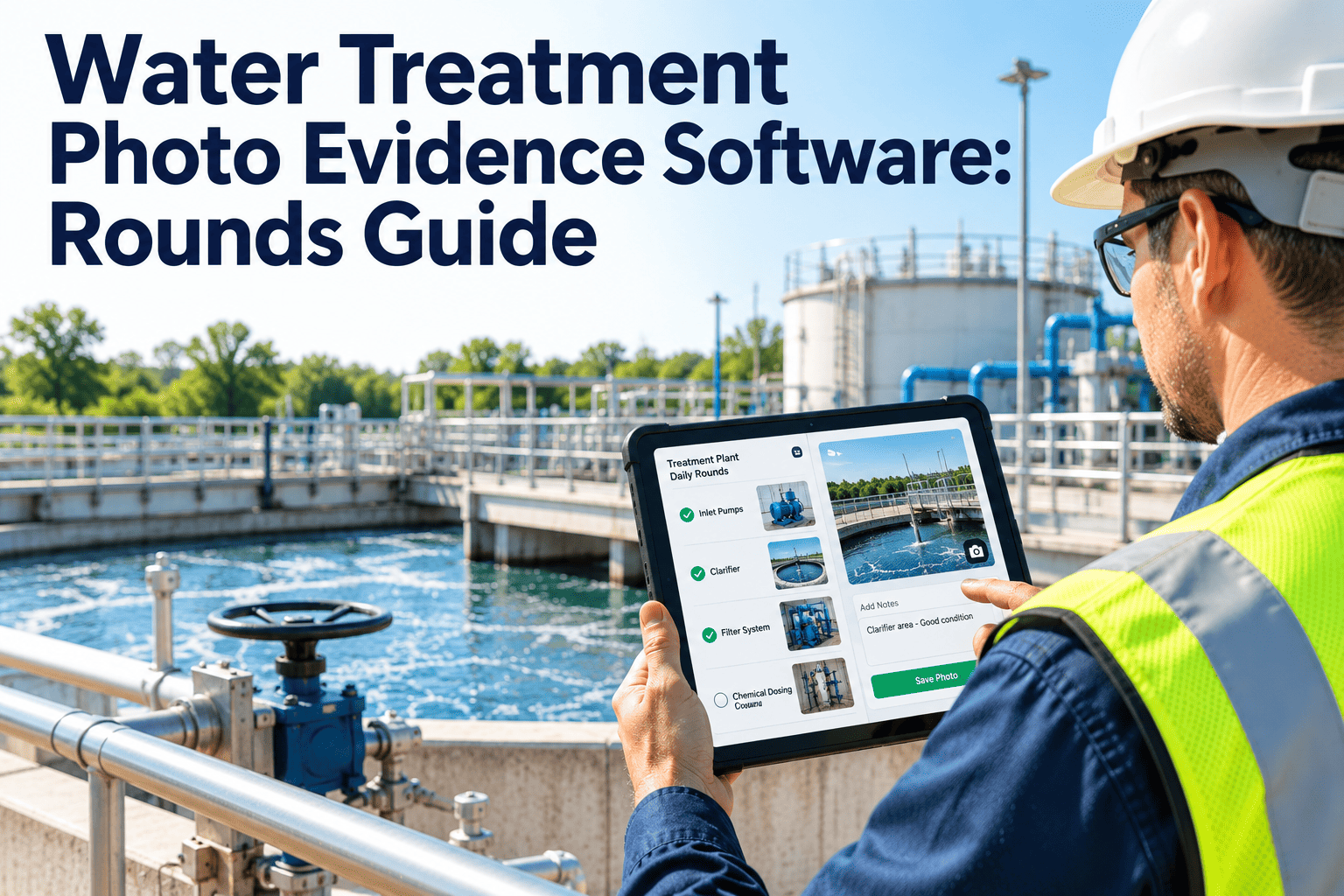
A water treatment plant operator can walk every checkpoint on schedule and still struggle to prove it later. Handwritten logs show that a round happened, but they rarely show what a chemical feed room, filter gallery, or clearwell actually looked like at that moment. When a primacy agency asks questions, an insurer reviews a claim, or counsel requests records, a timestamped photo is far stronger than a checkmark. The right water treatment photo evidence software captures that proof during the round itself, not afterward.
Water Treatment Photo Evidence Software: Rounds Guide
Why a Checkmark Is Not Evidence
Rounds sheets answer one question: was the item visited. Evidence answers more: what condition was it in, when, where, and who saw it.
Anatomy of an Evidence-Grade Round Photo
A photo is only as useful as the data attached to it. Each image should carry a minimum set of fields.
Who Relies on Photo Evidence
Different audiences ask different questions. Planning the record around them avoids gaps. Retention periods and admissibility are legal matters, so confirm requirements with your counsel and state program.
| Audience | What they look for | How photos help |
|---|---|---|
| Primacy agency | Evidence of routine operations, equipment condition, and follow-through during sanitary surveys and inspections | Dated images show that rounds and corrective actions happened as described |
| Insurance carrier | Condition of equipment before a loss, and maintenance practices | Historical photos support the pre-loss condition and care of assets |
| Legal counsel | Reliable records of what staff observed and when | Time-stamped, user-linked images are easier to authenticate than memory |
| Plant management | Trends in wear, leaks, and housekeeping | Side-by-side photos of the same checkpoint show change over time |
| Board or utility leadership | Confidence that rounds are real and complete | Completion rates with photo proof reduce reliance on assurance alone |
Checkpoint Library by Treatment Area
Define a photo standard for each area so every operator captures the same view. The examples below are starting points to adapt to your plant.
- Screens and trash racks for debris loading
- Raw water pumps and seals for leaks
- Intake structure and access conditions
- Day tanks, labels, and secondary containment
- Feed pumps, tubing, and fittings for leaks or crystallization
- Safety equipment such as eyewash and ventilation
- Mixer operation and floc appearance
- Basin surface, launders, and sludge blanket indicators
- Baffles and weirs for visible damage
- Filter surface during operation and after backwash
- Turbidimeter display and sample point
- Backwash valves and surface wash arms
- Chlorine or alternative feed equipment and monitors
- Gas detection and alarm panels where applicable
- Residual analyzers and sample lines
- Clearwell hatches, vents, and screens
- High service pumps, motors, and gauges
- Standby power and control cabinets
The Evidence Chain: From Camera to Case File
Evidence is strongest when each step is traceable. A simple chain keeps images trustworthy and easy to retrieve.
Paper Rounds Versus Photo-Verified Rounds
- Rounds can be filled out from memory at the end of a shift
- Concerns are described in words without visual proof
- Photos on personal phones are hard to locate and verify
- Findings depend on someone retyping them into a work request
- Records are slow to compile for an inspection or claim
- Required photos show the operator was physically at the checkpoint
- Annotated images make concerns clear to the next reader
- All images live with the asset and round record
- Findings turn into work orders from the same screen
- Records can be searched by asset, date, or issue
Photo Standards That Make Images Usable
Consistency matters more than volume. Publish a short standard and train every operator to follow it.
Operational Risks Photo Evidence Helps Catch
Photos do not replace instrumentation or laboratory results. They add a visual layer that often shows trouble before a reading changes.
Regulatory Context: Why Documentation Carries Weight
Public water systems operate under the Safe Drinking Water Act, and most states administer the program as the primacy agency. Requirements differ by state, system size, and treatment type, so confirm what applies to your plant.
| Situation | Documentation pressure | Where photos add value |
|---|---|---|
| Sanitary survey or agency inspection | Reviewers evaluate operations, maintenance, and equipment condition | Dated images show routine care and how deficiencies were handled |
| Treatment performance question | Staff must explain what was observed around the time of an event | Round photos give a visual timeline beside lab and instrument data |
| Chemical safety review | Storage, labeling, containment, and ventilation come under scrutiny | Photos confirm condition of feed rooms on specific dates |
| Insurance claim after equipment failure | Carrier asks about maintenance and prior condition | Historical images support the pre-loss state of the asset |
| Personnel or liability dispute | Questions about who saw what, and when | User-linked, time-stamped captures replace recollection |
A Hypothetical Shift: How a Photo Round Plays Out
This is an illustrative walk-through, not a customer case study.
Keeping Photo Records Trustworthy
Evidence is only persuasive if it can be trusted. These practices help protect the integrity of the record.
- Use individual operator accounts, never shared logins
- Capture inside the round workflow instead of importing from a gallery
- Keep device clocks synchronized
- Require a photo for critical checkpoints before a round can close
- Link every image to an asset, date, and user
- Restrict who can delete or alter records
- Back up records and follow your retention schedule
- Apply a legal hold process when counsel requests it
Using Photo History for Maintenance Decisions
Photo evidence is also a maintenance tool. A series of images of the same checkpoint reveals wear that a single visit cannot.
- Compare gaskets, couplings, and seals on a feed pump across several months to time replacement.
- Review corrosion progress on a tank ladder or railing to prioritize painting or repair.
- Check filter surface images against backwash events to identify recurring problems.
- Use photos to give contractors and engineers context before they visit the plant.
- Support capital requests with visible proof of deterioration rather than descriptions alone.
Common Pitfalls With Photo Rounds
Oxmaint Capabilities for Water Plant Photo Rounds
Oxmaint is a maintenance management platform, so photo evidence connects to the asset and the work that follows.
| Capability | Use in plant rounds |
|---|---|
| Mobile inspections | Round checklists on phones or tablets with required photo steps at each checkpoint |
| Asset management | Every pump, tank, and filter holds its photo history, manuals, and work records |
| Scheduling | Round routes assigned by shift, area, and frequency with overdue alerts |
| Work orders | Corrective work created from an abnormal finding and linked to the photo |
| Preventive maintenance | Routine tasks such as pump servicing and calibration scheduled alongside rounds |
| Compliance records | Round completion and findings kept in a searchable record for reviews |
| Dashboards and reporting | Completion rates, open findings, and repeat issues by area or operator |
Training Operators to Capture Better Evidence
Good photo habits come from short, practical training rather than long manuals. A single session with real checkpoints works best.
Roles in a photo evidence program
- Operators capture and annotate images during rounds and flag abnormal conditions.
- Maintenance supervisors review findings, assign work, and confirm closure with a follow-up photo.
- Plant managers monitor completion rates, repeat issues, and open findings.
- Compliance staff confirm that records match agency and internal requirements.
Metrics for a Photo-Verified Rounds Program
Rolling Out Photo Rounds Without Slowing Operators
Operators accept photo rounds when they save time later. Keep the first rollout small and useful.
- Start with one process area, such as chemical feed or filtration, before expanding.
- Require photos only where they add value; avoid forcing images at every trivial item.
- Train staff on the photo standard and show examples of good and poor images.
- Review the first month of findings with operators and adjust checkpoints.
- Set a retention approach with counsel and your state program before scaling up.