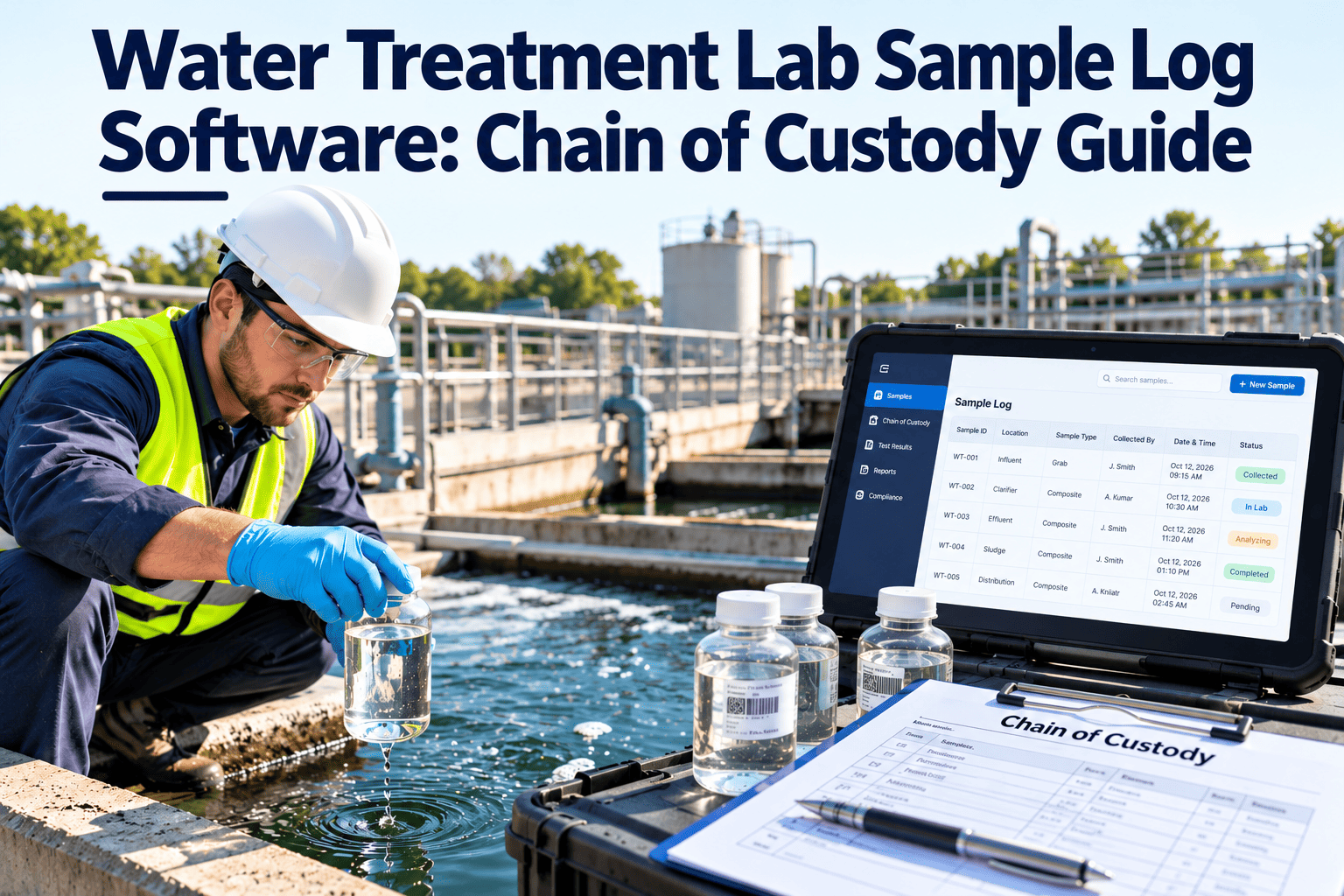
A water sample is only as defensible as the record behind it. When a regulator asks who collected a sample, how it was preserved, how long it sat in a cooler and who signed it into the lab, the answer has to exist on paper or on screen, not in someone's memory. Treatment plants that handle sample logs through clipboards and shared spreadsheets lose that trail more often than they admit. A CMMS-based sample log ties each sample to its asset, its collector and its clock.
Water Treatment Lab Sample Log Software and Chain of Custody
Record every compliance sample from tap to lab report with a sample ID, custody signatures and delivery time, so SDWA lab audits and primacy agency reviews find a complete trail instead of gaps.
Why Lab Sample Records Fail Audits
- Sample labels are handwritten at the tap, and the ID does not match the compliance schedule.
- Collection time is recorded, but delivery time to the lab is not.
- Cooler temperature is checked once, or not at all, when samples arrive.
- Custody transfers happen in a parking lot or a hallway with no signature.
- Missed monitoring periods are discovered only when the compliance report is being assembled.
The common root cause
Most gaps are not caused by bad operators. They come from a process that depends on memory, paper forms and separate spreadsheets that nobody owns end to end.
What Sample Discipline Means Under the Safe Drinking Water Act
- The Safe Drinking Water Act sets the framework, and the National Primary Drinking Water Regulations in 40 CFR Part 141 define monitoring requirements by contaminant.
- Most states hold primacy, so your state agency is usually the one reviewing monitoring schedules, lab certification and reports.
- Compliance samples are generally analyzed by a laboratory certified for the specific method and contaminant.
- Methods specify containers, preservatives, temperature and maximum holding times.
Why the record matters as much as the result
A passing result on a sample that exceeded its holding time, or was collected from an unapproved location, can still be invalid. The documentation decides whether the number counts.
Holding Time and Preservation: Where Samples Are Lost
| Sample type | Typical handling concern | What the log must show |
|---|---|---|
| Total coliform and E. coli | Short holding time, temperature control in transit, sterile bottle with dechlorinating agent | Collection time, chlorine residual, cooler temperature at receipt, delivery time |
| Disinfectant residual | Analyzed at the point of collection, not transported | Instrument ID, calibration status, reading time, operator |
| Nitrate and nitrite | Short holding time unless preserved | Preservation method, collection time, receipt time |
| Metals, including lead and copper | Acid preservation and site-specific collection instructions | Site, collection instructions followed, preservative lot, stagnation notes |
| Disinfection byproducts | Quenching agent and headspace control | Container type, quench confirmation, location in the distribution system |
| PFAS and other trace organics | Specialized containers and contamination avoidance | Container lot, collector, field blank reference |
Timeline view of a coliform sample
See Every Sample Clock in One Place
Set up sample schedules, custody records and delivery times in Oxmaint, so late and missing samples show up before the reporting deadline does.
What a Complete Chain of Custody Record Contains
At collection
- Unique sample ID tied to the monitoring schedule
- Sampling point or tap location
- Collector name and date and time
- Field readings such as chlorine residual, pH and temperature
- Container, preservative and any observations
At handoff and receipt
- Name and signature of each person who held the sample
- Date and time of every transfer
- Delivery time to the laboratory
- Cooler temperature and bottle condition on arrival
- Accepted or rejected status, with a reason if rejected
A CMMS Workflow for Sample Management
Schedule from the monitoring plan
Recurring work orders generate each required sample by site and period, so nothing depends on someone remembering a due date.
Dispatch on mobile
The operator opens the work order in the field, sees the site, container and preservative, and records readings on the spot.
Capture custody at each handoff
Each transfer is logged with a name and timestamp, which builds the trail as it happens.
Flag clock risk
Open samples approaching their holding limit surface on a dashboard so someone can act before it expires.
Close and archive
When results are attached, the work order closes and the record is retained for reporting and inspection.
Before and After: Paper Logs Versus a Connected Record
Before
- Monitoring calendar kept in a spreadsheet
- Chain of custody forms stored in binders
- Delivery time reconstructed after the fact
- Missed samples found during report assembly
- Audit prep takes days of pulling paper
After
- Required samples generated as scheduled work orders
- Custody entries timestamped as they occur
- Delivery time captured at handoff
- Overdue samples flagged in advance
- Records searchable by site, date, sample ID or collector
The Equipment Behind Defensible Samples
- Portable chlorine and pH meters need documented calibration, because a reading from an out-of-tolerance instrument is hard to defend.
- Sample coolers, refrigerators and thermometers need verification, since temperature at receipt is part of the record.
- Online analyzers on the plant floor, such as turbidity and chlorine units, depend on routine cleaning, reagent changes and verification.
- Autosamplers and sample pumps need preventive maintenance so that composite samples are representative.
- Sample taps in the distribution system need inspection to confirm they remain suitable sampling points.
Why this belongs in the same system
When asset maintenance and sampling live together, a failed calibration can be traced to every sample taken with that instrument. That linkage is difficult to rebuild from separate files.
Regulatory Pressure Is Rising on Sampling Programs
- Lead and copper rules continue to emphasize accurate tap sampling, site selection records and inventory documentation.
- EPA finalized national drinking water standards for several PFAS in 2024, which brings new monitoring and trace-level sampling procedures to many systems.
- Consumer confidence reports and public notification depend on monitoring data that is complete and traceable.
- States continue to review lab certification, so utilities using contract laboratories must show their own custody practices as well.
Sample Program KPIs Worth Tracking
Risk Matrix for Sample Handling Failures
| Failure | Likelihood without a system | Impact | Control |
|---|---|---|---|
| Missed monitoring period | Medium | High, possible monitoring violation | Auto-generated work orders and overdue alerts |
| Holding time exceeded | Medium | High, invalid result | Clock tracking from collection to receipt |
| Broken custody trail | High | Medium to high | Required signatures at every handoff |
| Out-of-calibration field meter | Medium | Medium | Calibration schedule linked to the asset |
| Wrong container or preservative | Low to medium | Medium, resample needed | Container instructions on the work order |
Implementation Checklist for Plant Teams
- List every required sample by contaminant, site, frequency and method.
- Define a sample ID format and apply it to labels, work orders and lab forms.
- Set holding-time and temperature limits for each sample type from the method.
- Decide who may hold a sample and how each transfer is recorded.
- Load field meters, coolers and autosamplers as assets with calibration schedules.
- Agree with your contract lab on how receipt data and results come back.
- Run a mock audit by picking five samples and tracing each one end to end.
Start small
Many plants begin with the coliform program, since its clocks are the tightest. Once that works, the same pattern extends to chemical and distribution system sampling.
Water Lab Sample Log FAQs
What is chain of custody for a water sample?
Can a CMMS replace my laboratory information system?
Why does delivery time matter?
Does this work for small systems?
How do I link instrument maintenance to samples?
Protect Every Compliance Sample From Collection to Report
Give operators a simple mobile workflow, give managers visibility into open samples, and give auditors a record that holds up.