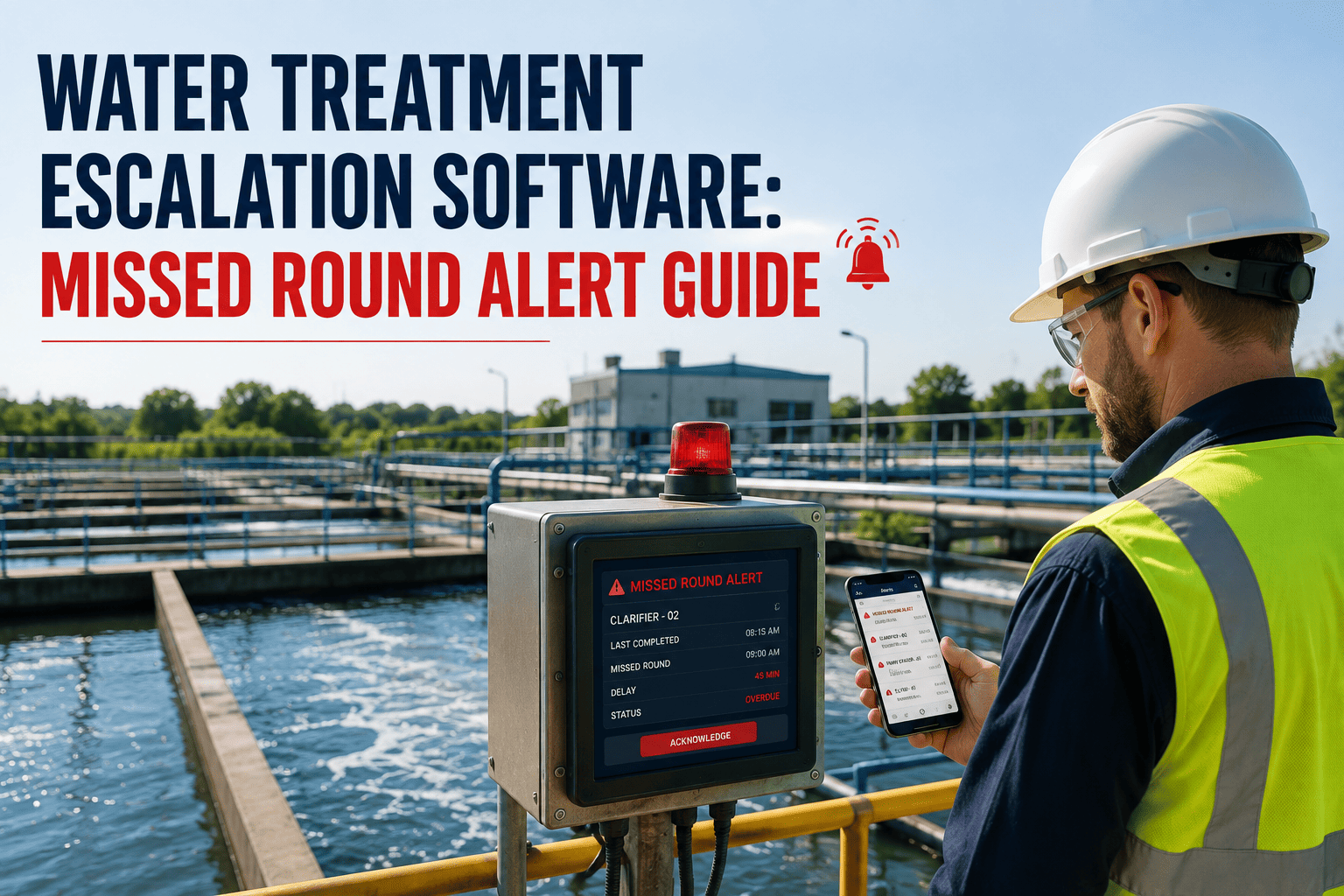
A missed operator round at a water treatment plant is rarely discovered the moment it happens. It surfaces hours later, in a chlorine residual that never got checked, a filter that ran past its backwash window, or a paper logbook with a blank cell nobody caught during shift change. Every one of those gaps carries the same risk: a water quality event that reaches the distribution system before anyone in a position to act even knows a checkpoint was skipped. The plants that avoid this outcome are not the ones with the most experienced operators — they are the ones with an escalation system that notifies a shift supervisor, chief operator, and plant manager automatically the moment a round is missed, instead of relying on someone remembering to look at a logbook. See how OxMaint builds that escalation chain automatically before your next missed checkpoint becomes a compliance file.
Water Treatment Escalation Software: Turn Every Missed Round Into an Automatic Alert
Paper logbooks catch a missed checkpoint after the fact. CMMS-driven escalation catches it in minutes — notifying the shift supervisor first, the chief operator next, and the plant manager if the round still isn't logged, with a timestamped record for every step.
Why a Missed Round at a Water Treatment Plant Is Never a Small Thing
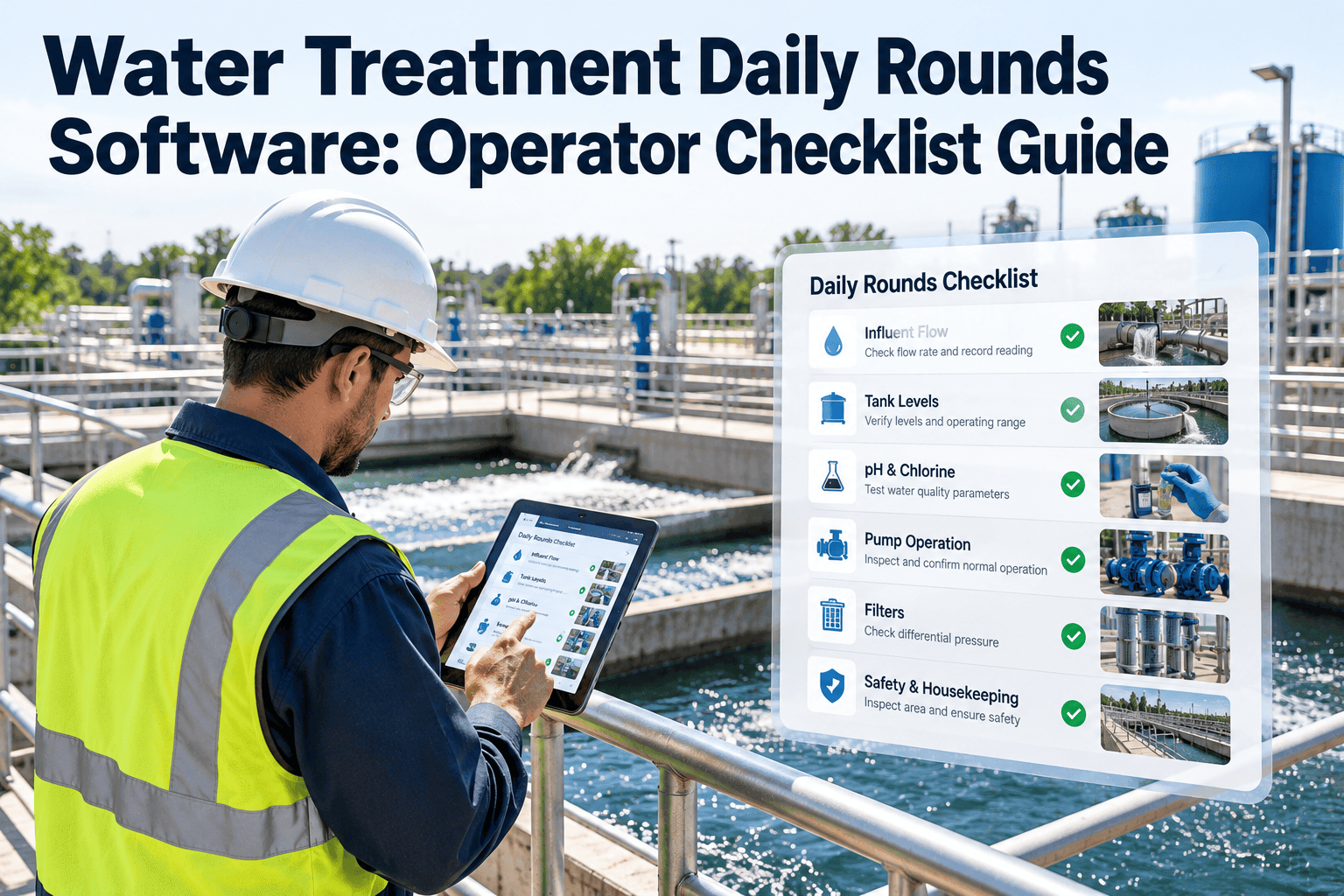
Every water treatment plant runs on a schedule of rounds — physical checks an operator performs at fixed intervals to confirm the plant is behaving the way it should. Rounds exist because instrumentation alone cannot catch everything: a sensor can read normal while a valve is stuck, a pump is short-cycling, or a chemical tote is nearly empty. When a round is skipped, the plant is running blind on exactly the parameters that keep water safe. The checkpoints below are the ones operators, auditors, and regulators pay the closest attention to.
Chlorine Residual Checks
Confirms disinfectant levels stay within the range required to inactivate pathogens before water reaches the distribution system. A missed check here is one of the fastest paths to a public health notice.
Turbidity and Filter Rounds
Verifies filtered water clarity and confirms backwash cycles ran on schedule. Filters that run past their intended cycle length lose efficiency long before an alarm ever fires.
Dosing Pump Inspection
Physical confirmation that coagulant, disinfectant, and pH adjustment pumps are feeding at the correct rate. Tote levels and calibration drift are easy to miss from a control room screen alone.
Pump and Pressure Rounds
Checks high service pumps, pressure readings, and standby equipment status to confirm the distribution system maintains adequate pressure under changing demand.
Calibration Verification
Confirms analyzers and meters are reading accurately. An uncalibrated instrument can silently report compliant numbers while the plant drifts out of range.
Site and Access Rounds
Physical security checks on gates, tanks, and restricted areas — a category regulators increasingly ask fleets to document alongside water quality rounds.
Who Gets Notified When a Round Is Missed — and When
Escalation only works if it follows a fixed, predictable structure that does not depend on who happens to be paying attention that hour. A well-built escalation ladder has four levels, each with its own time window and its own record of who was notified and when.
Shift Supervisor — First Alert
The moment a scheduled round passes its due time without being logged, the on-duty shift supervisor receives an alert. This is the level meant to catch simple delays — an operator pulled into an unplanned task — before they become anything larger.
Chief Operator — Secondary Alert
If the round is still unlogged after the first window closes, the chief operator is notified directly. At this level, the assumption shifts from "delayed" to "at risk," and the chief operator is expected to confirm the checkpoint was actually performed.
Plant Manager — Critical Alert
A round that remains missing past the second window reaches the plant manager, along with the full history of the checkpoint — who was assigned, when it was due, and what alerts already went out. This level exists for accountability, not just awareness.
Regulatory and On-Call Escalation
For checkpoints tied directly to compliance monitoring, an unresolved miss beyond a defined threshold can trigger a notification to an on-call responsible operator or a documented internal compliance review before it becomes a reportable event.
Paper Logbooks vs CMMS Escalation — Side by Side
The gap between a paper-based rounds program and a CMMS-driven one is not about neatness. It is about how fast a missed checkpoint is noticed and how defensible the record is afterward.
| Factor | Paper Logbook | CMMS Escalation Software |
|---|---|---|
| Detection of a missed round | Discovered at shift change or during a review, hours later | Detected the moment the due time passes |
| Notification method | Verbal handoff or a note left for the next shift | Automatic alert to shift supervisor, then up the chain |
| Escalation trigger | Depends on someone noticing the gap | Time-based rule, fires without human recall |
| Audit trail | Handwriting, easy to lose or dispute | Timestamped, exportable, tied to the specific checkpoint |
| Consistency across shifts | Varies by operator habits | Same rule applied every shift, every checkpoint |
| Compliance review readiness | Manual reconstruction from binders | Complete record available in minutes |
Give Every Missed Checkpoint an Automatic Chain of Command
OxMaint tracks every scheduled round against its due time and escalates automatically — shift supervisor first, chief operator next, plant manager if it still isn't resolved — with a timestamped record attached to the checkpoint itself. No verbal handoffs, no depending on someone remembering to check the logbook.
How OxMaint Builds the Escalation Chain Around Your Rounds
Escalation software only earns its place in a plant if it fits around the rounds operators already perform, rather than adding a second system to maintain. Here is what that looks like in practice.
Every Checkpoint Gets a Due Time
Chlorine residual checks, filter rounds, pump inspections, and every other recurring checkpoint are scheduled in OxMaint with a defined due time and an assigned operator, replacing the fixed intervals written into a paper rounds sheet.
The Clock Starts the Moment It's Due
If the round is not logged by its due time, OxMaint starts a countdown against the escalation rule set for that checkpoint. No one has to notice the gap for the system to react.
Alerts Move Up the Chain Automatically
The shift supervisor is notified first, the chief operator second, and the plant manager last — each alert carrying the checkpoint history so nobody has to ask what was missed or for how long.
Every Escalation Closes With a Record
Once the round is completed or the escalation is resolved, the full timeline — due time, missed time, each notification, and the resolution — is stored against that checkpoint, ready to export for any compliance review.
A Sample Escalation Timeline for a Missed Critical Round
What Plants Report After Moving Rounds Into an Escalation System
Water Treatment Escalation Software — Common Questions
What actually counts as a "missed round" that should trigger an alert? +
How is this different from a general maintenance reminder or checklist app? +
Can escalation rules be different for each type of checkpoint? +
Does the escalation history hold up during a compliance review or audit? +
How long does it take to set up escalation rules for an existing rounds schedule? +
Stop Waiting for Someone to Notice a Missed Round
OxMaint turns every scheduled checkpoint into a tracked event with a built-in escalation chain — shift supervisor, chief operator, plant manager — so a missed round is caught in minutes, not discovered during a review. Build the escalation discipline your rounds schedule has been missing.