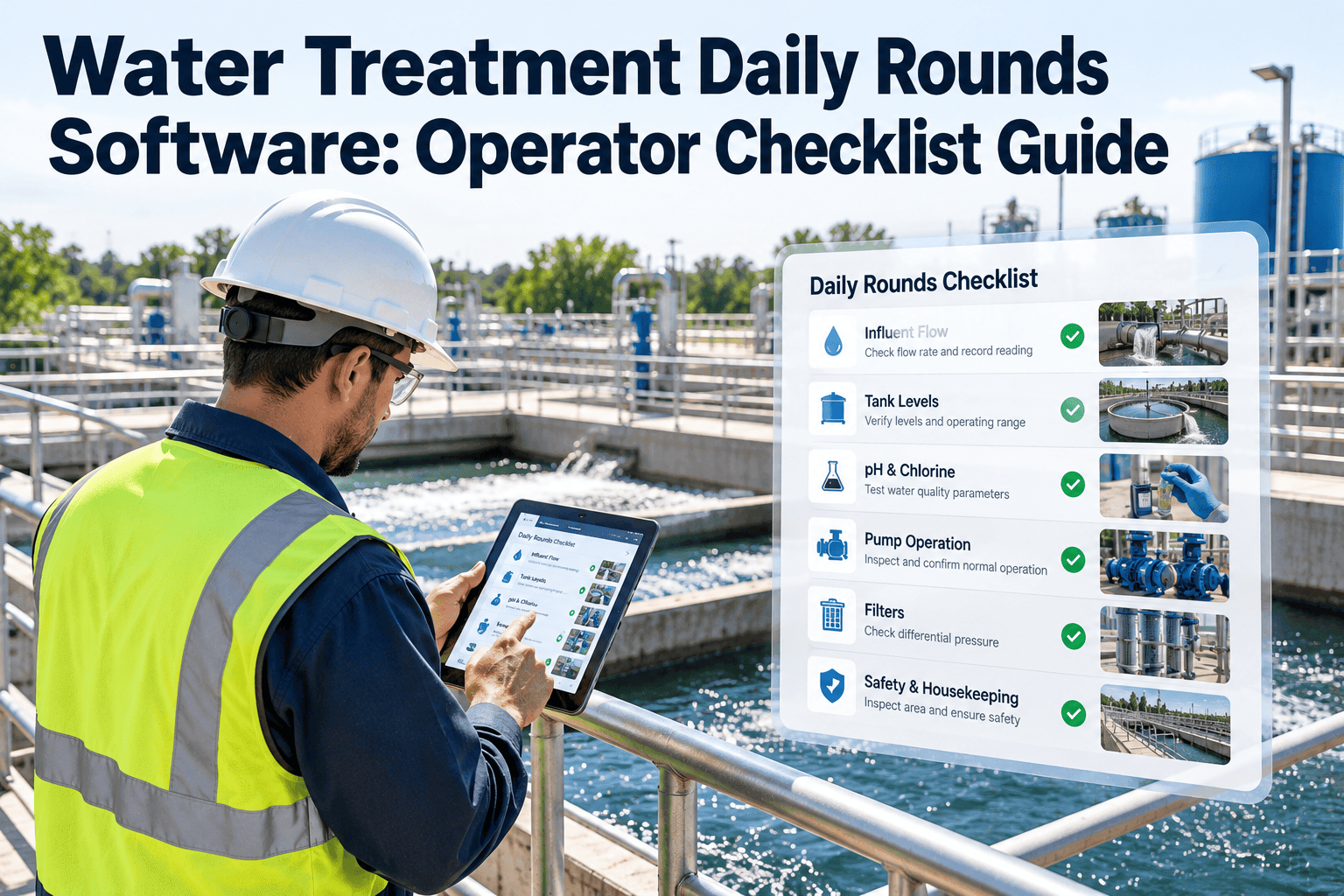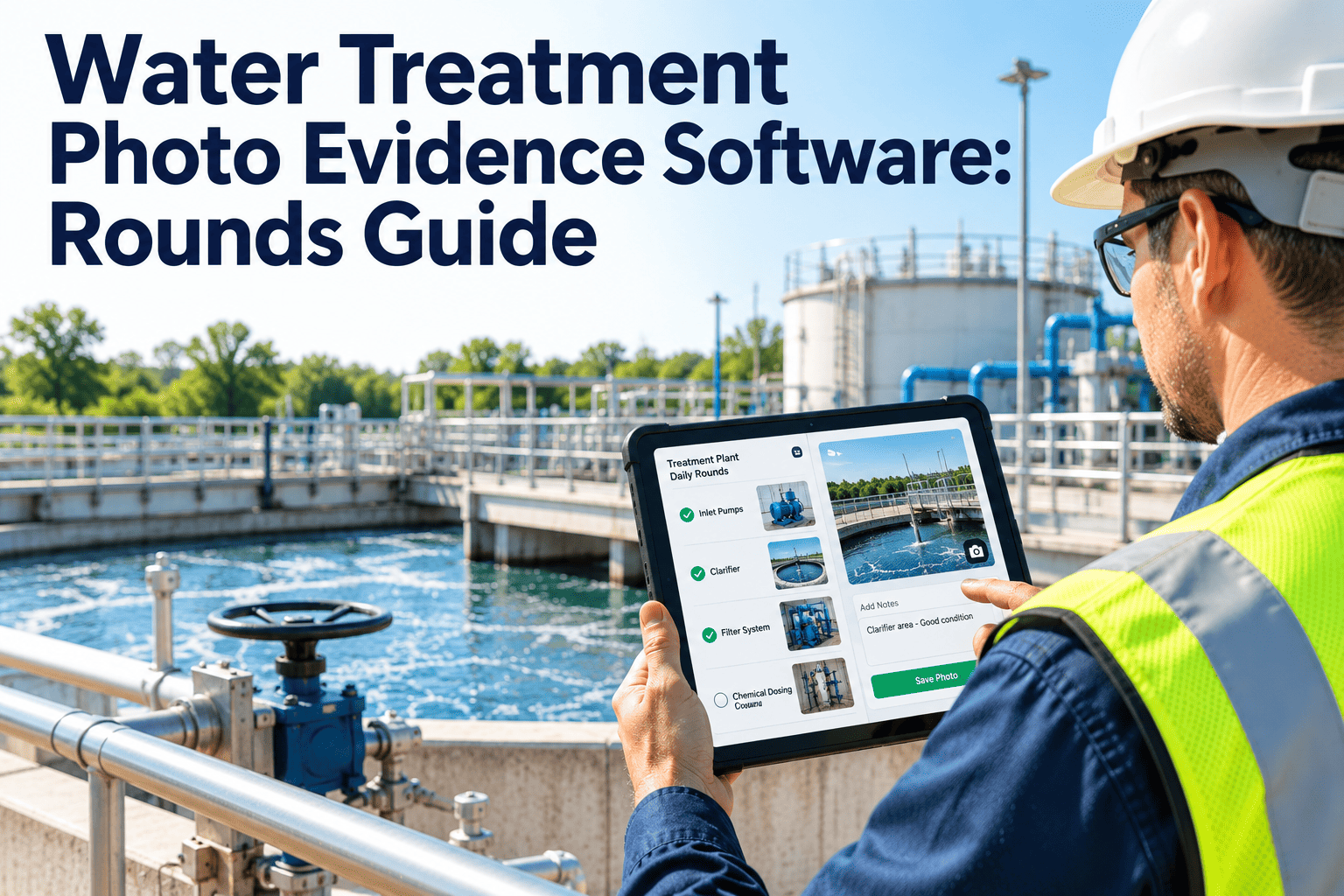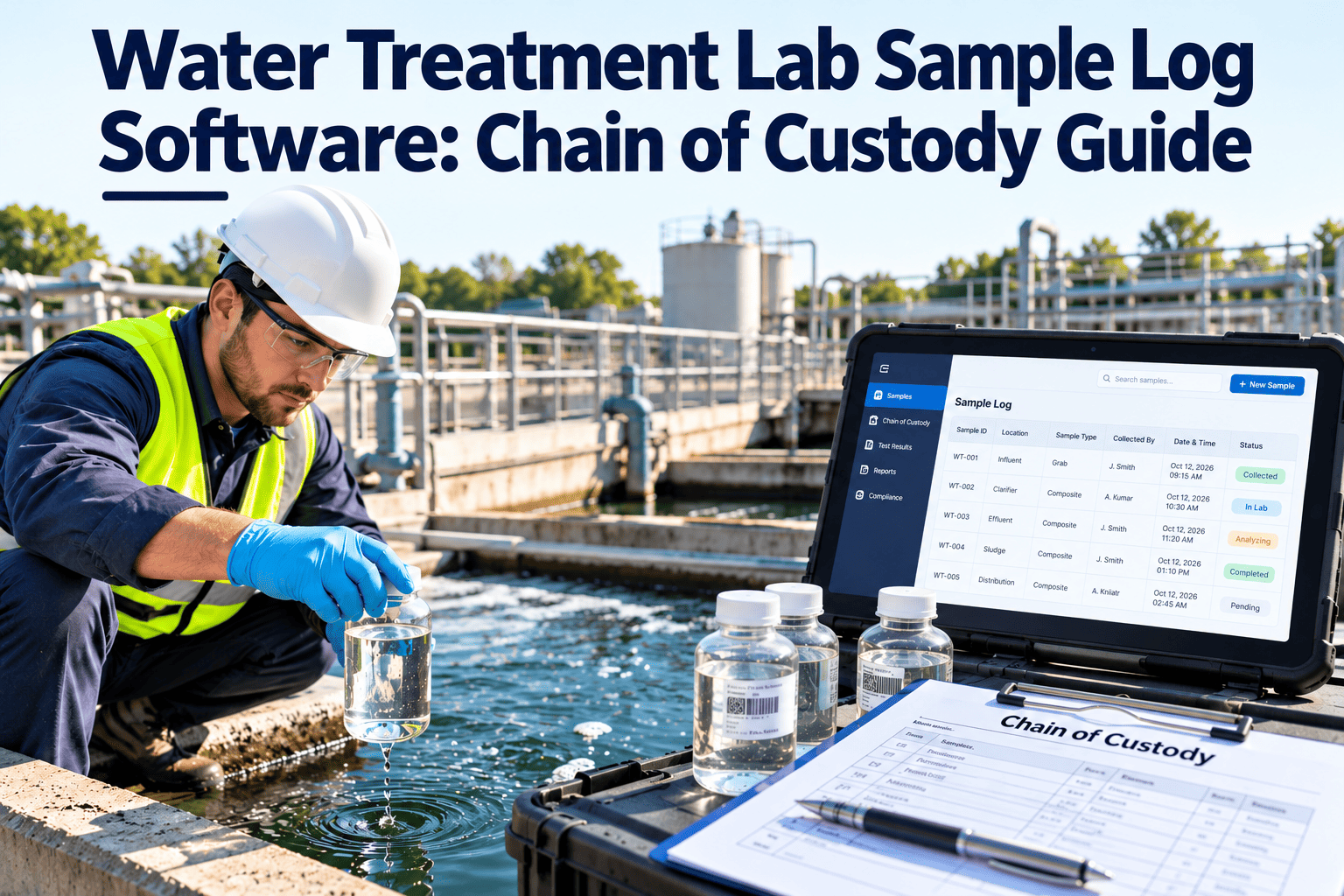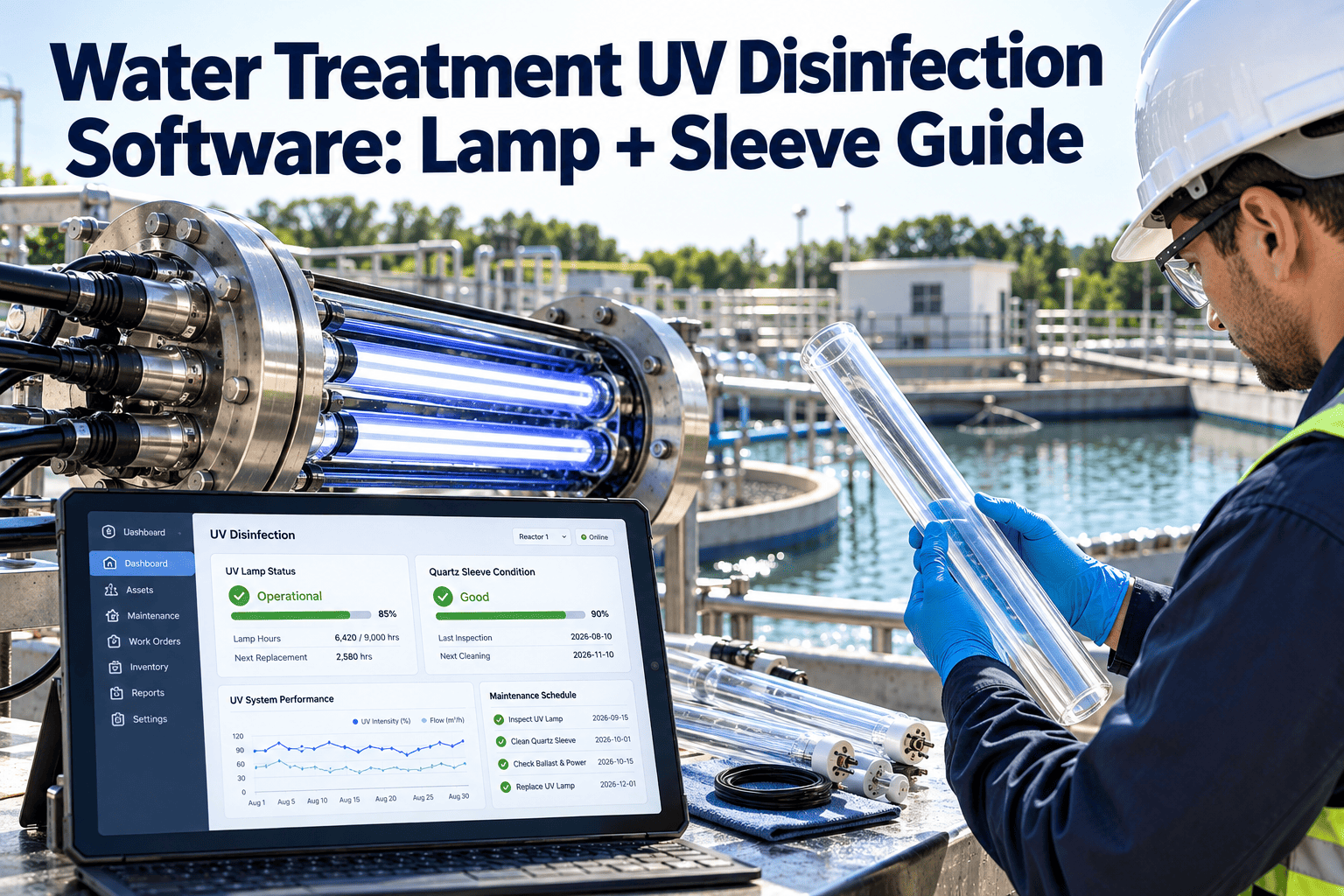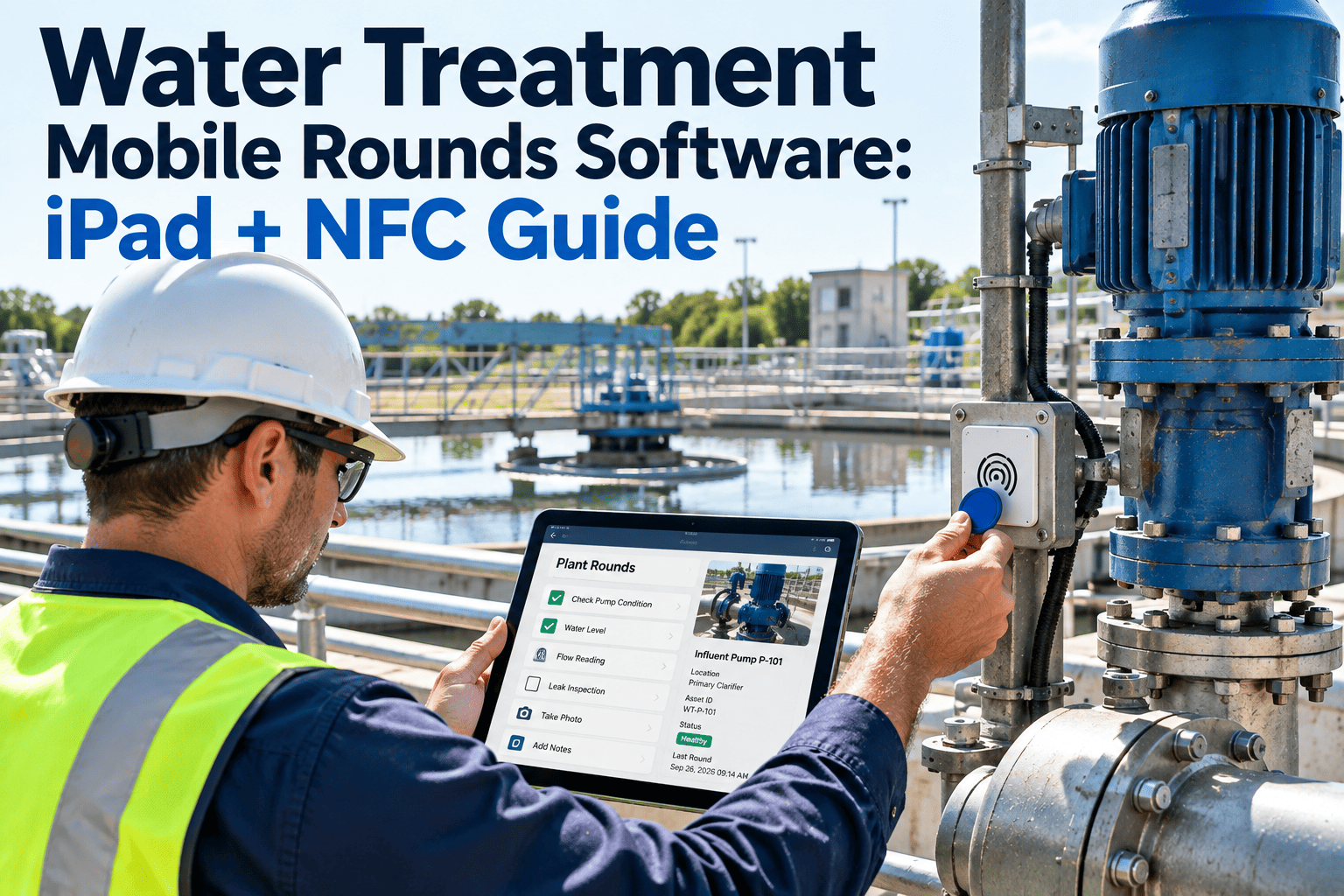
An operator finishing a paper round at a water treatment plant has completed the walk, but nobody downstream can actually prove it happened the way the logbook says it did. Checkpoints get filled in from memory at the end of a shift, a chlorine residual reading gets transcribed once from a test strip and again onto a report weeks later, and the only evidence a regulator or a plant manager has that a checkpoint was physically visited is a handwritten initial next to a blank line. Pairing an iPad-based rounds application with NFC tags at each checkpoint closes that gap by requiring a physical tap at the asset before a reading can be logged. This guide covers how the NFC verification model works, what a six to ten checkpoint round looks like on an iPad in the field, and how it connects to a CMMS built for water and wastewater operations.
Water Treatment Mobile Rounds Software: iPad + NFC Verification Guide
Paper rounds trust that a checkpoint was visited. NFC-verified iPad rounds prove it — a tap at the physical asset, a timestamp, and a reading that can't be logged without both.
Why Proof of Presence Matters More Than the Reading Itself
A water treatment plant runs on a schedule of physical checks — chlorine residual, turbidity, pH, filter head loss, pump vibration, tank levels — each performed by an operator walking a defined route. The reading matters, but so does confirming the operator was physically standing at that specific checkpoint when they recorded it, because a plausible-looking number written from memory is indistinguishable from a genuine one on a paper form.
What a Missed or Falsified Checkpoint Actually Risks
A chlorine residual that never got checked, or was estimated rather than measured, is the kind of gap that surfaces during a regulatory audit or, worse, during an actual water quality event that reaches the distribution system before anyone realizes a checkpoint was skipped. Round completion records are also commonly reviewed during state primacy agency inspections, where a logbook full of suspiciously identical handwriting and round times raises exactly the kind of question a plant manager doesn't want to answer live.
Why Paper Fails Quietly Rather Than Loudly
The uncomfortable part of paper-based rounds is that they rarely fail in an obvious way. A skipped checkpoint filled in from memory looks identical on the page to one that was genuinely visited — the numbers are plausible, the handwriting is consistent, and nothing about the logbook itself signals a problem. The failure only becomes visible when it intersects with something else: a water quality complaint that traces back to a chlorine residual that was never actually measured, or an auditor cross-referencing round times against a plant's access log and finding an operator "recorded" a reading from a location they weren't physically at.
Where the Risk Concentrates
Small and mid-size utilities are often the most exposed to this risk, precisely because they run leaner staffing. A single operator covering an entire overnight shift alone, with no second set of eyes on the logbook until the morning supervisor arrives, has both the least oversight and the strongest incentive to compress a long round into a shorter one when time is tight — the exact condition under which a proof-of-presence requirement matters most.
How NFC Verification Works at Each Checkpoint
The tag itself carries no readings and needs no battery or network connection — it's a passive identifier that simply confirms which physical asset the iPad is next to at the moment of the tap. That's what makes the checkpoint sequence-locked: without a valid tap, the app has no way to open the reading fields for that specific asset, which removes the option to fill in a whole route's worth of numbers from a break room at the end of a shift.
Tag Placement Decisions That Affect Reliability
Where a tag physically sits matters more than most rollouts anticipate. Mounting a tag directly on a metal pump housing can shield the NFC signal, so most successful deployments use a small plastic or composite mounting plate to hold the tag a short distance off metal surfaces. Tags near chemical feed points need a housing rated for the specific chemical environment, since a residual chlorine or ozone atmosphere degrades unrated plastics faster than expected. Placement also has to account for where an operator would naturally stand to take the reading — a tag mounted somewhere technically "at" the asset but physically awkward to reach gets worked around over time, which quietly reintroduces the same trust gap NFC verification was meant to close.
Replace "Trust the Logbook" With "Prove the Route"
OxMaint pairs NFC checkpoint verification with mobile rounds, so every reading arrives with a timestamp, a location, and an operator identity attached — a record a regulator can actually audit.
Deploying iPads in a Wet, Industrial Environment
A treatment plant floor is not an office, and the hardware decisions that work in a break room fail quickly in a chemical feed room or on a catwalk above a clarifier. A few deployment choices tend to separate rollouts that hold up from ones that don't.
Battery life deserves the same deliberate planning as ruggedization. A route that spans a full shift across an outdoor plant footprint, with the screen active for photo capture and reading entry at every checkpoint, draws down a standard iPad faster than office use would suggest. Plants running rounds across multiple shifts typically standardize on charging docks at shift-change locations and treat the device as shared infrastructure — checked out and returned like a radio — rather than as personal equipment assigned to one operator indefinitely.
Connecting Rounds Data to Maintenance and Compliance Reporting
A verified reading is only half the value — the other half is what happens to it after the round closes. When an out-of-range chlorine residual or an elevated pump vibration reading feeds directly into the CMMS as a flagged event, it can generate a corrective work order automatically, routed to the right technician without a phone call or a handwritten note bridging the gap between the operator who found it and the person who fixes it. That direct link between a field observation and a maintenance action is often the single biggest efficiency gain utilities report after switching away from paper, ahead of the compliance benefits that originally motivated the change.
Monthly Operating Reports Without the Re-Keying
Many state monitoring reports require the same readings that operators already capture during rounds, reorganized into a specific regulatory format. Pulling those numbers from a verified digital record rather than retyping them from a paper logbook removes an entire category of transcription error — and gives the plant a clear, timestamped source record if a regulator ever questions a specific entry on the submitted report.
Paper Rounds vs. NFC-Verified Mobile Rounds
| What Matters | Paper Logbook | iPad + NFC Verified Rounds |
|---|---|---|
| Proof of checkpoint visit | Handwritten initial only | Physical tap required to log a reading |
| Out-of-range detection | Caught only if someone reviews the page | Flagged instantly during the round |
| Route sequence | No enforcement, can be done out of order | Locked, next checkpoint unlocks on completion |
| Audit trail for regulators | Legibility and honesty of handwriting | Timestamped, location-verified digital record |
| Missed checkpoint escalation | Discovered after the fact, if at all | Escalates to a supervisor automatically |
| Connection to maintenance | Separate phone call or written note | Out-of-range reading can open a work order directly |
What Regulators Actually Expect From a Rounds Record
State primacy agencies enforcing the Safe Drinking Water Act generally expect operator round and monitoring records to be retained for a period ranging from three to several years depending on the specific parameter, with certain records — like those tied to a compliance violation — held considerably longer. A digital rounds record satisfies that expectation more reliably than a paper logbook because it can't be lost in a filing cabinet, damaged by the same moisture that affects the plant, or reconstructed after the fact.
Building the Case for a Digital Chain of Custody
Beyond retention, what an inspector is really evaluating is whether the plant can demonstrate that monitoring actually happened as scheduled, by a qualified operator, at the correct location and time. NFC-verified rounds answer all three parts of that question in a single digital record instead of asking an inspector to take a handwritten logbook on faith.
Rolling Out NFC Rounds Without Disrupting Operations
Plants that succeed with this transition rarely tag every checkpoint in the facility on day one. A phased rollout that starts with the highest-consequence checkpoints — chlorine residual, turbidity, and any parameter tied directly to a regulatory limit — lets operators get comfortable with the tap-and-log workflow before it becomes the standard for the entire route.
Operator buy-in tends to improve once the workflow demonstrably reduces friction rather than adding it — which is why the checklist for each checkpoint should surface only the fields relevant to that specific asset, rather than a long generic form. An operator who can complete a tap-reading-photo sequence in under thirty seconds per checkpoint has little reason to revert to paper, while a clunky multi-screen form invites exactly the workaround behavior the system was meant to eliminate.
Getting Started With NFC-Verified Rounds
Utilities evaluating this shift rarely need to replatform their entire operation to begin. The starting point is usually a route map of existing checkpoints, tags ordered for the highest-priority compliance points, and an iPad rollout scoped to one shift before expanding plant-wide — the same phased approach that keeps operator adoption high applies equally well to the initial evaluation. Most utilities find the checkpoint mapping exercise itself valuable independent of the technology decision, since it's often the first time in years that someone has walked the full route end to end and confirmed every checkpoint still matches what the current process documentation describes.
Frequently Asked Questions
Give Every Round a Record You Can Actually Defend
OxMaint pairs iPad-based rounds with NFC checkpoint verification, so a completed round means a proven route, not just a filled-in page.