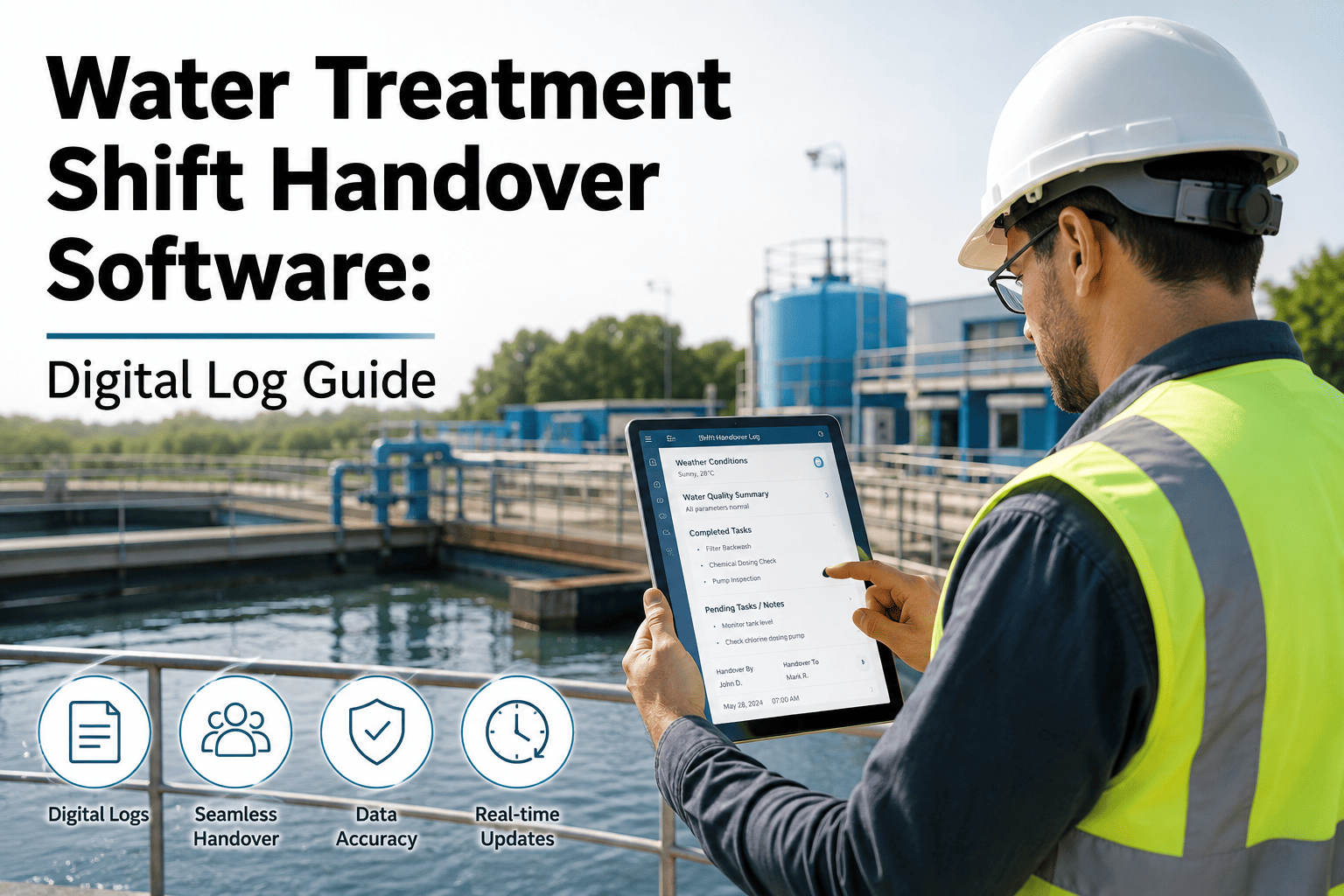
Shift handover at a water treatment plant is the one moment every day when responsibility for public health quietly changes hands, and at most utilities it still happens through a paper log book, a five-minute verbal summary, and whatever the outgoing operator remembers to say on the way out the door. A missed note about a chlorine residual trending low, a filter backwash that got postponed, or a chemical feed pump running on a borrowed part is not a paperwork gap — it is an operational blind spot that carries straight into the next shift and the next compliance sample. Plants that move handover onto a structured digital shift log consistently catch developing issues earlier and produce a clean, timestamped record for the next state primacy inspection. Sign in to OxMaint to see how a digital shift log closes that handover gap at your plant.
| Handover Element | Paper Log Book | OxMaint Digital Log |
|---|---|---|
| Entry format | Free text, handwriting quality varies | Structured fields, always legible |
| Open issue continuity | Depends on next shift reading closely | Carries forward automatically until closed |
| Plant state at handover | Reconstructed from notes and a walk-through | Captured as a timestamped snapshot |
| Trend visibility | Only visible by re-reading past pages | Searchable across every past shift |
| Supervisor oversight | Requires physically reviewing the binder | Live dashboard across all shifts and operators |
| Inspection readiness | Manual search through paper records | Exportable history in minutes |
A shift log is not just a record for the next operator — it is also the raw material for a plant's compliance history, its maintenance planning, and its training for new hires. When shift logs live on paper, that raw material stays locked in a binder and rarely gets reused for anything beyond the original handover conversation. When shift logs live in a structured digital system, the same entries can support several different needs without anyone re-entering data by hand.
Compliance reporting is the most obvious example. State primacy agencies expect operational records that show continuous, competent operation of the treatment process, including any deviations and the corrective action taken. A digital shift log that already captures readings, alarms, and interventions in a structured, timestamped format is far easier to compile into a compliance submission than a stack of paper pages that have to be manually transcribed. The same record that helped the incoming operator understand the plant at 6am also becomes the evidence the utility relies on when an inspector asks what happened on a specific date.
Maintenance planning benefits in a similar way. When an operator logs a manual intervention — restarting a pump, adjusting a valve position, or working around a faulty sensor — that entry is also a signal for the maintenance team. Instead of waiting for a formal work request to be filed separately, recurring interventions logged in the shift history can be flagged for a maintenance review, closing the gap between what operators notice day to day and what the maintenance schedule actually addresses.
New operator training is the quieter benefit, but often the one supervisors mention first once they have used a digital shift log for a few months. A new hire can review weeks of real shift history — what issues came up, how they were handled, and what a normal shift actually looks like at this specific plant — instead of learning entirely through shadowing and verbal stories. That shortens the ramp-up period and gives new staff a reference they can return to instead of relying purely on memory of a training conversation.
Not every digital log adds value just because it is digital. A poorly designed template can be just as frustrating as a paper page — too many required fields that do not apply to a given shift, or too few fields to capture what actually matters at a specific plant. The templates that operators actually use consistently tend to share a few traits: they are organised around the plant's real process flow rather than a generic checklist, they only require detail where detail genuinely matters, and they make it faster to log a normal, uneventful shift than to leave the log incomplete.
OxMaint shift log templates are configured around each plant's specific treatment process, so an operator at a conventional surface water plant sees fields relevant to coagulation, filtration, and disinfection, while an operator at a groundwater plant sees fields relevant to well status and wellhead treatment instead of a generic form built for neither. That specificity is what turns a digital log from an extra task into the fastest way to finish a shift's paperwork.
Shift Handover Should Not Depend on Memory. It Should Depend on a Record Both Operators Can See.
Digital shift logs, open issue escalation, process state snapshots, and full shift history in one dashboard — OxMaint gives every operator a complete picture at the start of their shift, and every supervisor a complete picture of the plant at any time.