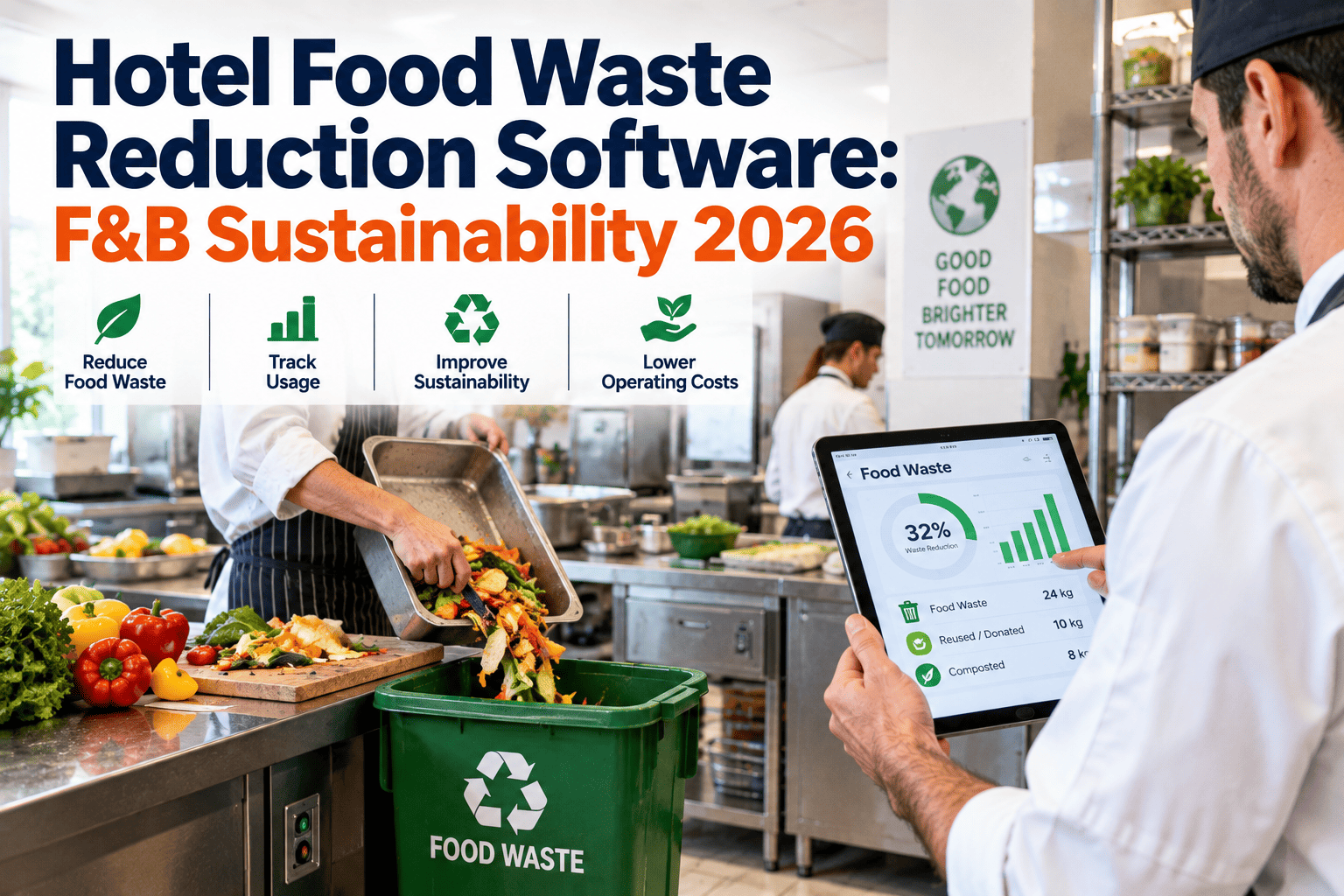
The executive chef at a 320-room convention hotel pulled the weekly waste report and felt his stomach drop. The property had thrown away 4,200 pounds of food in seven days—$11,400 in purchased ingredients that went straight into the dumpster. The banquet kitchen overproduced 340 covers worth of prime rib for a Saturday gala that only drew 280 guests. The breakfast buffet discarded 127 pounds of scrambled eggs, pastries and fruit across the week because production quantities hadn't been adjusted for 62% midweek occupancy. The manger station tossed 89 pounds of prepped vegetables that expired before the anticipated restaurant covers materialized. Room service wasted $1,800 in prepared meals that were never ordered because the menu hadn't been adjusted for the corporate group that ate exclusively at the convention center. In a single month, the hotel's F&B operation wasted $48,000 in food cost—representing 12.4% of total food purchases going directly to waste. An AI-powered food waste reduction system analyzing PMS occupancy data, historical consumption patterns, event BEO details, weather forecasts, and real-time POS ticket data would have recommended 280 covers for the gala (not 340), reduced breakfast production by 35% on Tuesday-Wednesday, flagged the vegetable prep excess before cutting began, and adjusted room service par levels for the convention group. Projected savings on that single week alone: $7,800. Annual impact across a property this size: $180,000-$260,000 in recovered food cost—money that drops straight to the bottom line.
Overproduction
45-55%
AI Reduces: 60%
Buffet Waste
25-35%
AI Reduces: 50%
Spoilage
15-20%
AI Reduces: 70%
Plate Waste
8-12%
AI Reduces: 35%
Prep Trim
5-8%
AI Reduces: 25%
$48K/mo
Average food waste cost for a 300-room full-service hotel with multiple F&B outlets
12.4%
Of total food purchases wasted before reaching a guest—industry average for hotels without AI
40-60%
Waste reduction achievable with AI-powered production forecasting and inventory management
AI-powered food waste reduction transforms hotel kitchen operations from experience-based guessing to data-driven precision. Instead of chefs estimating tomorrow's covers from memory and intuition—overproducing by 15-25% "just in case"—machine learning algorithms analyze occupancy forecasts, historical consumption patterns, event details, weather data, day-of-week trends, and real-time POS velocity to predict exact production quantities for every menu item across every meal period. Hotels that implement AI-integrated kitchen operations tracking through a CMMS platform connect waste monitoring with equipment maintenance, inventory management, and compliance documentation—creating the operational intelligence loop that turns food cost from uncontrolled variable to managed metric.
How AI Predicts Food Production Needs Before a Single Ingredient Is Prepped
Traditional hotel kitchens produce food based on three unreliable inputs: the chef's experience, yesterday's numbers, and a generous safety margin. AI replaces guesswork with correlated data analysis—processing dozens of variables simultaneously to forecast demand with 85-92% accuracy versus the 60-70% accuracy of human estimation. The result is production quantities that match actual consumption, eliminating the systematic overproduction that accounts for 45-55% of all hotel food waste.
1
PMS Occupancy Data
Room Count, Guest Segments, Arrival/Departure Patterns, Group Mix
Capture Rate
Pax Forecast
Segment Behavior
2
Event & Banquet BEOs
Guaranteed Counts, Menu Selections, Service Times, Dietary Requirements
Cover Prediction
Menu Mix
Timing Analysis
3
Historical Consumption
POS Item Sales, Buffet Depletion Rates, Menu Popularity Trends
Item Velocity
Day-of-Week
Seasonal Trends
4
External Factors
Weather Forecasts, Local Events, Holiday Calendars, Flight Schedules
Demand Shifts
Walk-In Traffic
Behavioral Impact
5
Real-Time POS Velocity
Live Order Flow, Item Sell-Through Rate, Table Turn Time
Mid-Service Adjust
86 Predictions
Prep Triggers
6
Inventory & Shelf Life
On-Hand Stock, Expiration Dates, Receiving Schedules, Par Levels
Use-First Alerts
Spoilage Risk
Cross-Utilization
The AI Waste Reduction Process: From Data to Kitchen Action
Understanding how AI transforms raw operational data into precise kitchen production guidance helps F&B teams see why the technology succeeds where spreadsheets and gut instinct consistently fail. The process runs continuously—adjusting forecasts as new data arrives right up until service begins. Teams ready to see the impact on their own operation can schedule a waste reduction assessment to evaluate current waste levels and projected AI savings.
1
Demand Aggregation
AI pulls PMS occupancy, BEO event data, weather, historical POS patterns, and inventory levels into a unified demand model updated every 4 hours
2
Production Forecasting
ML algorithms generate item-level production quantities per meal period per outlet—accounting for capture rates, menu mix probability, and segment behavior
3
Prep Sheet Generation
System outputs daily prep sheets with exact quantities, ingredient requirements, cross-utilization suggestions, and use-first-expiring-first alerts
4
Waste Tracking & Learning
Post-service waste is weighed, categorized, and fed back to the AI—improving prediction accuracy from 85% in month one to 92%+ by month six
Turn Food Waste Data Into Bottom-Line Savings
OXmaint integrates AI food waste tracking with kitchen equipment maintenance, walk-in temperature monitoring, and compliance documentation—connecting production intelligence with the operational reliability that keeps food safe and kitchens running.
Where Hotel Kitchens Waste the Most: AI-Targeted Reduction Areas
Food waste in hotel F&B operations follows specific patterns tied to outlet type, meal period, and production method. AI targets the highest-waste categories first—delivering fastest ROI by addressing the production decisions that generate the most waste dollars. Each waste category has distinct causes that AI addresses through different data correlations and prediction models.
AI Solution: Correlates historical no-show rates by event type, day-of-week, group segment, and weather to recommend production quantities 8-15% below guaranteed count—matching actual attendance within 3-5% accuracy
$72K-$130K annual savings potential
AI Solution: Adjusts buffet production per occupancy level, guest segment mix (leisure vs. business vs. group), departure patterns, and time-of-day depletion rates—reducing end-of-service excess by 40-55%
$36K-$65K annual savings potential
AI Solution: Tracks ingredient shelf life against forecasted demand, recommends menu features to utilize expiring inventory, triggers cross-utilization between outlets, and adjusts ordering to match actual consumption velocity
$28K-$48K annual savings potential
AI Solution: Analyzes POS item velocity by day-of-week, group type, and meal period to optimize mise en place quantities, reduce over-prepping of low-demand items, and adjust room service par levels for specific guest segments
$18K-$35K annual savings potential
Traditional Kitchen Management vs. AI-Powered Operations
Forecast Accuracy:
60-70% (chef experience)
Safety Margin:
15-25% overproduction
Inventory Decisions:
Manual par levels, static
Waste Visibility:
End-of-month P&L shock
Food Cost %:
32-38% (uncontrolled)
Forecast Accuracy:
85-92% (data-driven)
Safety Margin:
3-5% precision buffer
Inventory Decisions:
Dynamic, demand-adjusted
Waste Visibility:
Real-time by item & outlet
Food Cost %:
26-31% (managed)
40-60%
total food waste reduction
4-8 pts
food cost percentage improvement
$180K+
annual savings per 300-room hotel
ROI: What Hotels Actually Achieve with AI Waste Reduction
Weeks 1-4
Baseline & Audit
Waste stream categorization, Weight tracking setup, POS integration, Historical data loading
Foundation building
Months 2-3
First Forecasts
AI production recommendations begin, Buffet quantities adjusted, Banquet forecasting active
15-25% reduction
Months 4-6
Mature Prediction
92%+ forecast accuracy, Cross-utilization automated, Ordering integration active
35-50% reduction
Month 7+
Sustained Impact
Continuous learning, Menu engineering insights, Full ESG documentation
40-60% sustained
Typical Payback Period
2-4 Months
Expert Perspective: Why AI Succeeds Where Spreadsheets Fail
Industry Insight
"I've managed hotel kitchens for 24 years, and the dirty secret of our industry is that most chefs overproduce by 15-25% every single service because the cost of running out is more visible than the cost of throwing away. A guest who doesn't get their entrée complains to the GM. A bin full of overproduced prime rib gets tossed quietly at midnight. AI changes this equation entirely. When the system tells me I need 274 covers for Saturday's gala instead of my instinct saying 320, and the actual count comes in at 281—that's when you realize data beats intuition every time. My food cost dropped from 34.2% to 28.8% in six months. That's $210,000 annually at my property. Not from buying cheaper ingredients or cutting portions—from simply making the right amount of food."
— Executive Chef, AAA Four Diamond Resort, 24 Years Hotel F&B
Banquets Are Ground Zero
Banquet overproduction generates 35-45% of total hotel food waste. AI correlates event type, group segment, day-of-week, and historical no-show rates to nail production quantities within 3-5% of actual attendance.
Buffets Need Real-Time Adjustment
AI tracks depletion rates during service and adjusts replenishment recommendations—reducing end-of-service excess by 40-55% without any guest experiencing an empty chafing dish.
Cross-Utilization Is Money
AI identifies expiring inventory and recommends menu features, daily specials, and cross-outlet utilization—turning potential spoilage waste into revenue-generating dishes before ingredients expire.
Implementation Requirements: What AI Waste Tracking Needs
Smart scales at waste stations, Tablet for categorization, Camera AI for visual tracking, Temperature monitors for walk-ins
Accurate waste measurement
PMS occupancy feed, POS item-level data, Event/BEO system, Inventory management, Purchasing platform
Unified demand intelligence
Cloud AI platform, Forecasting models, CMMS integration, Mobile dashboards, ESG reporting suite
Predictive production intelligence
Stop Throwing Away $48,000 a Month in Food Cost
OXmaint connects AI food waste intelligence with kitchen equipment maintenance, walk-in cooler monitoring, and compliance tracking—ensuring the operational infrastructure behind food production is as precise as the forecasting intelligence driving it.
Frequently Asked Questions
How does AI reduce food waste in hotel restaurants and banquets?
AI reduces food waste by replacing experience-based production estimates with data-driven demand forecasting. Machine learning algorithms process PMS occupancy data, historical POS consumption patterns, event BEO details, weather forecasts, day-of-week trends, and guest segment behavior to predict exact production quantities for every menu item across every meal period and outlet. For banquets, AI correlates event type, group segment, and historical no-show rates to recommend quantities within 3-5% of actual attendance—versus the 15-25% overproduction safety margin most kitchens apply. For buffets, AI adjusts production based on occupancy-driven capture rates and tracks depletion velocity during service to optimize replenishment. For à la carte, POS item velocity analysis right-sizes mise en place quantities. The combined effect reduces total food waste by 40-60%, translating to $180,000-$260,000 in annual food cost savings for a 300-room full-service hotel.
How much can a hotel save with AI food waste reduction?
A 300-room full-service hotel with multiple F&B outlets typically wastes $400,000-$575,000 annually in food cost—representing 10-14% of total food purchases. AI-powered waste reduction systems typically recover 40-60% of this waste through precision forecasting, inventory optimization, and cross-utilization intelligence. This translates to $180,000-$345,000 in annual food cost savings, with an additional $15,000-$40,000 in reduced waste hauling, disposal fees, and grease trap service costs. Implementation costs for waste tracking hardware ($3,000-$12,000), system integration, and AI platform subscription ($500-$2,000/month) deliver payback within 2-4 months. Food cost percentage typically improves 4-8 points—from the 32-38% range to 26-31%—without any reduction in food quality, portion size, or guest satisfaction.
Does AI food waste technology work with existing hotel systems?
Yes—AI food waste platforms integrate with existing hotel technology stacks through standard APIs and data feeds. Core integrations include PMS systems (Opera, Mews, Cloudbeds) for occupancy and segment data, POS platforms (Micros, Toast, Lightspeed) for item-level consumption data, event management systems for BEO details, and inventory/purchasing platforms for ingredient tracking. Most platforms also connect with CMMS systems like OXmaint to monitor kitchen equipment health—because food waste prevention depends on functional walk-in coolers, reliable freezers, and properly maintained cooking equipment. Integration typically takes 2-4 weeks, with AI model training requiring an additional 4-8 weeks of operational data before forecasts reach optimal accuracy. No hardware changes to existing kitchen equipment are needed; waste tracking stations (smart scales and categorization tablets) are the only physical additions.
How does AI food waste tracking support hotel sustainability and ESG goals?
AI food waste platforms provide verified, data-backed sustainability metrics essential for ESG reporting, green certifications (LEED, Green Key, EarthCheck), and corporate travel RFP sustainability requirements. Specific metrics include total food waste by weight and cost per meal period, diversion rates for composting and donation programs, carbon footprint reduction calculations based on prevented waste, water and energy embedded in wasted food, and progress tracking against waste reduction targets. For hotels pursuing green certifications, AI waste data provides the auditable documentation that certification bodies require—replacing estimated waste figures with sensor-verified measurements. Corporate travel buyers increasingly require verified sustainability data in RFP responses; hotels with AI waste tracking can provide specific, property-level metrics that competitors relying on industry averages cannot match.