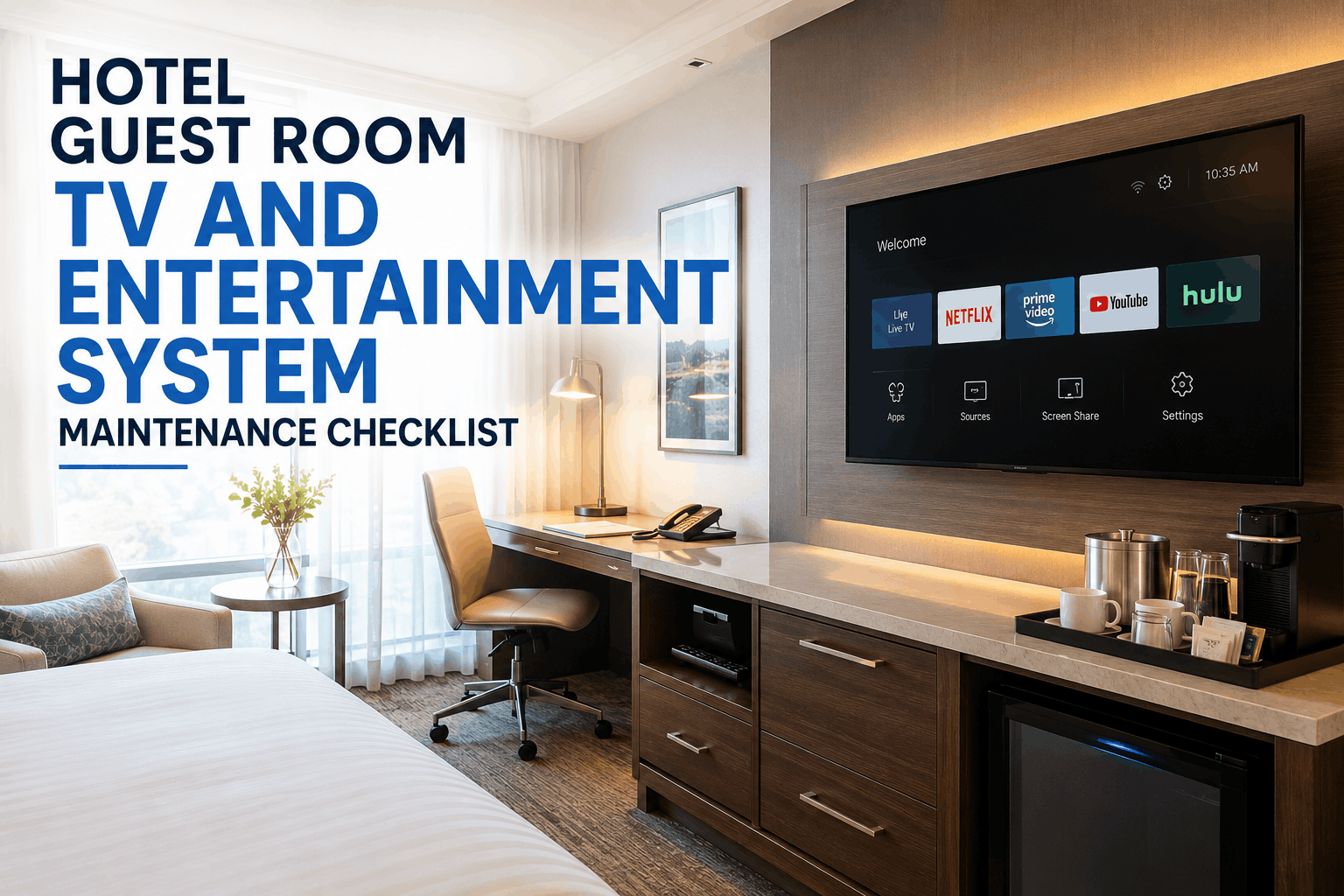
Guest room entertainment systems are mission-critical assets in modern hospitality — a broken television, non-functional streaming, or unresponsive remote control directly impacts guest satisfaction scores and online reviews. Hotels running preventive TV maintenance schedules report 34% fewer guest complaints related to entertainment systems and extend smart TV lifespan by 2-3 years. OxMaint's CMMS tracks TV maintenance schedules, remote control inventory, casting system diagnostics, and HDMI port testing per room — ensuring entertainment systems stay guest-ready while reducing costly emergency replacements.
Hotel Guest Room TV & Entertainment Maintenance: Complete Preventive System Checklist
Smart TV updates, remote battery replacement, HDMI testing, streaming service troubleshooting, TV mount inspection, and casting system diagnostics — the complete preventive maintenance guide for hotel entertainment systems that reduces downtime by 68% and guest complaints by 34%.
Section 1: Monthly Smart TV Preventive Maintenance Protocol
Smart TV failures in guest rooms stem from firmware gaps, memory bloat, and thermal buildup — issues that don't trigger visible errors until the guest presses the remote and finds the system unresponsive. Monthly preventive maintenance on hotel TVs should include firmware updates (firmware security patches fix 73% of streaming playback issues), cache clearing, HDMI port contact cleaning, TV mount fastener inspection, and thermal vent dust removal. Hotels implementing monthly TV maintenance schedules report 42% fewer guest-initiated maintenance calls during their stay and a 28% improvement in post-stay guest satisfaction ratings related to entertainment systems. OxMaint CMMS automates monthly TV maintenance scheduling per room, tracking firmware versions and generating task lists for engineering staff — ensuring no guest-facing entertainment asset sits unserviced.
Section 2: Remote Control & Input Device Management Strategy
Remote control batteries fail silently — guests find non-responsive controls at 11 PM when the front desk cannot respond. Hotels with reactive remote replacement strategies experience an average of 8 remote-related maintenance requests per 50-room floor per month. Implementing a predictive remote battery replacement schedule based on usage patterns reduces these requests by 81% and eliminates guest frustration. Smart remote batteries should be replaced every 90 days in high-occupancy hotels (80%+ occupancy) and every 120 days in moderate-occupancy properties. Backup remotes should be stored in every room's maintenance closet with clear labeling. Voice-command remote systems (Amazon Fire, Google TV) require additional firmware checks — voice command failures often result from cloud API misconfigurations rather than hardware defects, a 15-minute diagnostic that guests will never attempt themselves.
Section 3: Streaming Service & HDMI Casting System Diagnostics
Guest streaming failures are rarely TV hardware faults — 87% result from WiFi credential loss, incorrect HDMI input selection, or app authentication failures. When a guest cannot access Netflix or Disney+, they don't call maintenance immediately; they waste 20 minutes troubleshooting, then resort to negative online reviews about "broken TV systems." Hotels should implement a monthly streaming service credential audit and casting system test — verifying WiFi SSID is broadcasting with correct signal strength (minimum -65 dBm in guest rooms), each streaming app is logged in with valid credentials, and HDMI input auto-detection is working properly. Guest WiFi networks should isolate entertainment systems to prevent bandwidth contention; a single streaming guest on shared WiFi can reduce available bandwidth to all other TVs on that floor segment. HDMI CEC (Consumer Electronics Control) should be enabled to allow mobile device casting and disabled only if it causes input-switching chaos during initial setup — most modern TVs handle CEC well once configured correctly the first time.
Section 4: TV Hardware Testing & Safety Compliance Framework
TV mount safety should never be assumed. Televisions in guest rooms are mounted above beds and work areas where guest injury becomes hotel liability — quarterly mount inspections are not optional compliance, they are essential risk management. Quarterly TV mount safety audits should test VESA plate fasteners for tightness, verify wall anchor loads match TV weight specifications, and inspect bracket arms for stress cracks or fatigue. All mounting bolts should be tightened to manufacturer specification (typically 4-6 Nm for standard mounts) using a calibrated torque wrench — hand-tight fastening causes micromovement that gradually loosens fasteners over months. TVs over 50 inches should use dual-stud wall mounts with supplemental safety cables rated to 2.5× the TV weight. Any wall mount bracket showing visible movement when the TV is powered on and displaying content should be immediately removed from service until professional re-installation. Beyond mount safety, TVs should be powered through surge-protected circuits with 30-amp capacity to prevent startup surge damage — guest room power strips can be inadequate for 65+ inch TVs.
We implemented monthly TV maintenance scheduling through OxMaint 8 months ago. Before: averaging 15-18 guest entertainment complaints per month. After: down to 2-3. Our engineering team loves the automated reminders — no TV sits unserviced. Guest feedback on entertainment systems went from 3.4 to 4.7 stars. The cost savings on emergency replacements alone paid for OxMaint in the first quarter.
Frequently Asked Questions
Prevent Guest Entertainment Complaints Before They Happen
OxMaint automates TV maintenance scheduling, remote battery replacement, and streaming service audits — ensuring every guest room entertainment system is ready.
.png)


.png)
