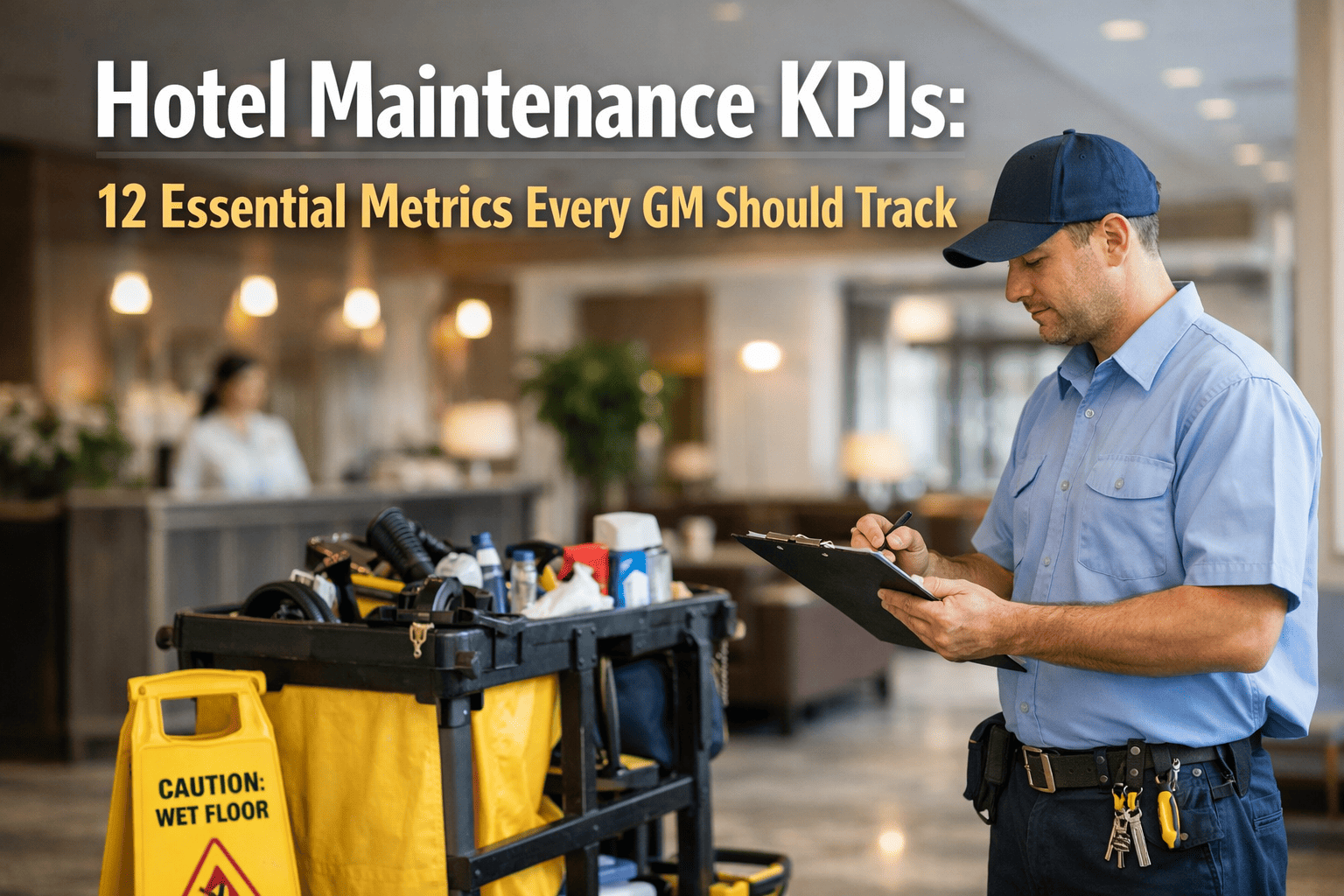
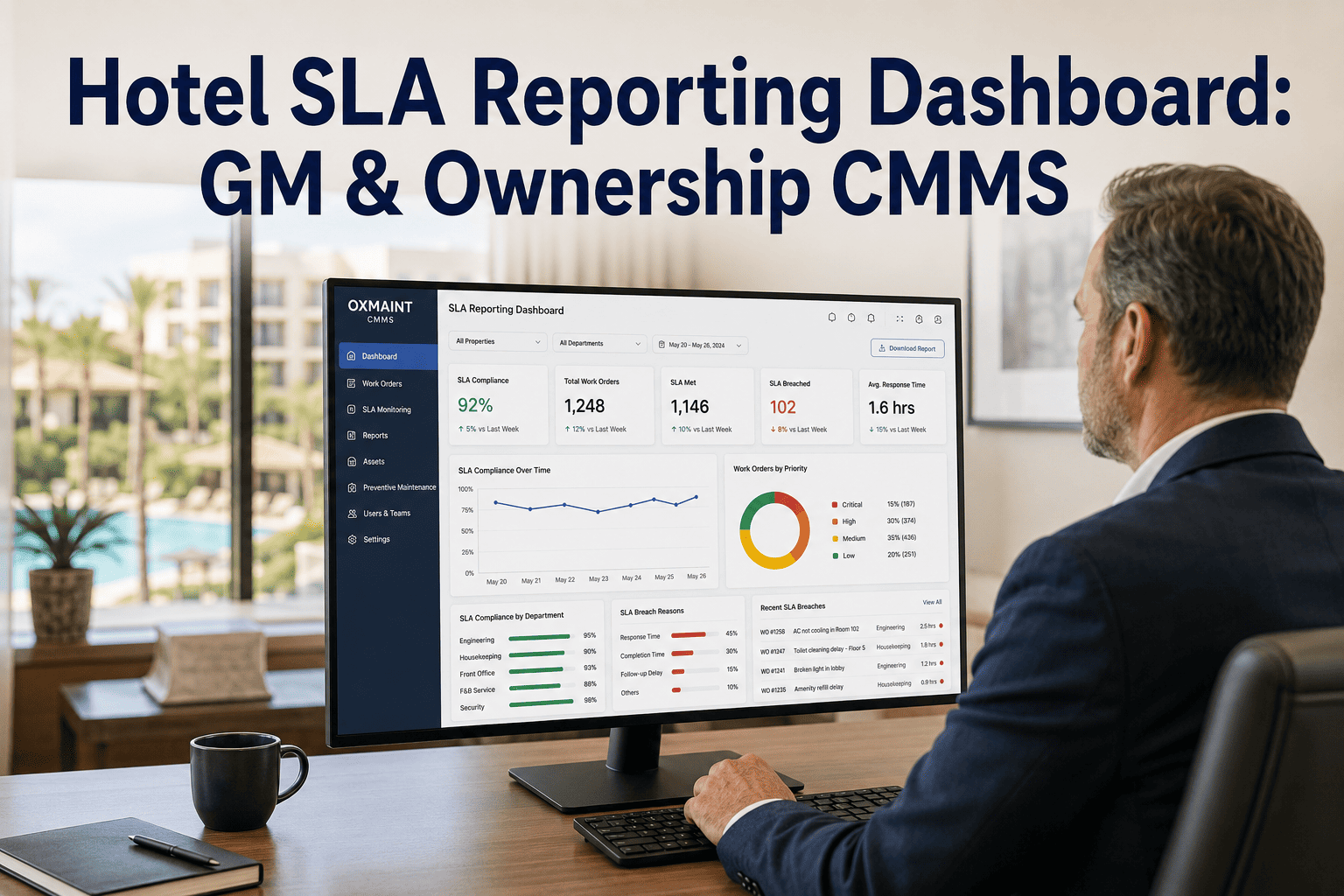
Most hotel GMs can tell you how many work orders were completed last month. Far fewer can tell you their mean time to repair, their PM compliance rate, or what percentage of their maintenance is reactive versus planned. That gap between activity tracking and performance measurement is exactly where operational costs hide — and where guest satisfaction scores quietly erode.OxMaint connects IoT leak sensors directly to your maintenance workflow and Book a demo
3–5x
higher cost of reactive vs planned maintenance
60%
of hotels still use paper, radio, and spreadsheets
28%
higher asset availability with MTTR under 4 hours
Why KPIs Matter More Than Work Order Counts
Work orders completed is a vanity metric. It tells you how busy the team was — not whether the maintenance program is working. A team closing 200 work orders a week could still be losing ground if 70% of those are reactive repairs driven by failures that preventive maintenance should have caught.
What average hotels track
Work orders completed
Open work order count
Technician hours logged
What top-performing hotels track
MTTR by asset class and zone
PM compliance rate
Reactive vs planned ratio
Cost per work order
First-time fix rate
Work order backlog age
The 12 KPIs Every GM Should See on Their Dashboard
These metrics are grouped into three categories: speed metrics that reflect how fast your team responds and resolves, quality metrics that show whether the maintenance program is working, and cost metrics that connect maintenance performance directly to the P&L.
Speed Metrics
01
Mean Time to Repair (MTTR)
Speed
The average time from fault detection to asset back in service. The single highest-impact metric for both guest satisfaction and emergency spend.
Total Repair Time / Number of Repairs
World-class
Under 2 hours
Industry target
Under 4 hours
02
Mean Time Between Failures (MTBF)
Speed
Average operating time between failures for a given asset. Rising MTBF confirms your PM program is extending equipment life. Falling MTBF on a specific asset class signals approaching end-of-life or inadequate maintenance intervals.
Total Operating Time / Number of Failures
Trend target
Rising month-over-month
Red flag
Falling on same asset type
03
Work Order Response Time
Speed
Time from work order creation to technician acknowledging and beginning work. Directly correlates with guest-facing resolution speed and front-desk communication accuracy.
Time of First Technician Action — Work Order Created Time
P1 Critical
Under 15 minutes
P3 Standard
Under 24 hours
Quality Metrics
04
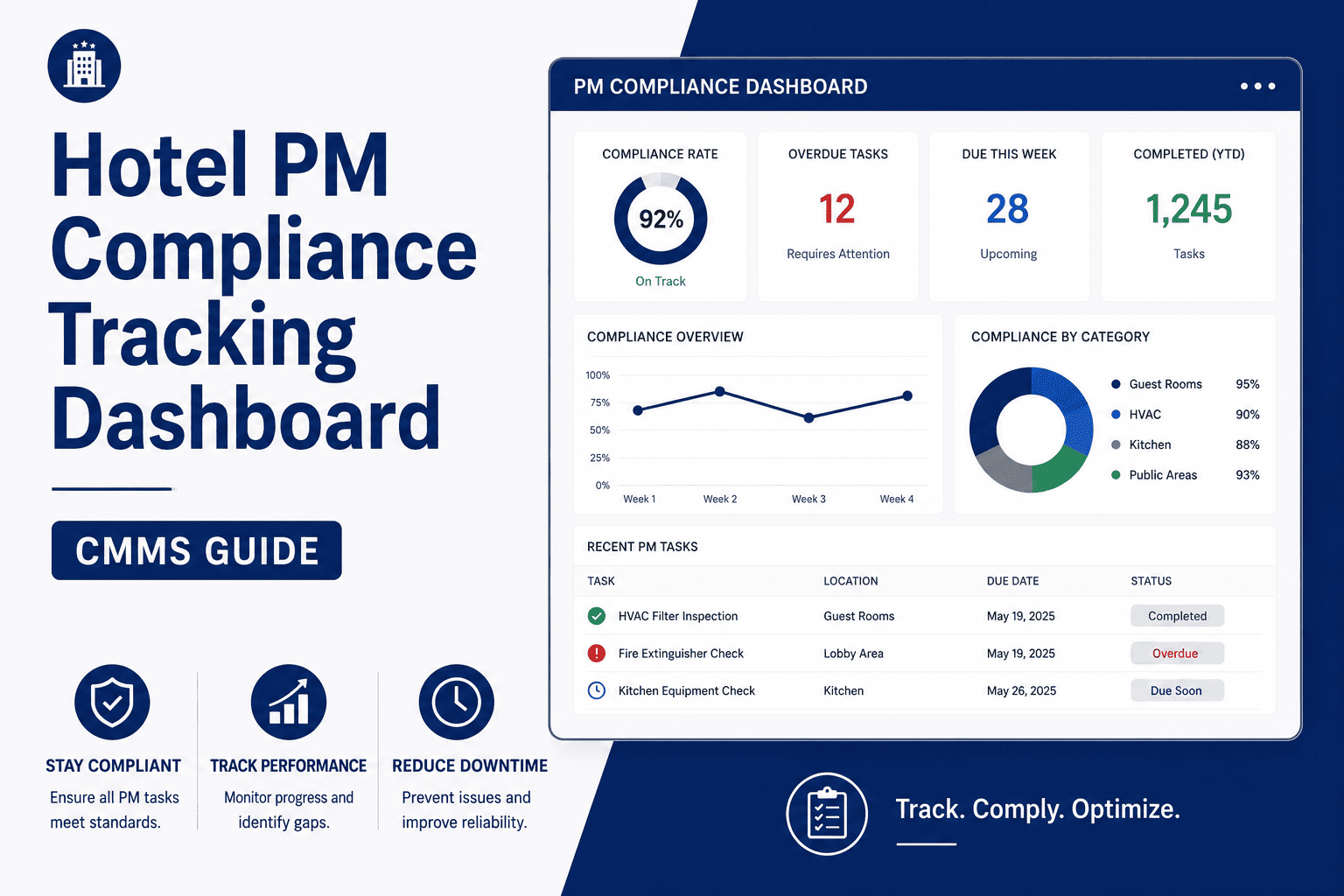
PM Compliance Rate
Quality
Percentage of scheduled preventive maintenance tasks completed on time. Foundational to any reliability-centered maintenance strategy. A rate below 80% typically signals reactive demand is consistently crowding out planned work.
(PM Tasks Completed on Time / PM Tasks Scheduled) × 100
05
Reactive vs Planned Ratio
Quality
The proportion of maintenance hours spent on unplanned reactive repairs versus scheduled planned work. The most revealing single metric of whether an engineering operation is in control or perpetually firefighting.
(Reactive Work Order Hours / Total Maintenance Hours) × 100
Best practice
Below 20% reactive
Acceptable
20–35% reactive
Red flag
Above 35% reactive
06
First-Time Fix Rate
Quality
Percentage of work orders resolved without a return visit for the same fault within 30 days. Low rates signal parts availability problems, inadequate technician training, or persistent root causes never addressed.
(Work Orders Resolved Without Repeat Visit / Total Work Orders) × 100
07
Work Order Completion Rate
Quality
Percentage of work orders closed within the target timeframe for their priority classification. Low completion rates create backlog that eventually forces deferred repairs into emergency status — at 3–5x the cost.
(Work Orders Closed on Time / Total Work Orders Created) × 100
08
Work Order Backlog Age
Quality
Average age of open work orders in the queue. A rising backlog age is an early warning that team capacity is undersized relative to incoming fault volume — weeks before the problem becomes visible to guests.
Average of (Today's Date — Work Order Created Date) for All Open Work Orders
Acceptable
Under 3 days average
Red flag
Above 7 days average
09
Equipment Downtime Rate
Quality
Percentage of time critical assets are unavailable due to failure or repair. Track separately for guest-impacting assets — HVAC, elevators, hot water systems — and back-of-house assets like laundry and kitchen equipment.
(Total Downtime Hours / Total Available Hours) × 100
Critical systems target
Below 1%
Cost Metrics
10
Maintenance Cost per Room
Cost
Total maintenance spend divided by number of rooms. The primary P&L-linked KPI for ownership reporting. Track separately for planned maintenance cost and emergency repair cost — the ratio between them reveals program effectiveness.
Total Maintenance Spend / Total Room Count
Select-service benchmark
$800–$1,400/room/year
Full-service benchmark
$1,400–$2,800/room/year
11
Emergency Repair Cost Ratio
Cost
Percentage of total maintenance spend attributed to emergency and unplanned repairs. Emergency repairs run 3–5x the cost of planned work for the same repair type. This metric directly quantifies the cost of a reactive maintenance culture.
(Emergency Repair Spend / Total Maintenance Spend) × 100
12
Cost per Work Order
Cost
Average total cost — labor, parts, and overhead — per closed work order. Track separately for planned PM work orders versus reactive repair work orders. The gap between these two figures is your reactive maintenance cost premium.
Total Maintenance Spend / Total Work Orders Closed
Planned work order
$80–$180 average
Reactive work order
3–5x higher
How to Review KPIs — The Right Cadence for Each Metric
Not every KPI belongs in every meeting. Operational metrics need daily or weekly visibility to catch problems before they compound. Strategic metrics need monthly and quarterly review to reveal trends that single-week data cannot expose.
Daily
Open P1 Work Orders
High-Priority Backlog Age
Real-Time Asset Downtime
Weekly
MTTR Trend
Work Order Completion Rate
Backlog Trajectory
Response Time by Priority
Monthly
PM Compliance Rate
First-Time Fix Rate
Reactive vs Planned Ratio
Cost per Work Order
Quarterly
MTBF by Asset Class
Maintenance Cost per Room
Emergency Repair Ratio
Equipment Downtime Rate
What the Numbers Look Like in Practice
Reactive-Heavy Hotel — Before CMMS Tracking
MTTR
11.4 hours
Faults reported verbally, logged hours later
PM Compliance
58%
Reactive demand consistently displacing scheduled PMs
Reactive Ratio
67%
Most of the team's time spent on unplanned repairs
Emergency Repair Ratio
41%
Nearly half the maintenance budget spent on emergency premiums
Same Hotel — 6 Months After OxMaint Deployment
MTTR
2.8 hours
QR scan to work order in under 60 seconds, instant routing
PM Compliance
91%
Auto-scheduled PMs with overdue alerts before windows are missed
Reactive Ratio
24%
PM program catching failures before they occur
Emergency Repair Ratio
11%
Budget reallocated from emergency premiums to planned work
Hotel Maintenance KPIs — OxMaint
See All 12 KPIs on One Dashboard — Live, Automatic, No Spreadsheets.
OxMaint calculates MTTR, PM compliance, reactive ratio, cost per work order, and every other metric in this guide automatically from your work order and asset data — in real time, across every floor and department.
The KPI Traps That Mislead GMs
Tracking the wrong metric — or tracking the right metric the wrong way — can drive decisions that make performance look better while the underlying program deteriorates.
Tracking completions without quality
A technician closing 20 work orders a day looks productive. If 30% of those are repeat visits to the same assets, first-time fix rate exposes what completions hide.
PM compliance without schedule adherence
A PM completed 45 days late counts as "compliant" in many systems. Tracking schedule adherence — not just completion — separates teams that prevent failures from teams that document them after the fact.
MTTR as a single number
An overall MTTR of 4 hours masks a 14-hour MTTR for elevator faults and a 90-minute MTTR for TV remotes. Segment MTTR by asset class and priority to find where time is actually being lost.
Cost per room without split by type
Total maintenance cost per room tells ownership how much was spent. Planned vs emergency split tells them whether the spending is controlled or crisis-driven — a fundamentally different signal.
Frequently Asked Questions
Which KPIs should a hotel start tracking first?
Start with three: reactive vs planned ratio, PM compliance rate, and MTTR. These expose the most common operational failure modes in hotel engineering. Once 90 days of baseline data exists, add work order completion rate, first-time fix rate, and cost per work order. These six metrics give a complete operational picture without dashboard overload.
How long does it take to see KPI improvement after implementing a CMMS?
Work order completion rate and MTTR typically improve within the first 60 to 90 days of structured CMMS use, as workflow visibility and accountability take effect. PM compliance usually reaches 80% or above within 90 days of automated scheduling deployment. Lagging indicators like MTBF and cost per asset require 6 to 12 months of consistent program execution to show statistically meaningful trends.
Can OxMaint calculate these KPIs automatically, or does someone have to enter data manually?
OxMaint calculates all 12 KPIs in this guide automatically from work order open and close timestamps, asset data, and technician activity logs. No manual calculation or spreadsheet compilation is required. KPI dashboards update in real time as work orders are created, assigned, and closed — saving 15 or more hours per week compared to manual reporting.
What is a realistic PM compliance target for a hotel engineering team?
World-class maintenance organizations maintain PM compliance above 95%. For most hotel engineering teams starting from a reactive baseline, a realistic first-year target is 80 to 90%. A rate consistently below 80% signals that reactive demand is structurally crowding out planned work — which requires either staffing adjustment or a reduction in the reactive load through better asset management.
Hotel Maintenance KPIs — OxMaint
Stop Managing by Gut Feel. Start Managing by Data.
Real-time
dashboard updates
15 hrs
saved weekly vs spreadsheets
OxMaint builds your KPI dashboard automatically from every work order, inspection, and asset record across your property. MTTR, PM compliance, reactive ratio, and 9 more metrics — live, segmented, and exportable for ownership reporting.