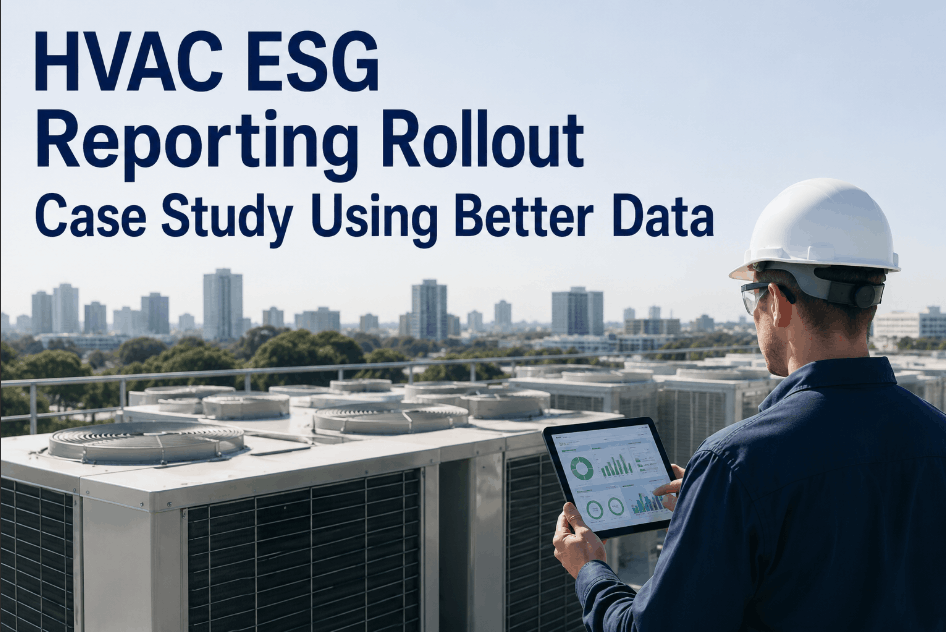
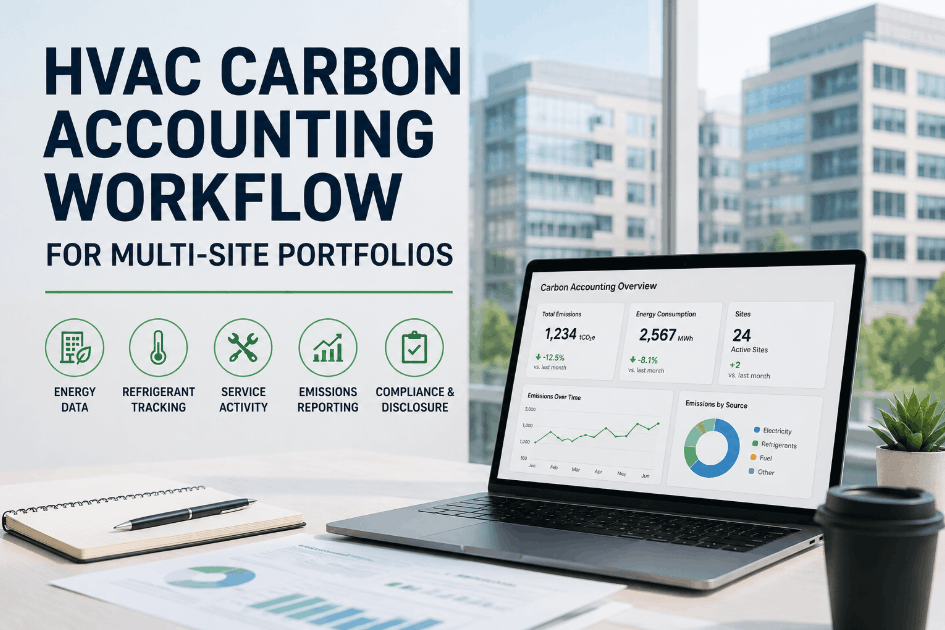
ESG reporting has moved from a voluntary disclosure exercise to a compliance obligation for many organizations — and HVAC systems represent one of the largest single contributors to facility carbon footprints. A commercial real estate operator managing a portfolio of 22 office and mixed-use properties began an ESG reporting rollout and discovered almost immediately that the underlying data was not usable: HVAC energy consumption figures were misallocated between assets, maintenance actions with direct carbon relevance had no connection to emissions records, and reporting workflows depended on manual data pulls that introduced systematic inconsistencies from quarter to quarter. If your portfolio is preparing for ESG reporting and your HVAC maintenance data is not yet clean enough to support it, Sign Up Free to see how Oxmaint structures maintenance and energy data for ESG reporting — or Book a Demo with an operations reporting specialist.
ESG Reporting · Energy Data · Carbon Metrics
Clean HVAC Data Is the Foundation Your ESG Report Needs
HVAC asset data cleanup, energy-to-maintenance alignment, carbon metric linkage, and reporting workflow automation — OxMaint gives facility teams the data infrastructure to support credible, audit-ready ESG reporting.
Portfolio Profile
The Operation: 22-Property Portfolio, Fragmented Energy Records, and No Maintenance-to-Carbon Connection
Portfolio Overview
IndustryCommercial real estate — 22 office and mixed-use properties, multiple climate zones
Team1 sustainability director, 4 property facility managers, 1 ESG reporting analyst
HVAC Scope340 HVAC assets across portfolio — AHUs, chillers, cooling towers, RTUs, VAV systems
Prior SystemUtility bills, disconnected maintenance logs, manual Excel-based energy summaries
Oxmaint FeaturesAsset Data Cleanup · Energy Consumption Tracking · Maintenance-to-Emissions Linkage · Work Order Carbon Tagging · ESG Reporting Workflow · Audit Trail Closure
ESG Readiness Gaps at Baseline
54%
Of HVAC asset records had energy consumption figures that could not be verified against individual asset-level metering or sub-metering data
4.2×
Longer time to complete quarterly ESG data compilation versus internal reporting target due to manual data reconciliation
0%
Of HVAC maintenance work orders had any carbon relevance classification — refrigerant handling, filter efficiency, controls tuning — attached to the asset record
Root Cause Analysis
Why the ESG Rollout Stalled — And Why HVAC Data Was the Bottleneck
A structured review of the portfolio's HVAC asset database, maintenance records, and utility data identified four data quality failures preventing ESG reporting from proceeding with confidence. The sustainability team was not short on reporting intent — framework alignment, disclosure targets, and stakeholder commitments were already defined. The problem was that the underlying operational data could not support the reporting structure. HVAC assets were the largest emissions contributor in the portfolio, but the data connecting maintenance activity, energy consumption, and carbon output existed in three systems that had never been aligned. Sign Up Free to assess your HVAC data readiness for ESG reporting — or Book a Demo to see how Oxmaint aligns maintenance and energy data for sustainability reporting workflows.
39%
Asset Energy Data Aggregated at Building Level, Not Asset Level
Utility consumption was tracked by property rather than by individual HVAC asset. Chiller performance improvements, AHU efficiency losses, and RTU energy anomalies were invisible at the building-level aggregate — making asset-level carbon attribution impossible without manual disaggregation.
27%
Maintenance Actions With Carbon Relevance Had No ESG Classification
Refrigerant top-offs, filter replacements, controls tuning, and coil cleaning — all with direct energy and emissions implications — were logged as generic work orders with no sustainability classification. Carbon-relevant maintenance activity was not distinguishable from routine service in any record.
22%
ESG Data Compilation Dependent on Manual Cross-System Reconciliation
Each quarterly ESG submission required a manual reconciliation between utility bills, maintenance logs, and asset records. Three separate data pulls, each with its own format inconsistencies, introduced compounding errors that required an analyst to manually verify before numbers could be used.
12%
Asset Database Had Duplicate, Retired, and Unclassified Records Inflating HVAC Count
The master HVAC asset list included decommissioned units still in active records, duplicated entries from vendor data imports, and units with no system classification. ESG reporting was being built on a foundation that overstated the portfolio's active asset count and misrepresented consumption baselines.
The Solution
How Oxmaint Cleaned the Data and Connected Maintenance to ESG Reporting Across All 22 Properties
The sustainability and facilities team deployed Oxmaint to address HVAC data quality before attempting to rebuild ESG reporting workflows. The asset database was cleaned first: duplicate, decommissioned, and unclassified records were resolved to produce an accurate 340-asset master list with verified system classifications and property-to-asset energy attribution. Carbon-relevant maintenance categories were added to the work order structure, allowing refrigerant handling, filter efficiency events, and controls optimization work to be tagged and tracked against asset emissions profiles going forward. Energy consumption data was linked to individual asset records where sub-metering supported it, and estimated consumption models were applied where it did not — giving each asset a defensible energy footprint rather than a building-level share allocation. ESG data compilation was automated from Oxmaint's maintenance and asset records, replacing the quarterly manual reconciliation with a structured export workflow. Book a Demo to see how Oxmaint prepares your HVAC data for ESG reporting across a multi-property portfolio.
01
HVAC Asset Database Cleanup and Verified Master Record Creation
All 340 HVAC assets were reviewed and resolved — duplicates removed, decommissioned units archived, unclassified systems categorized. The cleaned master asset list became the authoritative record for energy attribution, maintenance tracking, and ESG reporting — eliminating the baseline inflation that had distorted prior emissions calculations.
02
Carbon-Relevant Work Order Classification Across All Maintenance Activity
Work order categories were restructured to tag maintenance actions with direct emissions relevance — refrigerant service events, filter and coil maintenance, controls and scheduling optimization. Each tagged work order contributed to the asset's carbon maintenance record, creating an auditable connection between operational maintenance and ESG reporting metrics.
03
Asset-Level Energy Attribution and Consumption Modeling
Energy consumption was linked to individual HVAC assets using available sub-metering data, with modeled attribution applied where direct metering was unavailable. Each asset received a documented energy footprint — replacing building-level share allocations with defensible asset-level figures suitable for scope 1 and scope 2 reporting under standard ESG frameworks.
04
Automated ESG Data Export From Unified Maintenance and Asset Records
Quarterly ESG data compilation was restructured as an automated export from Oxmaint's asset and work order records. The manual three-system reconciliation process was replaced with a structured workflow that produced consistent, audit-ready outputs — reducing reporting preparation time and eliminating the analyst error introduced by repeated manual cross-referencing.
Results at 90 Days
What ESG Reporting Looked Like Three Months After Deploying Oxmaint
91%
Of HVAC assets with verified energy attribution — up from 46% at baseline, with defensible methodology for all 340 assets
76%
Reduction in quarterly ESG data compilation time — from 4.2× target to under 1.1× target
100%
Of carbon-relevant maintenance work orders classified and linked to asset emissions records going forward
+58%
Improvement in asset database accuracy — duplicate, retired, and unclassified records eliminated before next reporting cycle
0
Manual cross-system reconciliations required for quarterly ESG data submission after workflow automation
4.6×
ROI on platform cost within 90 days from reporting efficiency gains, avoided audit remediation, and data correction labor
| Metric |
Before Oxmaint |
90 Days After |
Change |
| HVAC assets with verified energy attribution |
46% of fleet |
91% of fleet |
+45pts |
| Quarterly ESG data compilation time |
4.2× target |
1.1× target |
-76% |
| Carbon-relevant work orders classified |
0% |
100% |
Full coverage |
| Asset database accuracy (clean records) |
Inflated by ~18% |
Verified master list |
Baseline corrected |
| Manual reconciliation steps per submission |
3 system pulls |
0 (automated export) |
Eliminated |
| Audit preparation time (ESG records) |
24 hrs avg |
6 hrs avg |
-75% |
Key Business Impact
What Clean HVAC Data Means for ESG Reporting Credibility and Compliance Readiness
"The ESG reporting challenge for most real estate operators is not a framework problem — it's a data problem. By the time a sustainability team is trying to build a defensible emissions report, they're discovering that the underlying asset records were never designed for that purpose. HVAC systems represent the majority of a commercial building's operational carbon footprint, and if the maintenance data, energy attribution, and asset classifications aren't structured to support reporting, you're either building the report on weak foundations or spending enormous analyst time trying to reconstruct the data from scratch every quarter. Getting the HVAC data cleaned and connected to a maintenance system that captures carbon-relevant activity isn't an ESG project — it's an operational data quality project that makes ESG reporting a natural output rather than a quarterly crisis."
Lena Vasquez, ESG Strategy and Facility Decarbonization Advisor
15 years commercial real estate sustainability and ESG reporting · Former head of ESG operations, multi-market property portfolio · Specialist in HVAC carbon attribution, scope 1/2 reporting methodology, and maintenance data alignment for sustainability disclosure
Asset Data Quality · Energy Attribution · Reporting Automation
Make Your HVAC Data ESG-Ready Before the Next Reporting Cycle
Asset database cleanup, carbon-relevant work order classification, energy attribution at asset level, and automated ESG export workflows — OxMaint gives sustainability and facilities teams the connected data infrastructure that ESG reporting actually requires.
FAQs
Frequently Asked Questions
How does Oxmaint support HVAC data preparation for ESG reporting?
Oxmaint structures HVAC asset records, energy attribution, and carbon-relevant maintenance classifications in a unified system — giving sustainability teams clean, consistent data for ESG submissions without manual cross-system reconciliation.
Can Oxmaint link HVAC maintenance activity to carbon emissions metrics?
Yes. Work order categories can be configured to classify carbon-relevant maintenance events — refrigerant handling, filter efficiency, controls optimization — linking operational maintenance directly to asset-level emissions records.
Does Oxmaint help clean up existing HVAC asset databases before ESG rollout?
Yes. Asset records can be reviewed, deduplicated, and classified within Oxmaint — correcting inflated or inaccurate baseline asset counts before they propagate into ESG consumption and emissions calculations.
How does Oxmaint reduce ESG reporting preparation time for facilities teams?
By consolidating asset records, maintenance history, and energy attribution in one system, Oxmaint enables structured data exports for ESG submissions — replacing manual multi-system reconciliation with a consistent, automated workflow.
How quickly can a portfolio begin ESG reporting after deploying Oxmaint?
Most portfolios complete asset data cleanup and carbon classification setup within the first 30–45 days. Structured ESG data exports are typically available by the following quarterly reporting cycle.
Every Clean Asset Record Is a Credible ESG Data Point
Give Your ESG Program the HVAC Data Foundation It Deserves
Oxmaint brings asset database cleanup, energy attribution at asset level, carbon-relevant maintenance classification, and automated ESG reporting exports to facility operations teams — without rebuilding your maintenance workflows from scratch.