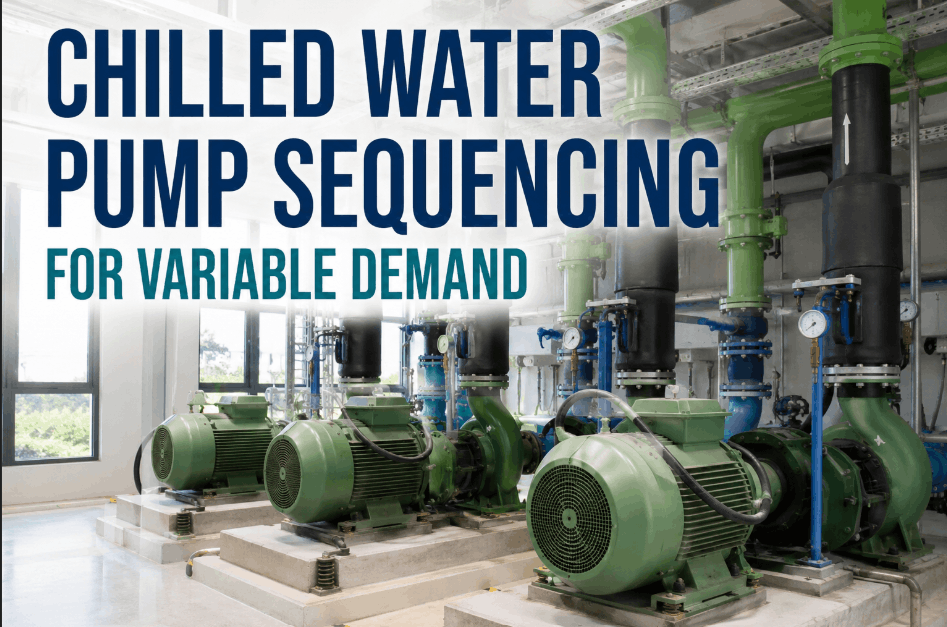
Chilled water pump sequencing for variable demand is one of the most consequential control decisions in central plant operations — and one of the most commonly mismanaged. When pumps stage up ahead of actual load, the system wastes energy maintaining loop pressure that the distribution network does not need. When sequencing lags actual demand, chilled water supply starves AHUs during peak load, driving comfort complaints and chiller instability. Getting the stage order right — and documenting it as a verified, repeatable procedure — is the difference between a plant that performs efficiently across the full load range and one that operates at a fixed setpoint regardless of conditions. OxMaint gives plant operations teams the PM scheduling and work order infrastructure to Sign Up Free and manage pump sequencing verification as a documented maintenance task. If your chilled water plant has no formal sequencing review process, Book a Demo to see how OxMaint supports hydronic system optimization through structured maintenance workflows.
OxMaint connects pump sequencing verification, staging procedure documentation, and PM scheduling so chilled water plants run the right number of pumps at the right time — consistently.
Why Pump Sequencing Matters for Variable Demand
Chilled water loop demand varies continuously — with occupancy schedules, weather, internal load, and AHU valve position all affecting required flow. Fixed staging sequences ignore this variability and produce four recurring performance failures.
Running two or three pumps at 40% system demand wastes motor energy and creates excessive loop pressure that forces control valves into near-closed positions — degrading controllability across AHUs.
Delayed stage-up during demand peaks starves the distribution loop — raising supply water temperatures, overloading the chiller, and driving comfort complaints before the second pump comes online.
Sequencing logic triggered by chiller load percentage rather than differential pressure or flow rate produces mis-staged conditions where the pump count does not match actual hydronic demand.
Plants where sequencing logic exists only as informal operator knowledge — not as documented, verified procedures — lose optimization whenever staff turns over or controls are reset after a fault.
Chilled Water Pump Sequencing Strategy Components
Effective pump sequencing for variable demand requires coordinated staging logic, verified control setpoints, and documented procedures that technicians can confirm and reset after system events. Sign Up Free to manage each component as a documented PM task in OxMaint. These four elements define a sequencing program that holds across load variations.
Set pump stage-up and stage-down triggers based on differential pressure at the critical loop index rather than chiller load percentage. DP-based sequencing responds to actual hydraulic demand — not a proxy signal that can diverge from loop conditions.
Define the VFD speed range within which each pump stage operates — staging up before VFDs hit maximum speed and staging down before speeds fall to minimum. This prevents pump hunting and protects the distribution system from pressure transients during transitions.
Document lead-lag rotation intervals and runtime balancing parameters as verified PM procedures. OxMaint work orders confirm that lead-lag settings are active and runtime hours are equalized across the pump fleet — extending service life and reducing maintenance peaks.
BAS staging setpoints drift after control resets, firmware updates, and manual overrides. OxMaint PM scheduling supports periodic setpoint audits where technicians confirm staging logic, DP setpoints, and speed limits against the documented design basis — capturing any deviations as corrective work orders.
Pump Sequencing Performance Reference
How OxMaint Supports Pump Sequencing Programs
Sequencing logic in a BAS is only as reliable as the last time a technician verified it. Book a Demo to see how OxMaint operationalizes chilled water pump sequencing verification through scheduled PM tasks, setpoint audit workflows, and asset-level staging documentation.
Schedule pump staging setpoint audits, VFD parameter checks, and lead-lag rotation verification as recurring PM tasks in OxMaint — triggered by calendar interval or seasonal commissioning cycle.
Technicians confirm DP setpoints, speed limits, and staging logic in BAS from mobile OxMaint checklists — logging actual versus design values at the controller and flagging deviations for corrective action. Sign Up Free to build this workflow.
Register each pump with its design duty point, VFD parameters, lead-lag assignment, and runtime history in OxMaint — giving plant operators a single reference for sequencing design intent and maintenance history.
OxMaint work order history documents every setpoint change, VFD parameter adjustment, and sequencing logic modification — creating a change log that supports commissioning agent reviews and energy audit requirements.
Track pump runtime hours, lead-lag rotation intervals, and sequencing audit completion rates across the plant fleet. Book a Demo to see how OxMaint correlates maintenance compliance with energy performance data.
When sequencing audits reveal setpoint drift, OxMaint automatically generates corrective work orders assigned to the responsible technician — ensuring deviations are resolved before the next billing cycle.
OxMaint connects chilled water pump sequencing verification, setpoint audit scheduling, and corrective action workflows into a single maintenance program — so your plant sequences correctly across every load condition. Sign Up Free or Book a Demo to optimize your pump fleet today.
Frequently Asked Questions
OxMaint gives chilled water plant teams the scheduling, verification, and documentation infrastructure to maintain pump sequencing performance across every load condition and control event.