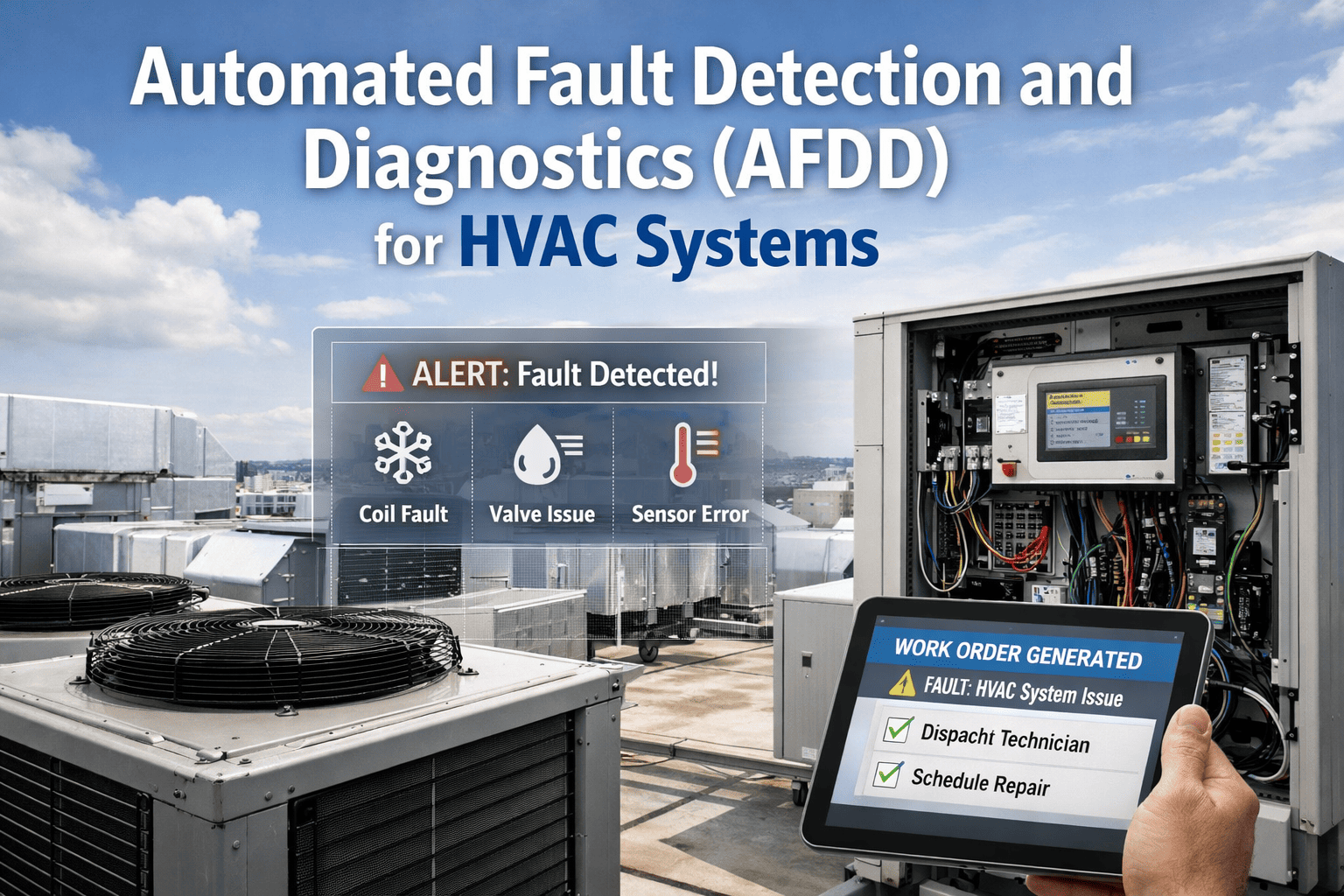
Chiller Failure Prediction AI for Commercial HVAC Systems
By James Smith on May 5, 2026
Commercial HVAC systems consume 40–60% of a building's total energy — and the chiller plant is where that cost concentrates. Calendar-based chiller maintenance was designed decades ago, when the alternative was no data at all. In 2026, AI-powered chiller failure prediction changes the equation entirely: multivariate anomaly detection across compressor current signatures, refrigerant pressure trends, and condenser approach temperatures now detects developing failures 8–14 weeks before catastrophic breakdown — with false positive rates below 12% in well-instrumented deployments. An avoided chiller compressor emergency saves $40,000–$80,000 per event. Start a free OxMaint trial to connect your chiller to predictive maintenance workflows, or book a 30-minute demo with our HVAC AI team.
Why Calendar PM Fails Chillers
The Problem with Scheduled Maintenance — In Numbers
67%
of developing chiller failures slip through undetected between scheduled inspections
3–4x
cost premium for emergency chiller repair vs. planned maintenance
8–14 wks
advance warning AI delivers before chiller failure events
91.6%
precision achieved by Carrier's 2026 temporal transformer model in predicting chiller lockouts within 60-day window
Stop Waiting for Chiller Failures to Tell You They're Coming
OxMaint's AI predictive maintenance connects to your chiller via BACnet or Modbus, establishes performance baselines, detects anomalies weeks before failure, and auto-generates work orders with full diagnostic context. No infrastructure replacement required — most deployments are live in 14–21 days.
The 5 Chiller Failure Modes AI Catches — Before You Do
01
Compressor Bearing Wear
Signal: Vibration spectrum shift
Lead time: 8–14 weeks
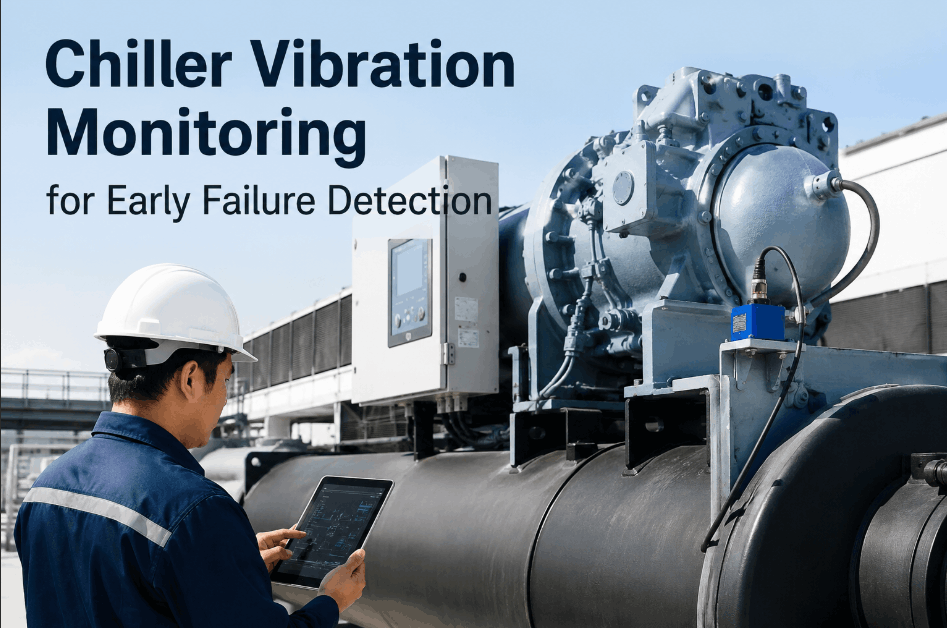
Bearing race defects produce characteristic frequency signatures in vibration data weeks before audible noise or temperature rise. AI detects the pattern shift from baseline — invisible to monthly walkthroughs.
02
Refrigerant Charge Degradation
Signal: Suction/discharge pressure trend
Lead time: 6–10 weeks
Slow refrigerant loss produces a predictable pressure trend — suction pressure drops, discharge pressure rises, superheat increases. AI identifies the pattern 6–10 weeks before capacity loss becomes noticeable.
03
Condenser / Evaporator Fouling
Signal: Approach temperature rise
Lead time: 4–8 weeks
Fouling increases approach temperature — the delta between refrigerant and water temperatures — measurably before efficiency loss reaches 5%. AI tracks approach temperature drift against a clean-tube baseline updated after each cleaning.
04
Compressor Valve Leakage
Signal: Current signature analysis
Lead time: 6–12 weeks
A leaking discharge valve changes the compressor's current draw signature — the motor works harder to compensate for reduced volumetric efficiency. AI detects this through motor current analysis without intrusive inspection.
05
Oil System Degradation
Signal: Oil pressure + temp correlation
Lead time: 3–6 weeks
Oil viscosity breakdown, pump wear, and contamination produce correlated changes in oil pressure and temperature readings. AI cross-references both against load and ambient conditions to separate real degradation from normal operating variation.
How It Works
From Sensor Data to Work Order — The AI Prediction Workflow
1
Sensor Data Collection
BACnet, Modbus, or manufacturer API feeds: compressor discharge temp, suction/discharge pressure, vibration, motor current draw, condenser approach temp, evaporator LWT — hundreds of data points per minute per chiller.
2
Baseline Establishment
ML model builds a normal operating envelope for each chiller — accounting for load variation, ambient conditions, and seasonal shifts. Baseline is continuously updated as operating conditions change.
3
Anomaly Detection
Multivariate anomaly detection flags deviations that cross-confirm across multiple sensor streams simultaneously — eliminating single-sensor false positives that erode technician trust. False positive rate: below 12%.
4
Work Order Auto-Created
OxMaint auto-generates a work order with asset ID, fault type, severity level, sensor trend data, recommended action, and parts pre-identified. Assigned to the right technician with full diagnostic context before they reach the plant room.
Comparison
Reactive vs. Calendar vs. AI Predictive — Real Cost Comparison
Metric
Reactive Maintenance
Calendar PM
AI Predictive (OxMaint)
Avg. failure detection lead time
0 — failure has occurred
1–4 weeks (scheduled interval)
8–14 weeks before failure
Emergency repair cost premium
3–4x planned cost ($40K–$80K)
Reduced — some failures still missed
Near-zero — failures planned in advance
Maintenance budget wasted on unnecessary work
High — reactive, unplanned spend
30–40% on unnecessary servicing
Condition-based — service when needed
Downtime per chiller event
48–96 hours (emergency)
12–24 hours (planned window)
4–8 hours (pre-scheduled, parts ready)
Tenant / occupant impact
High — unplanned loss of cooling
Moderate — planned outage windows
Minimal — failures prevented at root
Stop Waiting for Chiller Failures to Tell You They're Coming
OxMaint's AI predictive maintenance connects to your chiller via BACnet or Modbus, establishes performance baselines, detects anomalies weeks before failure, and auto-generates work orders with full diagnostic context. No infrastructure replacement required — most deployments are live in 14–21 days.
What Facility Engineers Say About AI Chiller Monitoring
The era of calendar-driven chiller service is ending — not because AI is fashionable, but because the economics are undeniable. A single avoided compressor failure pays for 3–5 years of an AI monitoring platform. The first-generation tools failed because false positive rates made alerts untrusted. Current multivariate anomaly detection changes that. When the alert fires, it is credible enough to act on immediately.
Condenser fouling is the most consistently underestimated chiller efficiency problem — it is invisible to walkthroughs, gradual enough to miss on monthly efficiency checks, but measurable in approach temperature data from day one. Approach temperature trending against a clean-tube baseline is the most cost-effective AI diagnostic to deploy first. It pays back within the first cooling season in most commercial buildings.
Priya N.
Mechanical Systems Consultant · Data Centre and Commercial HVAC, 14 yrs
Frequently Asked Questions
Chiller AI Predictive Maintenance: Common Questions
No new hardware is required in most commercial deployments. Modern chillers expose performance data — discharge temperature, suction pressure, motor current, condenser approach temperature, oil pressure — through BACnet/IP, Modbus TCP, or manufacturer API (Carrier, Trane, York, McQuay all provide native connectivity). OxMaint connects as a read client to your existing BMS or chiller controller without modifying programming or setpoints. For older chillers without native BMS connectivity, wireless IoT sensors can be retrofit-mounted on motor housings, bearing caps, and refrigerant lines for $200–$800 per sensor. Book a connectivity assessment to confirm your chiller model's integration path.
Rule-based fault detection (approach temperature drift, pressure deviation, current draw threshold) activates from day one of data connection and typically identifies 5–15 existing faults within the first week. Machine learning baselines — which adapt to your specific chiller's operating pattern and load profiles — require 4–8 weeks of seasonal data to deliver high-confidence anomaly detection. Full predictive capability with RUL (Remaining Useful Life) estimation typically matures at 8–12 weeks for a well-instrumented chiller. Most facilities see their first actionable predictive alert within 3–4 weeks of data connection. Start free to begin baseline collection today.
ROI is delivered through three primary channels: avoided emergency repair cost ($40,000–$80,000 per avoided compressor failure), reduced energy cost (fouling detection and condition-based cleaning typically recover 3–8% chiller efficiency), and reduced planned maintenance labor (condition-based servicing eliminates 30–40% of unnecessary interventions). Most commercial buildings achieve full payback on their first year of AI monitoring from a single avoided failure event. A field-validated LSTM study from a large Riyadh office building demonstrated 25% reduction in unplanned HVAC outages and measurable electricity savings after AI PdM deployment. Book a demo to model the ROI for your specific chiller plant configuration.
Stop Waiting for Chiller Failures to Tell You They're Coming
OxMaint's AI predictive maintenance connects to your chiller via BACnet or Modbus, establishes performance baselines, detects anomalies weeks before failure, and auto-generates work orders with full diagnostic context. No infrastructure replacement required — most deployments are live in 14–21 days.