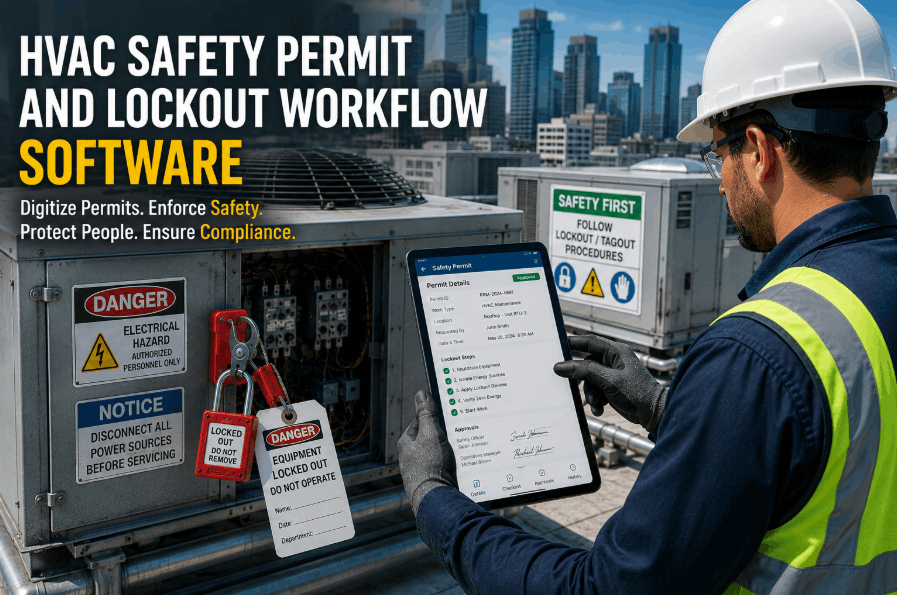
Hot work and roof access are the two highest-risk activity categories in HVAC maintenance — and the two most commonly managed with informal, paper-based permits that are lost before an incident investigation needs them. A rooftop RTU brazing operation without a hot work permit has been the source of documented building fires, OSHA citations averaging $15,625 per violation, and contractor liability claims exceeding $2 million. A structured, digitally tracked permit workflow eliminates the paperwork failure and creates the audit trail that protects your facility, your team, and your insurance coverage. OxMaint's Compliance Tracking embeds safety permit workflows directly into HVAC work orders — so the permit, the inspection, and the closeout are all in the same record, timestamped and searchable.
Complete HVAC Hot Work and Roof Access Permit Checklist
This checklist follows NFPA 51B (Hot Work Operations), OSHA 1910.252 (Welding and Cutting), and ANSI/ASSP Z359 (Fall Protection) requirements. Each phase must be completed and documented before work begins or proceeds.
Digitize Every Safety Permit Into Your HVAC Work Order
OxMaint links hot work permits, roof access logs, and LOTO records directly to the HVAC work order — creating a complete, searchable safety compliance record for every maintenance event. Book a demo to see the permit workflow in action.
Applicable Standards Reference
Expert Review
The pattern in HVAC hot work incidents is almost always the same: the work was planned, the right people were on site, and the equipment was ready — but the permit was verbal, the fire watch stepped away, or the LOTO log was never created because "everyone knew" the equipment was isolated. Paper permits fail at the closeout step more than at any other point. The fire watch leaves before the 60-minute post-work monitoring period ends. The smoke detector that was bypassed for work is never restored. The permit is never closed. A digital permit embedded in the work order changes this because the work order cannot be marked complete until every closeout field is signed off — the system enforces what a verbal agreement cannot. That audit trail is also what separates a manageable incident investigation from a facility-level liability exposure when a contractor's insurance carrier asks for the permit documentation three months after the fact.
Replace Paper Permits With a Digital Safety Audit Trail
OxMaint's compliance tracking links every safety permit to the work order, the asset, and the technician — creating an instantly exportable audit record for any inspection, insurance review, or incident investigation.
Frequently Asked Questions
When is a hot work permit legally required for HVAC maintenance?
A hot work permit is required by NFPA 51B and OSHA 1910.252 for any activity that produces sparks, flame, or heat capable of igniting surrounding materials — including welding, brazing, cutting, grinding, soldering, and use of open-flame torches. This covers virtually all refrigerant line brazing, rooftop RTU component replacement involving soldering, and any pipe cutting or grinding during HVAC installation or repair. NFPA 51B requires a written permit program for any facility where hot work is performed by maintenance staff or contractors. Verbal permits or supervisor sign-off without written documentation does not satisfy the standard and will not satisfy an OSHA inspection. OxMaint's compliance workflows enforce permit documentation at work order creation.
What are the fire watch requirements for HVAC rooftop hot work?
NFPA 51B requires a dedicated fire watch — a trained, named individual whose sole responsibility during hot work is monitoring for fire ignition. The fire watch must remain in the work area during all hot work and for a minimum of 60 minutes after all hot work stops. On rooftops, the fire watch must also monitor spaces below and adjacent to the work area, as heat and sparks can travel through seams, penetrations, and drainage paths. The fire watch must have immediate access to a charged fire extinguisher and must know the building fire alarm activation procedure. Self-monitoring by the hot work operator does not satisfy the requirement. Book a demo to see how OxMaint logs fire watch assignments in work orders.
What LOTO documentation is required for HVAC electrical isolation?
OSHA 1910.147 requires a written energy control program, documented energy control procedures specific to each piece of equipment, and a log of every LOTO application that includes the date, the authorized worker's name, the equipment isolated, the lockout devices used (with serial numbers), and the time of application and removal. The LOTO log must be retained for the life of the equipment. Each worker performing work under LOTO must apply their own personal lock — group LOTO with a single lock applied by the lead technician does not satisfy OSHA requirements for individual accountability. OxMaint's work order system includes LOTO log fields that satisfy 1910.147 documentation requirements directly in the mobile task interface.
Can OxMaint generate printable hot work permit forms for paper backup?
Yes. OxMaint's compliance tracking module generates printable permit summary documents from work order data — pre-populated with asset ID, work scope, permit issue and expiry time, contractor name, and all required safety check confirmations. These printed forms can be posted at the work site as required by NFPA 51B and retained in the facility safety file, while the digital record in OxMaint provides the searchable, timestamped audit trail. The two records are linked by work order number, so any audit or investigation can cross-reference the paper permit with the full digital maintenance history of the asset being worked on.