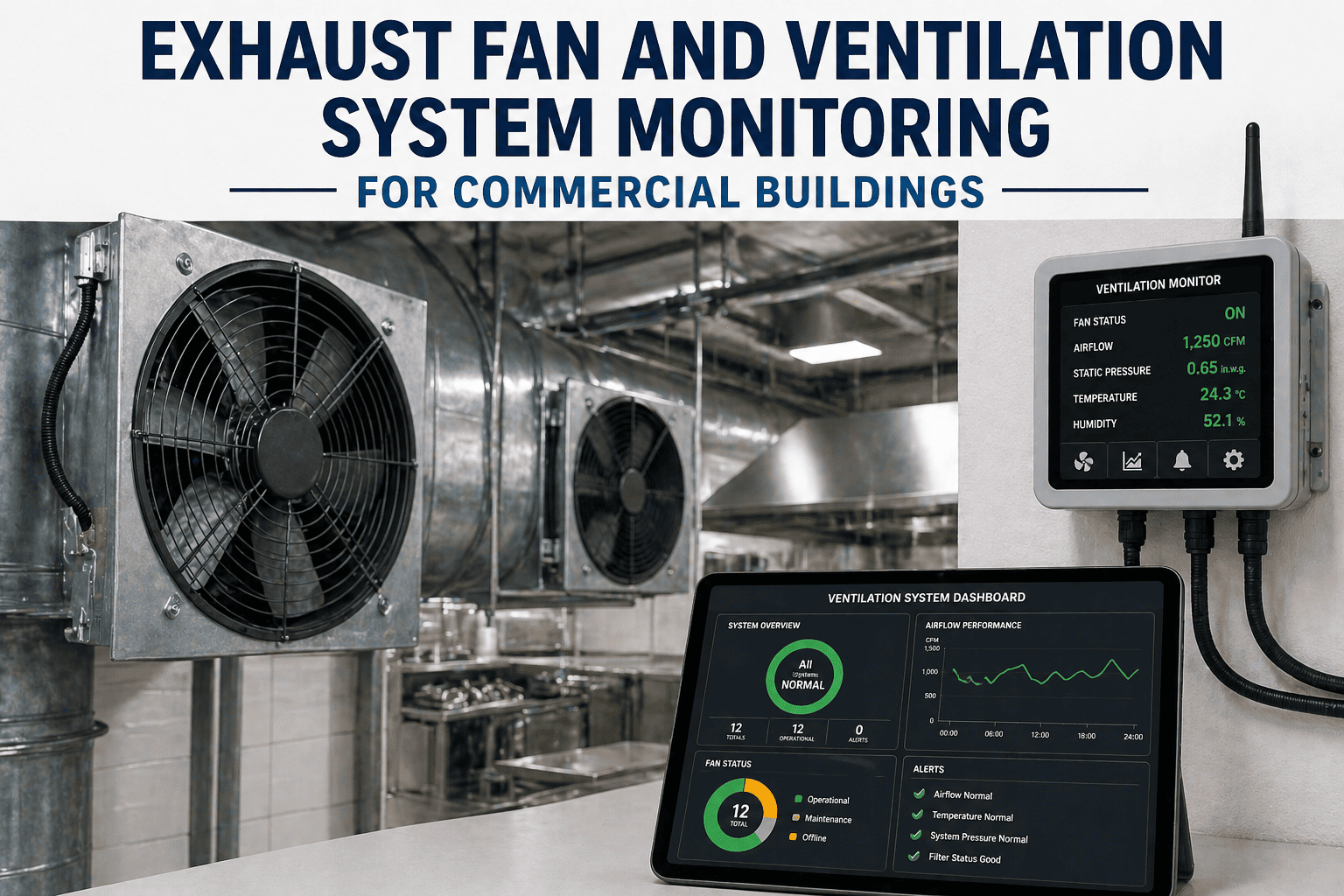
An exhaust fan running at 78% of design airflow capacity does not fail dramatically — it degrades quietly. Grease accumulates on kitchen hood fan blades, reducing impeller efficiency by 2–3% per month without inspection. Garage exhaust fan bearings run warm and noisy for six weeks before seizing during the hottest July on record, when the carbon monoxide sensor in Bay 4 finally trips. A rooftop supply fan belt glazes and slips, dropping outdoor air delivery 22% below the ASHRAE 62.1 minimum before anyone notices the CO₂ creeping past 1,100 ppm in the open-plan floor below. Ventilation system failures are almost never sudden events — they are the accumulated result of deferred inspections, missed lubrication intervals, and airflow performance that nobody measured since commissioning. Book a 30-minute demo to see how Oxmaint's Preventive Maintenance platform schedules, tracks, and documents exhaust fan and ventilation PM across every zone, fan type, and compliance requirement in your facility — or start a free trial and map your first ventilation PM schedule today.
Preventive Maintenance · Ventilation Systems
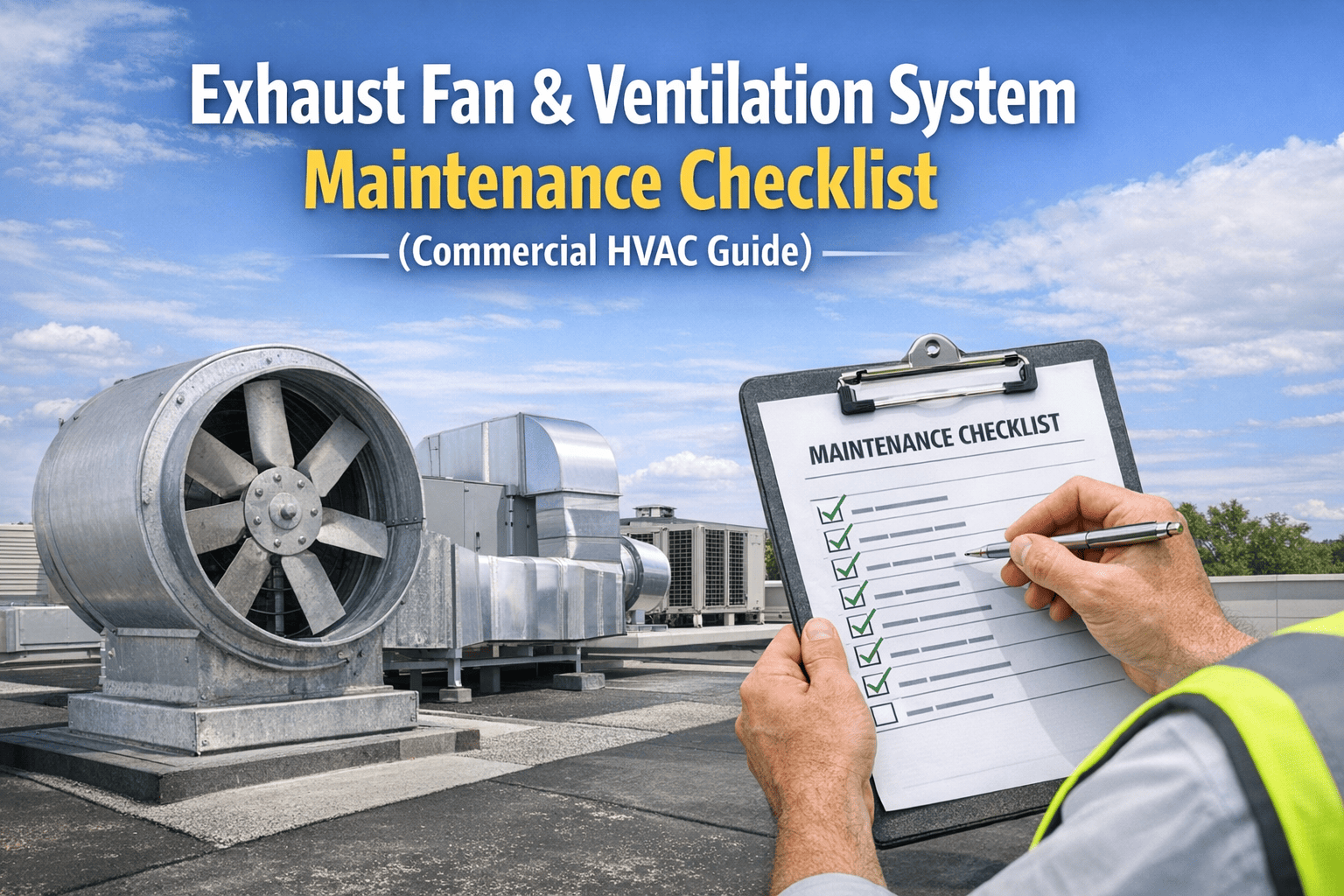
Exhaust Fan & Ventilation System Monitoring Checklist
Four complete inspection zones covering general commercial exhaust fans, kitchen hood systems, parking garage ventilation, and rooftop supply/exhaust units — with frequencies, responsible roles, and the KPIs that confirm the system is actually working.
11%
Energy savings from structured ventilation PM — US Dept of Energy
2–3%
Monthly airflow efficiency loss in unserviced commercial exhaust fans
NFPA 96
Kitchen exhaust cleaning standard — certified personnel required
ASHRAE 62.1
Ventilation for acceptable indoor air quality — minimum cfm per person/area
Zone 1 — General Exhaust Fans
Zone 2 — Kitchen Hood Systems
Zone 3 — Parking Garage
Zone 4 — Rooftop Units
Zone 01 — Daily & Monthly
General Commercial Exhaust Fans
General exhaust fans in office restrooms, server rooms, locker areas, and utility corridors are the most overlooked assets in a commercial PM programme. They run continuously, fail slowly, and are rarely inspected until a tenant complaint or a failed air balance survey forces the issue. Unserviced fans lose 2–3% efficiency per month — a fan rated at 500 cfm at commissioning may be delivering 380 cfm two years later with no visible fault indication.
A. Daily / Each Shift — Operator Level
Listen for abnormal noise — squealing (belt slipping), grinding (bearing wear), rattling (loose mounting or debris in wheel) at each fan location during building walkthrough
Record: Operator log entry · Role: Building operator / porter
Confirm fan is running by sensing airflow at intake grille — zero airflow with no alarm is the most common sign of a tripped breaker or failed capacitor on a single-phase motor
Record: None unless abnormal · Role: Building operator
B. Monthly — Maintenance Technician Level
Inspect fan blades and housing interior for grease, dust, or debris accumulation — clean blades when coating exceeds 1–2 mm to prevent imbalance and efficiency loss
Record: Condition noted in work order · Role: HVAC technician
Check and clean pulleys, inlet screens, and intake filters — blocked inlets are the most common cause of reduced cfm without any change in motor amperage or obvious fault
Record: Filter condition log · Role: HVAC technician
Inspect belt-drive systems: tension, wear, glazing, cracking, and pulley alignment — a belt riding low in the pulley groove must be replaced immediately, not at the next scheduled service
Record: Belt condition and tension reading · Role: HVAC technician
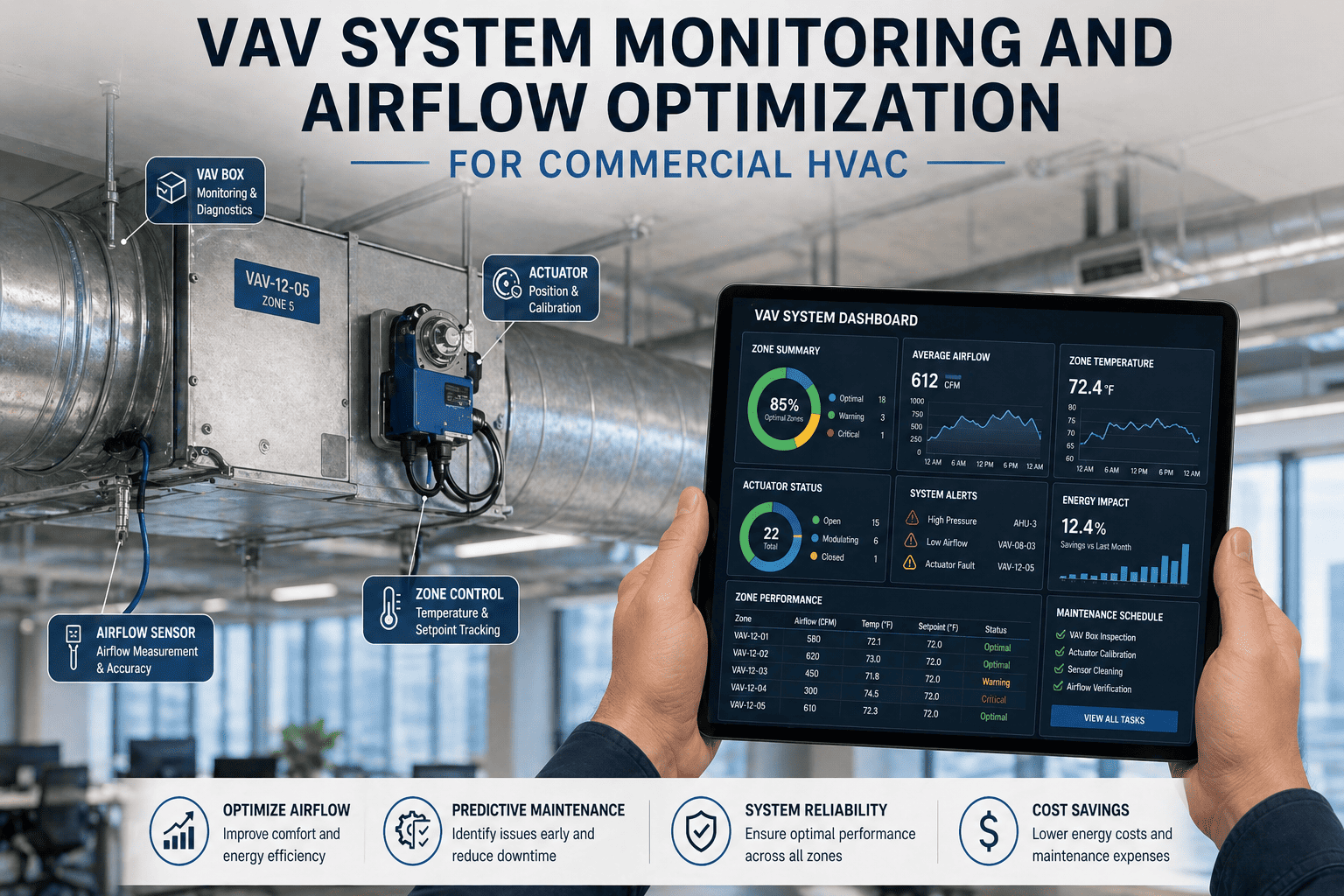
Check motor amperage against nameplate FLA using a clamp meter — amperage rising above 110% FLA indicates blocked airflow, bearing wear, or impending motor failure
Record: Amp reading with date in asset history · Role: HVAC technician
Measure airflow at exhaust grille with a balometer or vane anemometer — compare to design cfm and note deviation. Log any reading below 80% of design cfm as a corrective work order
Record: cfm reading vs design cfm in asset history · Role: HVAC technician
C. Quarterly / Semi-Annual
Lubricate bearings per manufacturer specification — apply correct grease type and quantity. Over-lubrication causes overheating as reliably as under-lubrication; use grease gun with counts, not until "it looks right"
Record: Lubrication work order with grease type and quantity · Role: HVAC technician
Check bearing housing temperature with infrared thermometer — above 180°F (82°C) at housing surface indicates lubrication failure or misalignment requiring immediate investigation before bearing seizure
Record: IR temperature reading with date · Role: HVAC technician
Inspect all mounting hardware, anti-vibration isolators, and duct connections for looseness, corrosion, or rubber isolator degradation — vibrating mounts transmit structural noise and accelerate bearing wear
Record: Mounting inspection sign-off · Role: HVAC technician
D. Annual
Inspect and clean all associated ductwork — access panels cleaned, duct integrity checked, insulation condition noted, dampers exercised through full stroke and checked for seal
Record: Duct inspection report · Role: HVAC contractor
Test and inspect all electrical connections, contactors, motor starter controls, and VFD parameters — loose connections cause arcing that degrades motor windings without triggering a fault alarm
Record: Electrical inspection certificate · Role: Licensed electrician
Oxmaint schedules every task above by fan ID — with runtime-hour triggers for bearing lubrication, calendar triggers for quarterly amp checks, and automatic escalation when airflow drops below design cfm.
Zone 02 — NFPA 96 Critical
Commercial Kitchen Exhaust Hood Systems
Kitchen exhaust hood systems are governed by NFPA 96 — Standard for Ventilation Control and Fire Protection of Commercial Cooking Operations. NFPA 96 §11.4 requires that upon inspection, if a system is contaminated with grease-laden deposits, the entire exhaust system shall be cleaned by trained, qualified, and certified personnel. Cleaning frequency is risk-based: high-volume cooking operations require monthly inspection and cleaning; moderate volume quarterly; light use semi-annually. The cleaning frequency applies to the entire system — fan, plenum, duct, and filters — not just the visible hood surface.
A. Monthly — NFPA 96 High-Volume Operations
Inspect entire exhaust system for grease accumulation — fan housing, plenum, duct, and grease baffles. If grease deposit depth exceeds 1/8 inch anywhere in the system, cleaning must occur immediately regardless of scheduled date
Record: Inspection report with photo evidence · Role: NFPA 96-certified technician
Check and clean grease filters — inspect mesh depth, confirm proper seating in tracks, replace any filters showing structural damage or clogging beyond 50% open area
Record: Filter inspection log with condition grading · Role: Kitchen facilities operator
Inspect grease collection cup / drain trough — confirm grease collection container is not overflowing, drain is unobstructed, and grease has been disposed of per local environmental regulations
Record: Grease removal log with volume and disposal date · Role: Kitchen operator
B. Quarterly — All Kitchen Operations
Measure and record capture velocity at cooking surface — verify airflow is adequate to contain cooking effluents at the equipment's peak operating output. Insufficient capture velocity is the primary cause of grease-laden air escaping hood containment
Record: Capture velocity reading in cfm · Role: HVAC technician
Inspect make-up air system operation — confirm discharge direction, temperature, and balance against exhaust rate. Make-up air 15–20% less than exhaust maintains negative pressure at hood face to improve capture without excessive energy cost
Record: Make-up air balance sheet · Role: HVAC technician
Inspect fire suppression system connections and nozzle positioning — confirm nozzle positions have not been disturbed during hood cleaning and are correctly aligned with protected cooking equipment surfaces
Record: Fire suppression inspection certificate · Role: Fire suppression contractor
Zone 03 — CO Safety Critical
Parking Garage Exhaust & Ventilation Systems
Parking garage ventilation systems are life-safety critical. ASHRAE 62.1 and IMC Section 404 require mechanical ventilation in enclosed garages to maintain CO below 25 ppm (8-hour TWA) and ensure rapid dilution during vehicle loading events. Most parking garage ventilation failures follow the same pattern: a sensor that has drifted out of calibration, a fan that is running at reduced speed due to a VFD fault, and a CO alarm threshold that nobody has tested since the last fire system inspection.
A. Monthly
Test CO sensor response using calibration gas — challenge each sensor with certified CO gas at 35 ppm and confirm alarm triggers within ±20% of setpoint. Electrochemical CO sensors drift and must be validated monthly, not assumed accurate
Record: Sensor test log with calibration gas certificate · Role: Safety officer / HVAC technician
Confirm CO-sensor-to-fan interlock is functioning — with fan off, introduce test signal and verify fans start automatically within 30 seconds. This interlock is the last line of defence against a CO accumulation event
Record: Interlock test sign-off · Role: Safety officer
B. Quarterly
Measure fan cfm output at each supply and exhaust point against design air change rate — minimum 0.75 cfm/sq ft per IMC or 6 air changes per hour, whichever produces higher ventilation rate for the garage floor area
Record: Air balance reading sheet with design vs actual cfm · Role: HVAC technician
Inspect jet fan nozzle positions and blade condition — jet fans in large garages direct airflow patterns that CO sensors rely on for representative sampling. A deflected nozzle creates dead zones that may accumulate CO without triggering the sensor network
Record: Jet fan inspection log with nozzle position verification · Role: HVAC technician
Inspect VFD operation and confirm fan speed setpoints match BMS control strategy — a VFD that has been set to manual override runs continuously at maximum speed, eliminating demand-controlled ventilation savings without alerting the BMS
Record: VFD parameter log · Role: Controls technician
C. Annual
Calibrate all CO sensors to NIST-traceable reference — annual full calibration against certified zero and span gas. Replace sensors showing drift greater than ±5 ppm from reference at span point, or any sensor more than 5 years old regardless of calibration result
Record: Calibration certificate per sensor with serial number · Role: Instrumentation technician
Zone 04 — Rooftop
Rooftop Supply, Return & Exhaust Units
A. Quarterly
Inspect belt tension and pulley alignment on all belt-drive rooftop units — use a belt tension gauge (not manual deflection) and straightedge or laser alignment tool. Misaligned pulleys on RTU supply fans are the leading cause of premature belt and bearing failure
Record: Belt tension reading and alignment deviation · Role: HVAC technician
Inspect weather seals, curb flashing, and unit housing integrity — water ingress into rooftop fan units is the primary cause of motor insulation failure and premature bearing rust. Any opening in the housing larger than a pencil diameter requires immediate sealing
Record: Rooftop unit inspection form with photo · Role: HVAC technician
Verify exhaust damper opens fully during operation and closes on shutdown — a damper stuck partially open allows rain and debris ingress; a damper stuck partially closed reduces airflow by 15–40% depending on obstruction geometry
Record: Damper stroke and leakage inspection note · Role: HVAC technician
B. Annual
Full motor inspection — measure winding insulation resistance (megohm test), record amperage on all three phases under operating load, and compare phase balance. Phase imbalance greater than 2% indicates supply voltage issue; rising megohm trend indicates moisture ingress in motor windings
Record: Motor test report with megohm and amp readings · Role: Electrician / HVAC contractor
Measure total system airflow against design and current ASHRAE 62.1 minimum outdoor air requirements — if occupied floor area or headcount has changed since commissioning, the ventilation design basis may be insufficient and a full air balance may be required
Record: Annual airflow measurement with design vs actual · Role: TAB contractor
KPI Reference
Ventilation System KPIs That Confirm the System Is Working
| KPI |
How to Measure |
Target |
Failure Trigger |
| Airflow delivery vs design cfm |
Balometer at each supply/exhaust point |
≥ 90% of design cfm |
Work order if below 80% design |
| Motor amperage vs FLA |
Clamp meter at motor terminals |
90–100% FLA at full load |
Investigate above 110% FLA |
| Bearing housing temperature |
IR thermometer at housing surface |
≤ 180°F (82°C) |
Stop fan above 200°F for investigation |
| Belt deflection tension |
Belt tension gauge (force/deflection) |
Per manufacturer ±10% |
Replace belt if cracked, glazed, or frayed |
| CO concentration (garage) |
Fixed electrochemical sensors |
≤ 25 ppm TWA (ASHRAE 62.1) |
Fan interlock trigger at 35 ppm |
| Kitchen capture velocity |
Velocity probe at hood face |
75–150 fpm (ASHRAE 154) |
Below 60 fpm — clean system, rebalance |
| PM completion rate |
Completed PMs / Scheduled PMs |
≥ 95% |
Below 85% — escalate to FM leadership |
Expert Review
What Ventilation Failures Actually Look Like Before They Become Incidents
"Ninety percent of the ventilation failures I investigate were predictable from the maintenance records — or more accurately, from the absence of them. Every garage CO event I have been called to had a CO sensor calibration record that was two years old, a fan VFD stuck in manual override since a controls upgrade eighteen months prior, and a BMS dashboard showing 'system normal' because nobody had validated that the sensors were still accurate enough to mean anything. The insidious thing about ventilation system degradation is that it is continuous and invisible. The building does not smell different. The tenants do not notice. The BMS still reads green. But the airflow has dropped 25%, the CO is sitting at 40 ppm in peak morning traffic, and the first time anyone checks the calibration gas on the sensors is when the fire brigade shows up. A structured CMMS with scheduled CO sensor challenges, quarterly airflow measurements, and automatic escalation when PM is overdue does not just save money. It prevents the incident that nobody thought could happen in their building."
David Osei, MEng, MCIBSE, CIBSE Fellow
Ventilation systems engineer · CIBSE Fellow · 21 years commercial building HVAC commissioning and incident investigation · Specialist in parking garage ventilation failures and kitchen exhaust fire investigations
FAQs
Frequently Asked Questions
How often should commercial exhaust fans be serviced?
General commercial exhaust fans require
monthly visual inspections and airflow checks, quarterly bearing lubrication and belt inspections, and annual motor testing and duct inspection. Kitchen exhaust systems under NFPA 96 require monthly inspection for high-volume operations and cleaning whenever grease deposits exceed 1/8 inch in depth anywhere in the system.
Book a demo to see Oxmaint's ventilation PM schedule template.
What is the ASHRAE 62.1 requirement for ventilation in commercial buildings?
ASHRAE Standard 62.1-2022 sets minimum outdoor air supply rates for commercial spaces — typically expressed in cfm per person plus cfm per sq ft of floor area, varying by occupancy type. Failure to maintain the minimum outdoor air delivery results in elevated CO₂, reduced occupant productivity, and non-compliance with building codes that reference ASHRAE 62.1. Annual airflow measurement against design cfm is the only way to confirm ongoing compliance.
What are the signs an exhaust fan bearing is about to fail?
The four early warning signs are: bearing housing temperature above 180°F (82°C) on IR thermometer, squealing or grinding noise during operation, excessive vibration felt at the housing, and visible grease leakage past the bearing seal. Motor amperage rising above 110% of FLA under normal load conditions is a secondary indicator. Catching these signs in a monthly inspection avoids the bearing seizure that causes shaft damage and requires full fan replacement instead of a bearing swap.
How does Oxmaint handle exhaust fan PM scheduling across multiple building zones and fan types?
Each fan is registered as an individual asset with its own PM template — kitchen exhaust fans on NFPA 96-aligned monthly schedules, garage ventilation fans with monthly CO sensor challenges and quarterly airflow verification, rooftop units on quarterly belt and damper inspection cycles.
Runtime-hour triggers handle bearing lubrication; calendar triggers handle regulatory compliance tasks. When a fan's airflow drops below threshold, Oxmaint auto-generates a corrective work order and escalates if overdue.
Start a free trial to build your first fan PM programme.
Stop Finding Out About Ventilation Failures When the CO Alarm Trips
Oxmaint's Preventive Maintenance platform schedules every exhaust fan and ventilation system inspection on the right trigger — calendar, runtime, or event-based — and creates the airflow performance records, sensor calibration certificates, and NFPA 96 cleaning logs that prove your system is working before anyone has to ask.