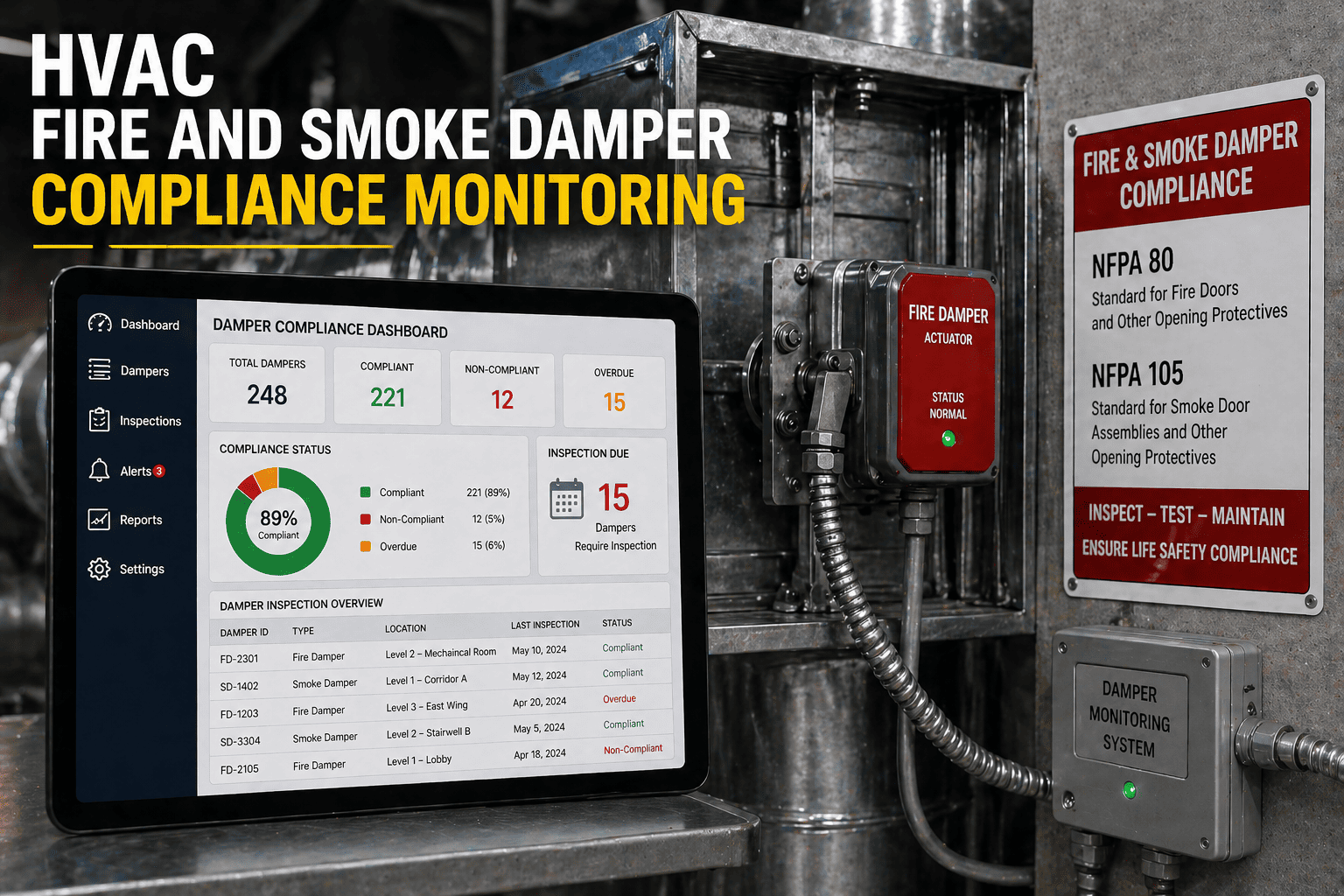
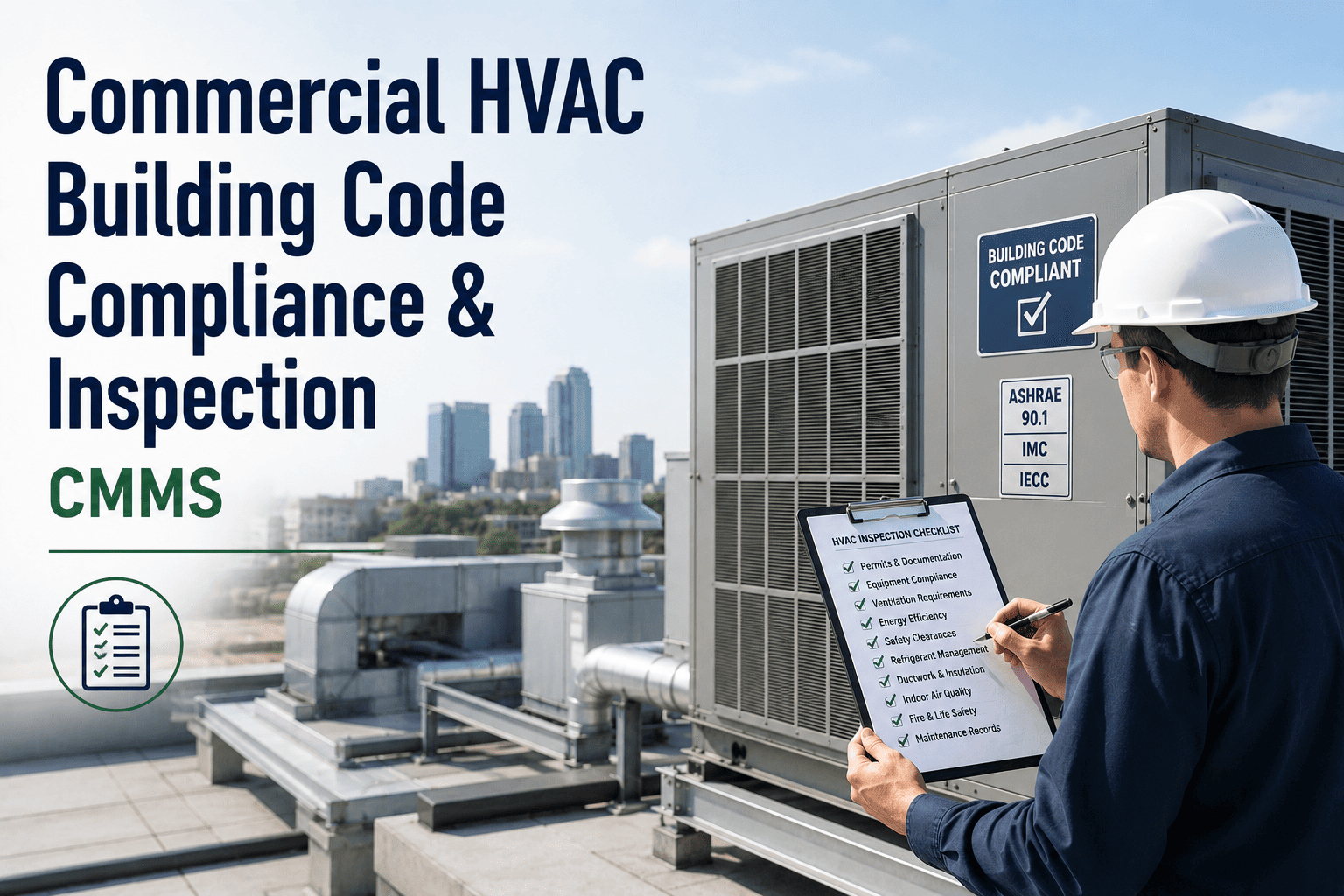
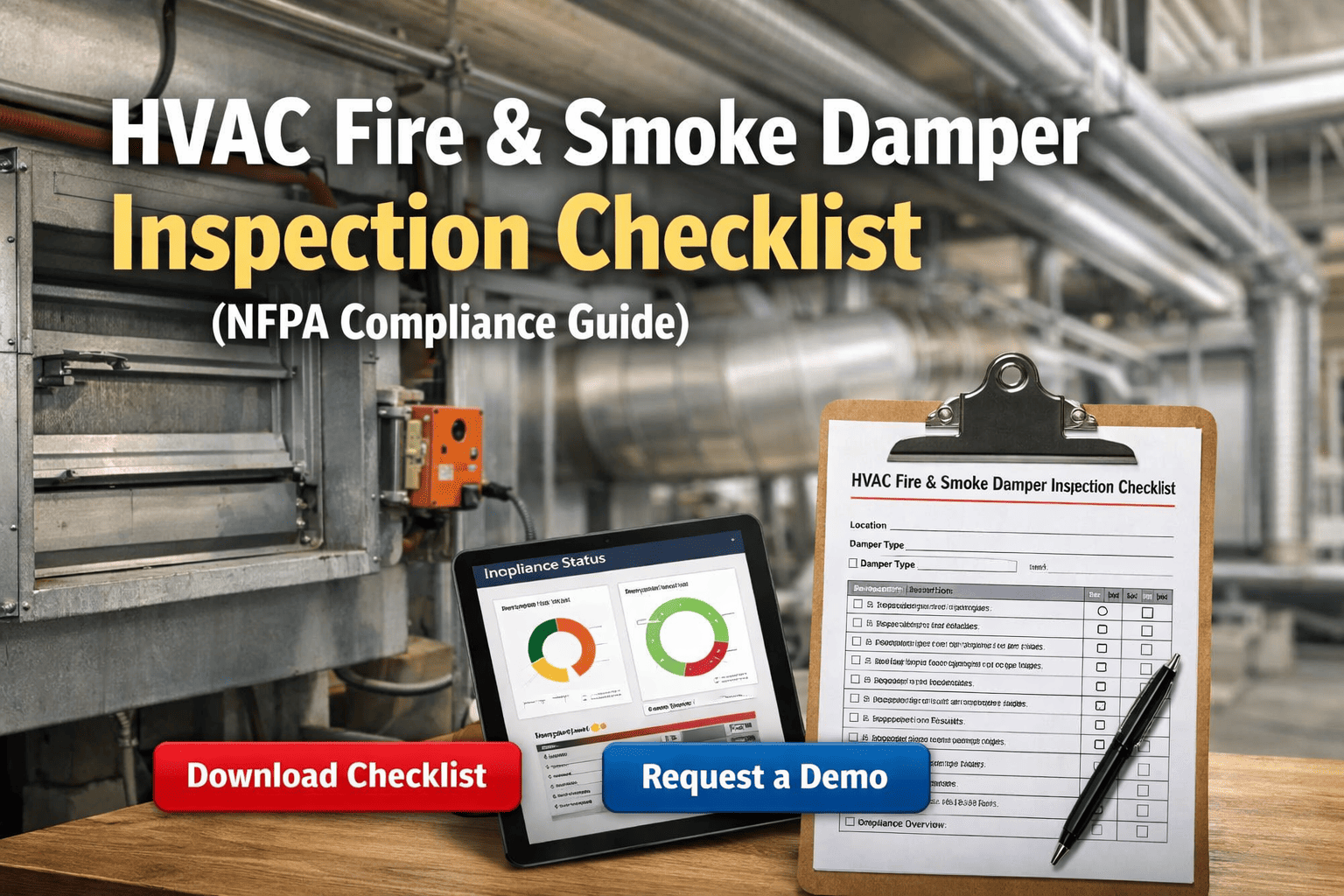
A fire damper that fails to close during a duct fire is not simply a maintenance failure — it is a life safety failure with direct liability exposure for the building owner and the facility manager who signed the compliance record. NFPA 80 (Standard for Fire Doors and Other Opening Protectives) and NFPA 105 (Standard for Smoke Door Assemblies and Other Opening Protectives) mandate specific inspection intervals, acceptance criteria, and documentation requirements for every fire and smoke damper in a building. The consequence of non-compliance is not just a code violation: it is a building that does not perform as designed during the event it was built to manage. Book a demo to see how OxMaint's Compliance Tracking automates fire and smoke damper inspection scheduling, pass/fail recording, deficiency management, and NFPA-compliant documentation across your building portfolio.
Life Safety Systems · NFPA 80 / 105 · Compliance Tracking
HVAC Fire & Smoke Damper Compliance Monitoring
NFPA 80 inspection schedules, NFPA 105 acceptance criteria, deficiency tracking, documentation requirements, and compliance gap analysis — a complete life safety compliance framework for fire and smoke dampers in commercial, healthcare, and high-rise facilities.
1 yr / 4 yr
NFPA 80 inspection cycle — annually for newly installed dampers; every 4 years thereafter (6 years for Category 2 per NFPA 105)
25% rule
If more than 25% of a random sample of inaccessible dampers fail, all inaccessible dampers must be made accessible and inspected
Immediate
Failed dampers must be repaired or replaced — no grace period. Non-functional dampers require AHJ notification and corrective action
3+ years
Minimum record retention for all damper inspection reports per NFPA 80 — AHJ and accreditation bodies request on-demand
Zone 1 — Damper Inventory
Zone 2 — Fire Dampers (NFPA 80)
Zone 3 — Smoke Dampers (NFPA 105)
Zone 4 — Combination Dampers
Zone 5 — Documentation & AHJ
Compliance Risk by Damper Condition
Failed to Close
Critical — immediate AHJ notification, corrective action required, occupancy risk
Inaccessible / Uninspected
Critical — NFPA 80 non-compliance, triggers access provision requirement
Actuator / Fusible Link
High — component failure means damper will not activate on demand
Overdue Inspection
High — Joint Commission and NFPA citations; life safety deficiency at survey
Missing Documentation
Medium — compliance record gap; AHJ and insurer cannot verify inspection history
Zone 01
Damper Inventory — Know Every Damper Before You Inspect Any of Them
NFPA 80 compliance requires a complete inventory of every fire and smoke damper in the building. Without an inventory, the inspection programme has no defined scope, no completion metric, and no way to demonstrate to the AHJ or accreditation body that all dampers have been inspected. For most commercial and healthcare buildings, this inventory does not exist in a usable form — it must be developed from as-built drawings, construction documents, and physical survey.
Inventory Development Tasks
NFPA 80 §19.4.3 — Record Requirements
Obtain as-built mechanical drawings and fire-rated construction documents — mark every fire wall, fire barrier, smoke barrier, and fire partition penetration where a damper is required or installed
Record: Damper location drawing set · Role: Facility Manager / Fire Protection Engineer
Assign a unique identifier to each damper — building-area-damper number format (e.g., BLD1-MECH-FD-042) — tag physically at the damper access panel and register in OxMaint as individual assets
Record: Damper register in CMMS · Role: Facility Manager
Classify each damper: fire damper (FD), smoke damper (SD), fire/smoke combination damper (FSD), or ceiling radiation damper (CRD) — each class has different inspection requirements and acceptance criteria
Record: Damper type classification in asset register · Role: Fire Protection Engineer
Identify and document all inaccessible dampers — NFPA 80 permits inspection from accessible locations on a sampling basis, but inaccessible dampers must be reported and the AHJ notified of access limitations
Record: Accessibility classification per damper · Role: Facility Manager
Record installation date, manufacturer, model, and rated temperature class for each fusible link damper — this determines the 4-year vs 1-year inspection cycle applicability and links to the building's life safety system test schedule
Record: Asset detail fields in OxMaint per damper · Role: Facility Manager
Zone 02
Fire Damper Inspection — NFPA 80 Requirements
Fire dampers are passive fire protection devices — they require no power or activation signal, closing automatically when a fusible link melts at the rated temperature. NFPA 80 mandates that all fire dampers be inspected and tested within one year of installation and every four years thereafter. In healthcare occupancies, The Joint Commission follows NFPA 80's schedule and citations for failed or uninspected fire dampers are classified as Immediate Jeopardy conditions.
At Inspection — Acceptance Criteria
NFPA 80 §19.4.3.3
Damper access panel verified in correct location and operable — all fasteners present; panel opens without tools to full access to damper assembly
Record: Access panel check on inspection form · Role: Qualified Inspector
Damper blades fully close when fusible link is released or manual trip is actuated — blades must reach full closed position with no obstruction, debris, or deformation preventing closure
Record: Pass/Fail on inspection form with photo · Role: Qualified Inspector
Fusible link present, unobstructed, and rated at correct temperature — not painted over, corroded, or physically damaged; link must be the listed temperature class for the installation location
Record: Fusible link condition on inspection form · Role: Qualified Inspector
Damper reset to open position after test — confirm damper is restored to normal operating position with fusible link re-engaged; document reset confirmed in inspection record
Record: Reset confirmation on inspection form · Role: Qualified Inspector
Frame and sleeve condition inspected — no corrosion, physical damage, or duct insulation blocking the damper sleeve that would prevent blade movement or compromise the fire-rated barrier
Record: Physical condition on inspection form · Role: Qualified Inspector
Failure Response — Mandatory Actions
NFPA 80 §19.4.3.5
Any damper that fails to close must be immediately reported and a corrective action work order issued — failed dampers cannot be left uninspected or in a failed state; corrective action must be completed and documented before closing the deficiency
Record: Deficiency work order in OxMaint with corrective action and verification · Role: Facility Manager
AHJ notification required for dampers that cannot be immediately corrected — maintain AHJ notification letter in the compliance record; document interim compensatory measures while repair is pending
Record: AHJ notification on file in OxMaint compliance module · Role: Facility Manager
OxMaint auto-schedules fire and smoke damper inspections per NFPA 80 and NFPA 105 cycles, captures pass/fail per damper on mobile, and generates the compliance record your AHJ and Joint Commission surveyor will request.
Zone 03
Smoke Damper Inspection — NFPA 105 Requirements
Smoke dampers are active devices — they require an electrical signal from the smoke detection system or building automation system to close. This introduces a different set of failure modes from fire dampers: electrical actuator failures, control wiring faults, integration failures with the fire alarm system, and battery backup degradation in dampers with local power supplies. NFPA 105 mandates annual inspection in the first year and inspection at 4-year (Category 1, single-duct) or 6-year (Category 2, corridor smoke control) intervals thereafter.
At Inspection — NFPA 105 Acceptance Criteria
NFPA 105 §8.4
Damper closes fully when test signal is sent from fire alarm panel or BAS — test from the panel itself, not by manual override, to verify the complete signal path from detection to closure is functioning
Record: Signal path test result on inspection form · Role: Qualified Inspector + Fire Alarm Technician
Actuator operation verified — electric actuator energises and de-energises correctly; spring-return function tested; no binding, sticking, or incomplete travel in either direction
Record: Actuator operation result · Role: Qualified Inspector
Damper status feedback to BAS/FACP confirmed — building automation and fire alarm system correctly receives closed signal when damper closes; open and closed status both verified in the supervisory panel
Record: Status feedback verification · Role: Fire Alarm Technician / BAS Technician
Blades reach full closed position with smoke leakage rating maintained — blade seals inspected for damage; no visible gaps in closed position that would compromise the smoke control rating
Record: Blade seal and closure inspection result · Role: Qualified Inspector
Damper reset to open after test and normal operation restored — BAS / FACP shows damper in open/normal status; no supervisory fault alarms active on the tested damper after reset
Record: Reset and normal status confirmation · Role: Qualified Inspector / BAS Technician
Zone 04
Combination Fire/Smoke Dampers — Dual Compliance Requirements
Combination fire/smoke dampers (FSDs) must meet both NFPA 80 fire damper and NFPA 105 smoke damper requirements simultaneously — and both must be tested during each inspection event. The inspection is more complex than either single-function damper because both the passive fire closure (fusible link or thermal actuator) and the active smoke closure (electrical actuator and signal path) must be verified independently.
Combination Damper — Full Test Sequence
NFPA 80 §19 + NFPA 105 §8
Smoke closure test first — activate damper via BAS/FACP signal, verify full closure, confirm status feedback, document result; restore to open before proceeding to fire closure test
Record: Smoke function test result · Role: Qualified Inspector + Fire Alarm Technician
Thermal closure test — manually trip fusible link or thermal actuator, verify damper closes fully to fire-damper standard (no blade gap, no obstruction); inspect fusible link condition per NFPA 80 criteria
Record: Fire function test result · Role: Qualified Inspector
Replace fusible link after thermal closure test, reset to full open, re-engage all interlocks, and confirm BAS/FACP shows normal status — one incomplete step voids the inspection record for this damper
Record: Reset and full restoration confirmed · Role: Qualified Inspector
Zone 05
Documentation & AHJ Compliance Records
The NFPA 80 inspection programme is only as defensible as its documentation. An inspector who tests 200 dampers and records results in a notebook — without a timestamped, per-damper record that can be retrieved on demand — has completed the work but not the compliance. AHJ inspections, Joint Commission surveys, and insurance assessments all request the damper inspection record, and the inability to produce it is treated the same as the inspections not having been performed.
Required Documentation per Inspection Event
NFPA 80 §19.4.3.4 — Record Retention
Inspection report per damper — unique damper ID, inspection date, inspector name and qualification, test method, pass/fail result, and deficiency description if failed; all fields required for each damper inspected
Record: Per-damper inspection record in OxMaint · Role: Qualified Inspector / Facility Manager
Photo evidence of failed dampers and corrective actions — photograph failed-to-close condition, deformed blades, or seized actuators; photograph post-repair restored condition; attach to deficiency work order in CMMS
Record: Photo attachment to work order in OxMaint · Role: Qualified Inspector
Summary report showing total dampers inspected, pass rate, failed dampers, and corrective action status — required for healthcare accreditation bodies (Joint Commission EC.02.03.05) and for AHJ annual inspection reporting
Record: Summary compliance report in OxMaint · Role: Facility Manager
Inaccessible damper list with access limitation justification and AHJ notification — buildings with inaccessible dampers must document which, why, and that the AHJ has been notified; this list is retained for the life of the building
Record: Inaccessible damper register in OxMaint compliance module · Role: Facility Manager
Next inspection due date calculated and entered for each damper — OxMaint auto-generates the next work order based on the NFPA 80/105 cycle applicable to each damper's type and installation year, preventing schedule slippage between inspection cycles
Record: Next due date auto-set in OxMaint PM schedule · Role: OxMaint Automated
Compliance Reference
NFPA 80 / 105 Inspection Intervals & Requirements by Damper Type
| Damper Type |
Governing Standard |
First Inspection |
Recurring Interval |
Acceptance Test Method |
OxMaint Trigger |
| Fire Damper (FD) |
NFPA 80 §19.4 |
Within 1 year of installation |
Every 4 years |
Manual fusible link trip; verify full closure; inspect link and frame |
Installation date + 1 yr; 4-yr calendar thereafter |
| Smoke Damper — Category 1 (SD-1) |
NFPA 105 §8.4 |
Within 1 year of installation |
Every 4 years |
Activate via FACP/BAS signal; verify closure and status feedback |
Installation date + 1 yr; 4-yr calendar thereafter |
| Smoke Damper — Category 2 (SD-2) |
NFPA 105 §8.4.2 |
Within 1 year of installation |
Every 6 years |
Same as SD-1 plus corridor pressure differential verification |
Installation date + 1 yr; 6-yr calendar thereafter |
| Combination FSD |
NFPA 80 + NFPA 105 |
Within 1 year of installation |
Most restrictive of both — 4 years |
Both smoke signal test AND thermal closure test — sequential |
Installation date + 1 yr; 4-yr calendar per NFPA 80 |
| Ceiling Radiation Damper (CRD) |
NFPA 80 §19.5 |
Within 1 year of installation |
Every 4 years |
Manual trip, full closure, thermal element inspection, reset |
Installation date + 1 yr; 4-yr calendar thereafter |
Expert Review
What Life Safety and Fire Protection Professionals Say
01
The most common finding when we conduct a fire damper programme assessment is not failed dampers — it is an incomplete inventory. The building has been through multiple renovations, the mechanical drawings have not been updated, and nobody can say with certainty how many fire dampers are in the building. You cannot demonstrate NFPA 80 compliance with an unknown total. The first step in any programme is always the same: go find every damper, give it a unique ID, classify it, and get it into a CMMS. Everything else follows from that.
Fire Protection Engineer, PE, SFPE Member · Life Safety Systems Specialist · 18 Years Damper Compliance Programmes
02
Joint Commission surveyors know exactly where to look in the EC.02.03.05 damper inspection record. They look at the total damper count, the inspection completion percentage, and the deficiency closure rate. A building that shows 94% of 312 dampers inspected with all deficiencies closed scores differently than one showing 72% inspected with 8 deficiencies open. The difference between those two facilities is almost always whether the programme has a CMMS that tracks completion in real time or a spreadsheet that gets updated after the fact.
Certified Healthcare Facility Manager (CHFM) · Environment of Care Director, 600-Bed Academic Medical Centre · 22 Years Healthcare Life Safety
03
Smoke damper failures are fundamentally different from fire damper failures in their diagnostic complexity. A fire damper either closes or it does not. A smoke damper can fail in four or five different ways — the actuator fails, the signal path fails, the feedback fails, the blade seals fail, or the BAS integration fails. When we implement damper compliance programmes in OxMaint, we configure a separate checklist item for each failure mode so the inspector has to verify each element independently rather than recording a single pass/fail. That granularity is what catches the partially-functioning damper that would pass a simple open/close test but has lost its status feedback.
Fire Protection Contractor, NICET Level IV · Damper Inspection Programme Manager · 15 Years HVAC Life Safety Systems
FAQs
Frequently Asked Questions
Who qualifies as a "qualified inspector" for NFPA 80 fire and smoke damper inspections?
NFPA 80 requires inspection by a "qualified person" — someone who has the necessary knowledge, skills, and training to perform the inspection. In practice, this typically means a fire protection contractor, licensed mechanical contractor, or facility maintenance technician who has completed a recognised damper inspection training programme (such as those offered by AABC, SMACNA, or the Damper and Air Distribution Products Division of AMCA). Healthcare facilities following Joint Commission standards typically require the inspector to have documented, specific training in damper inspection and testing. OxMaint's Workforce Management module tracks inspector qualification records and prevents unqualified technicians from being assigned to damper inspection work orders.
Book a demo to see damper inspection qualification tracking in OxMaint.
What is the 25% sampling rule for inaccessible dampers and how does OxMaint track it?
NFPA 80 §19.4.3.2.2 permits buildings with inaccessible dampers to test a minimum 25% random sample of those inaccessible dampers rather than requiring full access provision for all. If more than 25% of that sample fail, all inaccessible dampers must be made accessible and inspected within one year. OxMaint tracks inaccessible dampers as a classified subset of the damper register, automatically calculates the required 25% sample size, randomly selects the sample, generates the test work orders, and monitors the pass/fail rate against the 25% threshold that triggers full accessibility requirements — alerting the facility manager before the threshold is exceeded rather than after.
See OxMaint's inaccessible damper sampling module.
How does OxMaint handle the coordination between smoke damper inspection and the fire alarm system?
Smoke damper inspection requires simultaneous coordination between the damper inspector, the fire alarm technician, and often the BAS operator. OxMaint manages this through linked work orders — the smoke damper inspection work order is automatically linked to a fire alarm system test work order for the same damper zone, and both must be completed and signed off before the inspection event is recorded as complete. The damper inspector and fire alarm technician can be assigned to the same work order event with separate task acknowledgement fields, providing a single inspection record that documents both the physical damper test and the fire alarm signal path verification.
Every Fire and Smoke Damper. Every Inspection. Every Deficiency. One Compliance Record.
OxMaint's Compliance Tracking automates NFPA 80 and NFPA 105 inspection scheduling, captures per-damper pass/fail on mobile, manages deficiency work orders through to closure, and generates the AHJ-ready compliance record your building's life safety programme depends on.