It's 2 PM on the hottest day of summer. Your commercial HVAC unit just stopped cooling. The building temperature is climbing past 85°F, tenants are calling, and employees are heading for the exits. The emergency technician quotes $1,800 for an after-hours compressor repair—a part that would have cost $400 to replace during a routine service visit two months ago. This scenario plays out across thousands of commercial facilities every year. Americans spend $14 billion annually on HVAC services and repairs and a staggering portion of that goes toward emergency fixes that proper planning would have prevented. The choice between preventive and reactive HVAC maintenance isn't just a technical decision—it's a financial one that directly impacts your bottom line, your equipment lifespan, and your facility's reliability.
Understanding the Two HVAC Maintenance Strategies
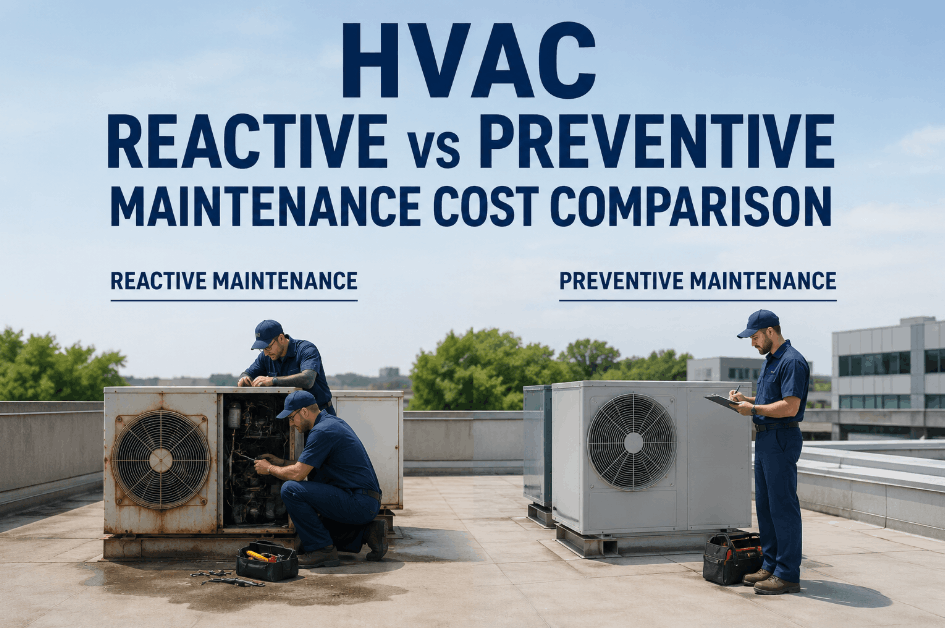
Every commercial facility faces the same fundamental question: do you maintain your HVAC systems on a schedule, or do you wait until something breaks? The answer determines not just your repair budget, but your energy costs, equipment longevity, tenant satisfaction, and regulatory compliance. Preventive maintenance is the planned, scheduled approach—regular inspections, filter changes, coil cleaning, refrigerant checks, and component servicing performed before failures occur. Reactive maintenance is the opposite: you run equipment until it breaks, then scramble to fix it. Both strategies have real costs, but the difference between them is dramatic. Facilities that sign up for a structured HVAC maintenance platform consistently outperform those relying on break-fix approaches across every measurable metric.
| Factor | Preventive Maintenance | Reactive Maintenance |
|---|---|---|
| Annual Cost | $200 – $500 planned | $1,000 – $5,000+ unplanned |
| Downtime Risk | Minimal, scheduled | High, unpredictable |
| Energy Efficiency | Optimized (5–20% savings) | Degraded over time |
| Equipment Lifespan | 15 – 20 years | 10 – 12 years |
| Emergency Repairs | Rare | Frequent (2–3x cost) |
| Compliance | Maintained consistently | Risk of violations |
| Budget Predictability | Stable, forecastable | Volatile, unpredictable |
The Real Cost Difference: What the Data Shows
The financial gap between these two strategies is wider than most facility managers realize. According to the U.S. Department of Energy, comprehensive planned maintenance programs result in a 50% reduction in total maintenance costs compared to reactive approaches. Emergency HVAC repairs cost 50–100% more than standard service calls, and running equipment to failure costs 3–10 times more than proper maintenance programs. For context, the average HVAC repair runs about $350, but emergency after-hours service pushes that to $600–$1,200 or more. A commercial compressor replacement during a planned visit might cost $1,200 in parts and labor; the same repair as an emergency can exceed $3,000 when you factor in rush service, overtime charges, and the productivity losses from an uncomfortable or uninhabitable building.
Every dollar of deferred maintenance becomes $4 in capital renewal costs, according to a Pacific Partners Consulting Group study. That filter you skipped replacing? It's now restricting airflow, forcing your compressor to work harder, increasing energy consumption by up to 15%, and accelerating wear on components that weren't designed to run under that kind of strain. Facilities ready to stop the reactive cost spiral can book a free demo to see how structured planning eliminates budget surprises.
Energy Efficiency and Performance: The Silent Savings
HVAC systems account for roughly 44% of energy consumption in commercial buildings, according to the U.S. Department of Energy. A well-maintained system operates up to 20% more efficiently than a neglected one. The DOE estimates that proper operations and maintenance practices alone deliver 5–20% annual energy savings. That's not a marginal improvement—on a $10,000 annual energy bill, that's $500 to $2,000 back in your operating budget every single year. Dirty coils, clogged filters, low refrigerant, and misaligned belts don't just cause breakdowns—they silently inflate your energy costs every day they go unaddressed.
Post-cleaning HVAC systems deliver 10–46% more airflow compared to uncleaned systems, with 41–60% reductions in energy consumption for fan and blower operation following proper HVAC cleaning. These aren't theoretical numbers—they translate directly to lower utility bills and more comfortable buildings. Facilities that sign up to track HVAC performance through maintenance software can monitor these efficiency gains in real time and ensure no scheduled service gets missed.
Equipment Lifespan: Extending Your HVAC Investment
An HVAC system is one of the largest capital investments in any commercial facility, with replacement costs ranging from $5,000 to $15,000 per unit—and significantly more for large commercial installations. Systems that receive regular preventive care last 15–20 years, while neglected units may need replacement in as little as 10 years. That's 5–10 additional years of useful life from a maintenance investment that typically costs $200–$500 annually. The math is straightforward: spend $2,500 over five years on preventive maintenance, or spend $10,000+ on early replacement. Research published in Building and Environment found that condition-based maintenance increased Mean Time Between Failures by 90–175 hours and boosted expected profitability by 210–265% compared to reactive approaches.
Safety, Compliance, and the Risk You Can't Afford to Ignore
HVAC maintenance isn't just about comfort and cost—it's a safety and compliance obligation. Poorly maintained systems create real hazards: carbon monoxide leaks from cracked heat exchangers, electrical fires from failing components, refrigerant leaks that violate EPA regulations, and degraded indoor air quality that affects occupant health. Reactive maintenance inherently increases these risks because problems go undetected until they become critical. Preventive inspections catch cracked heat exchangers, frayed wiring, and refrigerant leaks early—before they endanger occupants or trigger regulatory penalties. Many manufacturers also require documented proof of annual maintenance to keep equipment warranties valid, meaning a skipped service visit could void coverage on a $10,000+ system. Facilities managing multiple HVAC units can sign up for a free CMMS to centralize compliance documentation that automatically logs every inspection and service action.
Expert Perspective: Why Preventive Maintenance Is No Longer Optional
The data is now overwhelming and irrefutable: preventive HVAC maintenance isn't a nice-to-have—it's the single most cost-effective decision a facility manager can make. Facilities implementing structured maintenance programs see 70–75% fewer system breakdowns, 35–45% shorter repair durations, and near-100% operational availability. The organizations still running reactive-only strategies are effectively choosing the most expensive path available to them.
Making the Switch: Your Preventive Maintenance Roadmap
Transitioning from reactive to preventive HVAC maintenance doesn't require overhauling your entire operation overnight. It starts with documenting what you have, establishing service schedules, and building the habits that keep your systems running at peak performance. The facilities that succeed with this transition share one common trait: they use a maintenance management system that automates scheduling, tracks completion, and generates accountability.
The transition typically shows measurable results within the first year, often from a single prevented emergency breakdown. A compressor failure that would have cost $3,000+ in emergency service and lost productivity can justify an entire year of preventive maintenance investment. For facilities managing multiple buildings or complex HVAC systems, book a free demo to see how CMMS automation works for your specific equipment and schedules.