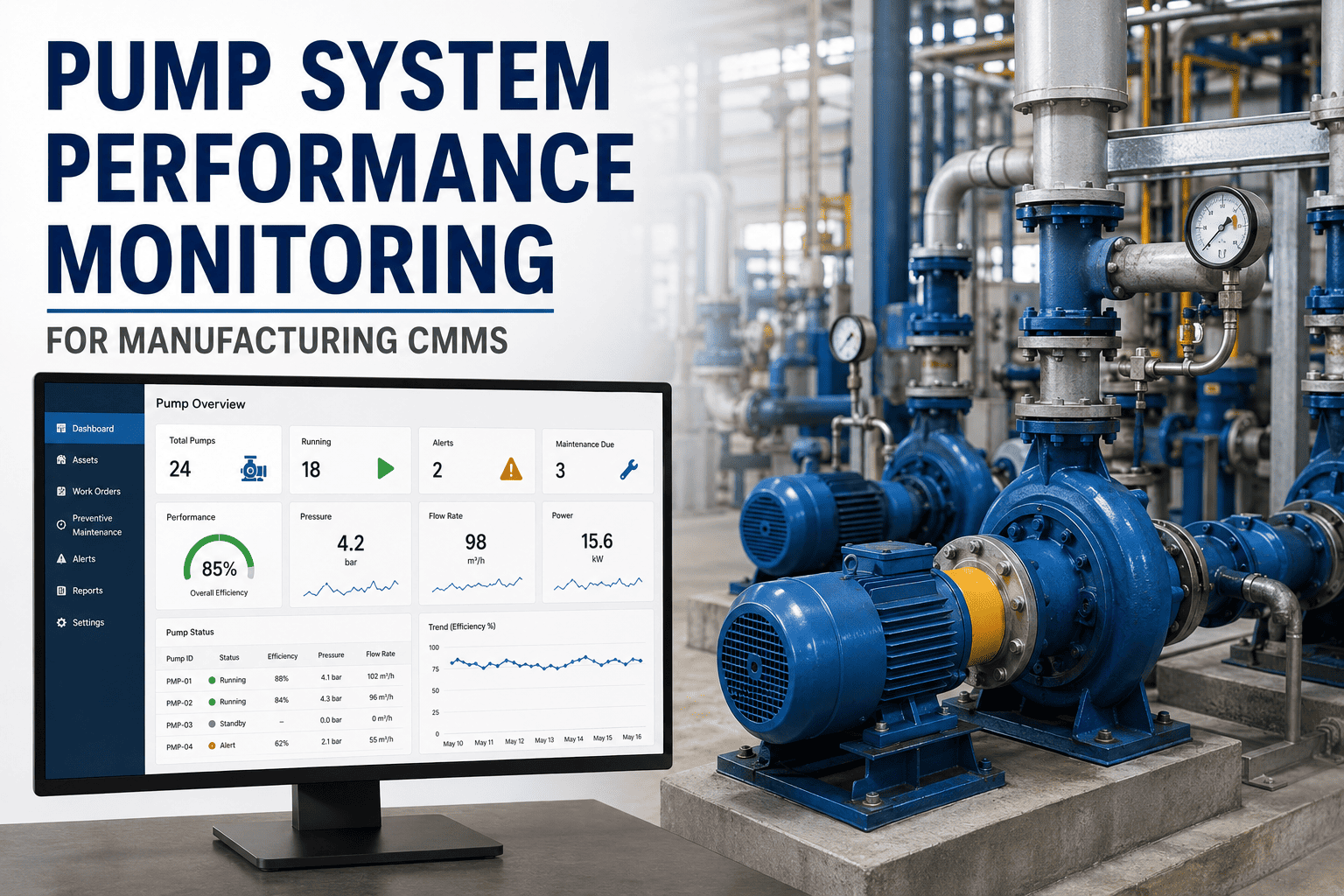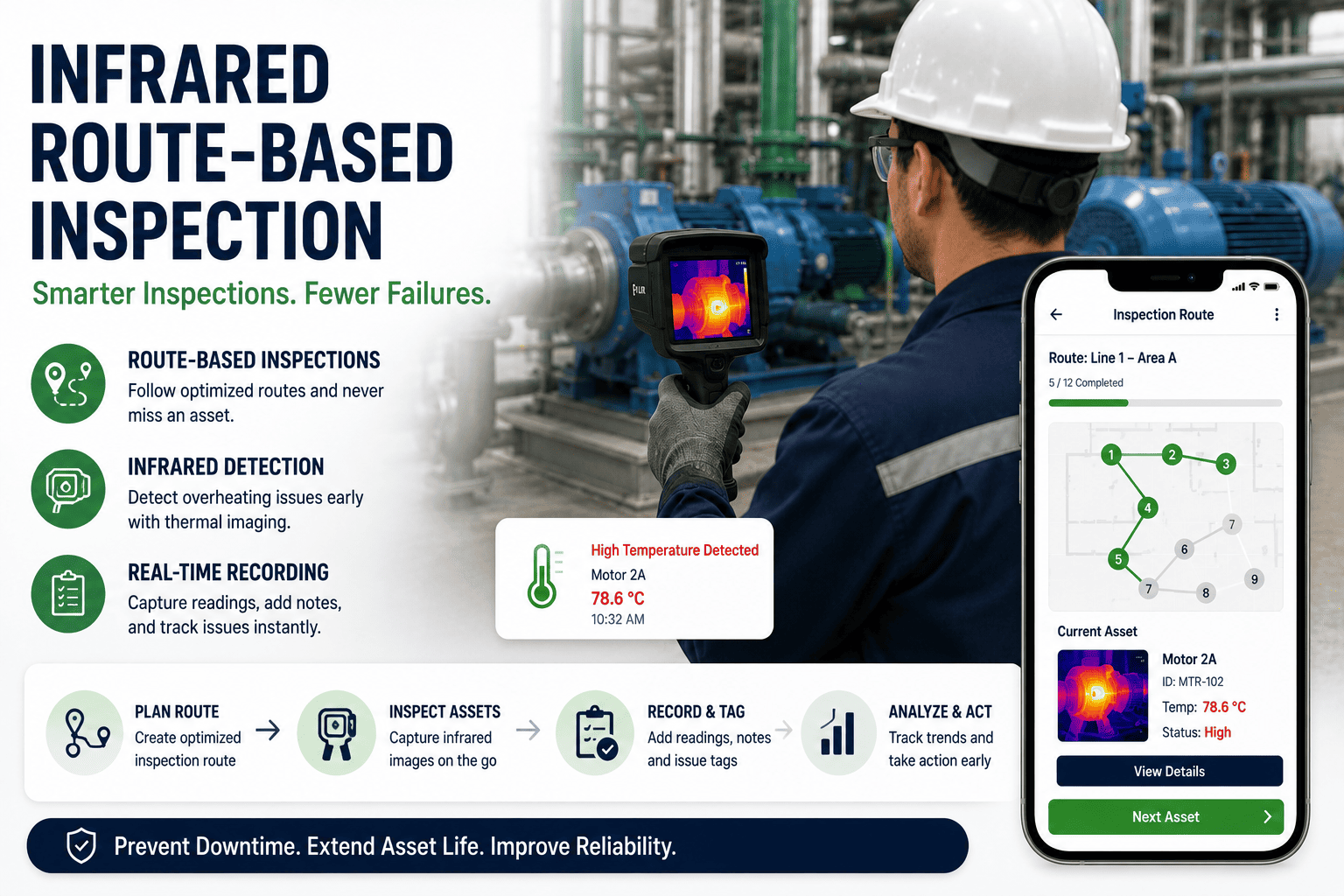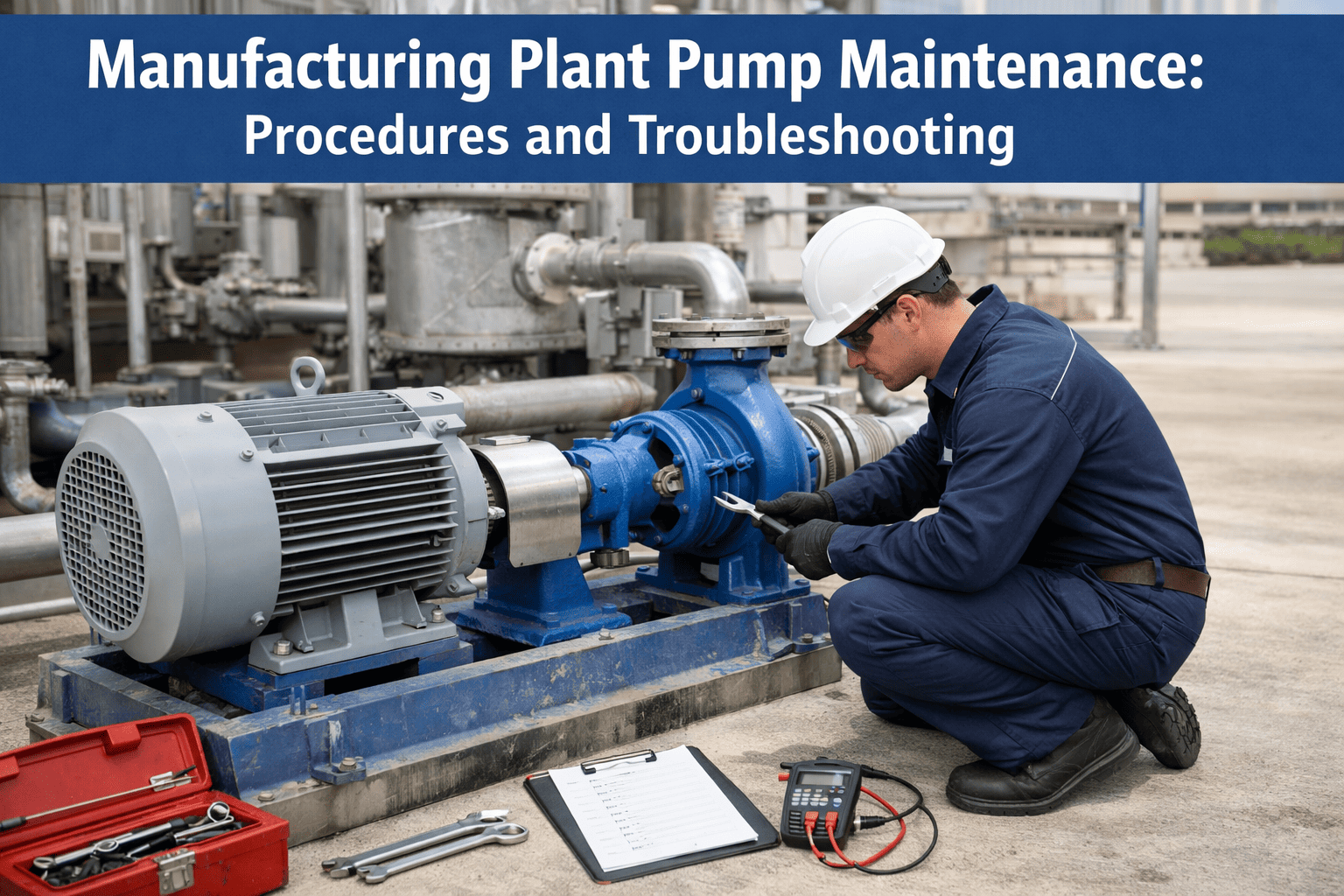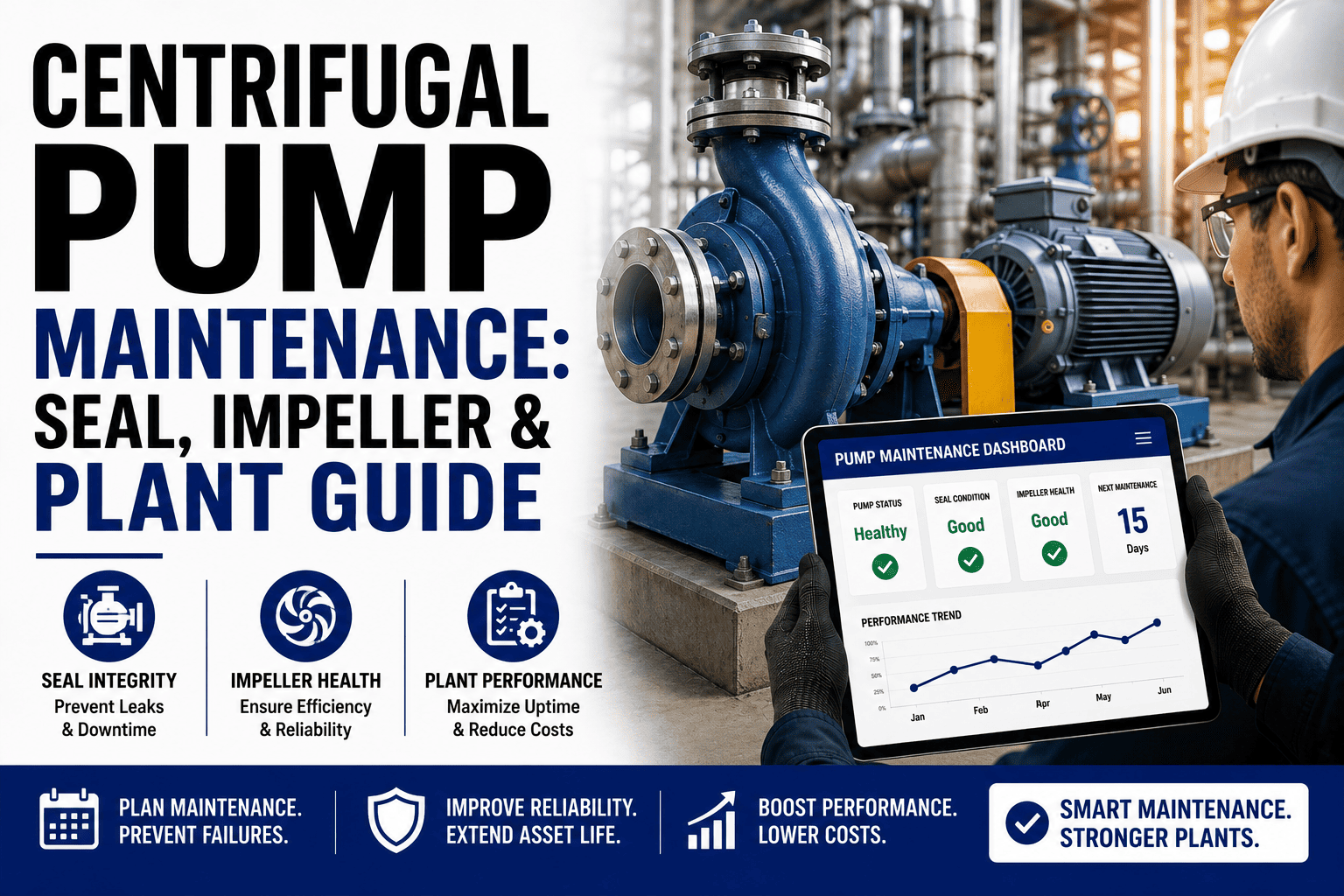
Centrifugal pump maintenance is the single highest-leverage reliability discipline in manufacturing, because centrifugal pumps move the water, chemicals, slurries and coolants that keep your entire plant running — and mechanical seal failure is their number-one downtime cause. A well-structured centrifugal pump PM program covering seal selection, impeller wear, bearing housing care, and shaft alignment can cut unplanned downtime by 30–50% and extend pump MTBF from months to years. This guide breaks down the inspection routines, wear limits, and CMMS workflows that maintenance and reliability teams need to stop reacting to leaks and start predicting them. Build your pump maintenance schedule inside a platform like OxMaint, or simply Start Free Trial to see how AI-driven work orders and predictive analytics transform your pump reliability.
CENTRIFUGAL PUMP RELIABILITY GUIDE
Is mechanical seal failure draining $50K+ a year from your plant's pump fleet?
Over 70% of centrifugal pump failures in manufacturing trace back to mechanical seals, bearing wear, or shaft misalignment — and most are preventable with a disciplined PM route. This guide shows you exactly how to build one inside your CMMS.
FAILURE ROOT CAUSES
Why centrifugal pumps fail in manufacturing plants
Centrifugal pumps represent the most populous rotating equipment class in most manufacturing facilities — and they account for a disproportionate share of maintenance spend because small defects compound rapidly under continuous duty.
Consider a 180-asset manufacturing plant running 40 centrifugal pumps across cooling, wash-down and transfer duties. At a conservative 1.5 unplanned failures per pump annually — each costing $4,200 in parts, labor and downtime — the plant absorbs roughly $252,000 per year in avoidable pump maintenance. A structured centrifugal pump PM program inside a CMMS typically recovers 40–60% of that cost within the first year.
SEAL SELECTION & CARE
Mechanical seal pump maintenance: types, failure modes & inspection
The mechanical seal is the most failure-prone component on a centrifugal pump — selecting the right seal type for the duty and inspecting it on a fixed cadence is the fastest way to reduce leakage events.
Seal Selection Factors
- Match seal face material to fluid chemistry — silicon carbide for abrasive slurries, carbon vs ceramic for clean water
- Verify API flush plan (Plan 11, 21, 53A) matches temperature and pressure envelope — wrong flush plans cause 30% of seal failures
- Specify double seals for hazardous or high-temperature media to isolate the process from atmosphere
- Confirm elastomer compatibility (Viton, EPDM, FFKM) with pumped fluid and any cleaning chemicals in CIP cycles
Seal Inspection Cadence
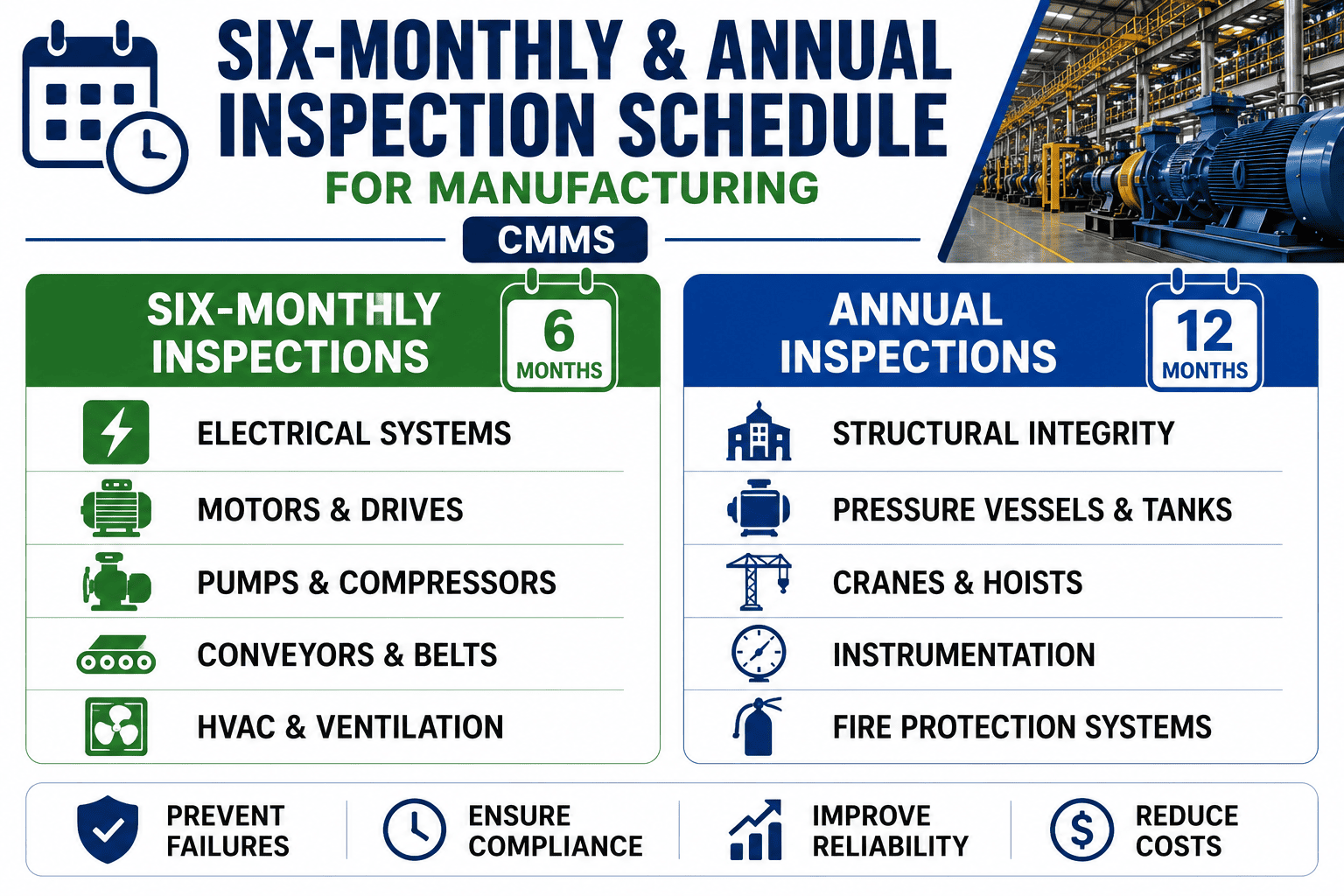
- Weekly visual: check for visible leakage at seal faces — any steady drip exceeds API 682 acceptance limits
- Monthly: measure flush plan flow rate and supply pressure — drops below 5 psig signal blockage or orifice wear
- Quarterly: inspect seal chamber temperature — a 15°C rise above baseline indicates face wear or flush failure
- Annual: replace seal if vibration at the seal chamber exceeds 3.5 mm/s RMS under normal load
| Seal Type | Best Fit | Typical Lifespan | Common Failure Mode |
|---|---|---|---|
| Single Mechanical | Clean, non-hazardous water & coolants | 12–18 months | Dry running, face wear |
| Double (Back-to-Back) | Hazardous, high-temp, abrasive media | 18–36 months | Barrier fluid loss, O-ring extrusion |
| Cartridge Seal | Plants needing fast swap-out, no on-site setting | 18–24 months | Misalignment at installation |
| Split Seal | Large-bore pumps where sleeve removal is costly | 12–20 months | Face contamination during install |
IMPELLER & CASING
Pump impeller inspection: wear limits, cavitation damage & casing checks
Impeller wear and casing erosion develop slowly but silently rob the pump of head and efficiency — a 2mm increase in impeller eye clearance can drop output by 15% while the motor draws the same power.
Performance baseline check
Record discharge pressure, flow rate and motor amperage under standard load. A 5–10% drop in developed head with stable flow signals impeller wear or internal recirculation. Log readings in your CMMS for trend analysis.
Cavitation & vibration survey
Listen for gravel-rattling sound at the suction eye and measure vibration at the pump casing. Cavitation-induced vibration at 1x and 2x vane-pass frequency confirms impeller erosion. NPSH margin should exceed 0.5x NPSHr.
Wear ring clearance measurement
During planned downtime, measure wear ring clearances with feeler gauges. Replace when clearance exceeds 0.010 inch per inch of shaft diameter — a worn wear ring increases internal recirculation and overheats the mechanical seal.
Impeller & casing internal inspection
Remove the upper casing half. Inspect impeller vanes for pitting, erosion and cracking. Measure vane thickness — replace if wall loss exceeds 20%. Check casing volute for washout at the cutwater. Document all findings with photos in the CMMS asset record.
ALIGNMENT & BEARINGS
Shaft alignment & bearing housing care that prevents 80% of secondary failures
Misalignment between the pump and motor shaft is the hidden root cause behind most bearing failures and a large share of mechanical seal leaks. A laser alignment check takes 20 minutes and prevents thousands in rebuild costs.
Alignment Target (Laser)
Angular: < 0.05 mm / 100 mm
Offset: < 0.05 mm
Per API 682 and ISO 21940. Re-check after any piping reconnection or baseplate grout repair.
Bearing Life (L10)
L10 = (C / P)³ × 16,667 / n
A 2x increase in dynamic load P cuts bearing life by 8x. Contamination and misalignment are the biggest multipliers of P.
Alignment Discipline
- Perform laser alignment after every seal replacement, motor swap or baseplate disturbance
- Check soft foot first — shim corrections on a soft-footed base create bearing load within 2 mm
- Account for thermal growth — calculate vertical expansion from pump duty temperature before final shimming
Bearing Housing Care
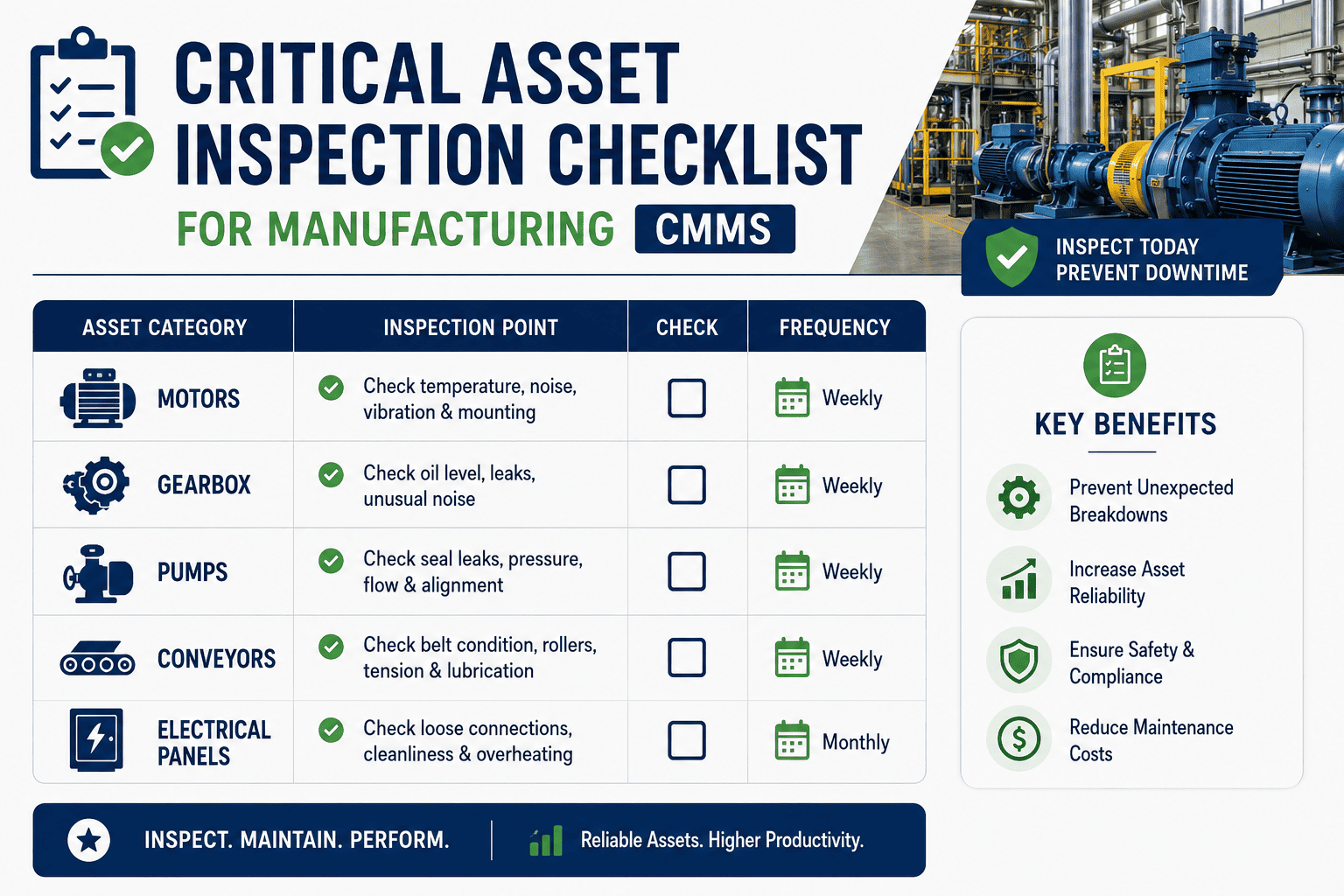
- Monthly: measure bearing housing vibration — alarm at 3.5 mm/s RMS, critical at 7.1 mm/s per ISO 10816
- Quarterly: sample oil for particle count (ISO 4406) — > 19/16 target signals contamination or wear
- Verify lip seal or labyrinth condition — moisture ingress is the leading cause of bearing corrosion in humid plants
CMMS WORKFLOW
How to build a centrifugal pump PM schedule inside your CMMS
A centrifugal pump maintenance schedule only works if it lives in a system that triggers work orders automatically, routes them to the right technician, and captures inspection data for trend analysis — that is exactly what a CMMS is built for.
Register each pump as a tracked asset
Record pump tag, manufacturer, model, serial number, installation date, duty point (flow/head/rpm), seal type, impeller diameter and motor rating. Attach the OEM manual, datasheet and baseline performance curve. In OxMaint this becomes the single source of truth for every work order, reading and parts issue against that asset.
Define PM triggers by runtime and calendar
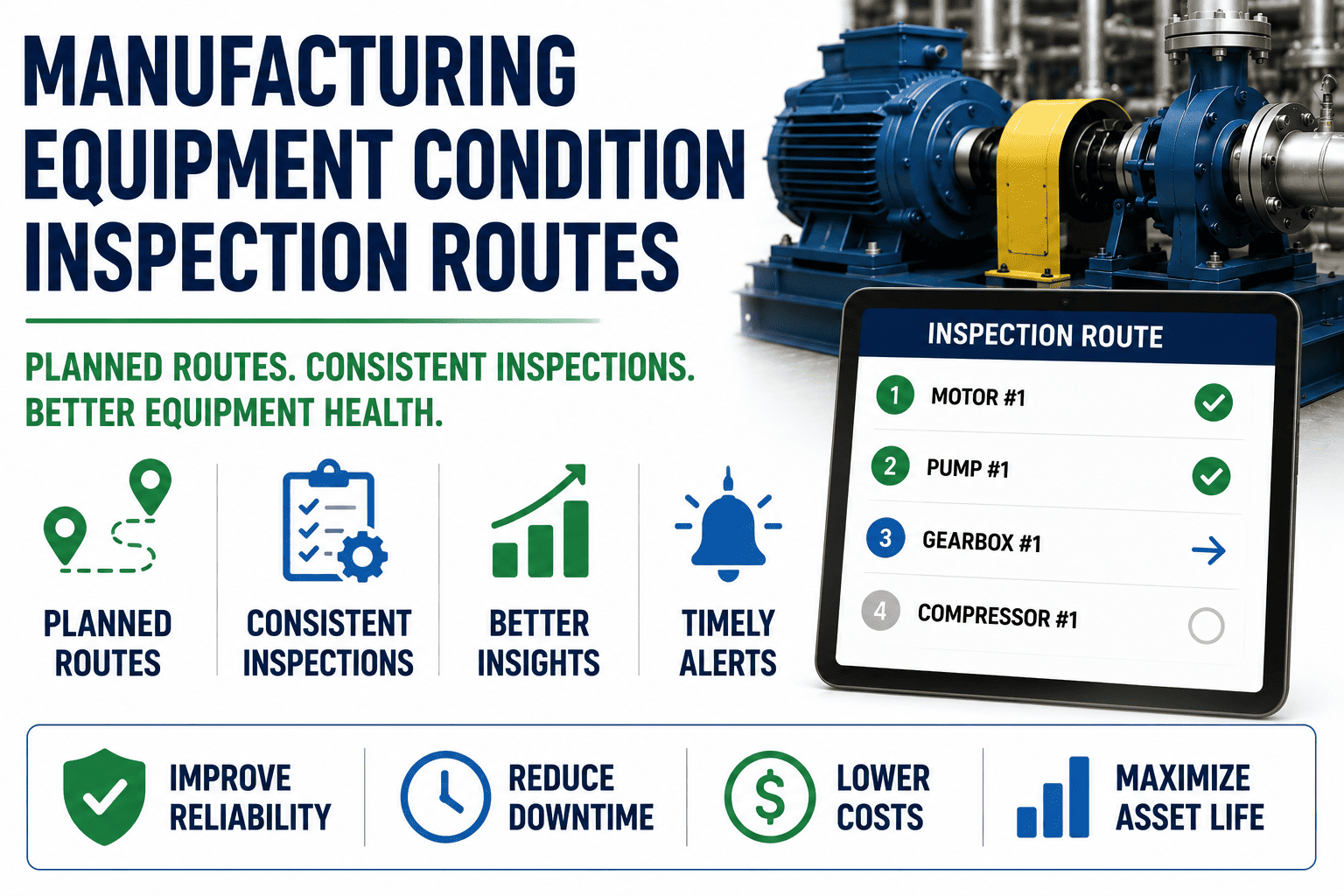
Set dual triggers — hours of operation (e.g., every 4,000 hours) and calendar interval (e.g., monthly visual, quarterly vibration). The CMMS auto-generates the work order when either threshold is reached, so a pump running hard gets serviced before a calendar-only schedule would catch it.
Build checklists inside each work order
Embed the seal, impeller, bearing and alignment inspection items as structured checklist fields — numeric readings (vibration, temperature, pressure), pass/fail toggles and photo upload prompts. This eliminates clipboard maintenance and ensures every technician captures the same data for trend analysis.
Link spare parts and seal kits to the asset record
Attach the BOM — seal kit part number, bearings, wear rings, gaskets — with current stock levels and min-reorder points. When a PM work order opens, the CMMS pre-reserves the parts so the technician never arrives on-site without the kit.
Trend readings and escalate to predictive
As vibration, temperature and performance readings accumulate, OxMaint's AI models detect drift patterns — a rising vibration trend at 1x RPM triggers a corrective work order before the bearing fails. This is the shift from preventive to predictive maintenance, and it is where MTBF gains of 3x or more are achieved.
HOW OXMAINT HELPS
OxMaint: the CMMS built for centrifugal pump reliability
OxMaint maps directly to every step of the pump PM workflow above — from asset registration to AI-driven failure prediction — turning your centrifugal pump maintenance from reactive firefighting into a data-driven reliability program.
Automated PM work orders
Auto-generate pump PM work orders on runtime or calendar triggers. Technicians arrive with checklists, parts and history on their mobile device — no paper, no missed PMs.
Outcome: 30–50% reduction in unplanned pump downtime
Predictive analytics
AI models trend vibration, temperature and performance data across your pump fleet and flag drift before failure. Move from time-based PM to condition-based maintenance.
Outcome: 3x improvement in pump MTBF within 12 months
Spare-parts inventory
Link seal kits, bearings and wear rings to each pump's asset record with min-reorder triggers. Parts are pre-reserved when a PM opens — no more arriving on-site without the kit.
Outcome: 60% faster PM cycle time, zero stock-out delays
Audit-ready compliance
Every inspection reading, part swap and alignment correction is timestamped and stored against the asset. Generate a full pump maintenance history for ISO 55000, OSHA or internal audit in seconds.
Outcome: 100% audit pass rate, zero manual record assembly
"We moved 38 centrifugal pumps from a spreadsheet PM log into OxMaint. Within four months our unplanned pump failures dropped by nearly half — the predictive vibration alerts alone caught three bearing failures before they turned into seal-destroying events."
See OxMaint on your pump fleet — book a 30-minute demo
Walk through a live pump PM workflow: asset setup, automated work orders, vibration trending and spare-parts reservation. We will map it to your plant's actual pump list.
FAQ
Centrifugal pump maintenance FAQs
How often should centrifugal pumps be inspected in a manufacturing plant?
A weekly visual leak check and monthly performance baseline (pressure, flow, amperage) cover 80% of early warning signs. Quarterly vibration surveys and annual internal impeller and casing inspections complete the cadence. Embed all of these as auto-triggered work orders in your CMMS — Start Free Trial to set up the full schedule in minutes.
What is the most common cause of centrifugal pump failure?
Mechanical seal failure is the single most common cause, responsible for roughly 40–50% of unplanned pump outages. The root causes are usually dry running, shaft misalignment, cavitation, or wrong flush-plan selection — all of which a disciplined PM route catches before the seal leaks.
How do I know when a pump impeller needs replacing?
Replace the impeller when vane wall thickness loss exceeds 20%, when visible pitting or cavitation damage extends across more than 25% of a vane surface, or when developed head drops more than 10% below the baseline performance curve at the same flow rate. A trending discharge-pressure reading in your CMMS makes this threshold visible early.
Can a CMMS improve centrifugal pump reliability?
Yes — a CMMS improves pump reliability by automating PM scheduling, standardizing inspection checklists, trending condition data, and linking spare parts to asset records. Plants using a CMMS for pump PM typically see a 3x improvement in MTBF and a 30–50% reduction in unplanned downtime within the first year. Book a demo at https://calendly.com/oxmaintapp/30min to see the workflow live.
What vibration level indicates a centrifugal pump problem?
Per ISO 10816, vibration velocity at the bearing housing should stay below 3.5 mm/s RMS for most industrial centrifugal pumps. Readings between 3.5 and 7.1 mm/s indicate a developing fault — schedule a corrective work order. Above 7.1 mm/s, shut the pump down immediately to prevent catastrophic bearing or seal failure.
Stop reacting to pump failures. Start predicting them.
Build your entire centrifugal pump PM program in OxMaint — asset records, automated work orders, vibration trending, spare-parts reservation and audit-ready history. Your pumps run longer, your technicians work smarter, and your plant stops bleeding downtime dollars.
Free 14-day trial · No credit card