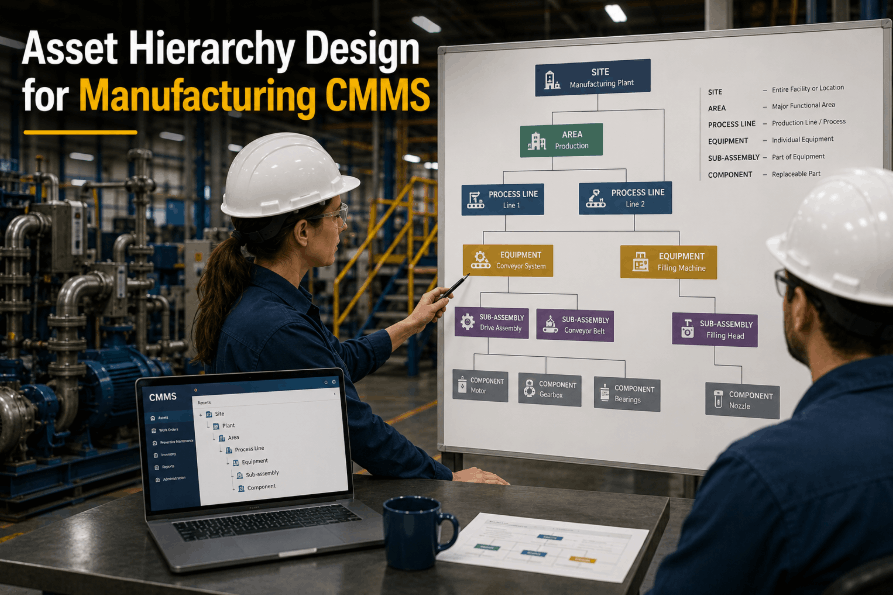
Plant commissioning is the single most critical window for establishing maintenance excellence — yet 68% of manufacturing plants go live with incomplete asset registers, generic PM schedules copied from OEM manuals, and no structured CMMS implementation plan. The decisions made in the 90 days before and after plant startup determine whether maintenance becomes a competitive advantage or a recurring cost burden for the next 15-20 years. Equipment commissioned correctly with proper documentation, defined failure modes, and baseline performance data performs 30-40% better over its lifecycle than equipment rushed into production without foundation work. The gap between a well-commissioned plant and a poorly-commissioned plant is measured in millions of dollars of prevented downtime, extended asset life, and avoided emergency repairs over the plant's operational lifetime. Book a 30-minute demo to see how OxMaint integrates with plant commissioning workflows to capture asset data, PM schedules, and operational baselines from day one.
Plant Commissioning · Maintenance Foundation · Asset Lifecycle Management
Manufacturing Plant Commissioning: Maintenance Considerations from Day One
Maintenance success starts at commissioning — not six months after production begins. This guide covers how to structure asset registers, define PM schedules, implement CMMS during plant startup, and establish performance baselines that drive reliability for decades.
The Lifetime Impact of Commissioning Decisions
30-40%
Better lifecycle performance from properly commissioned equipment vs rushed startup
68%
Plants that go live with incomplete asset registers and no CMMS plan
$2.4M
Average cost of poor commissioning over first 5 years of operation
15-20 yr
Duration that commissioning decisions affect plant performance
Sources: Plant Engineering Commissioning Study 2024, McKinsey Operations Excellence Report, Industrial Maintenance Institute
The Three Phases of Maintenance-First Commissioning
Successful commissioning integrates maintenance planning into every phase — before equipment arrives, during installation and startup, and through the first 90 days of production stabilization.
Phase 1
Pre-Commissioning Foundation
90-120 Days Before Production Start
Core Objectives
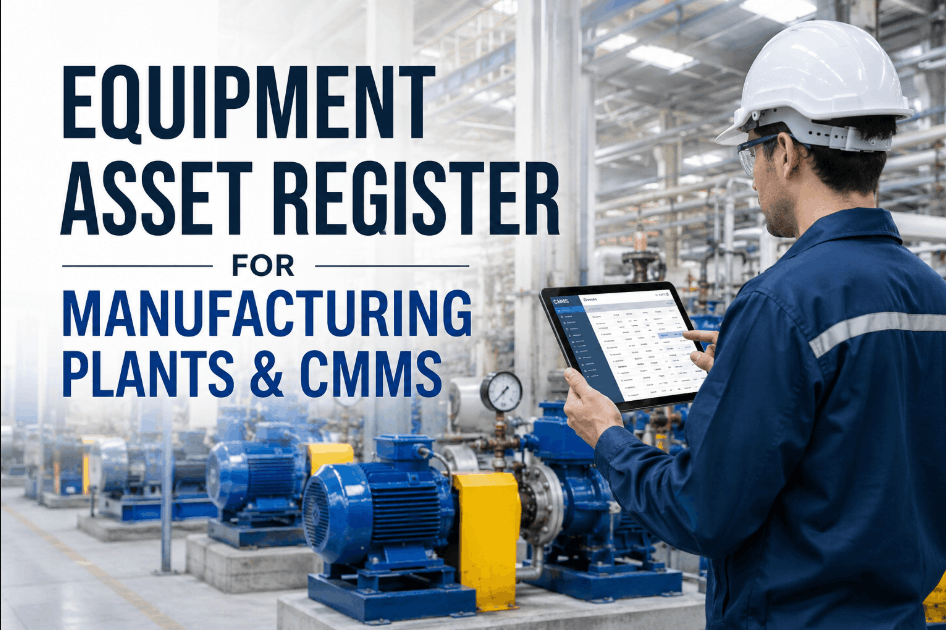
Build complete asset register with hierarchical structure organized by production line, system, and equipment type. Assign unique asset IDs aligned to naming convention standards.
Collect OEM manuals, parts lists, and recommended maintenance schedules for every critical asset. Extract PM tasks, intervals, and spare parts requirements into structured format.
Define asset criticality classifications based on production impact, safety risk, and replacement cost. Establish different PM frequencies and documentation requirements per criticality level.
Select and configure CMMS platform. Import asset register, create PM templates, establish work order workflows, and define user roles before equipment installation begins.
Develop maintenance team training plan covering CMMS usage, asset-specific procedures, and safety protocols. Schedule training sessions during equipment installation phase.
Deliverable: Complete asset register in CMMS with PM schedules ready to activate on equipment startup. Maintenance team trained on system before production launch.
Phase 2
Installation and Startup Commissioning
Equipment Installation Through Production Ramp-Up
Core Objectives
Capture baseline performance data during equipment commissioning runs — vibration signatures, temperature profiles, power consumption, cycle times. Store as reference benchmarks in CMMS for future condition monitoring.
Document as-built configurations including actual installation specs, calibration settings, and any deviations from design. Attach photos, drawings, and commissioning reports to asset records.
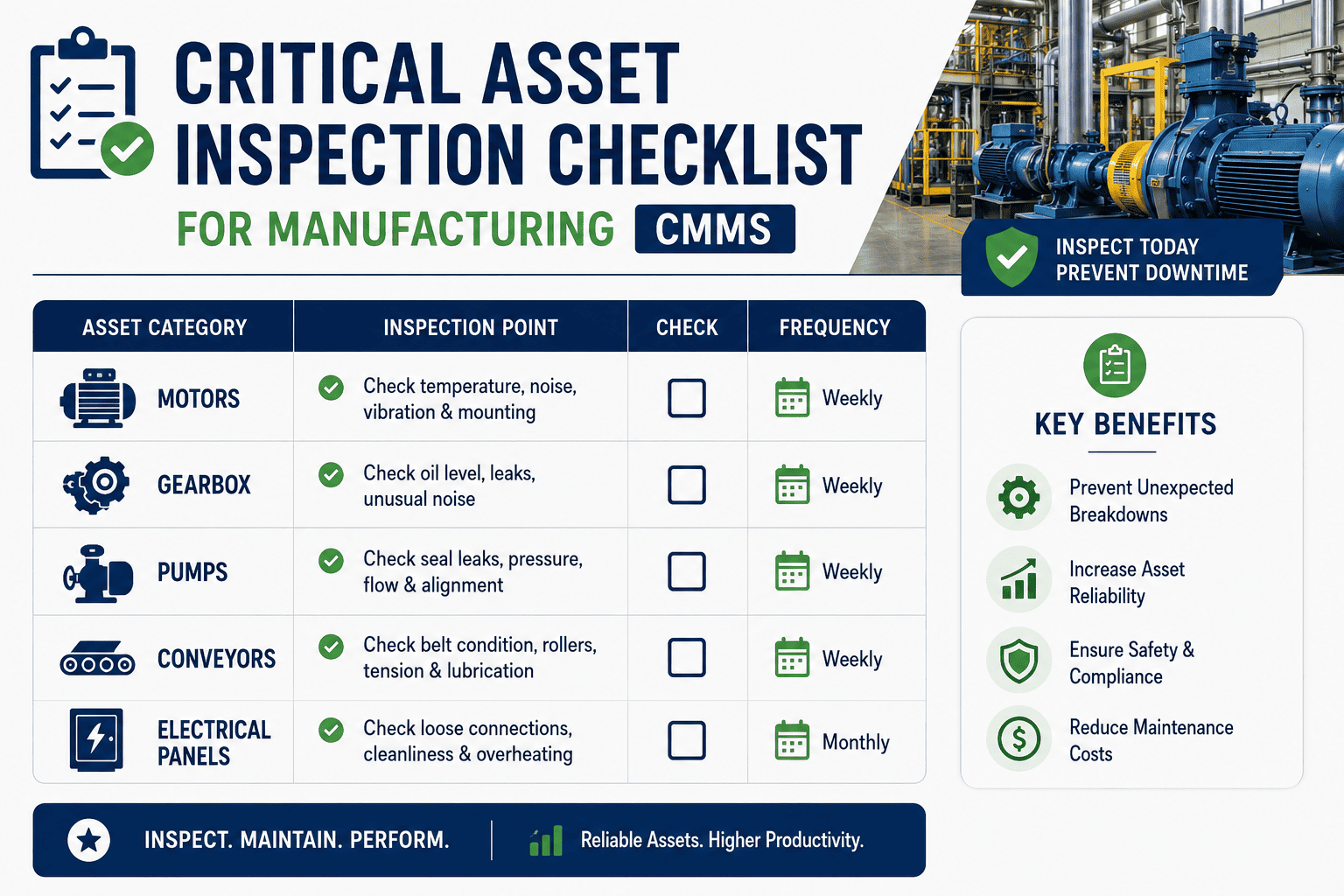
Conduct initial PM tasks as part of commissioning checklist — first lubrication, initial alignments, sensor calibrations. Log completion in CMMS to establish PM history from day zero.
Install condition monitoring sensors on critical rotating equipment during commissioning phase while access is easiest. Connect sensor outputs to CMMS for real-time alerts.
Create asset-specific SOPs based on OEM guidance and site conditions. Link SOPs to asset records so technicians access procedures directly from work orders.
Deliverable: Every commissioned asset has baseline performance data, as-built documentation, and active PM schedule in CMMS before production begins. Condition monitoring sensors operational.
Phase 3
Production Stabilization and Optimization
First 90 Days of Commercial Production
Core Objectives
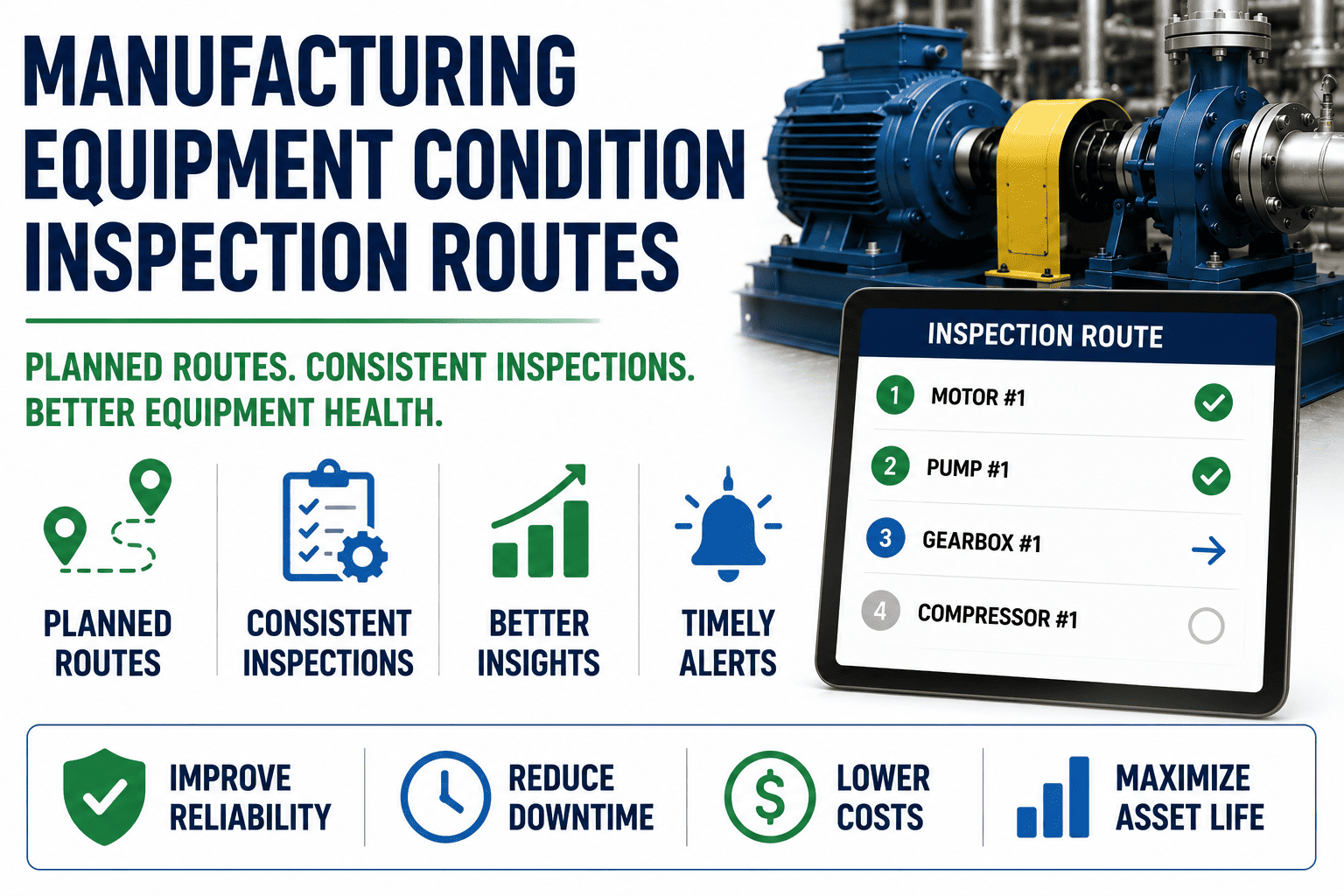
Track every failure, adjustment, and work order during initial production ramp. Identify infant mortality failures vs ongoing issues. Document root causes and corrective actions in CMMS.
Refine PM intervals based on actual equipment behavior vs OEM defaults. Increase frequency on assets showing early wear patterns, decrease on over-maintained equipment.
Establish KPI baseline for first 90 days including MTBF, MTTR, PM completion rate, and unplanned downtime percentage. Use as benchmark for ongoing performance tracking.
Build critical spare parts inventory based on actual failure patterns and lead times observed during startup. Avoid generic stock lists — stock what breaks in your operating conditions.
Conduct maintenance effectiveness review at day 30, 60, and 90. Adjust PM schedules, work order processes, and spare parts levels based on real operational data.
Deliverable: Optimized PM schedules based on actual performance. Baseline KPIs established. Spare parts inventory aligned to real failure patterns. Maintenance system fully operational and continuously improving.
Pre-Commissioning CMMS Setup Checklist
Complete this checklist 60-90 days before equipment installation to ensure CMMS is ready to capture commissioning data from day one.
Asset Register Configuration
✓
Define asset hierarchy structure aligned to plant layout and production flow
✓
Establish asset ID naming convention with location, type, and sequence codes
✓
Create asset criticality classification system with A/B/C tiers
✓
Import equipment list from procurement with manufacturer, model, serial numbers
✓
Generate QR code labels for all assets and affix during installation
PM Schedule Development
✓
Extract PM tasks from OEM manuals and translate to structured checklists
✓
Define PM frequencies per asset criticality level and operating intensity
✓
Create PM templates in CMMS with task lists, estimated duration, required skills
✓
Schedule initial PM trigger dates aligned to commissioning completion
✓
Configure automatic PM work order generation and assignment rules
Documentation Framework
✓
Upload OEM manuals, parts catalogs, and electrical schematics to asset records
✓
Create document folders for commissioning reports, calibration certificates, warranties
✓
Define required fields for work order closure including root cause coding
✓
Enable photo/video attachments for work orders and asset inspections
✓
Configure audit trail logging for all asset changes and configuration updates
Team Readiness
✓
Define user roles and permissions for maintenance team, supervisors, planners
✓
Conduct CMMS training sessions covering work order flow and mobile app usage
✓
Create quick reference guides for common tasks and troubleshooting
✓
Assign asset ownership responsibilities to specific technicians or teams
✓
Establish KPI dashboard and reporting cadence for maintenance performance tracking
Commission Smart, Maintain Better
Set Your Maintenance Foundation Before Production Starts
The commissioning window is the easiest time to establish maintenance excellence — equipment is accessible, documentation is fresh, and OEM support is available. Once production starts, you are in reactive mode. OxMaint integrates with commissioning workflows to capture asset data, baseline performance, and PM schedules before equipment goes live, so your maintenance system is operational on day one instead of being built retroactively six months later.
Critical Data to Capture During Commissioning
The following data points captured during commissioning become invaluable reference baselines for condition monitoring, troubleshooting, and lifecycle planning.
Performance Baselines
Vibration signatures at normal operation, temperature profiles under load, power consumption at rated capacity, cycle times at standard speed, pressure and flow rates at design conditions, noise levels during commissioning runs.
Used for condition monitoring to detect deviation from healthy operation. Any future measurement compared against commissioning baseline to identify degradation trends.
As-Built Documentation
Final installation drawings showing actual piping, electrical routing, foundation details. Calibration certificates with instrument settings and zero points. Alignment reports for coupled equipment. Torque specifications for critical fasteners.
Enables accurate troubleshooting and prevents errors during future maintenance. Technicians see what was actually installed vs design intent.
Configuration Settings
PLC program versions and parameter settings, control loop tuning values, safety setpoints and interlock logic, drive parameters for VFDs, sensor calibration data with certificates.
Allows restoration to known-good configuration after changes or failures. Prevents configuration drift over time. Critical for regulated industries requiring validated settings.
Warranty and Compliance
Warranty start dates and coverage terms per asset, required maintenance actions to maintain warranty validity, compliance certifications and regulatory approvals, safety inspection completion records.
Protects warranty coverage by documenting required maintenance. Provides audit trail for regulatory compliance. Flags warranty expiration dates for capex planning.
Spare Parts Identification
Critical spare parts list from OEM with part numbers, recommended stock quantities based on MTBF, supplier details and lead times, cross-reference to generic or alternative parts.
Speeds initial spare parts procurement. Prevents stocking wrong items. Establishes baseline for inventory optimization as actual failure patterns emerge.
Initial Performance Testing
Production rate at rated capacity, energy efficiency measurements, product quality metrics from trial runs, process capability indices, equipment availability during commissioning period.
Establishes performance expectations. Identifies underperforming equipment before warranty expires. Provides baseline for OEE tracking and continuous improvement initiatives.
Seven Common Commissioning Mistakes That Create Maintenance Problems
Delaying CMMS Implementation Until After Production Starts
Result: First 6-12 months of asset history lost. No baseline data captured. Maintenance team builds system retroactively while fighting fires. PM schedules never properly established.
Prevention: Select and configure CMMS 90 days before commissioning begins. Import asset register and PM templates during equipment installation phase. Go live with production startup.
Generic PM Schedules Copied from OEM Manuals Without Adaptation
Result: Over-maintenance on low-duty equipment, under-maintenance on high-intensity assets. PM intervals ignore actual operating conditions, production schedules, and environmental factors.
Prevention: Use OEM intervals as starting point then adjust based on duty cycle, operating environment, and criticality. Plan to refine schedules after first 90 days of operation based on real failure data.
No Baseline Performance Data Captured During Commissioning Runs
Result: No reference point for condition monitoring. Cannot distinguish normal variation from developing failures. Troubleshooting starts from zero every time without historical context.
Prevention: Conduct instrumented commissioning runs capturing vibration, temperature, power, flow, and pressure at normal operation. Store measurements as asset baseline in CMMS for future comparison.
Incomplete Asset Documentation and Missing OEM Manuals
Result: Technicians lack parts lists, torque specs, alignment procedures, and electrical schematics when needed. Maintenance takes longer, errors increase, warranty claims rejected due to missing documentation.
Prevention: Require OEM manuals, parts catalogs, and electrical drawings as commissioning deliverable. Upload all documentation to CMMS asset records before equipment handover to operations.
No Asset Criticality Classification System Defined
Result: All equipment treated equally. Critical bottleneck assets get same PM frequency as redundant support equipment. Maintenance resources misallocated. High-impact failures not prioritized.
Prevention: Classify assets A/B/C based on production impact, safety risk, and replacement cost before commissioning. Define different PM frequencies, spare parts requirements, and response times per tier.
Maintenance Team Not Trained Before Equipment Startup
Result: Technicians learn on-the-fly during production ramp causing errors, safety incidents, and equipment damage. CMMS sits unused as team defaults to whiteboards and spreadsheets they understand.
Prevention: Schedule maintenance training during equipment installation phase. Hands-on sessions on actual equipment before production starts. CMMS training concurrent with asset commissioning so team is ready day one.
No Infant Mortality Tracking Plan for First 90 Days
Result: Early failures dismissed as "normal startup issues" without root cause analysis. Recurring problems not identified. Warranty claims missed. Defective equipment not returned to vendor in claim window.
Prevention: Aggressive work order logging for first 90 days with mandatory root cause coding. Weekly failure review meetings. Track infant mortality separately from steady-state reliability to identify systemic issues.
Commissioning Timeline with Maintenance Milestones
When should we implement the CMMS — before or after commissioning?
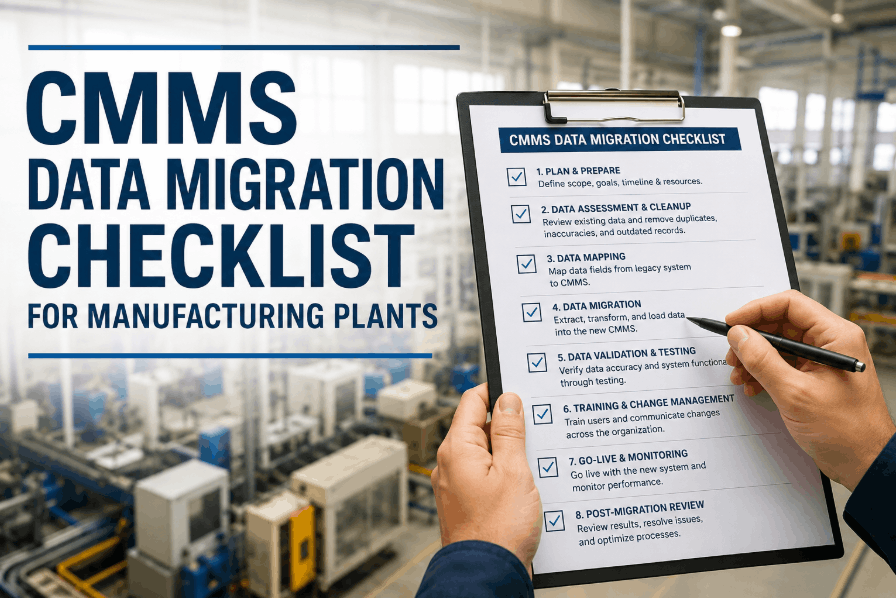
Before commissioning, ideally 90 days ahead. The CMMS should be ready to capture baseline data, commissioning test results, and as-built documentation as equipment is installed. Implementing after startup means losing critical early-life data and starting with an incomplete system.
Should we use OEM maintenance intervals as-is or customize them?
Start with OEM intervals then refine based on actual operating conditions, duty cycles, and environmental factors specific to your plant. Plan to adjust after 90 days of production using real failure data and equipment behavior patterns.
What baseline performance data is most valuable to capture during commissioning?
Vibration signatures on rotating equipment, thermal profiles under load, power consumption at rated capacity, and process performance metrics. These baselines enable condition-based monitoring and make future troubleshooting dramatically faster.
How do we handle maintenance during the warranty period?
Document all maintenance activities in CMMS to protect warranty coverage. Many warranties require proof of proper maintenance. Track warranty expiration dates per asset and flag required actions to maintain validity.
Can OxMaint integrate with our commissioning and project management systems?
Yes — OxMaint can import equipment lists from project databases, accept as-built documentation from commissioning contractors, and integrate with project schedules to align PM activation with equipment handover dates.
OxMaint Plant Commissioning Integration
Commission Your Plant with Maintenance Excellence Built In
The commissioning phase is your single best opportunity to establish maintenance foundation — complete asset registers, optimized PM schedules, baseline performance data, and a CMMS your team actually uses. Miss this window and you spend years catching up, rebuilding documentation retroactively, and fighting fires that proper commissioning would have prevented. OxMaint integrates with commissioning workflows to capture the data that matters from day one, so your maintenance system launches with production instead of limping along six months behind.