Failure to control hazardous energy is one of the deadliest regulatory violations in manufacturing — OSHA estimates that inadequate Lockout/Tagout (LOTO) procedures account for 10% of all serious industrial accidents, causing approximately 50,000 injuries and 120 fatalities every year in the United States alone. OSHA 29 CFR 1910.147 mandates a written energy control programme, machine-specific LOTO procedures, and annual programme audits for every facility where workers perform maintenance or servicing on equipment that could store or release hazardous energy. Facilities with documented LOTO programmes pass compliance audits in a fraction of the time and have significantly lower workers' compensation exposure. This checklist covers every phase of the LOTO process — preparation, isolation, verification, work, and re-energisation — with each step mapped to the OSHA standard it satisfies and the specific hazard it controls. Start managing your LOTO procedures and audits digitally with OxMaint's energy isolation compliance platform, built for manufacturing environments.
LOCKOUT
TAGOUT
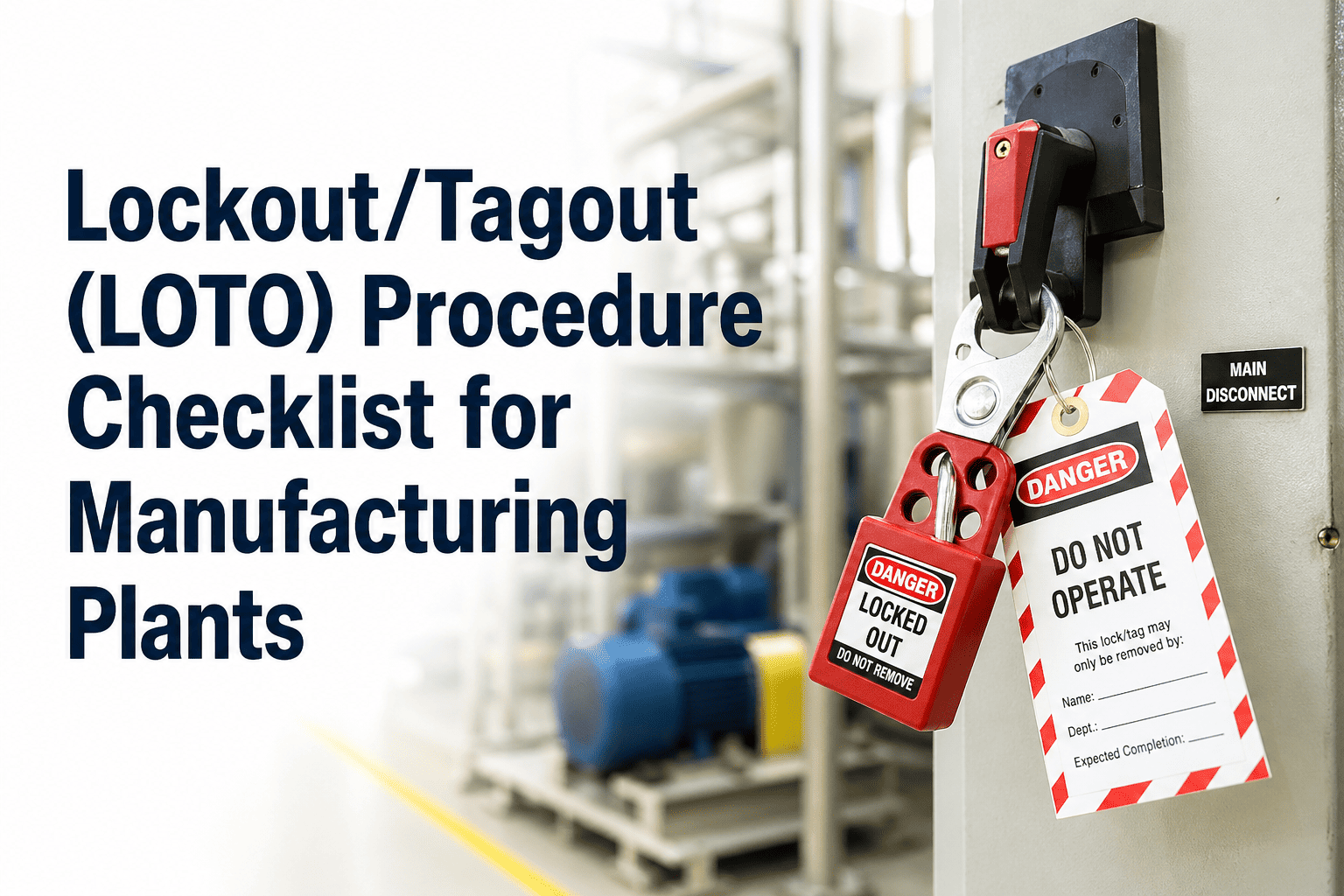
Lockout/Tagout (LOTO) Procedure Checklist
Complete step-by-step LOTO checklist for manufacturing maintenance — preparation through re-energisation — mapped to OSHA 29 CFR 1910.147, covering all hazardous energy types: electrical, pneumatic, hydraulic, mechanical, thermal, and chemical.
Preparation
Isolation
Lockout
Verification
Re-energisation
120
Fatalities per year attributed to inadequate LOTO (OSHA estimate)
50K
Injuries annually from uncontrolled hazardous energy in the US
1910.147
The OSHA standard that mandates your written energy control programme
$156K
Maximum OSHA penalty per wilful LOTO violation (as of 2024)
Step 01 — Preparation
Pre-LOTO Preparation Checklist
Preparation is the most skipped phase of LOTO — and the most dangerous to skip. Without a reviewed machine-specific procedure, workers improvise energy isolation, which means energy sources are missed. OSHA 1910.147(c)(4) requires a documented procedure for every piece of equipment where LOTO is performed.
Retrieve the machine-specific LOTO procedure
Locate the written energy control procedure for the specific machine being serviced — do not rely on memory or a generic procedure; confirm procedure is current (last reviewed within 12 months) and matches actual machine configuration
Standard: OSHA 1910.147(c)(4)(i) · Role: Authorised Employee · Record: LOTO permit
Identify all energy sources on the procedure
Review procedure for all energy types — electrical (all voltage levels), pneumatic, hydraulic, gravity (suspended loads and stored spring energy), thermal (steam, heated components), and chemical (process fluids); confirm all isolation points are labelled on the machine
Standard: OSHA 1910.147(c)(4)(ii) · Role: Authorised Employee · Record: LOTO permit
Notify affected employees and operators
Inform all operators and affected employees that the machine is being taken out of service for maintenance; confirm no production scheduled on the equipment; record names of notified employees on the LOTO permit
Standard: OSHA 1910.147(f)(2) · Role: Authorised Employee · Record: LOTO permit — affected employees section
Gather all required LOTO hardware
Collect personal padlocks, hasps, lockout tags, valve lockout devices, electrical plug lockouts, and circuit breaker lockouts as specified in the machine procedure; verify all hardware is in serviceable condition — damaged or incorrect hardware must not be used
Standard: OSHA 1910.147(c)(5) · Role: Authorised Employee · Record: LOTO hardware log
Step 02 — Shutdown & Isolation
Machine Shutdown & Energy Isolation
Isolation is the mechanical act of separating each energy source from the machine. OSHA 1910.147(d) requires energy isolation to be performed in the sequence specified in the machine procedure. Each energy type has specific isolation device requirements — there is no single universal method.
Perform normal controlled machine shutdown
Use the machine's normal shutdown procedure — stop cycle, return moving parts to safe position, and confirm machine is at rest before beginning energy isolation; never begin isolation while machine is in motion or under load
Standard: OSHA 1910.147(d)(2) · Role: Authorised Employee · Record: LOTO permit
Isolate all electrical energy sources
Open and lockout all circuit breakers, disconnects, and isolating switches as listed in the machine procedure; include all voltage levels (480V main disconnect, 120V control circuit, and any UPS or battery-backed systems); each isolation point receives its own lockout device
Standard: OSHA 1910.147(d)(3) / NFPA 70E · Role: Authorised Employee · Record: LOTO permit — isolation checklist
Isolate all pneumatic and hydraulic energy sources
Close and lockout all air and hydraulic supply valves; bleed all downstream pressure to zero using the bleed valve or manual release; confirm pressure gauge reads zero before proceeding; residual pressure in hydraulic accumulators must be discharged — do not assume bleed-down is complete without gauge confirmation
Standard: OSHA 1910.147(d)(4) · Role: Authorised Employee · Record: LOTO permit — pressure bleed log
Control gravity and stored mechanical energy
Block, restrain, or support all suspended loads, elevated components, and coiled or compressed springs before work begins; never rely on hydraulic or pneumatic pressure to support a raised component during maintenance — gravity isolation requires a physical block or restraint
Standard: OSHA 1910.147(d)(6) · Role: Authorised Employee · Record: LOTO permit — stored energy section
LOTO Compliance Across Your Entire Plant — Without the Paperwork
OxMaint stores machine-specific LOTO procedures, assigns permits to authorised employees, tracks annual programme audits, and generates OSHA-ready compliance reports — all in one platform.
Step 03 — Lockout & Tagout
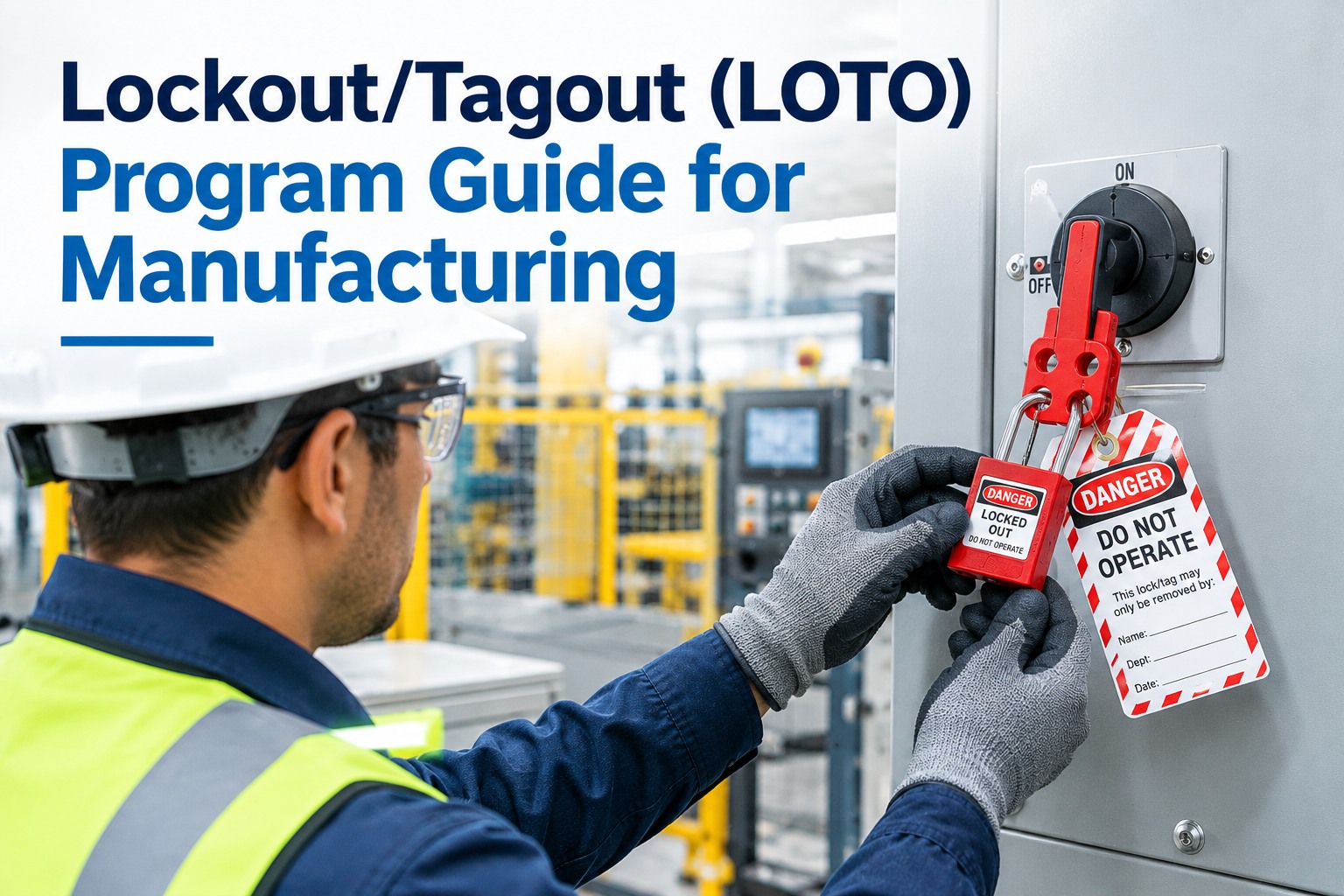
Applying Lockout and Tagout Devices
Apply personal padlock to each isolation point
Each authorised employee applies their own personal padlock to every isolation point — never share a lock or allow a supervisor to hold the key; if multiple workers are performing maintenance, each applies their own lock to a hasp at each isolation point; no lock, no entry
Standard: OSHA 1910.147(c)(5)(ii) · Role: Each Authorised Employee · Record: Lock number logged to employee name on LOTO permit
Attach danger tag to each lockout device
Attach OSHA-compliant danger tag to each lock — tag must include employee name, date of application, and reason for lockout; tags must not be used alone where lockout is feasible; tags are a supplement to locks, not a substitute
Standard: OSHA 1910.147(c)(5)(iii) / 1910.147(f)(1)(ii) · Role: Each Authorised Employee · Record: LOTO permit
Step 04 — Verification (Try-Out)
Zero Energy State Verification
Verification is the most safety-critical step in the entire LOTO process. OSHA 1910.147(d)(6) requires verification that all energy has been isolated and restrained before work begins. Skipping verification is the primary cause of LOTO-related fatalities.
Test electrical isolation with a calibrated meter
Use a calibrated CAT III or CAT IV meter to verify zero voltage at all points where work will be performed — test all conductors including neutral; confirm meter is operational before and after testing using a known voltage source; document meter ID and readings on LOTO permit
Standard: OSHA 1910.147(d)(6) / NFPA 70E 120.5 · Role: Authorised Employee · Record: Voltage test readings on LOTO permit
Attempt to operate machine controls (try-out test)
With all locks applied, attempt to start the machine using normal operator controls — press start buttons for each motion; any response confirms an isolation point was missed and work must not begin until the additional source is found and isolated
Standard: OSHA 1910.147(d)(6) · Role: Authorised Employee · Record: Try-out test result on LOTO permit
Verify all pressures are at zero
Confirm pneumatic and hydraulic pressure gauges read zero on all circuits; slowly open a downstream fitting or drain valve to confirm no residual pressure; do not open a fitting without confirming zero pressure first — residual hydraulic pressure causes injection injuries
Standard: OSHA 1910.147(d)(6) · Role: Authorised Employee · Record: Pressure readings on LOTO permit
Step 05 — Re-energisation
Controlled Re-energisation Checklist
Re-energisation must follow a specific sequence under OSHA 1910.147(e). It is a common source of injury when workers re-energise before the work area is fully cleared or before all personal locks are removed. The sequence below is mandatory — never skip steps.
Confirm all tools and materials are removed from machine
Inspect all work areas, access panels, and guarded zones to confirm no tools, rags, fittings, or other materials have been left inside the machine; re-install all guards and covers removed for maintenance access before any locks are removed
Standard: OSHA 1910.147(e)(1) · Role: Authorised Employee · Record: LOTO permit — restoration section
Confirm all workers are clear of machine hazard zones
Physically verify that all workers are outside all machine guarded zones and pinch point areas before any lock is removed; announce re-energisation verbally and confirm verbal acknowledgement from all affected employees and the area supervisor
Standard: OSHA 1910.147(e)(2) · Role: Authorised Employee · Record: LOTO permit — clearance section
Each employee removes their own personal lock
Each authorised employee removes only their own personal lock from each isolation point — no one may remove another employee's lock except under the emergency lock removal procedure, which requires supervisor sign-off and documentation; confirm all locks removed before re-energisation
Standard: OSHA 1910.147(e)(3) · Role: Each Authorised Employee · Record: LOTO permit — lock removal confirmation
Re-energise in sequence and verify normal machine function
Re-apply energy in the sequence specified in the machine procedure — restore electrical first, then pneumatic, then hydraulic; run machine through one complete cycle under observation before returning to production; log completion time and authorised employee name on LOTO permit
Standard: OSHA 1910.147(e)(4) · Role: Authorised Employee + Operator · Record: Completed LOTO permit (retained 12 months minimum)
Annual Programme Requirements
LOTO Annual Audit & Certification Requirements
A
Annual Programme Audit
OSHA 1910.147(c)(6) requires an annual audit of the energy control programme by an authorised employee other than the one being audited. The audit must be documented and retained. Any deficiencies found must be corrected before the next use of the procedure.
Standard: OSHA 1910.147(c)(6) · Record: Annual audit report · Role: Designated Auditor
B
Annual Employee Training Certification
All authorised employees must receive initial LOTO training and periodic retraining when procedures change, when an audit reveals deficiencies, or when there is reason to believe an employee does not understand the procedure. Training records must identify each employee and the date of training.
Standard: OSHA 1910.147(c)(7) · Record: Training record · Role: Safety Manager
C
Machine Procedure Review & Update
All machine-specific LOTO procedures must be reviewed annually or whenever the machine is modified, relocated, or when a near-miss involves the machine. Updated procedures must be re-issued to all authorised employees and the prior version marked obsolete and archived.
Standard: OSHA 1910.147(c)(4) / (c)(6) · Record: Procedure version log · Role: EHS Manager
LOTO Compliance Standards Reference
What LOTO Safety Professionals Say
01
Every LOTO-related fatality we have investigated had one thing in common — the try-out test was skipped. Workers assumed the machine was dead because they could see the lockout device. Verification is not a formality. It is the step that keeps people alive.
Industrial Accident Investigator — OSHA Compliance Consultant, 25 years
02
Machine-specific procedures are where most LOTO programmes fail. Generic procedures miss energy sources that are unique to each piece of equipment. The investment in writing a proper procedure for each machine is paid back the first time a technician avoids a missed isolation point.
EHS Director — Automotive Tier 1 Supplier, 18 years
03
Digital LOTO permit systems eliminate the two biggest compliance failures we see in audits: missing permits and unsigned permits. When the permit is on a tablet that requires a signature to close, neither failure is possible. Our OSHA citation rate dropped to zero within one year of going digital.
Maintenance Manager — Chemical Processing Plant, 400+ LOTO permits per month
Frequently Asked Questions
Who is an authorised employee under OSHA LOTO?
An authorised employee is a person who locks or tags out machines to perform servicing or maintenance. They must receive specific LOTO training for each machine they service. Operators who simply start and stop machines are affected employees, not authorised employees, and have different LOTO responsibilities.
Can a tagout alone be used instead of a lockout?
Only if it can be demonstrated that tagout provides equivalent protection to lockout — this is an extremely high bar under OSHA 1910.147(c)(3). In practice, lockout is required wherever lockout is feasible. Tags alone are only permitted on equipment that physically cannot be locked out, and additional protective measures must be taken.
How often must LOTO procedures and training be updated?
OSHA 1910.147 requires annual audits of energy control procedures and retraining when inspections reveal deficiencies, when procedures change, or when a worker is observed not following the procedure correctly. Retraining is mandatory — not optional — when any of these conditions occur.
What records must be kept for LOTO compliance?
Required records include: completed LOTO permits (minimum 12 months), annual programme audit reports, employee training records with dates and scope, and machine-specific procedure version logs. OSHA inspectors will request these records immediately upon site arrival — they must be retrievable within minutes, not hours.
Your LOTO Programme Should Run Itself — Not Rely on Memory
OxMaint stores every machine-specific LOTO procedure, issues digital permits to authorised employees, tracks annual audit completion, and generates your OSHA compliance report on demand. No missing permits. No unsigned procedures. No citation risk.

-audit-checklist-for-manufacturing-plants.png)


