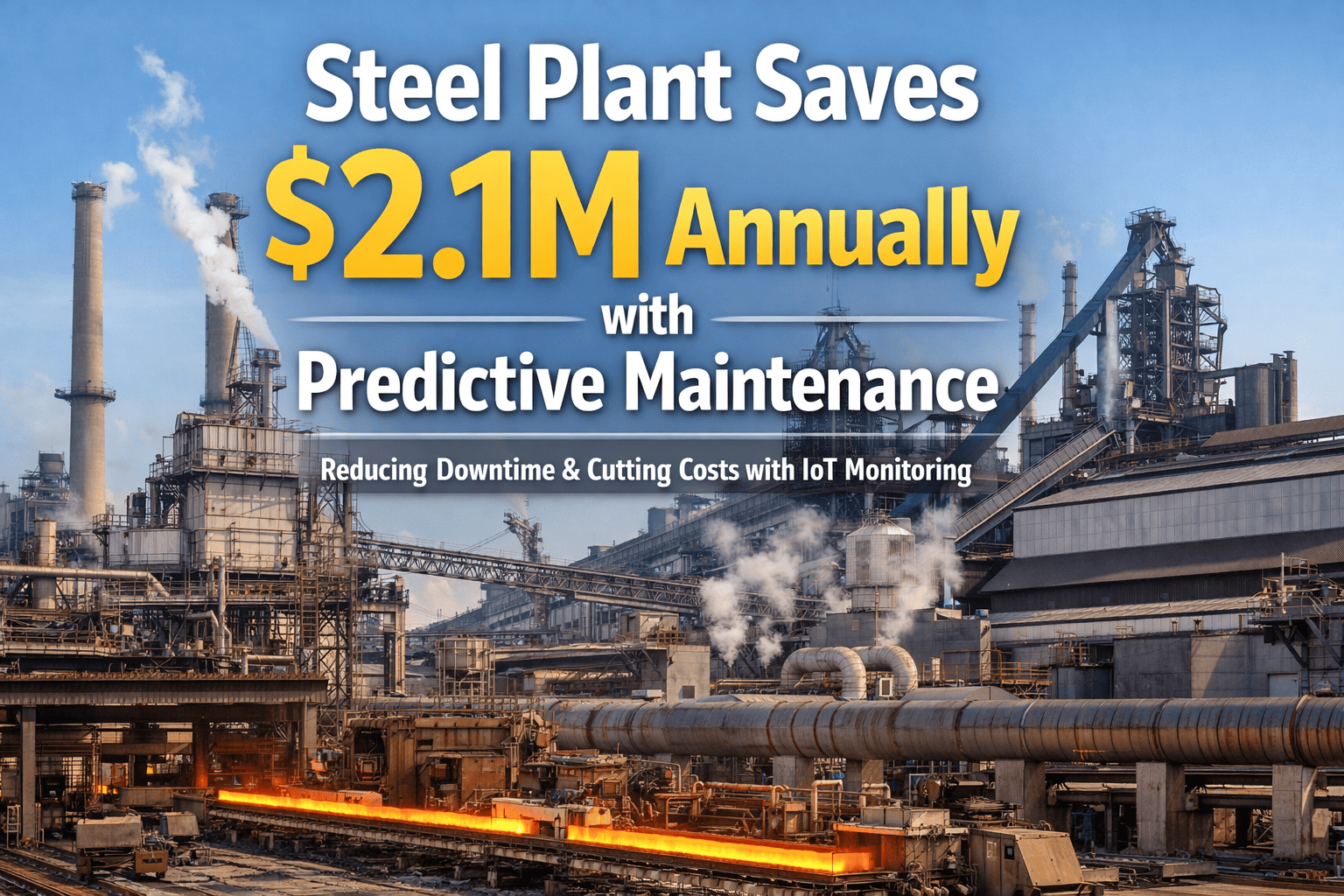
Predictive maintenance is no longer a theoretical advantage — it is a documented strategy with measurable ROI across automotive, pharmaceutical, food processing, and heavy industry. The business case has shifted from "will PdM reduce costs" to "how much and how fast" based on real plant data from manufacturers who have deployed condition-based monitoring and AI-driven failure prediction. The average PdM implementation delivers 25-40% maintenance cost reduction, 70% reduction in equipment downtime, and extends asset life by 20-40% compared to reactive or time-based preventive strategies. The challenge is not whether predictive maintenance works — the data proves it does — but how to build the roadmap from reactive maintenance to fully operational predictive systems in your plant. Book a 30-minute demo to see how OxMaint walks manufacturing plants up the predictive maintenance ladder with phased ROI tracking from day one.
Average PdM ROI Across Manufacturing Sectors — 2024/2025 Data
25-40%
Maintenance cost reduction vs reactive maintenance
70%
Reduction in unplanned equipment downtime
20-40%
Equipment lifespan extension
8-14 mo
Typical payback period for PdM investment
Sources: McKinsey PdM Analysis 2024, Deloitte Manufacturing Survey, Aberdeen Group Industrial IoT Study
The following case studies are based on documented PdM implementations from global manufacturers across different industries. Each case includes baseline metrics, implementation approach, and quantified results after 12-24 months.
Automotive Manufacturing
European Automotive OEM — Engine Assembly Plant
Baseline Challenge
Plant experienced 18-22 unplanned downtime events per month on critical CNC machining centers and robotic welding lines. Mean time to repair averaged 4.2 hours due to diagnostic delays. Reactive maintenance accounted for 63% of total maintenance work orders.
PdM Implementation
Deployed vibration sensors on 140 critical motors and bearings, temperature monitoring on hydraulic systems, and oil analysis on gearboxes. Integrated sensor data with CMMS to trigger condition-based work orders when thresholds exceeded normal range. AI model trained on 6 months of baseline data to predict bearing failures 7-10 days in advance.
Documented Results (18 months)
Unplanned downtime reduced from 18-22 events/month to 6-8 events/month. MTTR decreased from 4.2 hours to 1.8 hours due to pre-staged parts and advance notice. Maintenance costs reduced by 32% year-over-year. Equipment availability improved from 87% to 94%. ROI achieved in 11 months including sensor capex and CMMS upgrade.
Food & Beverage Processing
Global Beverage Manufacturer — Bottling Line Operations
Baseline Challenge
High-speed bottling line ran 24/7 with zero tolerance for contamination or product loss. Unexpected failures on filling nozzles, conveyor motors, and capping machines caused 12-15 line stops per month averaging 2.1 hours per stop. Each hour of downtime cost $42K in lost production and spoilage.
PdM Implementation
Installed current signature analysis on conveyor motors to detect electrical anomalies. Added pressure and flow sensors on pneumatic systems. Implemented acoustic monitoring on filling valves to detect early wear. Connected all sensor inputs to cloud-based PdM platform with real-time alerting to maintenance team mobile devices.
Documented Results (24 months)
Unplanned line stops reduced from 12-15/month to 3-4/month. Average downtime per event dropped from 2.1 hours to 0.9 hours. Total annual downtime decreased by 76% from baseline. Cost avoidance calculated at $3.8M annually based on prevented production loss. Payback period: 8 months. Maintenance labor productivity improved 28% as team shifted from reactive firefighting to scheduled interventions.
Pharmaceutical Manufacturing
US Pharma Plant — API Production Facility
Baseline Challenge
Sterile production environment with strict FDA validation requirements. Reactive failures on HVAC systems, cleanroom pressure controls, and mixing vessels risked batch contamination and regulatory findings. Unplanned equipment failures caused 8-10 batch rejections per year valued at $1.2M per batch.
PdM Implementation
Deployed wireless temperature and humidity sensors in all cleanrooms with FDA 21 CFR Part 11 compliant data logging. Vibration monitoring on mixing vessel drive motors and critical pumps. Integrated PdM alerts with validated CMMS system to maintain audit trail compliance. Predictive algorithms developed to forecast HVAC filter saturation 5-7 days before performance degradation.
Documented Results (12 months)
Batch rejection rate due to equipment failure dropped from 8-10/year to 1-2/year. Cost avoidance from prevented batch loss: $8.4M annually. Regulatory audit findings related to equipment reliability eliminated completely. Unplanned maintenance reduced by 64%. Payback period: 9 months. Cleanroom environmental compliance improved from 96.2% to 99.7% due to predictive HVAC maintenance.
Cement Manufacturing
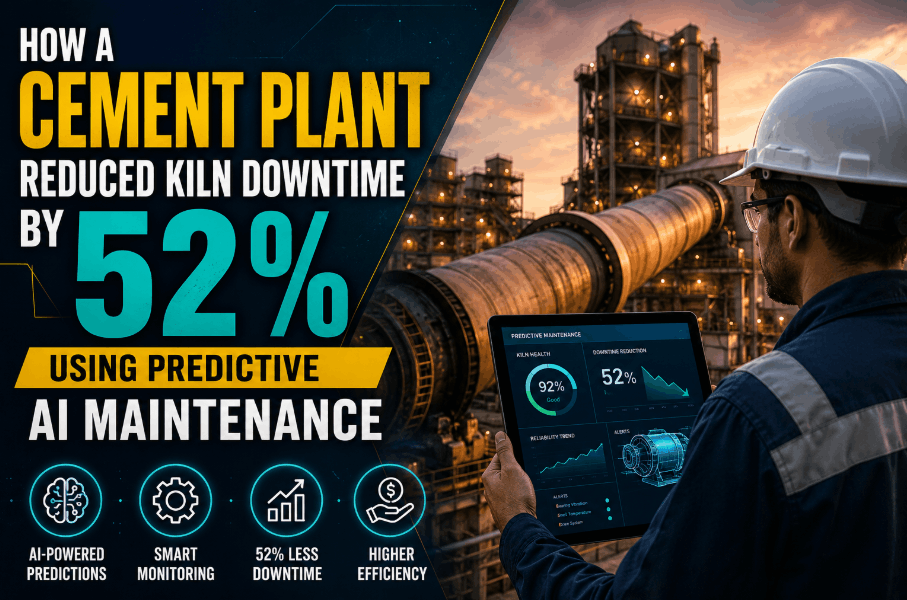
Middle East Cement Producer — Kiln and Grinding Operations
Baseline Challenge
Rotary kiln and ball mill operations subject to extreme temperatures, abrasive materials, and continuous duty cycles. Bearing failures on kiln rollers and mill drives caused catastrophic downtime averaging 18-24 hours per event. Plant experienced 6-8 major failures per year with combined downtime exceeding 140 hours annually.
PdM Implementation
High-temperature vibration sensors installed on kiln support rollers and mill bearings. Thermal imaging cameras for kiln shell monitoring. Ultrasonic thickness gauges on refractory linings. AI-based anomaly detection trained on 9 months of operational data to identify failure signatures 10-14 days before critical failure point.
Documented Results (18 months)
Major failures reduced from 6-8/year to 1-2/year. Unplanned downtime decreased by 82% from 140+ hours/year to 25 hours/year. Maintenance cost per ton of cement produced reduced by 38%. Equipment lifespan extended by estimated 35% based on reduced wear rates. Total cost savings: $4.2M annually including avoided downtime and extended asset life. Payback: 10 months.
PdM ROI Components: Where the Savings Come From
Predictive maintenance ROI is not a single number — it is a combination of direct cost savings, cost avoidance, and productivity gains across multiple categories.
Reduced Unplanned Downtime
Typically 60-80% reduction in unplanned events. Each prevented hour of downtime saves direct production loss plus labor, material waste, and restart costs. Average value: $15K-$50K per prevented downtime hour depending on industry.
Lower Maintenance Labor Costs
Technicians spend less time diagnosing failures and more time on planned interventions. Overtime and emergency callouts reduced by 40-60%. Maintenance labor productivity improves 25-35% as reactive firefighting decreases.
Extended Equipment Lifespan
Operating equipment within safe parameters and replacing components before secondary damage occurs extends asset life 20-40%. Deferred capex on equipment replacement translates to millions in avoided spend over 5-10 year cycles.
Optimized Spare Parts Inventory
Predictive alerts allow just-in-time parts ordering instead of safety stock hoarding. Inventory carrying costs reduced 15-25%. Emergency expedite fees eliminated. Parts obsolescence and waste minimized.
Reduced Secondary Damage
Catching bearing failure before it destroys the shaft, gearbox, or motor housing prevents cascading damage. Secondary failure costs average 3-5x the primary component cost. PdM prevents 70-85% of secondary damage events.
Improved Product Quality
Equipment running within optimal parameters produces fewer defects. Batch rejection rates decrease 30-50% in process industries. Scrap and rework costs reduced. Customer complaint rates improve as quality consistency increases.
Ready to Build Your PdM Business Case?
Turn Industry Benchmarks into Your Plant's ROI Projection
The case studies above are not outliers — they represent typical PdM outcomes when implementation is structured and phased correctly. OxMaint provides the CMMS foundation, sensor integration, and AI-driven failure prediction to replicate these results in your plant. Start with the assets that drive 80% of your downtime cost, layer in condition monitoring, and measure ROI quarter by quarter as unplanned failures decrease.
PdM Implementation Roadmap: From Pilot to Full Deployment
Successful PdM implementations follow a phased approach — pilot on critical assets, validate ROI, then scale across the plant. This roadmap is based on the deployment pattern from the case studies above.
Quarter 1
Pilot Phase
Select 10-15 critical assets driving majority of downtime cost. Install condition monitoring sensors. Establish baseline failure rates and maintenance costs. Integrate sensor data with CMMS. Train maintenance team on PdM alerts and response workflows.
Outcome: First predictive alerts generated. 1-2 failures prevented in pilot group demonstrating proof of concept.
Quarter 2
Validation Phase
Expand monitoring to 30-50 assets across multiple lines. Refine alert thresholds based on Q1 data. Document cost avoidance from prevented failures. Build AI models for failure prediction using 6 months of sensor history. Present initial ROI to leadership with expansion business case.
Outcome: Measurable reduction in unplanned downtime on monitored assets. Payback period projected based on early results.
Quarter 3
Scaling Phase
Deploy sensors across 80-120 critical assets plant-wide. Automate condition-based work order creation. Integrate PdM alerts with production scheduling for planned interventions. Establish KPI dashboard tracking PdM effectiveness, cost savings, and alert accuracy.
Outcome: PdM becomes standard operating procedure. Reactive maintenance percentage drops below 30%. ROI becomes measurable at plant level.
Quarter 4
Optimization Phase
Add advanced analytics for failure trend analysis and predictive parts ordering. Extend equipment lifespan targets based on condition data. Benchmark performance vs industry standards. Document full-year ROI with cost savings, downtime reduction, and asset life extension quantified.
Outcome: Full PdM maturity achieved. 12-month ROI documented and validated. Roadmap for Year 2 optimization established.
ROI Comparison: Reactive vs Preventive vs Predictive Maintenance
Data compiled from McKinsey, Aberdeen Group, and Deloitte manufacturing studies 2023-2025
Frequently Asked Questions About PdM ROI
What is the typical payback period for predictive maintenance investment?
Most manufacturing plants achieve full ROI within 8-14 months based on reduced downtime, lower maintenance costs, and extended asset life. Industries with high downtime costs like pharma and food processing often see payback in 6-10 months.
Do we need to deploy PdM across the entire plant or can we start with a pilot?
Start with a pilot on 10-15 critical assets to validate ROI, then scale. The case studies above all began with pilots on high-value equipment before expanding plant-wide. OxMaint supports phased deployments with modular sensor integration.
How long does it take to train AI models for failure prediction?
AI models require 6-9 months of baseline sensor data to achieve reliable prediction accuracy. Early alerts based on threshold monitoring begin immediately while AI learning runs in background. Prediction accuracy improves continuously as data accumulates.
What sensors are required for a basic PdM implementation?
Vibration sensors for rotating equipment, temperature sensors for motors and bearings, current monitoring for electrical systems, and pressure sensors for hydraulic/pneumatic lines cover 80% of common failure modes. Specific sensor selection depends on asset criticality and failure history.
Can PdM ROI be measured if we are already doing preventive maintenance?
Yes — measure the reduction in unplanned failures vs baseline, decreased MTTR from advance notice, and eliminated over-maintenance from time-based schedules. Plants transitioning from preventive to predictive typically see 20-30% additional cost reduction and 40-60% further downtime improvement.
OxMaint Predictive Maintenance Platform
Build Your PdM Business Case with Real Data, Not Projections
The case studies above prove predictive maintenance delivers measurable ROI across every manufacturing sector — but the business case for your plant requires your data, your downtime costs, and your asset failure patterns. OxMaint provides the CMMS foundation, sensor integration, and analytics to baseline your current state, pilot PdM on critical assets, and track ROI quarter by quarter as unplanned failures decrease and maintenance costs drop. Start with a pilot, prove the value, then scale.