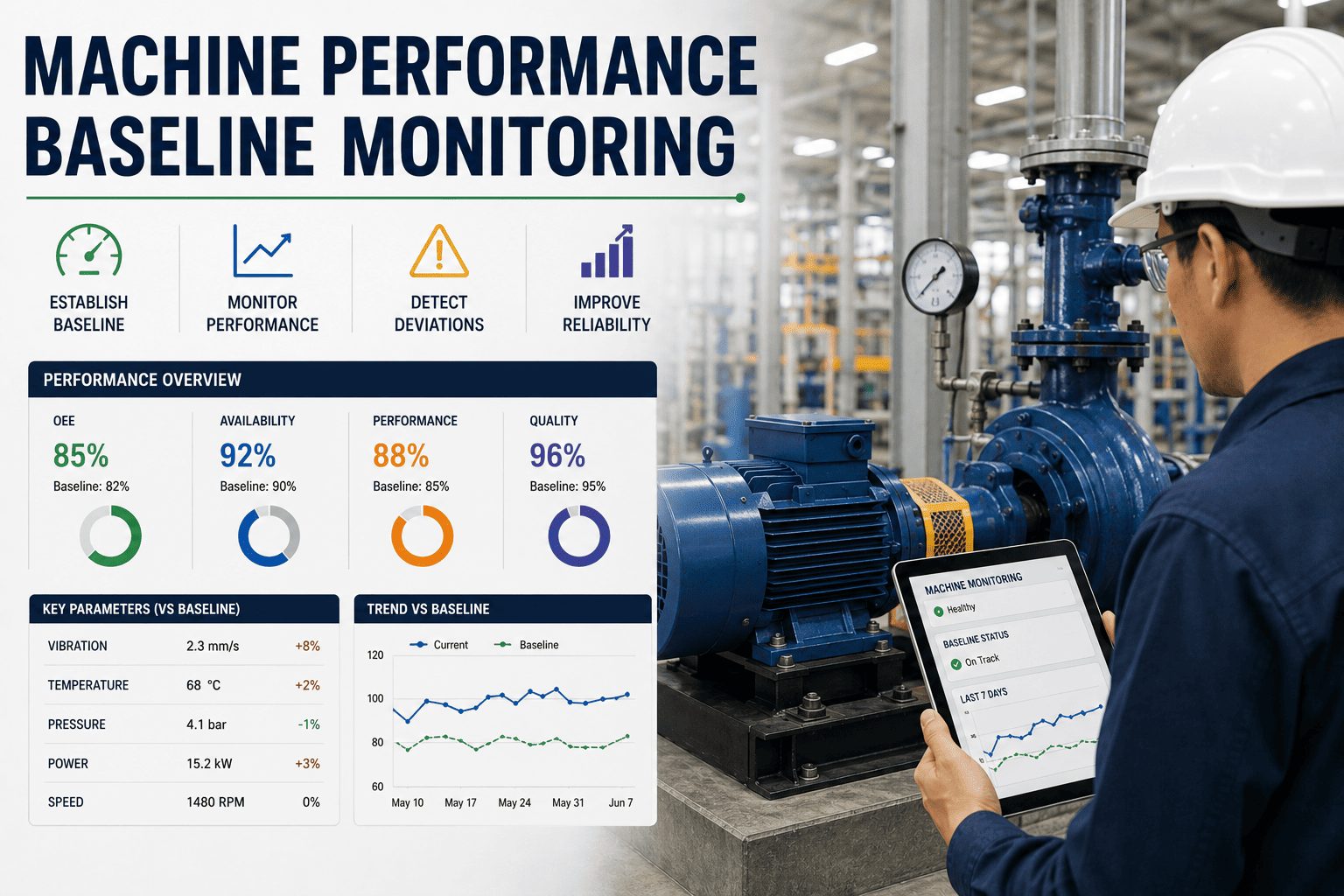
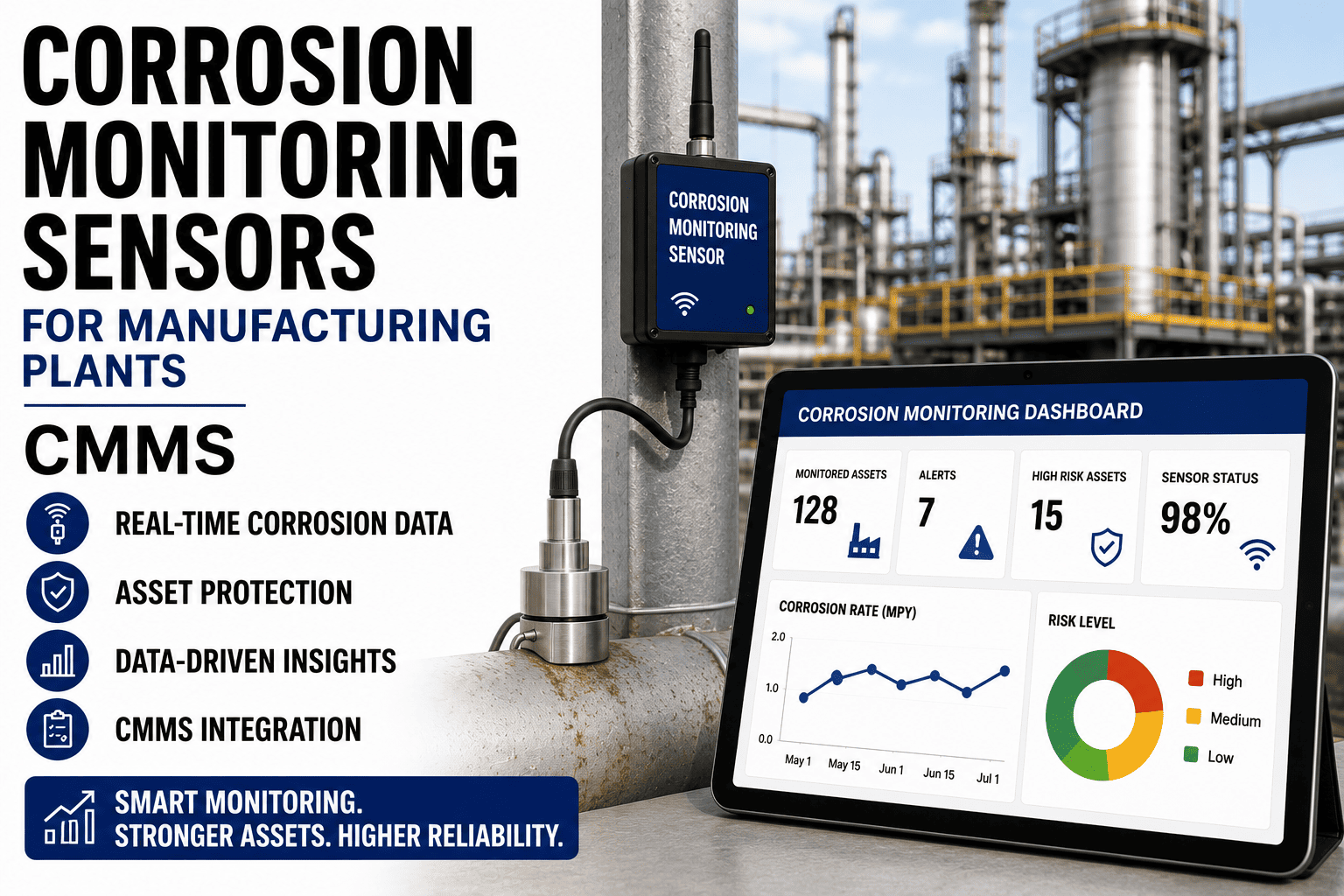
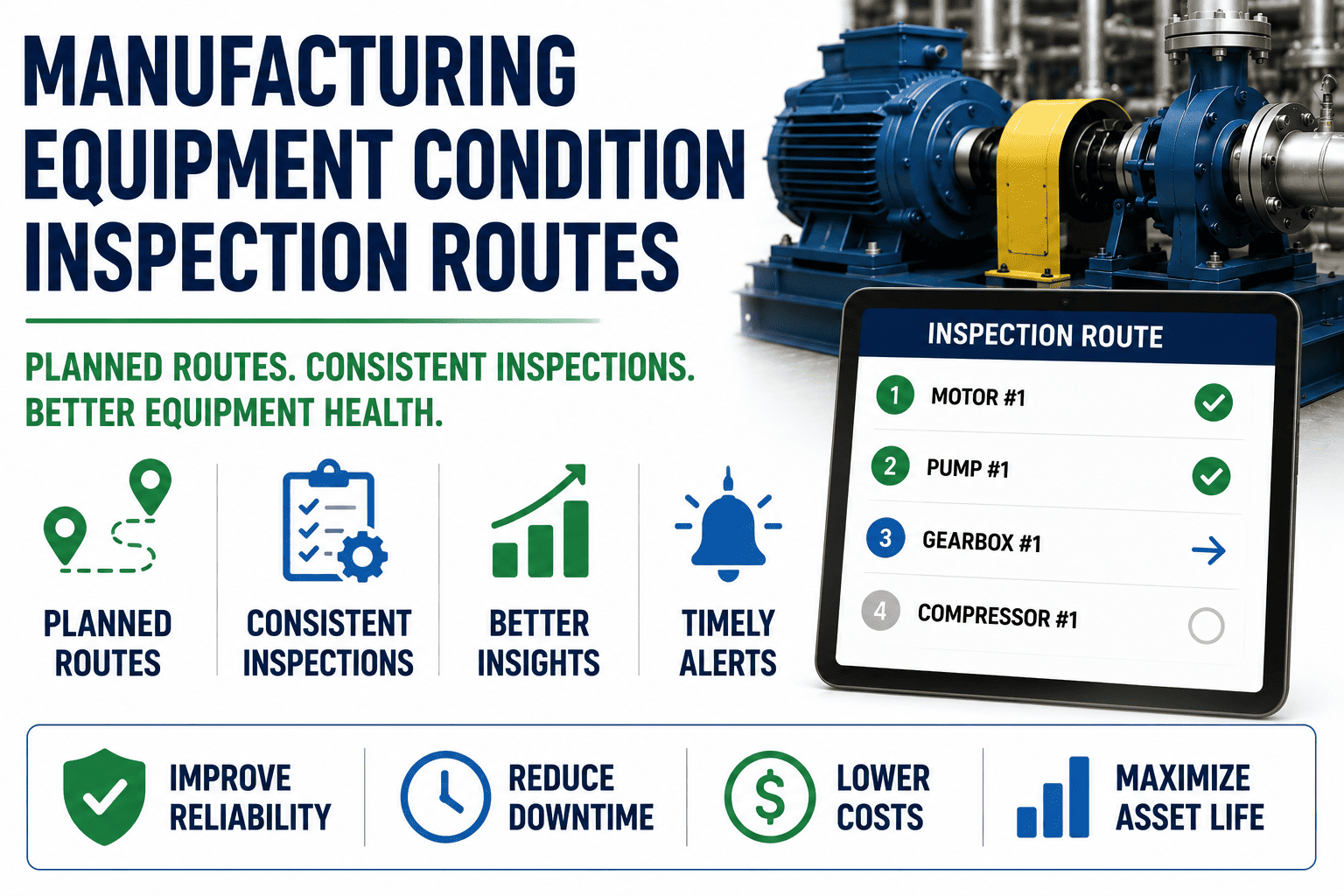
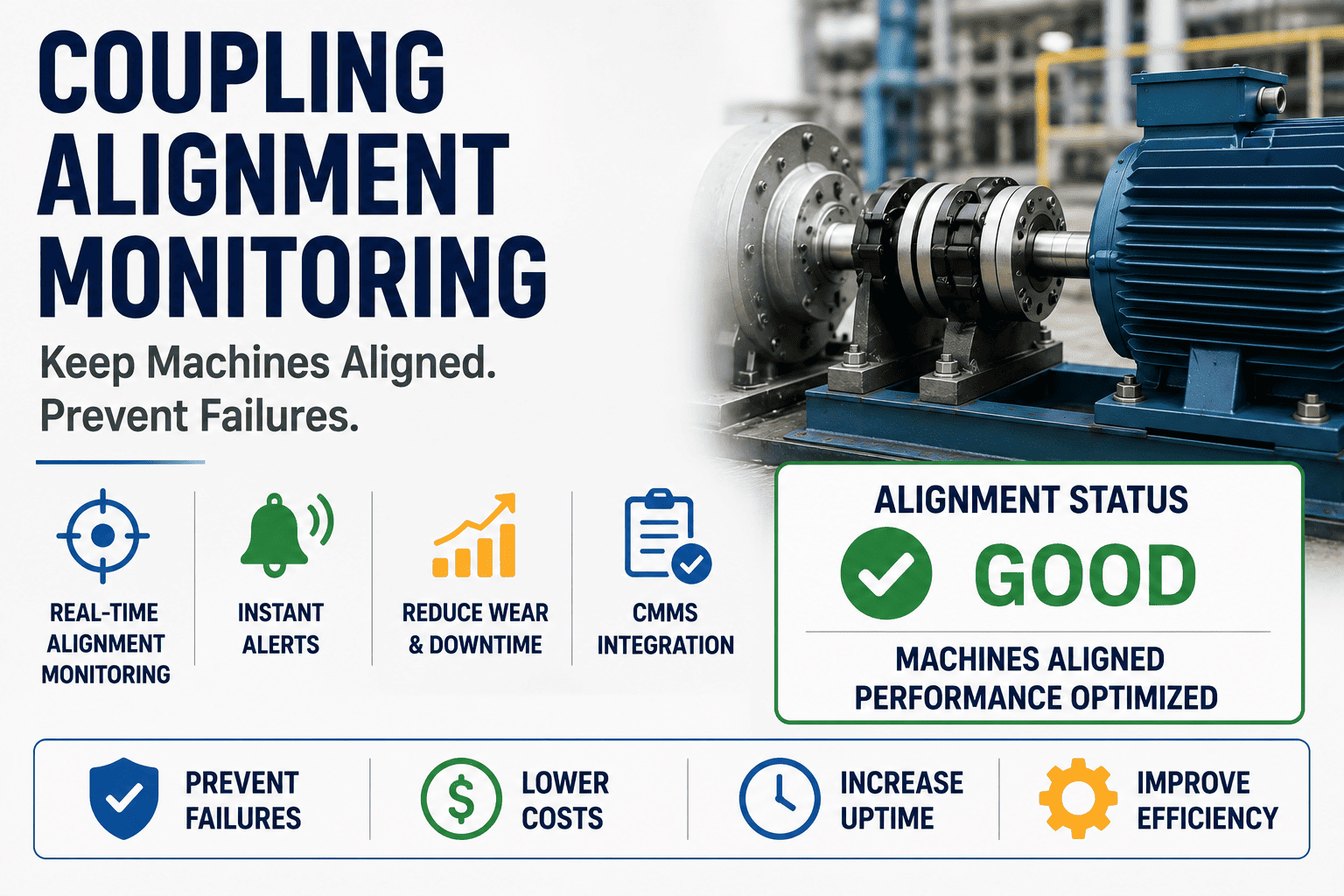
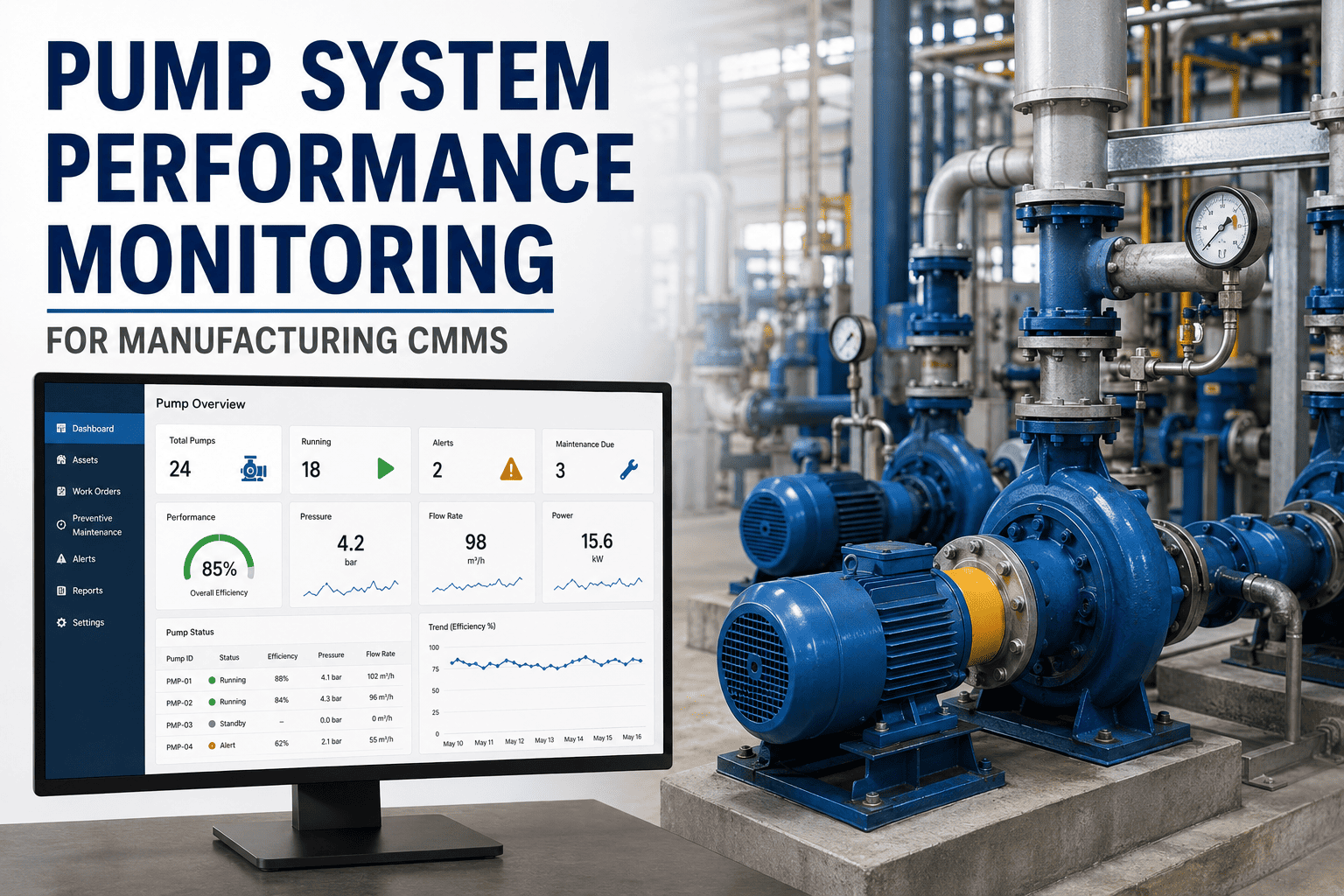
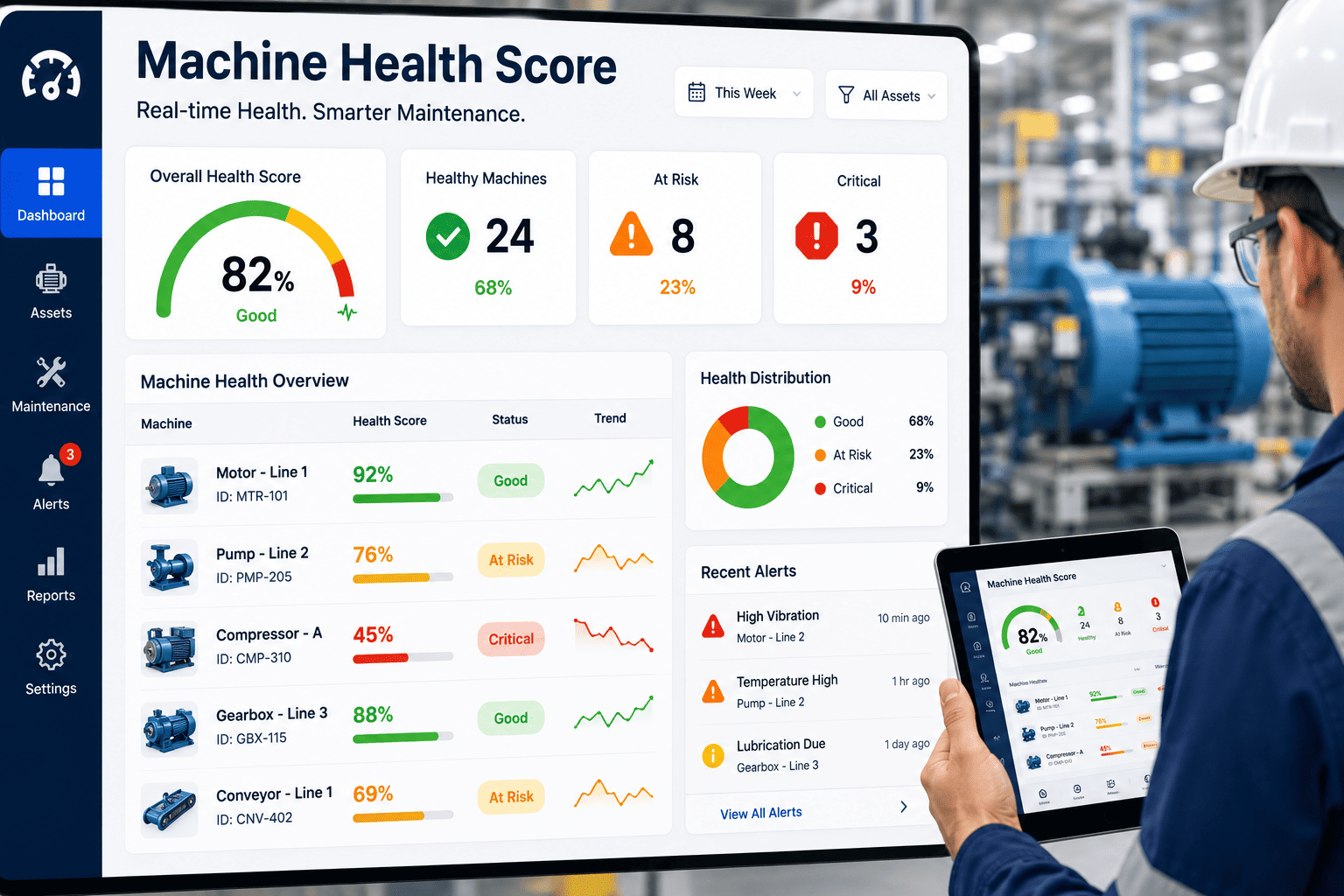
Most maintenance teams can tell you when a machine failed, but almost none can tell you what its healthy signature looked like the day before. A machine performance baseline is that missing reference point — a captured fingerprint of vibration, temperature, motor current, cycle time and pressure when the asset is running clean, within spec and after a proper commissioning. Without it, condition monitoring alerts fire against arbitrary thresholds, operators chase ghost alarms, and the first sign of bearing wear is often a catastrophic seizure. This guide walks plant engineers and reliability leads through establishing, storing and re-baselining performance references inside a modern CMMS — the same workflow our customers use when they Start Free Trial on Oxmaint.
Baseline Monitoring · Reliability Engineering
Without a baseline, every alarm is just noise.
70% of plants running vibration and current sensors have no captured healthy signature to compare against — which means deviations are detected late, by feel, after parts are already damaged.
3.2×
faster mean-time-to-detect
degradation when a captured baseline feeds automatic deviation alerts vs. periodic route-based rounds
What to Baseline
Six signal channels every critical asset needs captured
A performance baseline is only as useful as the signals it covers. For a typical rotating or reciprocating asset, reliability engineers should capture these six channels simultaneously during a known-healthy run window — ideally post-overhaul, post-PM, at steady-state load.
01
Vibration (RMS & spectrum)
Capture overall RMS velocity in mm/s plus a baseline FFT spectrum at the drive and non-drive end. ISO 10816 thresholds are the floor — your captured healthy signature is the real reference.
02
Bearing temperature
Steady-state skin temperature at each housing, measured after 30+ minutes of continuous load. A 12–15°C creep from baseline is an early bearing, lubrication or alignment red flag.
03
Motor current
RMS current per phase plus a current signature (MCSA). Baseline spikes reveal rotor bar, stator winding and belt-load issues weeks before the drive trips.
04
Cycle time
For CNC, press and packaging lines, a 3–8% drift in cycle time from baseline signals valve wear, dull tooling or pneumatic leak — long before scrap appears.
05
Pressure & flow
Hydraulic rail pressure, compressed-air flow and coolant flow at steady state. A 10% deviation from baseline is a pump, filter or relief-valve warning.
06
Acoustic emission
Ultrasonic baseline at bearing housings and steam traps. Catches lubrication starvation and internal leaks that vibration and temperature miss entirely.
Capture Workflow
Five steps to a defensible healthy signature
Capturing a baseline is not a one-button job. Skip a step and the reference is contaminated — every downstream alert loses credibility. The timeline below mirrors the procedure used by a 180-asset CNC plant in Ohio that cut unplanned downtime 28% in nine months.
Step 1
Day 0–2
Verify asset health
Complete the latest PM, confirm alignment within 0.05 mm/inch, change lubricants, and inspect bearings. A baseline on a sick machine locks in a bad reference.
Step 2
Day 3
Lock steady-state load
Run the machine at its normal production load for 30–60 minutes. Record speed, feed, product code and ambient temperature — these become the baseline's metadata.
Step 3
Day 3
Capture all channels simultaneously
Sample vibration, temperature, current, cycle time and pressure in the same 5-minute window. Time-aligned data is what lets later root-cause analysis cross-correlate signals.
Step 4
Day 4
Validate & tag
Compare the captured profile against ISO 10816 / 20816 zone limits. If within A/B, tag the record as the asset's "healthy signature" with a version number in the CMMS.
Step 5
Day 5+
Arm deviation alerts
Set ±15% vibration, ±10°C temperature and ±8% current deviation alerts against the stored baseline. Route them straight to the CMMS work-order queue.
Deviation Logic
The math behind a deviation alert
Most CMMS platforms let you set a static high/low threshold. That is not baseline monitoring — it is limit-checking. True baseline monitoring compares the live signal against the captured healthy signature and fires only when deviation crosses a defined sensitivity band.
Worked example
A 75 kW blower motor captured a baseline vibration of 2.1 mm/s RMS. Six weeks later, live RMS reads 2.9 mm/s. Deviation = ((2.9 − 2.1) ÷ 2.1) × 100 = 38% — well past the 15% alert band. The CMMS auto-generates a work order for bearing inspection. Mechanics find a lubrication breakdown on the non-drive-end bearing. Cost of the fix: $340 in grease and labour. Cost if it had run to seizure: $4,200 in motor rewind plus 11 hours of line downtime.
Baseline vs. Threshold
Why static thresholds fail plants every day
A threshold says "vibration above 4.5 mm/s is bad." A baseline says "this machine normally runs at 2.1 mm/s, so 3.0 mm/s is a 43% anomaly worth inspecting." The second statement catches the failure three months earlier.
| Dimension |
Static Threshold |
Baseline Monitoring |
| Reference point |
Generic ISO / OEM limit |
This machine's own healthy signature |
| Detection sensitivity |
Late — fires near failure |
Early — fires at 10–20% drift |
| False-alarm rate |
High — ignores load & product mix |
Low — load-compensated confidence factor |
| Cross-machine comparability |
Same limit for every asset |
Per-asset signature, apples-to-apples trend |
| CMMS work-order trigger |
Manual or crude hi/lo |
Auto-generated on validated deviation |
| Typical cost of a missed event |
$4K–$18K per seizure |
$300–$900 per early intervention |
Storage & Re-Baselining
Keep the baseline alive inside your CMMS
A baseline is a living record, not a one-time snapshot. Store it as a versioned asset profile in the CMMS, tagged with capture date, load condition, ambient temperature, lubricant batch and operator. Re-capture after every event that physically changes the machine.
After major repair or overhaul
Bearing swaps, rewinds, gearbox rebuild and rotor replacement all change the machine's signature. Re-capture within 48 hours of return-to-service — an old baseline on a rebuilt asset will generate a storm of false positives.
After alignment or coupling work
Laser alignment, shim changes and coupling swaps shift the vibration profile. Even a 0.05 mm change can move the baseline RMS by 8–12%, so re-capture is mandatory.
On product or load change
If the line permanently shifts to a heavier product mix, the old steady-state baseline no longer applies. Capture a new signature and store both — tagged by product family.
Quarterly validation refresh
Even without a physical change, re-verify every 90 days. If the live signature has drifted more than 5% from the stored baseline without a triggering event, treat the machine as in slow degradation.
Version & archive
Never overwrite a baseline. Store v1, v2, v3 in the CMMS asset record with capture date and technician. Older baselines are the forensic record when RCA needs to ask "when did this really start?"
Link to work-order history
Every baseline version should link to the PM or work order that preceded it. This gives reliability engineers a closed loop from signature change → corrective action → new signature.
Ready When You Are
Turn captured baselines into automatic work orders
Oxmaint stores per-asset baseline signatures, watches every live signal channel and generates validated work orders the moment a deviation crosses your alert band.
Frequently Asked
Baseline monitoring, answered
How long does it take to baseline a typical machine?
For a single rotating asset, expect 60–90 minutes: 30 minutes of steady-state warm-up, 5 minutes of simultaneous multi-channel capture, and 20–40 minutes of validation against ISO 10816 limits and CMMS tagging. A 180-asset plant can fully baseline its top 30 critical machines in roughly three weeks with two technicians.
Do I need permanent sensors, or can I baseline with portable equipment?
Both work. Permanent IoT sensors give you continuous live comparison and auto-alerts. Portable data collectors — walk-route vibration pens, thermal cameras, clamp meters — are perfectly valid for a quarterly baseline refresh on B- and C-class assets. The key is storing the captured signature in a CMMS that timestamps and versions it. You can
Book a Demo to see how Oxmaint handles both data sources.
What alert bands should I start with?
Begin with ±15% on vibration RMS, ±10°C on bearing temperature, ±8% on motor current and ±5% on cycle time. Tighten or loosen them after the first 60 days based on your actual false-positive rate. The goal is to fire on real degradation, not on normal load variation.
When exactly should I re-baseline an asset?
Re-capture after any bearing swap, motor rewind, gearbox rebuild, major alignment, coupling change, or permanent product/load shift. Also re-baseline if the live signal has drifted more than 5% from the stored signature without a known cause — that drift itself is the early warning you built the baseline to catch.
Can baseline monitoring work with an existing CMMS?
Yes, if the CMMS supports per-asset custom fields, file attachments and a work-order API. The baseline is stored as a versioned record on the asset master; live sensor data is compared against it and triggers a work order on deviation. Oxmaint ships this workflow out of the box —
Start Free Trial to test it on three of your own machines.
Capture the Signature · Catch the Drift
Stop detecting failures late. Start with a baseline.
Spin up Oxmaint on three critical assets, capture healthy signatures this week, and watch validated deviation alerts flow straight into your work-order queue.