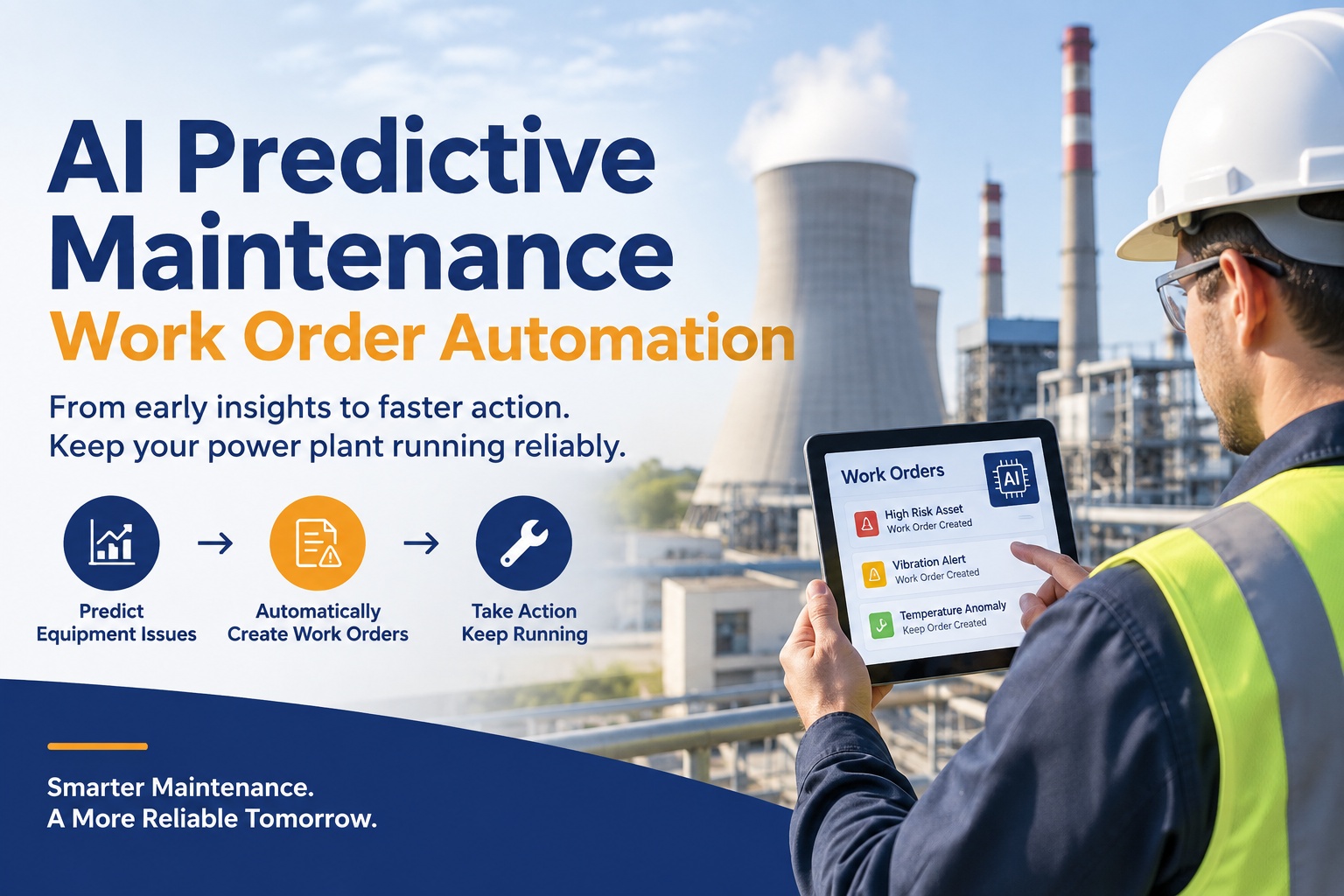
Solar farms lose an estimated 10–25% of potential annual revenue not from weather or resource limitations but from delayed maintenance responses, untracked inverter degradation, and panel performance losses that compound silently over months before anyone investigates. OxMaint CMMS gives solar O&M teams a structured platform to track inverter health, panel output trends, and preventive maintenance schedules in one connected system — replacing spreadsheets, disconnected alerts, and reactive repair cycles with data-driven work order management. Book a free OxMaint demo to see how solar asset teams are recovering lost generation revenue through better maintenance operations.
Solar O&M · CMMS · Inverter Health · Panel Performance · OxMaint
Solar Farm Maintenance Software: CMMS for Inverter Health and Panel Performance
OxMaint gives utility-scale and commercial solar operators a single CMMS platform to manage inverter health tracking, panel degradation monitoring, preventive maintenance scheduling, and work order automation — so every megawatt your panels can produce is actually delivered to the grid.
25%
Revenue lost annually from deferred solar maintenance across global PV fleets
0.7%/yr
Average panel degradation rate — tracked and actioned with OxMaint performance monitoring
48 hrs
Average inverter fault response time without CMMS vs under 4 hrs with OxMaint automation
18 mo
Typical OxMaint ROI payback period for solar O&M teams replacing manual tracking
Why Solar Maintenance Fails
Four Maintenance Failures That Drain Solar Farm Revenue Every Year
These are not theoretical risks — they are the operational patterns consistently found across solar farms running without a structured CMMS. Each one represents a measurable and preventable revenue loss that compounds across every year of plant operation.
01
Inverter Faults Go Unresolved for Days
Without automated fault-to-work-order routing, inverter alarms from SCADA or monitoring platforms generate notifications that are read, acknowledged, and lost — no work order, no assigned technician, no tracked resolution. The inverter sits faulted while the string it serves produces zero output.
Revenue impact: A 500kW inverter offline for 48 hours at $0.05/kWh = $1,200 per event
02
Panel Degradation Tracked in No System
Panel-level performance data sits in monitoring dashboards but is never formally tracked against warranty thresholds or degradation baselines. Underperforming strings — due to soiling, micro-cracks, or cell degradation — are not identified until output losses become impossible to ignore.
Revenue impact: A 5% untracked soiling loss on a 10MW farm = $35,000 in annual generation loss
03
Preventive Maintenance on Spreadsheets
Cleaning cycles, torque checks, thermographic surveys, and string performance tests are scheduled in spreadsheets with no automated reminders, no completion tracking, and no evidence capture. Tasks slide by weeks — and the SCADA fault that follows is treated as unexpected, despite being entirely predictable.
Operational impact: 40% of solar PM tasks completed late when managed outside a CMMS
04
No Asset History for Warranty or Insurance Claims
When panels or inverters fail under warranty, manufacturers require documented maintenance history to process claims. Without a CMMS, that history lives in disconnected emails and log files — or does not exist. Claims are rejected, and the plant absorbs replacement costs that warranties should have covered.
Financial impact: Rejected warranty claims average $8,000–$45,000 per major inverter failure event
Inverter Health Tracking
How OxMaint Tracks Inverter Health Across the Entire Solar Fleet
Inverters are the highest-value, highest-failure-risk components in a solar farm. OxMaint structures inverter health tracking so every fault, every performance deviation, and every maintenance action builds a complete, queryable asset history — not isolated events in a SCADA log.
01
Fault-to-Work-Order Automation
SCADA and monitoring platform fault alerts trigger OxMaint work orders via webhook — with inverter ID, fault code, string affected, timestamp, and recommended action pre-populated. No manual data entry. No lost alerts. Response begins the moment the fault fires.
02
Performance Ratio Baseline Tracking
Each inverter's Performance Ratio (PR) is tracked against its own baseline and fleet average. OxMaint flags inverters trending below threshold — generating inspection work orders weeks before PR degradation reaches the level visible on financial reporting.
03
Scheduled Maintenance — Never Missed
Firmware update cycles, capacitor replacement intervals, cooling filter checks, and thermal imaging inspections are scheduled in OxMaint with automatic work order generation, technician assignment, and mobile task completion — all time-stamped and evidence-backed.
04
Full Maintenance History Per Inverter
Every fault, every repair, every inspection, and every scheduled service creates a permanent record in OxMaint under the inverter asset — accessible in seconds for warranty claims, insurance reviews, technical audits, and asset sale due diligence processes.
Panel Performance Monitoring
From Panel Output Data to CMMS Action — Closing the Loop on Degradation
Monitoring dashboards show you the problem. OxMaint makes sure someone fixes it. Panel performance management in OxMaint connects output data to maintenance scheduling so every identified degradation issue generates a documented response — not just a data point on a chart.
| Panel Issue |
How It Appears in Monitoring |
OxMaint Action Triggered |
Typical Performance Recovery |
| Soiling and Dust Accumulation |
String current below fleet median by 3–8% without weather explanation |
Cleaning work order — assigned, scheduled, and completion-tracked |
3–8% output recovery per cleaning cycle |
| Hot Spot Cells |
Thermal imaging flags elevated cell temperature — isolated module |
Module inspection work order with thermal image attached |
Full string output recovered after module replacement |
| Micro-Crack Degradation |
Single module output trending down 1–2% quarter over quarter |
Warranty claim work order — maintenance history exported |
Warranty replacement if within degradation guarantee threshold |
| String Disconnection |
Full string drops to zero output — no weather event explanation |
Urgent electrical work order — high priority, same-day response |
100% string output on reconnection — hours of loss avoided |
| Bypass Diode Failure |
Module output at 67% baseline — partial shading pattern in clear conditions |
Module swap work order — spare part request automatically raised |
Full module performance restored after diode or module replacement |
Stop tracking solar maintenance in spreadsheets. Start tracking it in OxMaint.
Every inverter fault, panel degradation event, and scheduled O&M task becomes a tracked, assigned, and closed work order — automatically. Free to start. No infrastructure changes required.
Preventive Maintenance Schedule
The Solar Farm Preventive Maintenance Calendar OxMaint Automates
Industry-standard solar O&M programs require 15–22 distinct maintenance activity types across daily, monthly, quarterly, and annual cycles. OxMaint automates work order generation for all of them — so your team executes to schedule rather than catching up to failures.
Monthly
Inverter cooling filter inspection and replacement
Clogged filters raise inverter operating temperature — accelerating capacitor and IGBT degradation that leads to premature inverter failure.
String-level performance ratio review
Monthly PR comparison against baseline identifies soiling and degradation trends before they compound into significant generation loss.
Electrical connection visual inspection
Combiner box, junction box, and DC disconnect visual check for corrosion, pest damage, and physical security of connections.
Quarterly
Panel cleaning — full array
Frequency adjusted by site soiling rate — high-dust environments may require 6-weekly cycles tracked against post-cleaning generation recovery data in OxMaint.
Thermographic survey — all strings
Thermal imaging identifies hot-spot cells, bypass diode failures, and loose connections that cause isolated module underperformance invisible to string-level monitoring.
Mounting structure torque verification
Racking hardware torque checks ensure structural integrity — particularly important in high-wind sites where module movement causes micro-crack development over time.
Annual
Inverter firmware and parameter audit
Full firmware version review and reactive power settings audit against current grid code requirements — with OxMaint work order capturing pre and post configuration state.
I-V curve tracing — full fleet
Individual module I-V curve measurement against nameplate specification identifies degraded modules beyond monitoring dashboard visibility at string or inverter level.
Earthing and lightning protection test
Ground continuity and surge protection device testing — OxMaint work order captures test results, pass/fail status, and any replacement actions as permanent asset record.
Proven Outcomes
What Solar O&M Teams Measure After 12 Months on OxMaint
Outcome ranges tracked across utility-scale and commercial solar O&M deployments where OxMaint CMMS replaced spreadsheet-based and reactive maintenance programs — measured in the first full operating year after deployment.
4 hrs
Average Fault Response
Down from 48 hrs on reactive programs
Automated fault-to-work-order routing eliminates the alert-acknowledgment-delay cycle that keeps inverters offline for days in unstructured O&M programs.
94%
Preventive Maintenance Completion Rate
Up from 61% on spreadsheet scheduling
Automated work order generation with mobile task assignment ensures PM tasks are executed on schedule — not caught up on after the fault they were meant to prevent.
2.1%
Generation Output Gain
From structured inverter and panel maintenance
Each 1% availability gain at a 10MW farm represents approximately $35,000 in additional annual revenue — making structured CMMS maintenance compound significantly over the plant's 25-year life.
100%
Warranty Claim Documentation Rate
vs near-zero without structured maintenance records
Every maintenance action creates a permanent, timestamped record in OxMaint — giving O&M teams complete documentation packages for manufacturer warranty claims on panels and inverters.
Frequently Asked Questions
Solar CMMS — What O&M Teams Ask Before Switching to OxMaint
Does OxMaint integrate with solar monitoring platforms like SolarEdge, Fronius, or SMA?
OxMaint integrates with solar monitoring and SCADA platforms through REST API and webhook connections — when your monitoring system flags an inverter fault or string underperformance event, it sends a structured payload to OxMaint which automatically creates a work order with the asset pre-populated. Most monitoring platform integrations do not require custom development and can be configured within OxMaint's integration settings in under two hours.
Book a technical call to confirm your monitoring platform's compatibility before committing to any contract — our team will confirm integration paths and data field mapping specific to your setup.
How does OxMaint handle multi-site solar portfolios with different team structures?
OxMaint supports multi-site portfolio management with site-level asset registers, location-specific work order routing, and consolidated portfolio-level dashboards — so a regional O&M manager sees cross-site performance while field technicians see only their assigned site's active work orders. User permission structures allow contractors, subcontractors, and in-house crews to work within the same platform with different data access levels.
Sign up for a free OxMaint account to explore multi-site configuration before onboarding your full portfolio — no infrastructure investment required to test across two or three sites initially.
Can OxMaint track panel-level degradation against manufacturer warranty thresholds?
OxMaint's asset records support custom performance fields that allow you to log panel output measurements, PR readings, and I-V curve results against each module or string asset — and flag assets where measurements have crossed configurable warranty degradation thresholds. When a module reaches the threshold that justifies a warranty claim, OxMaint's full maintenance history for that asset exports as the documentation package manufacturers require.
Start a free OxMaint account to set up your panel asset register and begin logging baseline performance data — the earlier you start, the stronger your warranty claim documentation becomes over the panel's 25-year life.
What mobile capabilities does OxMaint provide for field technicians at remote solar sites?
OxMaint's mobile application allows field technicians to receive work orders, view asset history, complete inspection checklists, capture photo evidence, log measurements, and close tasks — all from a smartphone or tablet in the field, including offline mode for sites with limited connectivity. Completed tasks sync automatically when connectivity is restored, and all evidence is attached to the work order record permanently.
Book a demo to see OxMaint's mobile interface live — including how a technician responds to an inverter fault work order from fault alert to field resolution and work order closure in a single mobile session.
Solar O&M · CMMS · Inverter Health · Panel Performance
Every Panel You Maintain Better Is Revenue You Keep. OxMaint Makes That Systematic.
Inverter faults resolved in 4 hours instead of 48. Panel degradation tracked against warranty baselines. Preventive maintenance completed on schedule, every schedule. And a documented maintenance history that protects every warranty claim your fleet will ever need. That is what structured solar CMMS management delivers — and it starts free with OxMaint.