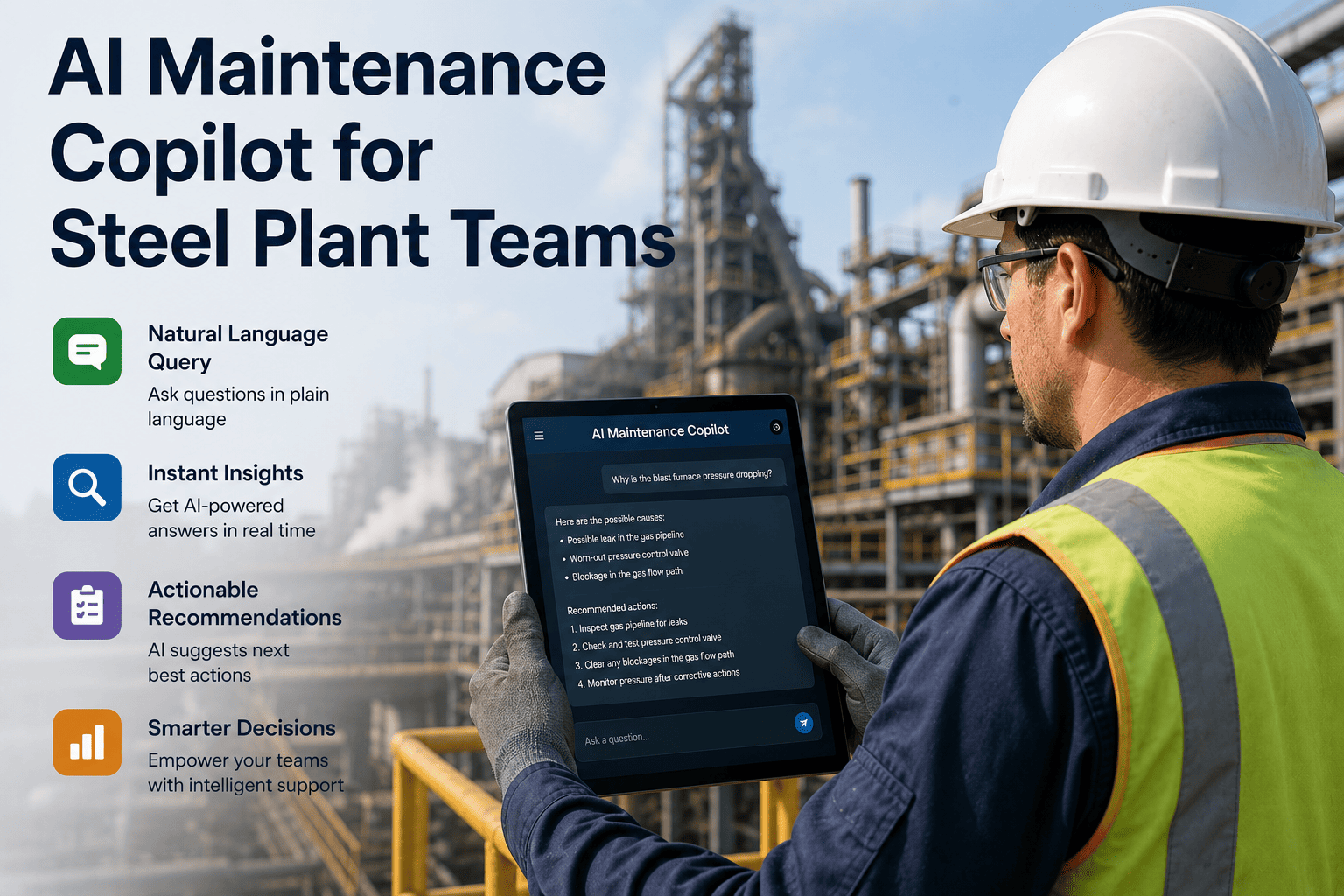
When a rolling mill drive motor trips at 2 AM, the responding technician has minutes — not hours — to diagnose the fault, find the right procedure, check parts availability, and decide whether to attempt a repair or escalate. In most steel plants, that technician is working alone, relying on memory, radio calls to a sleeping supervisor, and a paper binder that may or may not be current. An AI maintenance copilot changes that equation completely. The Oxmaint AI Copilot puts the equivalent of every experienced engineer's troubleshooting knowledge, every failure history, and every approved SOP on the technician's mobile device — in plain language, at the exact moment they need it. Start a free trial or book a demo to see the AI Copilot in a live steel plant maintenance workflow.
AI Maintenance Copilot for Steel Plant Teams
How the Oxmaint AI Copilot helps technicians troubleshoot faster, generate RCA notes automatically, follow verified checklists, and close work orders with complete evidence — without waiting for senior engineers.
The Problem the AI Copilot Solves — Knowledge That Leaves When Engineers Do
Steel plant maintenance teams are facing a knowledge crisis. Experienced engineers are retiring, taking decades of troubleshooting knowledge with them. New technicians face equipment failures they have never seen before, with documentation that does not tell them what actually works — only what the procedure says.
The most effective troubleshooting steps for a blast furnace blower bearing failure exist in a senior engineer's head — not in the CMMS, not in the SOP binder. When that engineer retires or is unavailable at 2 AM, the knowledge gap becomes a downtime event.
Without guided troubleshooting, technicians default to familiar fixes — replacing parts that are not the root cause, calling multiple people for confirmation, and extending downtime while the search for the right answer continues across shift changes.
Technicians working under production pressure close work orders with minimal data — "repaired" with no fault description, no root cause, no parts recorded. The failure history that should drive reliability improvement never gets written. The same failure recurs in six months.
Root cause analysis on failures is widely acknowledged as high-value and consistently deprioritized in favor of the next breakdown. Without an AI tool that generates a structured RCA draft at work order closure, it simply does not happen for most events.
What the Oxmaint AI Copilot Does — Six Core Capabilities
The AI Copilot is embedded directly in the Oxmaint mobile work order — it activates at the point of work, not after the fact in a reporting tool.
The technician describes the symptom in plain language. The AI cross-references the asset's failure history, fault codes, and sensor data to generate a ranked list of probable causes with verification steps. No manual lookup required.
The Copilot generates a step-by-step inspection and repair checklist based on the specific fault, asset type, and failure mode — not a generic SOP, but a procedure tailored to this asset's history and the current fault signature.
At work order closure, the AI drafts a structured root cause analysis note from the technician's inputs, sensor readings, parts used, and failure history. The technician reviews, edits, and approves — reducing RCA documentation time from 45 minutes to under 5.
When the same asset fails for the same reason for the second time, the Copilot flags it automatically and surfaces the previous failure record, the original RCA, and any corrective actions that were — or were not — completed. Pattern detection that used to require a reliability engineer now happens at the point of the work order.
Based on the diagnosed fault, the Copilot recommends the exact parts required — cross-referenced against current inventory levels. If a part is not in stock, a procurement request is generated automatically before the technician leaves the storeroom.
Every work order closed with the Copilot captures structured failure data — fault code, root cause, repair method, and outcome. This data feeds back into the AI model, making the Copilot more accurate for the same asset class with every job closed.
Case Study — AI Copilot Impact Across a Steel Maintenance Team
The following metrics are drawn from steel plant maintenance teams that deployed the Oxmaint AI Copilot across their technician workforce. Baseline figures represent the pre-deployment state captured from CMMS historical data.
| KPI | Before AI Copilot | After AI Copilot | Improvement |
|---|---|---|---|
| Mean Time to Diagnose (MTTD) | 47 min average | 18 min average | 62% faster |
| Work order closure completeness | 38% had full fault data | 91% with complete closure | +53 percentage points |
| RCA documentation rate | 12% of failures had RCA | 84% with AI-drafted RCA | 7× improvement |
| Repeat failure rate (same fault) | 34% recurrence within 90 days | 11% recurrence | 68% reduction |
| First-time fix rate | 54% | 82% | +28 percentage points |
| Escalation to senior engineer | Every 3rd job | Every 9th job | 67% fewer escalations |
How the AI Copilot Handles a Blast Furnace Blower Fault — Step by Step
A technician scans the QR code on BF-BLW-02. The asset has flagged a vibration anomaly. Here is exactly what the AI Copilot surfaces and does.
Last PM date, previous failures, sensor trend (vibration up 34% over 6 days), and open work order history displayed before the technician asks a single question.
Based on the vibration signature and failure history: (1) Bearing wear — 78% probability. (2) Impeller imbalance — 16%. (3) Coupling misalignment — 6%. Verification steps provided for each.
Step-by-step bearing inspection procedure for this blower model — IR thermometer check at housing, grease purge observation, manual play check — with pass/fail criteria and photo capture prompts at each step.
Bearing confirmed failed. AI confirms replacement bearing is in stock — 2 units in Storeroom B. Technician proceeds without a storeroom trip or radio call. Parts reserved against the work order automatically.
At work order closure: AI generates RCA note — "Bearing failure on BF-BLW-02 due to insufficient lubrication. Last grease interval was 127 days vs 90-day recommendation. Corrective action: adjust PM frequency to 75-day cycle." Technician approves in one tap.
Frequently Asked Questions
Put Every Engineer's Knowledge in Every Technician's Pocket
Oxmaint AI Copilot guides steel plant technicians through diagnosis, checklists, and RCA — at the point of failure, on mobile, with or without connectivity. Faster closures, fewer repeat failures, and knowledge that stays in the system when engineers retire.