A steel plant's maintenance output is only as strong as the team executing it. Technician productivity, skill deployment, backlog velocity, and task quality are the four levers that separate a maintenance department running at 91% PM compliance from one stuck at 47% — and the difference rarely comes down to headcount. It comes down to visibility. Most steel plant maintenance managers cannot answer basic questions in real time: which technician is available, what skills are matched to the open work order, how long the current backlog would take to clear at today's capacity, or which assets are accumulating repeat failures because the right skill was not deployed the first time. OxMaint's Workforce Management module turns these blind spots into a live analytics dashboard — giving steel plant operations the labour intelligence they need to run a maintenance team, not just schedule one.
Maintenance Workforce Analytics for Steel Plants
Technician productivity, skill utilisation, backlog control, and maintenance quality — the complete workforce intelligence framework for steel plant maintenance operations.
The Four Workforce Blind Spots Costing Steel Plants
Before workforce analytics, steel plant maintenance teams operate on informal knowledge: supervisors who know which technician is good at hydraulics, who handles rolling mill gearboxes, and which crew covers blast furnace inspections. When that supervisor leaves, the institutional knowledge leaves with them. Workforce analytics makes this knowledge systematic — and makes performance measurable.
Without a live view of technician availability, skill profile, and current task load per shift, dispatchers assign work orders by proximity and intuition — not by capacity data. The result: some technicians are overloaded while others are underutilised on the same shift, backlog accumulates unevenly, and PM tasks compete with reactive work for the same few people who are seen as capable.
A rolling mill drive alignment requires a Level 3 mechanical technician with laser alignment certification. A blast furnace tuyere cooling inspection requires a thermal systems specialist. When work orders are routed by availability alone — not skill match — first-time fix rates drop, rework rises, and the same assets appear repeatedly in the failure log because the task was technically completed but not competently executed.
A backlog that looks manageable in isolation may contain three overdue Tier 1 PM tasks on the BOF converter that are invisible to management because they sit in a shared work order queue without priority ranking. Backlog analytics — showing age, priority, assigned skill requirement, and completion probability — transforms an undifferentiated list into an actionable capacity problem with specific resolution paths.
Maintenance quality in a steel plant is hard to measure without data. Which technician's bearing replacements last 14 months versus 8 months before re-failure? Which team's cooling system inspections are consistently missing nozzle flow tests? Workforce analytics surfaces the quality signal that raw work order completion rates hide — enabling coaching, training targeting, and recognition based on outcome data, not supervisor opinion.
Live Workforce Dashboard — OxMaint Steel Plant View
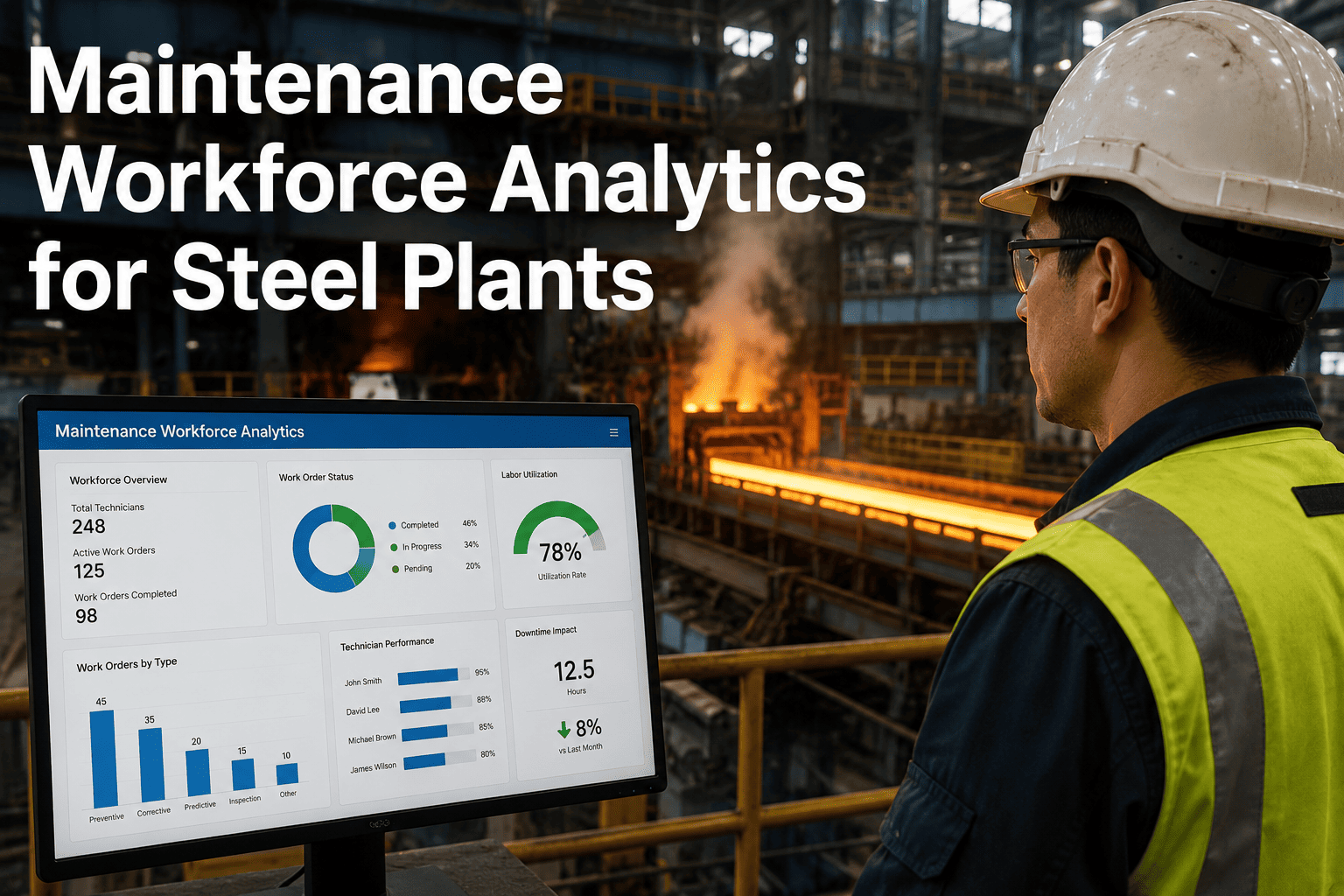
The dashboard below represents a real-time view of maintenance workforce status across a three-shift steel plant operation. Every number is live — pulled from open work orders, technician check-ins, and asset records — not a manually compiled report.
Workforce Analytics Metrics: What to Measure and Why
Not all workforce KPIs are equally useful in a steel plant context. The table below defines the analytics metrics that have the highest correlation with maintenance outcomes — and explains what each metric should trigger when it moves outside target range.
| KPI | Target Range | What a Negative Trend Signals | Management Action |
|---|---|---|---|
| PM Compliance Rate | 85–95% | Capacity shortage, skill mismatch, or scheduling gaps on critical assets like BOF converter and rolling mill | Skill gap analysis — identify which asset class is driving non-compliance |
| First-Time Fix Rate (FTFR) | 85–92% | Wrong skill deployed; insufficient asset history at point of work; inadequate SOP adherence | Review routing logic; verify technicians have mobile asset history access |
| Mean Backlog Age | Under 5 days | Work order intake rate exceeds capacity; reactive work crowding out PMs; priority misclassification | Backlog aging report — escalate Tier 1 asset overdue tasks immediately |
| Technician Utilisation Rate | 75–88% | Below 75%: under-deployment, scheduling inefficiency. Above 88%: burnout risk, reactive-only operation | Balance load distribution; review planned vs reactive work ratio |
| Skill-to-Task Match Rate | 90%+ | Technicians completing tasks outside their certified skill grade — increases failure recurrence and safety risk | Update skill matrix; enforce routing rules in OxMaint by certification level |
| Mean Time to Assign (MTTA) | Under 15 min | Manual dispatch bottleneck; lack of real-time availability visibility; supervisor overload | Enable auto-dispatch rules in OxMaint based on skill + proximity + workload |
| Repeat Failure Rate | Under 8% | Same asset failing within 30 days of maintenance — indicates FTFR failure or incomplete root cause resolution | Flag assets in OxMaint; require RCA before next work order can be closed |
Turn Your Maintenance Team Data Into Operational Intelligence
OxMaint gives steel plant maintenance managers a live view of technician productivity, skill coverage, backlog status, and quality metrics — replacing morning handover guesswork with data-driven dispatch decisions. See the workforce dashboard live in 30 minutes.
Backlog Control: From Accumulation to Velocity
Backlog in a steel plant maintenance operation is not just a list of pending tasks — it is a risk register. A 60-day-old PM task on a blast furnace blower bearing is not simply overdue; it represents 60 days of bearing degradation that has not been caught. Backlog analytics must show not just quantity but age, priority distribution, and the skill capacity required to clear it at current staffing levels.
Skill Matrix Management: Certifications, Gaps, and Training Triggers
Steel plant maintenance requires certified competency for specific asset categories — not just general mechanical or electrical ability. A technician without Level 3 rotating equipment certification should not be performing rolling mill spindle alignment. A technician without confined space entry certification cannot perform blast furnace internal inspection. OxMaint's skill matrix tracks individual certifications, expiry dates, and competency levels — and enforces routing rules so work orders only reach qualified hands.
| Skill / Certification | Asset Class | Required Level | Current Coverage | Training Trigger |
|---|---|---|---|---|
| Laser Alignment — Level 3 | Rolling mill drive train, coupling systems | Certified (OEM or trade) | 6 / 6 required — Current | Auto-alert 60 days before cert expiry |
| Vibration Analysis — ISO Cat II | All rotating assets — blast furnace, mills | ISO 18436-2 Category II | 3 / 5 required — 2 expired | Training WO auto-created — 2 techs |
| Confined Space Entry | Blast furnace internals, ladle inspection | Annual recertification | 8 / 8 required — Current | Auto-alert 30 days before expiry |
| OT System Access — PLC Level | All OT-connected assets | OT security clearance + individual account | 4 / 9 required — Gaps | Access blocked until cleared in OxMaint |
| High Voltage Electrical | Rolling mill drives, arc furnace (EAF) | Licensed HV electrician | 4 / 4 required — Current | Auto-alert 90 days before licence renewal |
Expert Review
The productivity gap between a high-performing steel plant maintenance team and an average one is rarely explained by headcount. In my experience across flat products and long products divisions, the difference is almost always information quality at the point of dispatch. The supervisor who can see in real time that the one technician certified for rolling mill laser alignment is already 6 hours into a 4-hour task, and that the next-best option is on break for 20 more minutes, makes a fundamentally better scheduling decision than one working from a whiteboard and a phone call. That information quality is exactly what OxMaint's workforce analytics delivers — and the compounding effect on first-time fix rate, backlog velocity, and PM compliance across a full quarter is measurable and significant. The skill matrix enforcement function alone has prevented more repeat failures in my plant than any single piece of condition-monitoring equipment we have deployed.
Frequently Asked Questions
Your Maintenance Team Is More Capable Than Your Current Visibility Shows
OxMaint Workforce Management gives steel plant maintenance leaders the live analytics to deploy the right skill to the right asset at the right time — turning a team of capable technicians into a high-performance maintenance operation with measurable outcomes. Start with a free trial or get a walkthrough tailored to your plant's workforce structure.