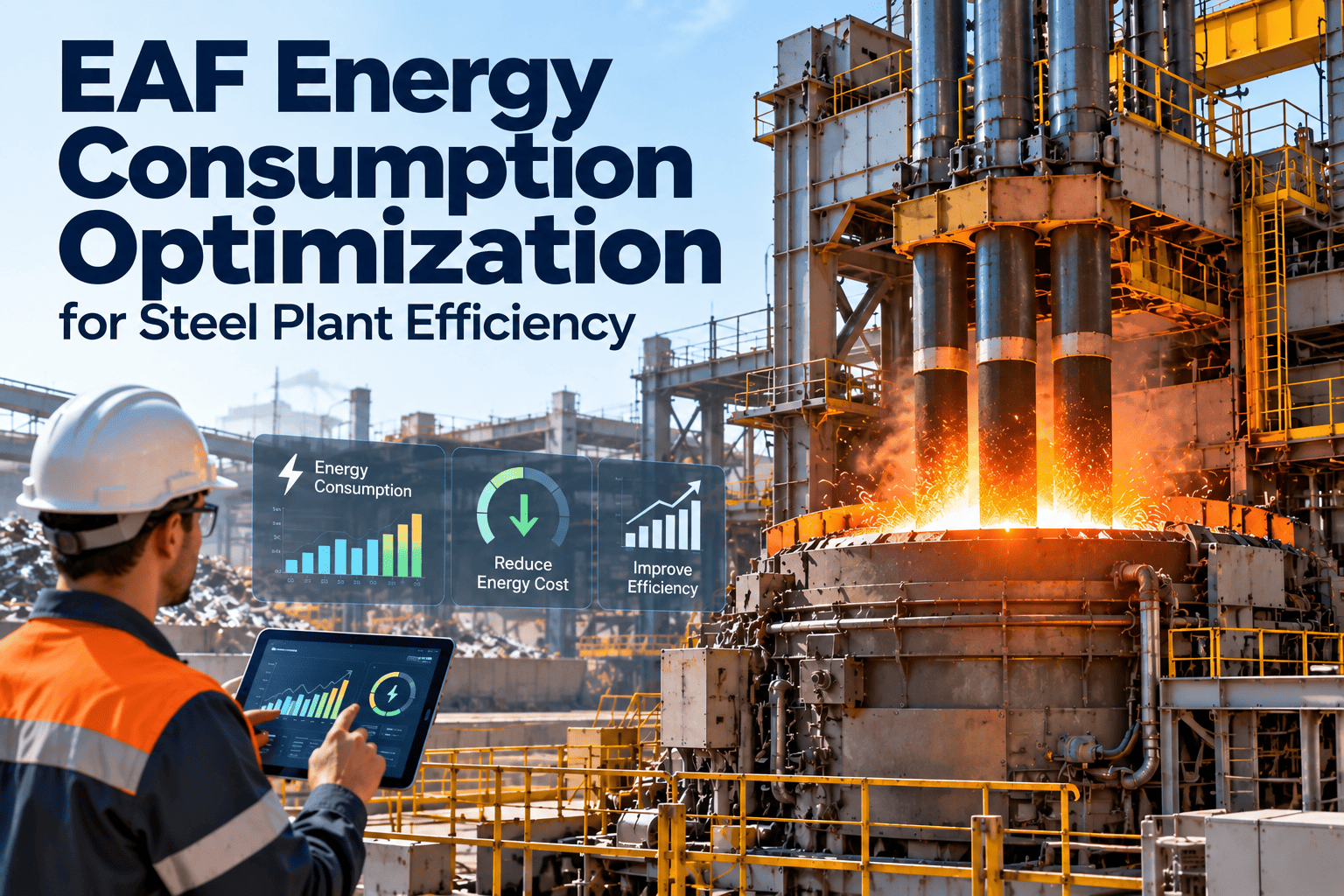
An electric arc furnace consuming 400 kWh per tonne when best-in-class is 300 kWh per tonne is wasting $2.8 million per year in electricity alone at 500,000 annual tonnes — before counting electrode overconsumption, off-spec reprocessed heats, and demand charges triggered by power peaks that no one is actively managing. Most EAF melt shops still run fixed power recipes regardless of scrap mix composition, rely on operator experience for tap timing, and review energy performance on end-of-shift reports rather than real-time data. OxMaint's EAF energy monitoring engine connects to existing furnace instrumentation at sub-cycle sampling rates, builds per-heat consumption models, and delivers the real-time visibility that converts a reactive melt shop into one where every gigajoule is tracked, optimised, and cost-attributed — heat by heat.
An EAF heat has four phases, and each has a distinct energy signature, a distinct set of optimisation levers, and a distinct cost per wasted minute. Fixed power recipes treat all four phases identically regardless of the scrap mix charged, producing consistent energy waste on every heat.
Roof off, scrap basket lowered. Primary energy waste: delay time between tap and next charge. Every extra idle minute wastes heat retained in the vessel. OxMaint tracks tap-to-charge cycle time against target and flags delays that extend the following boring phase.
Electrodes arc through solid scrap. Maximum safe power applied — scrap shields water-cooled panels. AI determines the optimal voltage step for the current scrap density and moisture content, preventing both over-power (panel damage risk) and under-power (extended boring time, +1.5 kWh/t per extra minute).
All scrap melted — energy now superheats liquid steel to tap temperature. Every extra minute in this phase costs $40–60 in energy and electrode wear without adding value. Foamy slag maintenance is critical: poor slag shielding radiates arc energy directly to water-cooled panels instead of the bath. OxMaint monitors flat bath duration deviation against baseline and detects slag quality issues from arc impedance patterns.
Steel poured into ladle through EBT. Tap temperature must be precise — a 10°C overshoot across 1,000 heats per year wastes over $200,000 in unnecessary energy. OxMaint's endpoint temperature model predicts tap temperature from arc energy input, oxygen injection, and bath progression, enabling operators to stop the heat at target rather than overshooting for safety margin.
Sub-cycle measurements at 1,000+ samples/second — active power (MW), reactive power (MVAR), power factor, voltage, current, and harmonic content per phase. Arc impedance tracking detects electrode position anomalies and slag condition changes in real time.
Oxygen injection rate and cumulative volume, carbon injection, natural gas burner input, bath temperature (where measured), charge weight per basket, scrap composition classification, and cumulative power-on time per heat phase.
kWh/tonne per heat, tap-to-tap time, power-on time vs. power-off time, electrode consumption per heat (kg/t), melt rate (t/min), chemical energy contribution as percentage of total, and endpoint temperature deviation from target.
Real-time electricity cost per heat based on current tariff (including peak demand period detection), coincident peak charge tracking across furnaces and auxiliaries, and daily/monthly cost attribution by shift, crew, and steel grade.
| Optimisation Lever | Mechanism | Typical Impact | Annual Value (500K t/yr) |
|---|---|---|---|
| kWh/tonne reduction — power profile | Dynamic voltage step selection vs. fixed recipe based on scrap mix and melt progression | 15–30 kWh/t reduction | $750K–$1.5M/yr |
| Tap temperature precision | Endpoint model eliminates systematic 8–12°C overshoot to avoid cold tap risk | $200K+ energy waste eliminated | $200K–$400K/yr |
| Demand charge reduction | AI schedules power peaks to avoid grid coincident demand windows and coordinates auxiliary loads | 12–15% demand charge reduction | $300K–$600K/yr |
| Electrode consumption optimisation | Power profile and arc length control linked to electrode consumption tracking per heat | 0.1–0.2 kg/t reduction | $180K–$640K/yr |
| Flat bath duration control | AI detects when bath is at tap temperature — flags early to prevent over-duration | 1–3 min/heat reduction | $40–120/heat saved |
The fundamental problem with EAF energy management in most melt shops is not a lack of data — it is that the data is reviewed after the heat, not during it. By the time an operator reads the end-of-shift energy report, the heats that consumed 340 kWh per tonne when the target is 300 are gone. The money is already spent. Real-time monitoring changes the decision timing: the flat bath that is running four minutes over target is flagged while there is still time to tap, not after. The electrode consumption that drifted above baseline is visible at Heat 12, not when the monthly invoice arrives. That shift from retrospective to real-time is where the measurable cost reduction comes from — not from any single optimisation, but from catching every small deviation before it compounds across a hundred heats.