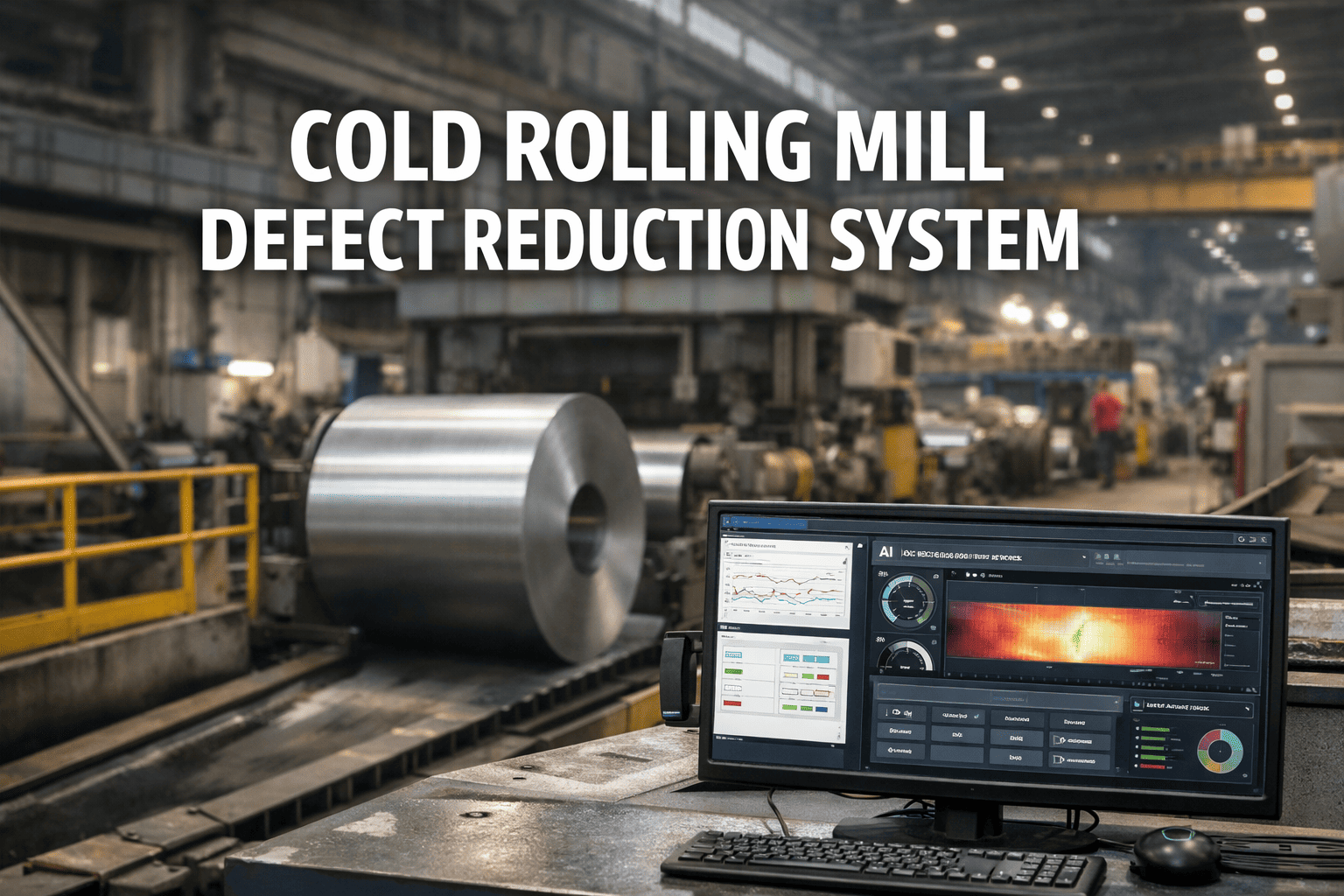
A cold rolling mill running 50–90% thickness reduction across six stands at 1,500 m/min has roughly 40 independent process parameters interacting with each other every millisecond — roll force, forward and backward tension, reduction distribution, emulsion flow, work roll hardness, rolling speed, strip width. When one parameter drifts, the defects that appear are not random. Third-octave chatter at 100–150 Hz produces gauge variation. Fifth-octave resonance prints visible stripes on the strip. Excessive reduction in F1 produces edge cracks. Low emulsion concentration produces roll spalling. Oxmaint models every defect against the parameters that produced it, so corrections happen before the next coil — or walk through your tandem mill parameter map in a 30-minute demo.
Process Optimization AI
Every Defect in a Cold Rolling Mill Is a Parameter That Left Its Window. Put the Window Back.
Strip breaks, chatter marks, gauge excursions, and edge cracks do not appear randomly. Each one has a fingerprint in roll force, tension distribution, emulsion flow, or reduction schedule. AI process optimization learns the windows for your mill, your products, your rolls — and flags drift before it becomes scrap.
Quick Definition
Process optimization AI for cold rolling uses real-time process data — roll force, tension, speed, gap, emulsion, vibration — combined with defect outcomes from downstream inspection to learn the safe operating window for every product grade. When any parameter drifts toward a known defect-producing zone, the system alerts operators before the defect is produced. Over time, it discovers the parameter combinations that minimize defect rate while maximizing throughput.
What the Parameter Window Actually Looks Like
For every product grade you roll, there is a region in parameter space where defect rate is minimized. Outside that region, different defect types appear on different boundaries. AI optimization does what no operator manually can — it holds you inside the window at all six stands, simultaneously, at 1,500 m/min.
Defect Mode Boundaries Around the Sweet Spot
Chatter Zone
Speed too high
Edge Cracks
F1 reduction too aggressive
Roll Marks
Tension imbalance
Slip & Scuff
Emulsion too rich
Strip Break
Process slippage
Gauge Deviation
AGC drift
Sweet Spot
AI holds you here
The 6-Stand Tandem Mill, Parameter by Parameter
Each stand in a tandem cold mill has its own parameter load. The reduction ratio distributes across F1 to F6 — total 50–70% — but the specific reduction at each stand determines which defects become likely. AI learns the distribution that minimizes defect risk for each product.
F1
Entry Stand
Reduction: 30–35%
Edge cracks if excessive
F2
Heavy Reduction
Reduction: 25–30%
Roll force peaks here
F3
Intermediate
Reduction: 20–25%
Thickness lock-in
F4
Shape Control
Reduction: 15–20%
Flatness-critical stand
F5
Chatter-Prone
Reduction: 10–15%
3rd octave chatter starts
F6
Finish Stand
Reduction: 5–10%
Final surface quality
Hot band in
Cold rolled coil out
Defect-to-Parameter Root Cause Matrix
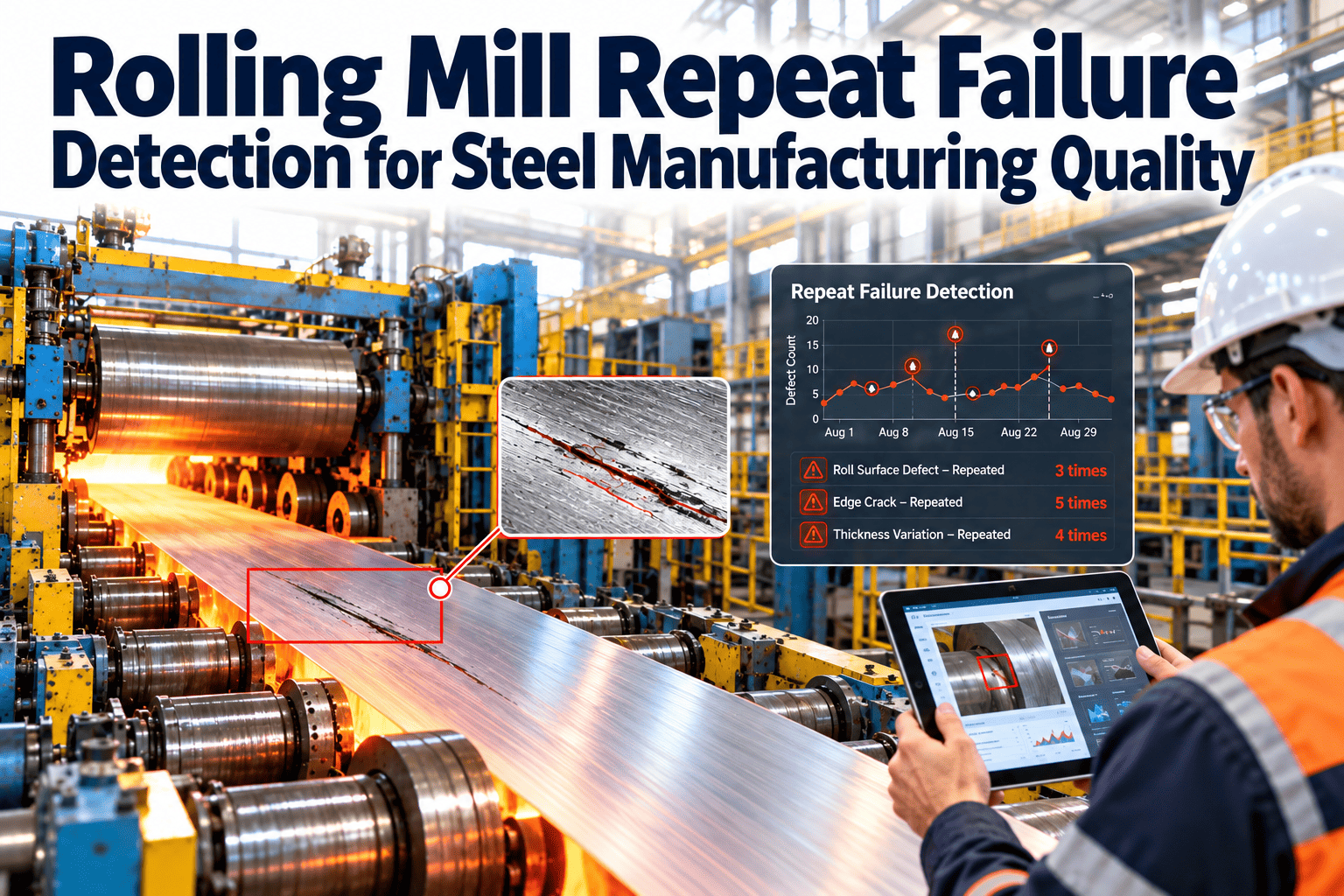
The fastest way to stop a recurring defect is to know which process parameter produces it. The matrix below maps the six most common cold rolling defects to the parameters most likely to cause them — the data AI uses to trace every defect back to its origin in seconds instead of weeks.
Strip Break
Tension imbalance F5/F6
Edge crack propagation
Rebalance tension, slow down
Chatter Marks
Self-excited vibration 100–150 Hz
Emulsion film instability
Speed reduction, emulsion tuning
Gauge Variation
AGC bandwidth limit exceeded
Roll eccentricity
AGC retuning, roll scheduling
Edge Cracks
F1 reduction too aggressive
Incoming hot band defects
Redistribute reduction schedule
Roll Spalling
Emulsion temperature too low
Strip break thermal shock
Emulsion control, roll campaign limit
Flatness Defects
Roll bending at F4
Uneven roll cooling
Bending force rebalance, cooling tuning
Process data plus defect outcomes in one system
Your AGC System Knows What Happened. Your CMMS Should Know Why.
Oxmaint links every process parameter excursion to the defect it produced and the maintenance action that fixes it — so the same strip break does not happen on the next campaign.
The Two Chatter Modes That Cost You Speed
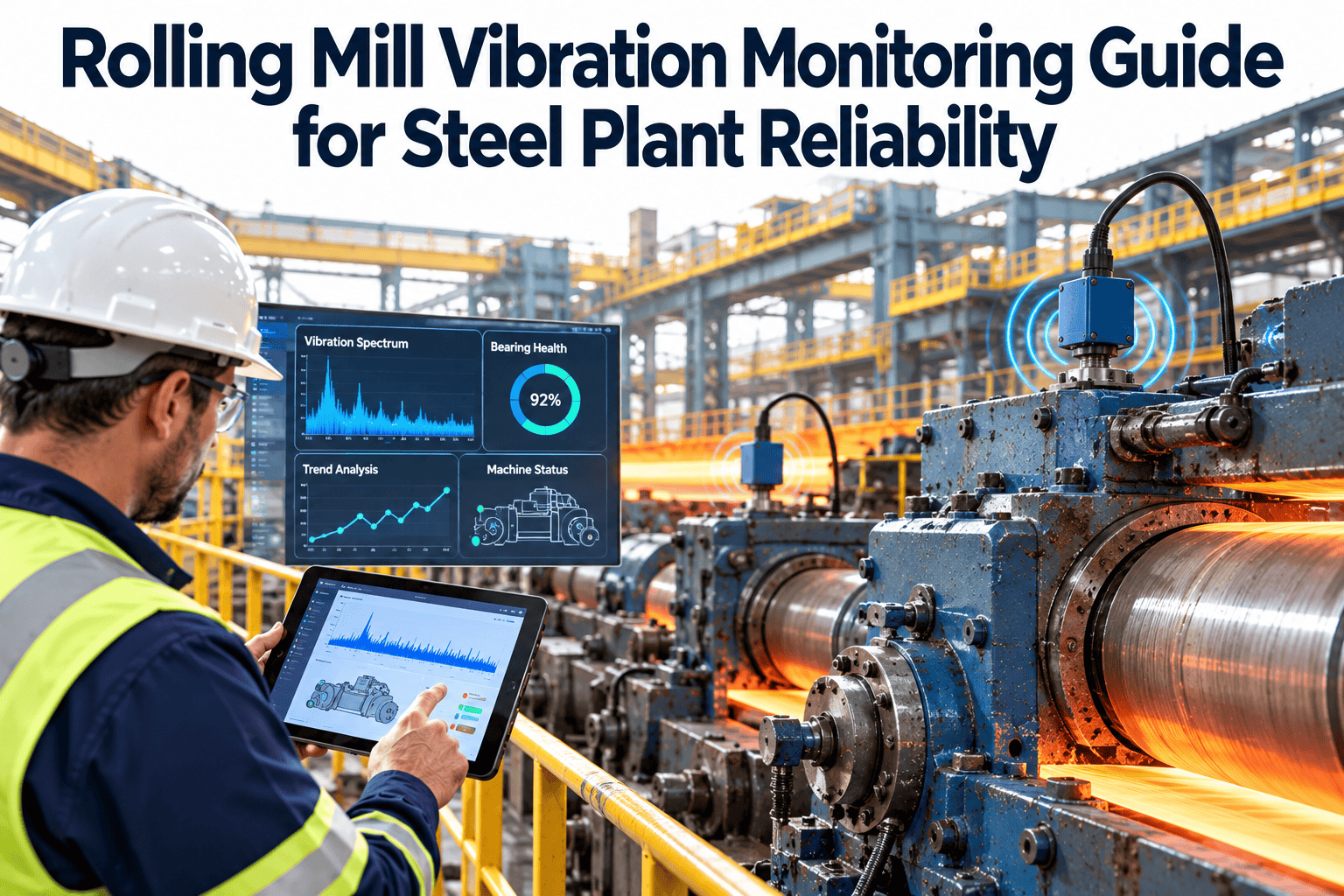
Third-octave and fifth-octave chatter are the two vibration phenomena that force most tandem cold mills to run below design speed. Both are self-exciting. Both are detectable early. AI monitoring catches them before they force a speed reduction or produce a full coil of scrap.
3rd Octave
100–150 Hz
Gauge Chatter
Self-exciting vertical resonance in rear stands (F5/F6) of the tandem. Top two rolls move anti-phase against bottom two. Rises to destructive amplitude in under one second. Produces gauge variation and strip breaks.
AI Detection
Accelerometer-based monitoring detects peak developing at 100–150 Hz. Automatic speed reduction before amplitude reaches break threshold.
5th Octave
500–700 Hz
Mark Chatter
Forced vibration from work roll bearing defects, gear wear, or grinding-origin roll marks. Prints periodic light-and-dark stripes perpendicular to strip movement. Customer-rejecting surface defect on exposed-panel grades.
AI Detection
Vibration spectrum analysis identifies bearing fault frequencies and roll eccentricity. Work order generated for roll swap or bearing inspection.
How AI Optimization Closes the Feedback Loop
Every coil rolled produces two sets of data: process parameters during rolling, and defect outcomes from downstream inspection. AI correlates the two sets to build a model of which parameter combinations produce which defects. The loop tightens with every coil.
1
Capture Parameters
Roll force, tension, speed, gap, emulsion, vibration, and temperature at every stand — 100 Hz sampling for the full coil length.
2
Capture Defect Outcomes
Surface inspection, gauge measurements, flatness meter, and edge scanner data tagged to each coil with exact position coordinates.
3
Correlate and Learn
AI matches parameter signatures to defect signatures. Learns the window boundaries for each product grade over thousands of coils.
4
Advise Next Coil
Parameter set-points adjusted for the next coil before it enters F1. Corrections happen in the same campaign, not the next audit.
The Economics of Holding the Window
Process optimization is a direct lever on two of the biggest cost centers in a cold mill — scrap rate and roll consumption. Both move quickly when parameter drift is caught before it becomes damage.
Strip Breakage Rate
Reduction observed on 950mm continuous cold mill after parameter control program implementation
Roll Failures / Month
Roll bursts and surface spalling dropped significantly after hardness tuning and parameter monitoring
Mill Speed at Gauge Target
Chatter-damped operation allows higher rolling speeds for thin-gauge strip without damage or delamination
Prime Yield
Secondary-grade diversions drop when process parameters hold the sweet spot for the product mix
Where Oxmaint Plugs Into Your Control Architecture
Oxmaint is not a replacement for your Level 2 automation or AGC system. It is the maintenance and quality layer that captures process events, links them to assets, and drives corrective action through work orders — the feedback loop that process control alone cannot close.
Level 1
PLC & Drive Control
Roll force, AGC, tension regulation
Level 2
Process Automation
Schedule calc, set-point distribution
Level 3
MES & Quality
Coil tracking, quality disposition
Oxmaint
Defect-to-Asset Layer
Work orders, roll life, audit trail
What You Get Inside the Platform
Parameter Window Monitoring
Real-time tracking of roll force, tension, speed, and gap against learned safe windows. Drift alerts before the defect is produced.
Roll Campaign Tracking
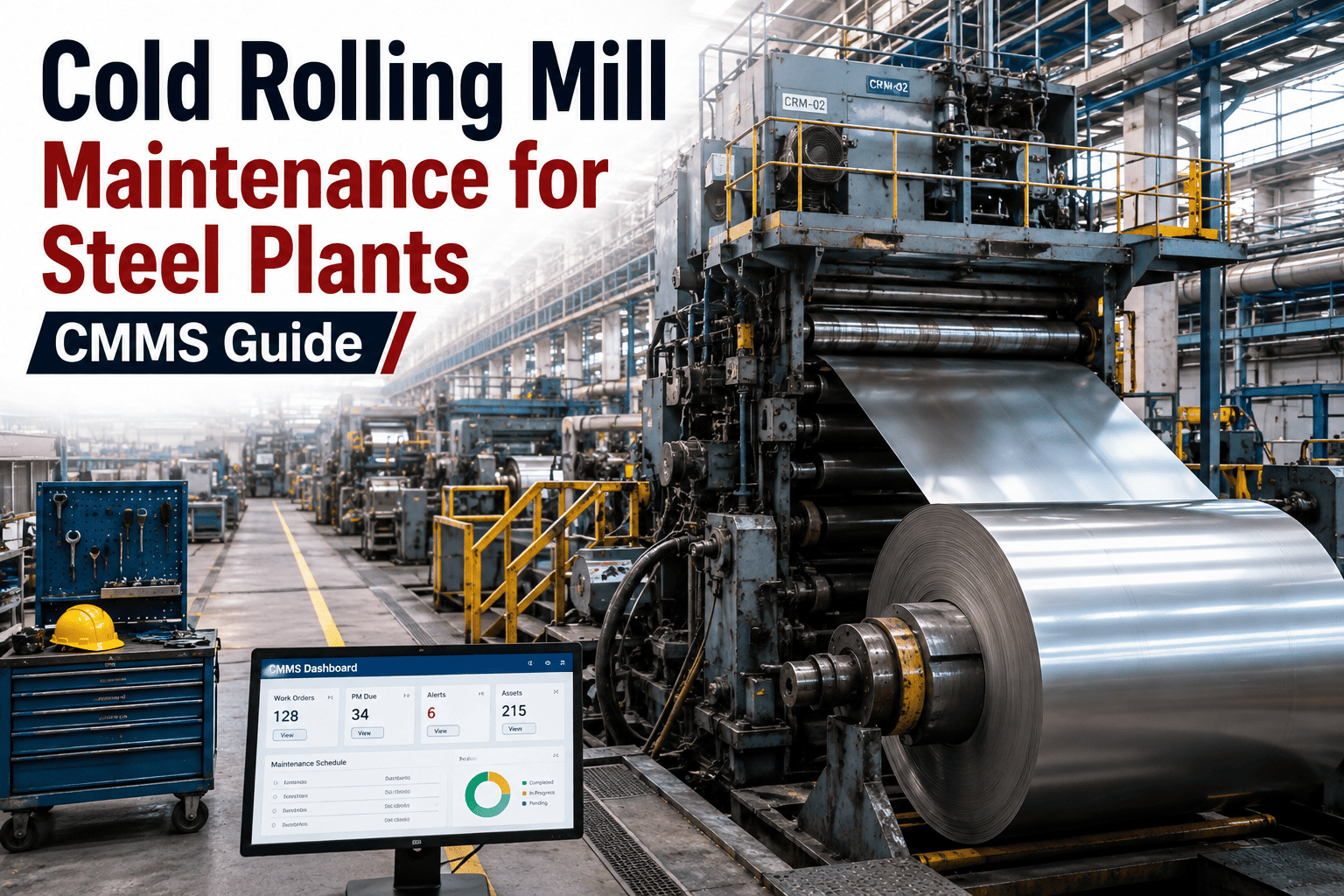
Each work roll identified uniquely with lifecycle log: grinding history, defect record, rolling volume, and current condition.
Chatter Event Log
Every vibration event timestamped with stand, frequency, amplitude, and operator response. Pattern analysis across campaigns.
Emulsion Maintenance
Concentration, temperature, contamination, and filtration tracking with automated sampling schedules and oil change work orders.
Strip Break Root Cause
Each strip break captured with the full parameter state 60 seconds before the event. Pattern detection across break history.
Grade-Specific Rule Sets
Different product grades get different parameter windows, acceptance thresholds, and roll scheduling rules. No one-size-fits-all rolling.
From parameter drift to corrective action in one platform
The Strip Break at F5 Last Tuesday Had a Signature in the Data 90 Seconds Before It Happened.
Oxmaint captures that signature, logs the event, and runs the next campaign with the parameter window tightened. No more guessing at the tension. The data says which stand, which parameter, which shift.
Frequently Asked Questions
Does this replace our existing AGC or Level 2 system?
No. Oxmaint sits alongside Level 1 and Level 2 as the defect, roll, and maintenance layer. It reads process data, does not write set-points.
How long before the AI model is useful on our mill?
Useful alerts begin within 2–3 weeks as baseline parameter windows are established. Full product-grade model accuracy typically takes 8–12 weeks.
Can it detect 3rd octave chatter before strip break?
Yes, if vibration sensors are installed on the mill stands. The AI identifies the amplitude growth pattern and alerts in under one second.
What data integration does deployment need?
OPC UA read access to Level 1 process tags, plus coil-level quality data from your surface inspection and gauge systems. Standard industry connectors.
Cold rolling, window-locked
Fewer Strip Breaks. Fewer Roll Changes. More Prime Coil Out the Door.
Oxmaint turns your tandem cold mill from a process you operate into a process you optimize. The parameter windows learn themselves. You run faster, break less, and ship more prime.
Parameter Window AI
Chatter Detection
Roll Campaign Tracking
Strip Break Root Cause