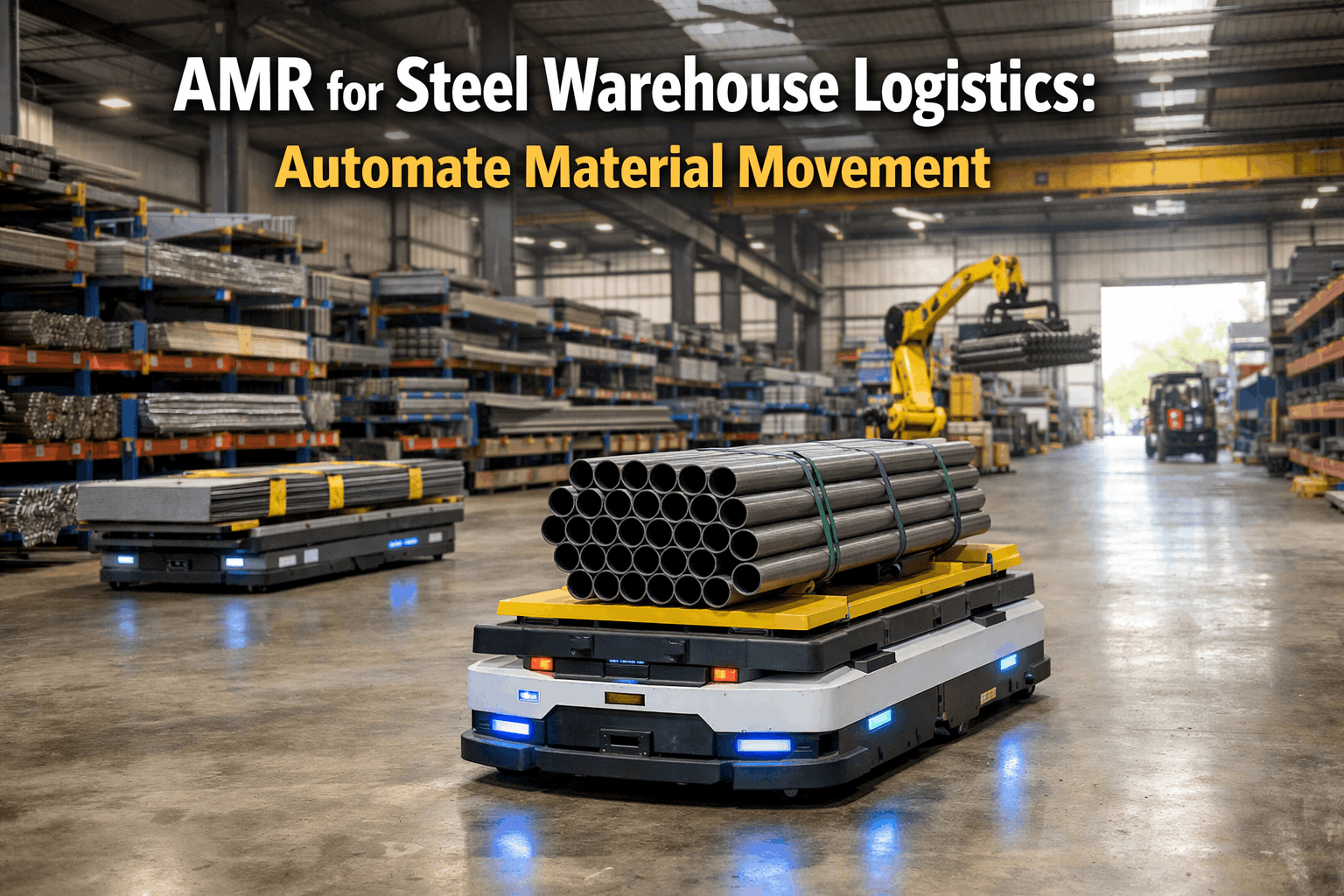
A single steel coil weighs between 5,000 and 40,000 pounds. Moving it from receiving dock to storage bay to staging area to outbound shipping requires a crane, a forklift, an operator, and—on a good day—20 minutes of coordinated effort. On a bad day, it requires all of that plus a near-miss incident report, a damaged coil edge, and a customer complaint about a delayed shipment. Now multiply that across 200–500 material movements per shift in a mid-size steel service center. The math is brutal: manual material handling in steel warehouses consumes 35–45% of total operating labor, drives forklift-related injury rates 3x higher than the manufacturing average, and creates throughput bottlenecks that limit your facility to 60–70% of its theoretical capacity. Autonomous Mobile Robots aren't a futuristic concept for steel logistics—they're an operational necessity that leading service centers are deploying now. AMRs designed for heavy-payload steel environments are eliminating the labor, safety, and throughput constraints that have defined warehouse operations for decades. The question isn't whether AMR technology works for steel. It's whether your competitors will deploy it before you do.
35–45%
Of operating labor consumed by manual material movement
3x
Higher forklift injury rate in steel vs. general manufacturing
60%
Average capacity utilization—manual handling creates the ceiling
$1.2M
Annual material handling labor cost for a 200K sq ft facility
The Steel Warehouse Challenge: Why Manual Handling Hits a Wall
Steel warehouses are fundamentally different from general distribution centers. The payloads are heavier, the product is harder to handle, the damage threshold is lower, and the safety stakes are exponentially higher. These aren't challenges you can solve by adding more forklifts or hiring more operators—they're structural limitations of manual material handling in heavy industrial environments. Facilities that sign up to modernize their material movement operations are addressing all five constraints simultaneously through AMR deployment.
Labor Scarcity & Cost
Qualified forklift operators for steel environments command $22–$35/hr. Turnover exceeds 40% annually. Every unfilled shift creates cascading throughput losses across receiving, storage, and shipping.
Safety & Incident Risk
Steel handling generates 12.4 injuries per 100 workers annually—nearly double the national average. Crush injuries, tip-overs, and struck-by incidents account for 68% of lost-time events.
Throughput Bottlenecks
Manual forklift operations create sequential dependencies—one blocked aisle stops multiple movements. Peak-period congestion reduces effective throughput by 25–40% vs. theoretical capacity.
Product Damage & Claims
Forklift-induced edge damage, surface scratches, and coil telescoping cost steel service centers $150,000–$500,000 annually in rejected material, rework, and customer claims.
Inventory Visibility Gaps
Manual put-away and retrieval means inventory location accuracy degrades to 85–90%. Misplaced coils create search time that averages 15–25 minutes per lost-location event.
AMR Capabilities for Steel Material Movement
Today's heavy-payload AMRs are engineered specifically for the demands of steel logistics—not adapted from light-duty warehouse robots. These are purpose-built autonomous vehicles capable of navigating narrow aisles with multi-ton loads, coordinating with overhead cranes, and operating continuously across all three shifts without fatigue, distraction, or turnover.
Heavy-Payload Autonomous Transport
AMRs rated for 5,000–60,000 lb payloads autonomously transport coils, bundles, plates, and bar stock between receiving docks, storage bays, processing stations, and shipping lanes. No operator required.
Impact: Eliminates 70–85% of forklift-dependent material movements
Dynamic Path Planning & Fleet Coordination
Multi-robot fleet management systems optimize routes in real time—avoiding congestion, coordinating with crane movements, and rebalancing workloads automatically as priorities change.
Impact: 30–40% reduction in average material transit time vs. manual dispatch
Integrated Inventory Positioning
Every AMR movement updates inventory location in real time. When an AMR places a coil in Bay J-14, the WMS knows it's there instantly—not because someone scanned a barcode 20 minutes later.
Impact: Inventory location accuracy improves from 85–90% to 99.5%+
Safety-First Navigation with Obstacle Detection
LiDAR, 3D cameras, and proximity sensors create a 360° safety envelope around every AMR. The robot detects personnel and equipment at 30+ feet, stopping instantly—eliminating struck-by and crush injuries.
Impact: 90–95% reduction in material-handling-related safety incidents
24/7 Continuous Operation
AMRs operate across all shifts with 95%+ uptime—no breaks, no shift changes, no overtime premiums. Autonomous battery management coordinates charging during low-demand windows. One AMR replaces 2.5–3.0 FTEs.
Impact: 2.5–3.0x labor equivalent per AMR unit across three-shift operations
Forklift vs. AMR: The Head-to-Head Comparison
For repetitive material movements between fixed zones—receiving to storage, storage to processing, staging to shipping—AMRs outperform manual forklifts on every metric that affects your bottom line.
See AMR Material Movement in a Steel Environment
Watch how autonomous robots transport coils, bundles, and plates across a working steel warehouse—coordinating with cranes, updating inventory in real time, and running 24/7 without operators.
Deployment Roadmap: From Assessment to Full Operation
AMR deployment in steel warehouses follows a proven phased approach. Most facilities achieve measurable ROI within the first phase—typically 12–16 weeks from project kickoff—and reach full-scale operation within 6–9 months.
Weeks 1–4
Assessment & Mapping
Facility layout scan, material flow analysis, payload profiling, obstacle mapping, and integration requirements with existing WMS/ERP. Define target zones and movement patterns.
Weeks 5–10
Pilot Zone Deployment
Deploy 2–4 AMRs in highest-value zone (typically receiving-to-storage). Validate navigation, payload handling, safety systems, and WMS integration in live operations.
Weeks 11–16
Optimization & Expansion
Refine routes based on pilot data, expand to additional zones, add fleet units, and calibrate fleet coordination algorithms. First ROI measurement against baseline metrics.
Months 5–9
Full-Scale Operation
Complete fleet deployment across all target zones. Full integration with WMS, ERP, and crane management. 24/7 autonomous operation with remote monitoring and predictive maintenance.
System Integration: How AMRs Connect to Your Operations
AMRs don't operate in isolation—their value multiplies when connected to your existing warehouse management, ERP, and production planning systems. Facilities that sign up to integrate AMR fleet maintenance with their CMMS ensure their robots maintain 95%+ uptime through automated preventive maintenance scheduling.
WMS / Inventory
Real-time location updates, put-away instructions, pick-list optimization, and automatic inventory reconciliation with every AMR movement
ERP System
Order fulfillment triggers, material allocation, shipping schedule synchronization, and production planning alignment
Crane / MHE Control
Movement coordination with overhead cranes, handoff sequencing, and zone-access scheduling to prevent conflicts
Safety Systems
Emergency stop integration, zone-lockout protocols, personnel detection sharing, and safety compliance reporting
CMMS / Maintenance
Predictive AMR maintenance, auto-generated work orders, runtime tracking, sensor diagnostics, and uptime monitoring
ROI Dashboard: What AMR Deployment Delivers
The financial case for AMR deployment in steel warehouses is built on measurable value drivers. Facilities consistently report payback periods of 18–30 months—with cumulative savings accelerating in years two and three as the fleet scales.
$680K
Labor Cost Reduction
Eliminates 18–22 FTE equivalents across three shifts
$280K
Damage & Claims Reduction
80–90% reduction in handling-related product damage
$190K
Throughput Improvement
25–35% more material movements per shift at same facility footprint
$120K
Safety & Workers' Comp Savings
Near-elimination of forklift-related injuries and associated costs
Expert Perspective: Deploying AMRs in Heavy Industrial Environments
"The steel service centers that get AMR deployment right share three traits: they start with their highest-volume, most repetitive movement lanes—not the most complex ones. They integrate with their WMS from day one—not as a phase-two afterthought. And they treat the robots as a fleet, not individual units—because fleet-level optimization is where the real throughput gains come from. The facilities that deploy as a connected system from the start capture 80–90% of available value within the first year."
Start with the highest-volume lane, not the hardest problem
Integrate WMS on day one—standalone robots leave value on the table
Deploy as a coordinated fleet with centralized management from the start
Connect AMR maintenance to your CMMS for 95%+ fleet uptime
The operational transformation AMRs deliver goes beyond labor savings—it changes throughput capacity, safety performance, and inventory accuracy simultaneously. If you're evaluating AMR technology for your steel operation, book a free demo to see how autonomous material movement integrates with maintenance and inventory tracking across your entire facility.
Automate Your Steel Warehouse. Maintain Your Fleet. Maximize Uptime.
OxMaint connects AMR fleet operations to a complete maintenance platform—every robot tracked, every work order automated, every performance metric visible. Keep your autonomous fleet running at peak with predictive maintenance built for heavy industrial environments.
Frequently Asked Questions
Can AMRs handle the weight of steel coils and bundles?
Yes—heavy-payload AMRs designed for steel environments are rated for payloads ranging from 5,000 to 60,000 pounds, covering the vast majority of coil, bundle, plate, and bar stock handling requirements. These are purpose-built industrial robots with reinforced chassis, heavy-duty drive systems, and specialized load-bearing platforms. Payload handling includes coil cradles for eye-to-sky and eye-to-wall orientations, flat-deck configurations for plate and sheet bundles, and custom fixtures for long products. The AMR's navigation system accounts for payload weight in all movement calculations, adjusting speed, acceleration, and turning radius for safe handling at every load level.
What's the ROI timeline for AMR deployment in a steel warehouse?
Most steel warehouse AMR deployments achieve payback within 18–30 months, with annual value generation of $1M–$2M for a 200,000 sq ft facility running an 8–12 unit fleet. The ROI comes from four primary sources: labor cost reduction (eliminating 18–22 FTE equivalents across three shifts), product damage reduction (80–90% fewer handling-related claims), throughput improvement (25–35% more material movements per shift), and safety savings (near-elimination of forklift-related injuries). Cumulative savings accelerate in years two and three as fleet optimization compounds.
How do AMRs integrate with existing warehouse management systems?
AMR fleet management systems integrate with existing WMS, ERP, and production planning platforms through standard APIs. The WMS sends movement instructions to the AMR fleet, and the AMRs send confirmation and location data back—creating real-time inventory accuracy without manual scanning. Integration also extends to crane management for coordinated handoffs, safety systems for emergency stop protocols, and CMMS platforms for automated AMR maintenance scheduling. Most integrations are completed during the pilot phase and fully validated before fleet expansion.
How safe are AMRs operating alongside workers in a steel warehouse?
AMRs are significantly safer than manual forklifts. Each unit operates with a 360-degree safety envelope using LiDAR, 3D cameras, and ultrasonic proximity sensors that detect personnel at 30+ feet. When a person enters the safety zone, the AMR automatically reduces speed or stops completely—with millisecond response times. Steel facilities deploying AMRs report 90–95% reductions in material-handling-related safety incidents. The robots eliminate fatigue, distraction, and visibility limitations that cause the majority of forklift accidents during second and third shifts.
What maintenance do AMRs require in a steel warehouse environment?
AMRs require preventive maintenance driven by runtime hours and environmental conditions: wheel and drive system inspection every 500–1,000 hours, LiDAR and sensor cleaning weekly (steel dust affects sensor accuracy), continuous battery health monitoring via onboard diagnostics, software and navigation map updates, and monthly structural inspection of load-bearing components. When connected to a CMMS platform, AMRs automatically generate maintenance work orders based on sensor diagnostics and runtime thresholds. Well-maintained fleets achieve 95%+ uptime across three-shift operations.