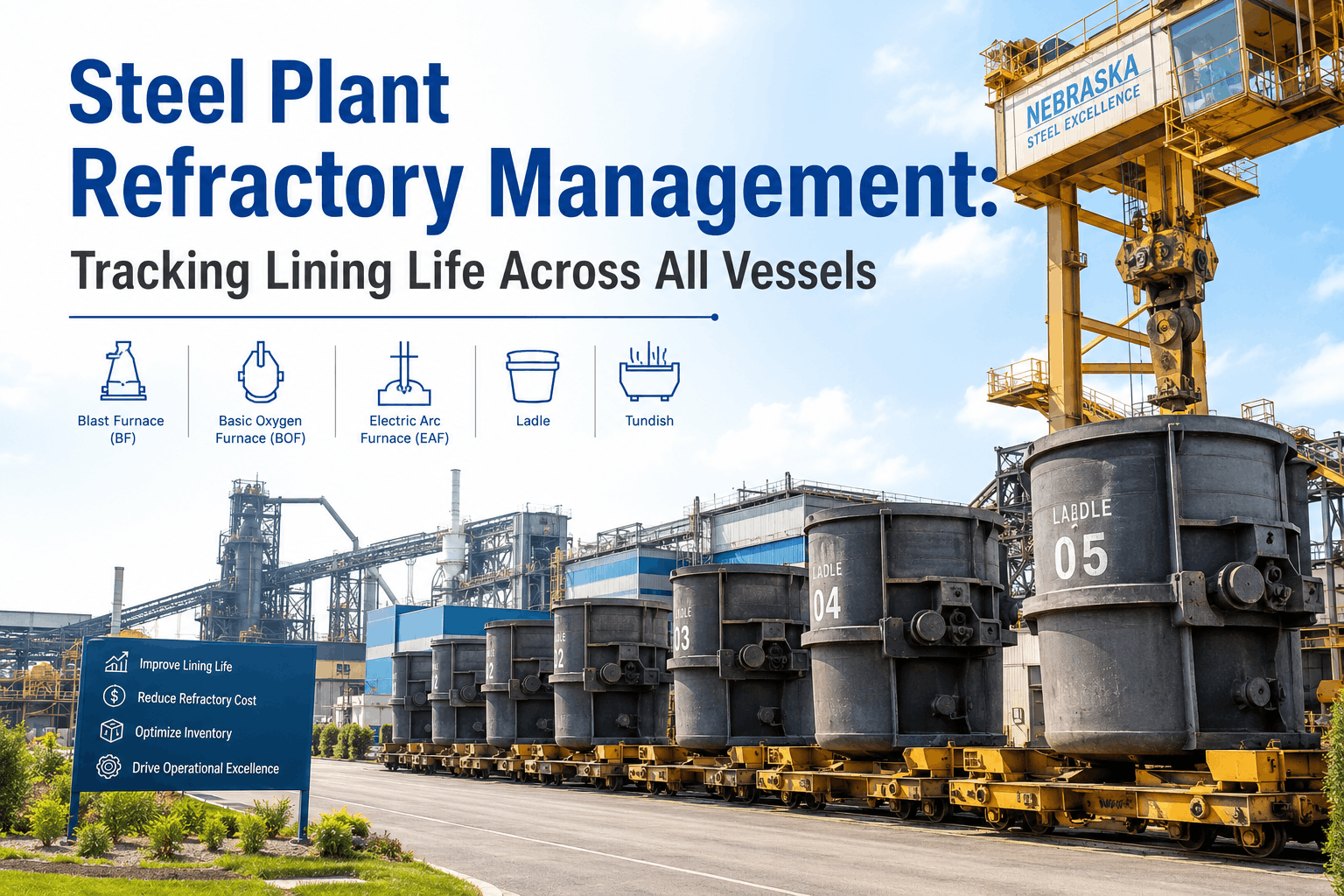
Ladle Tracking and Heat Sequencing Optimization for Steel Plants
By james smith on April 28, 2026
A melt shop running 12 to 24 steel ladles in simultaneous circulation is managing one of the most thermally violent asset fleets in heavy industry. Each 300-tonne ladle cycles from ambient temperature to 1,650°C and back every 4 to 6 hours — carrying liquid steel through tapping, secondary metallurgy at the ladle furnace, continuous casting, deskulling, and back to preparation. A cold ladle entering the tapping sequence drops steel temperature by 30 to 80°C, risks slide gate freezing, and compresses the casting temperature window for every downstream heat in the sequence. A ladle run past its campaign limit without refractory thickness verification is a breakout waiting for a trigger. And a heat sequence built without visibility of each ladle's heat count, preheat status, and slide gate condition will produce delays, quality deviations, and emergency relines that each individually cost more than the annual licence fee of the analytics platform that would have prevented them. Book a 30-minute demo to see how Oxmaint's Analytics & Reporting platform gives melt shop operators real-time ladle fleet visibility, heat sequence optimisation, and lifecycle-driven reline scheduling — or start a free trial and configure your first ladle fleet dashboard today.
Ladle Tracking and Heat Sequencing Optimisation for Steel Plants
Heat count tracking by refractory zone, preheat compliance enforcement, slide gate lifecycle management, and heat sequence optimisation — the four analytics disciplines that determine whether your ladle fleet protects casting quality or creates it as the constraint.
Steel temperature loss from a cold ladle — risks casting sequence failure
The Ladle Lifecycle — Eight Stages That Must All Be Tracked Simultaneously
Every ladle in the melt shop cycles through the same eight operational stages. The heat sequence optimiser needs to know where every ladle is in this cycle, what its refractory status is, and when it will next be available for tapping — simultaneously across the entire fleet. Without that visibility, heat scheduling is educated guesswork.
Minimum 1,480°C — grade-dependent; new lining: 12 hr cure preheat
3
Tapping Bay
Molten steel tapped at 1,650°C — heat count incremented
4
Ladle Furnace (LF)
Secondary metallurgy — alloying, desulphurisation, temperature trim
5
Continuous Caster Turret
Steel poured into tundish — slide gate open/close cycles recorded
6
Deskulling
Residual steel skull removed — skull weight logged per heat
7
Maintenance Bay
Refractory inspection — slag line measurement, hotspot scan, reline decision
8
Reline / Return
Full reline or partial repair — campaign reset or continued with updated limits
Refractory Zone Tracking — Why Heat Count by Zone Changes Everything
The critical insight in ladle refractory management is that the ladle does not wear uniformly. Three zones wear at entirely different rates, require different materials, and must be tracked independently. A single "total heat count" for the ladle tells you almost nothing actionable. Heat count by zone — compared against grade-specific wear rates — is the number that drives real maintenance decisions.
Slag Line Zone
MgO-C brick — corrosion-resistant against aggressive slags
Wear driverChemical dissolution by slag, oxygen lancing, high argon stirring flow
Replacement2–3 slag line changes per full barrel campaign
Risk signalIncreasing skull weight per heat; ladle shell temperature rise at slag line elevation
Tracking triggerPer-heat skull weight log + monthly infrared shell scan at slag line band
Barrel (Side Wall) Zone
High-alumina or MgO-C brick — campaign-limiting component
Wear driverThermal cycling, mechanical impact from scrap charging, stirring erosion
Tracking triggerPorous plug argon flow monitoring per heat; visual inspection every 15 heats
Oxmaint tracks heat count per zone for every ladle in your fleet — generating reline work orders automatically when zone-specific thresholds are reached, not when the worst-case campaign average is exceeded.
Heat Sequence Optimisation — The Scheduling Problem That Determines Casting Quality
Heat sequencing is not a production scheduling problem — it is a maintenance-data problem. The sequence optimiser cannot build an achievable schedule without knowing the real-time status of every ladle: its current position in the 8-stage lifecycle, its heat count against campaign limit, its preheat temperature, and when its slide gate was last changed. Without that data, the sequence is built on assumptions that break during the shift.
Preheat compliance failure → steel temperature loss
A ladle entering the tapping bay below minimum preheat temperature causes a 30–80°C drop in tapping temperature. For high-alloy grades with extended LF processing cycles, this drop cannot be recovered without adding heat — extending furnace time, consuming energy, and compressing the casting window for the heats queued behind. Grade-specific minimum preheat enforcement, with automatic hold on any ladle failing the temperature gate, prevents this cascade.
Analytics triggerPreheat temperature vs grade minimum at ladle release gate
Slide gate failure at caster → tundish freeze and sequence break
Slide gate failure during casting causes uncontrolled steel flow, tundish freeze, or forced sequence break — each costing $50,000–$150,000 in lost production and emergency consumables. Slide gate components have defined cycle lives per steel grade and ladle diameter. Tracking open/close cycles per component, per ladle, per grade identifies gates approaching end-of-life before they are scheduled for a sequence, not during it.
Analytics triggerCumulative slide gate cycles vs rated life per ladle per grade
Campaign limit exceedance → breakout risk with no warning
A ladle scheduled past its campaign limit without a thickness verification is the highest-consequence failure mode in the melt shop. Breakouts during casting or at the caster turret are catastrophic — equipment destruction, potential injury, and production stoppage measured in days. The heat sequence must exclude from assignment any ladle within 5 heats of its zone-specific campaign limit without a confirmed thickness measurement in the CMMS.
Analytics triggerZone heat count approaching 95% of campaign limit → mandatory thickness survey WO
Ladle availability bottleneck → sequence gaps and heat delays
When multiple ladles reach reline simultaneously — or when an unplanned reline removes a ladle from the active fleet — the available fleet size drops below the minimum needed to sustain the casting sequence without gaps. Ladle fleet analytics that show the projected campaign-end distribution across all active ladles — weeks in advance — allow planned relining to be staggered so no more than one ladle is out of service at any time.
Ladle Analytics KPIs — The Metrics That Drive Melt Shop Performance
KPI
How Measured
Target
What Failure Looks Like
Campaign heats achieved — barrel zone
Total heats per ladle before full reline
>120 heats (best practice)
Below 90 heats = refractory wear rate too high; grade or practice review
Preheat compliance rate
Ladles meeting grade minimum temperature at tapping bay / total ladles tapped
>98%
Below 95% = systematic schedule mismatch or preheat station constraint
Unplanned reline rate
Emergency relining events / total relining events
<5%
Above 15% = tracking or thickness measurement gaps
Ladle turnaround cycle time
Average time from casting completion to tapping-ready status
<4 hours
Above 6 hours = preparation or preheat scheduling bottleneck
Slide gate failure rate at caster
Gate failures during casting / total casting sequences
<0.5%
Any increase = grade-life correlation review required immediately
Refractory cost per tonne of steel
Total refractory cost / total steel tonnage per period
0.9–1.5 kg/t (brick)
Above 2.5 kg/t = over-relining or grade-driven excess wear
Expert Review — The Melt Shop That Tracks Ladles by Zone Outperforms the One That Counts Heats
"The fundamental mistake in ladle management — and I have seen it in 60-tonne EAF shops and 300-tonne BOF shops alike — is managing the ladle as a single asset rather than three refractory systems in one shell. The slag line is consuming itself against aggressive basic oxygen slag at a rate that has nothing to do with how the barrel lining is performing. The bottom ZCC is wearing around the porous plug at a rate driven by tapping stream impingement and argon flow rates that are grade-specific. When you run a flat heat count against a single campaign limit that was calculated for your average grade mix, you are simultaneously under-maintaining some ladles and over-maintaining others. The plants that achieve 120-plus heats consistently are the ones that track zone heat count against grade-specific wear coefficients, measure thickness every 20 heats with a laser profile, and feed that data into a CMMS that tells the heat scheduler exactly which ladles are available for high-alloy grades and which should only be assigned to clean, low-wear heats until their next reline. That is not complexity — it is precision that saves 20 to 30% of refractory cost and eliminates the unplanned relines that break casting sequences."
Dr. Pradeep Nair, FIMMM
Fellow of the Institute of Materials, Minerals and Mining · 22 years ladle refractory engineering and melt shop analytics · Former Technical Director, Refractory Products Division, SAIL · Specialist in ladle campaign optimisation and grade-specific wear modelling
Frequently Asked Questions
What is the standard campaign life for a steel ladle barrel lining?
Best practice target is 120 or more heats per full barrel relining campaign for high-alumina or MgO-C brick. Rourkela Steel Plant achieved a documented record of 157 heats through MgO-C brick optimisation. Campaign life varies significantly by steel grade — high-alloy and stainless grades are more aggressive on slag line and barrel refractory, often reducing campaign life by 20–35% versus clean carbon steel grades. Grade-specific heat count tracking (Grade-Specific Heat Count, GSHC) is the accurate approach; fleet-average heat count produces both premature relining and dangerous over-running. Book a demo to see GSHC tracking in Oxmaint.
What minimum preheat temperature is required before steel tapping into a ladle?
The minimum preheat temperature before tapping is typically 1,480–1,590°C (2,700–2,900°F) for ladles in normal circulation, to prevent thermal shock damage to the refractory and avoid the 30–80°C steel temperature drop that a cold ladle causes. For new or freshly relined ladles, the first-heat preheat requires a slow cure cycle of approximately 12 hours to prevent spalling of the new castable or brick. For high-alloy grades requiring extended LF processing, the minimum should be set higher to ensure adequate tapping temperature margin. The ladle sequence should block any ladle failing the grade-specific temperature gate from entering the tapping bay.
How does Oxmaint track ladle heat count across multiple refractory zones?
Oxmaint maintains a distinct heat count for each of the three refractory zones — slag line, barrel, and bottom — per ladle, per steel grade. Each heat tapped is logged against the ladle's record with grade tag attached. Zone-specific wear coefficients per grade allow Oxmaint to calculate remaining zone life in real heats, not just against a flat campaign average. When any zone reaches 95% of its grade-adjusted campaign limit, a mandatory thickness survey work order is auto-generated. When the survey confirms minimum thickness has been reached, a reline work order is raised and the ladle is blocked from assignment until the reline is confirmed complete. Start a free trial to configure your ladle fleet.
What data does a heat sequence optimiser need from the ladle management system?
A heat sequence optimiser requires: current lifecycle stage for each ladle (tapping bay, LF, caster turret, deskulling, maintenance, preheat stand, or available); current preheat temperature vs grade minimum for ladles on preheat stands; zone heat count vs campaign limit for each active ladle; slide gate cycles remaining before mandatory change; estimated time to tapping-ready status per ladle in preparation; and projected reline dates for the next 7–14 days across the active fleet. Without all six of these inputs, the sequence is built on assumptions that produce delays, quality deviations, and emergency relines during the shift.
How often should ladle refractory thickness be measured?
Laser profiling thickness survey every 20 heats for barrel and bottom zones, and after every slag line replacement. Infrared shell scan every month or any time a hot spot is visible on the shell. For ladles within 15 heats of their campaign limit, thickness survey frequency should increase to every 5–10 heats. Between surveys, shell thermocouple data provides a continuous low-resolution proxy — a consistent temperature rise at a specific shell elevation between surveys is an early indicator of localised lining thinning that should trigger a non-scheduled inspection, not a wait until the next scheduled survey.
Your Ladle Fleet Is Your Casting Quality Constraint or Your Casting Quality Enabler — Analytics Determines Which
Oxmaint Analytics & Reporting tracks heat count by refractory zone, preheat compliance, slide gate lifecycle, and fleet-wide campaign-end forecasting — giving melt shop operators the real-time fleet visibility that transforms heat sequencing from shift-by-shift guesswork into a precision schedule built on actual ladle condition data.