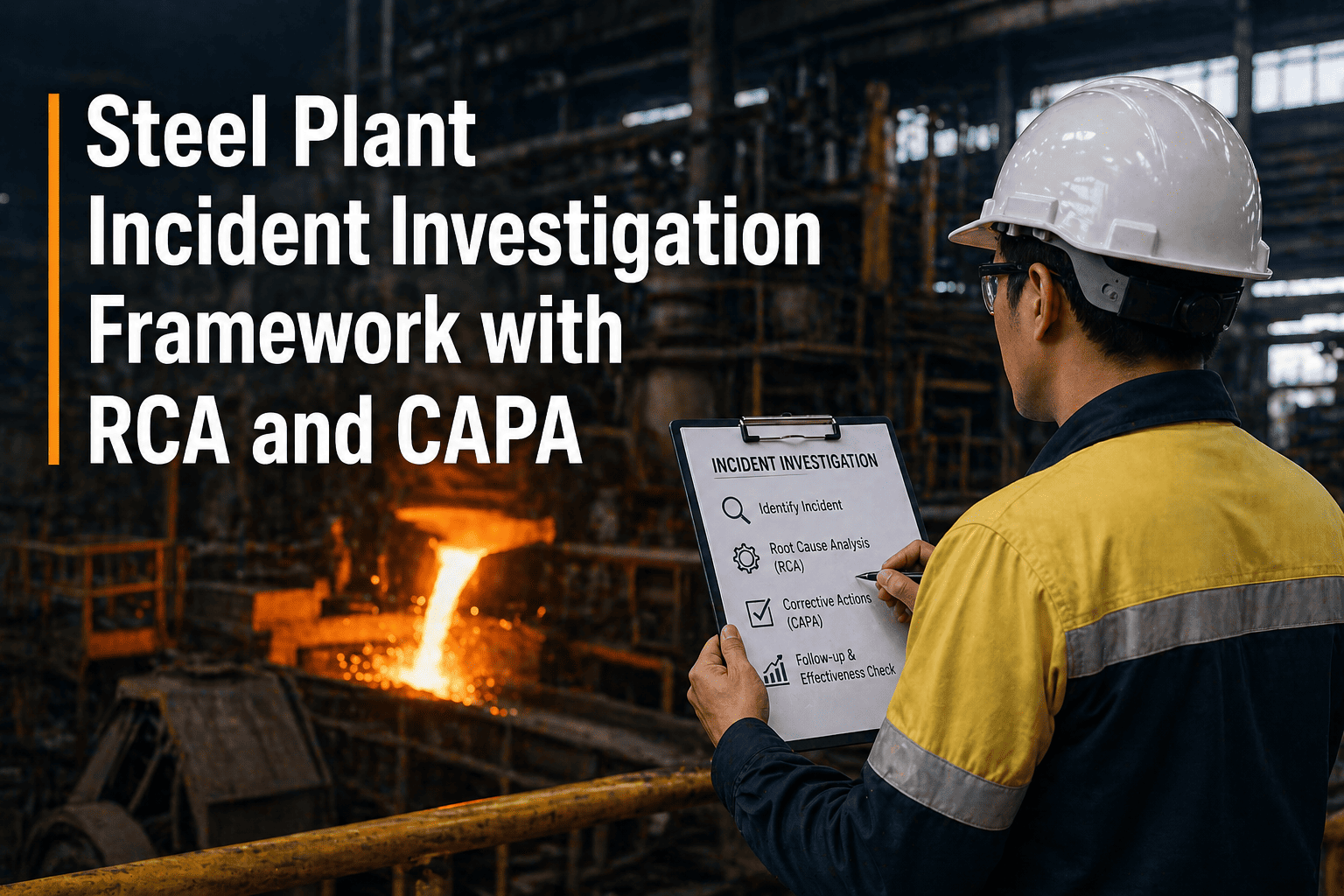
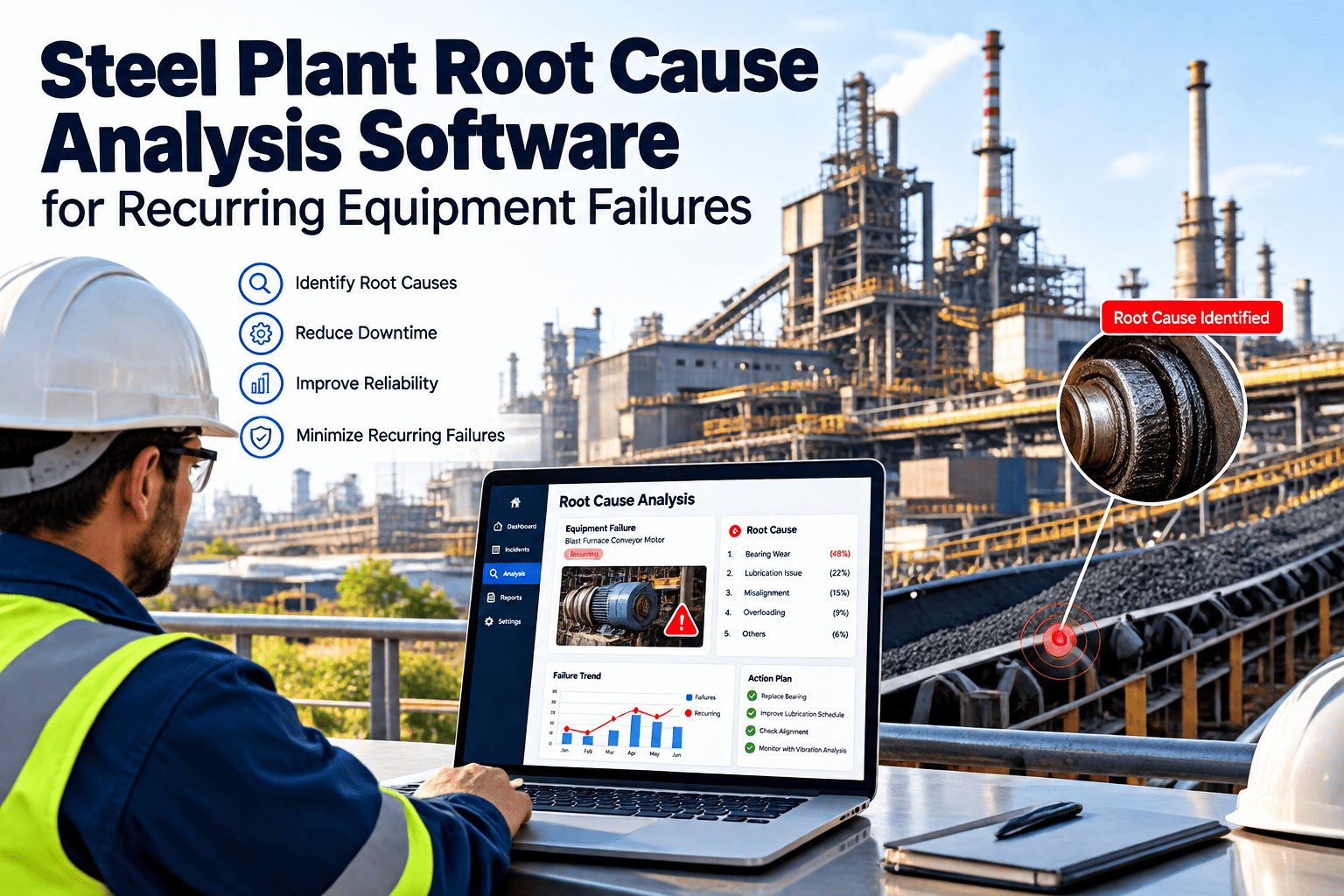
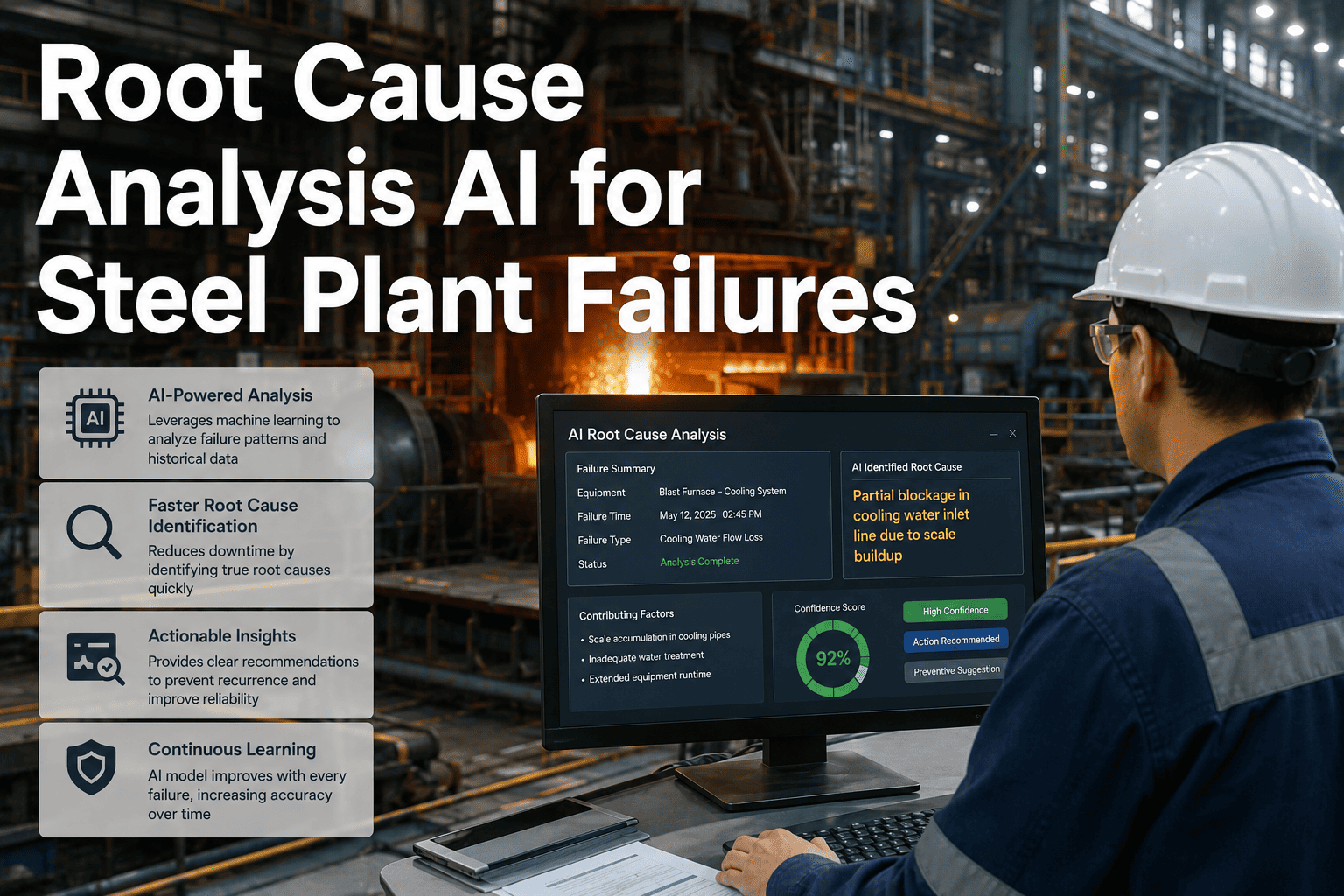
A 4,200-employee integrated steel plant in the US Midwest recorded a TRIR of 4.7 in 2022 — nearly double the manufacturing sector average of 2.8 — with 31 OSHA recordable incidents across melt shop, hot rolling, and maintenance operations, including two lost-time events involving molten metal splash burns and one confined space medical treatment case. A post-incident audit revealed not that investigations were being skipped, but that they were being completed without producing prevention. Every incident generated a report. Barely half produced a corrective action with an assigned owner and a verified closure date. Of the CAPAs that were raised, 68% remained open past their target date with no escalation triggered. The 2023 implementation of a structured RCA and CAPA framework — with Oxmaint's Compliance Tracking as the evidence and accountability layer — reduced the plant's TRIR to 2.1 within 18 months, below the manufacturing sector average, without a single additional safety hire. Book a 30-minute demo to see how Oxmaint's Compliance Tracking platform builds the investigation workflow, CAPA assignment, and verified closure chain that prevents repeat incidents — or start a free trial today.
Case Study · Safety & Compliance · Compliance Tracking
Steel Plant Reduces TRIR from 4.7 to 2.1 with Structured RCA and CAPA Framework
How a 4,200-employee integrated steel plant rebuilt its incident investigation programme from report-filing to genuine prevention — using structured root cause analysis, accountable CAPA assignment, and verified closure documentation that eliminated repeat incidents within 18 months.
4.7 → 2.1
TRIR reduced in 18 months — from nearly 2× sector average to below it
68%
CAPA past due before framework — no escalation triggered
0
Additional safety hires required to achieve the improvement
18 mo
Time from framework deployment to below-sector-average TRIR
100%
CAPA closure verification rate at 12 months post-framework
Plant Profile
The Plant: 4,200 Employees, Integrated Operations, TRIR Nearly Double the Sector Average
Plant Profile
Plant typeIntegrated steel — BF/BOF, hot rolling, cold rolling, coating lines
Workforce4,200 direct employees + 600 on-site contractors
TRIR baseline4.7 (2022) vs manufacturing sector average 2.8
Incident profileMelt shop burns (molten metal splash), maintenance confined space, crane and rigging near-miss events, rolling mill caught-in incidents
Prior systemPaper incident reports, EHS manager spreadsheet for CAPAs, no escalation mechanism for overdue actions
Oxmaint featureCompliance Tracking — RCA workflow, CAPA assignment, verified closure, trend reporting
The Three Problems the Audit Found
1
Reports without root causes. 100% of incidents had a report. 54% had a documented root cause beyond "worker error" or "inattention." Only root causes drive preventable CAPAs — the rest are reassignments of blame.
2
CAPAs without owners. 38% of corrective actions raised had no named responsible person. An action without an owner is a statement of intention, not a commitment to prevention.
3
Closure without verification. 68% of CAPAs were past their target date with no escalation. "Closed" on paper with no evidence that the corrective measure was implemented or effective.
The RCA Framework
Steel Plant Incident Hazard Categories — What RCA Must Address by Operations Area
Steel plant RCA is not generic manufacturing RCA. The hazard categories, energy sources, and failure pathways are specific to the process — and the root cause investigation must be structured around the actual failure modes in each operating area. A 5-Whys analysis that stops at "PPE not worn" on a melt shop burn incident has not reached the root cause.
| Operations Area |
Primary Hazard Categories |
Common Proximate Cause (Surface) |
Root Cause Categories RCA Must Reach |
| Melt Shop (BF/BOF/EAF) |
Molten metal exposure, oxygen lance handling, crane loads, CO/CO₂ atmosphere |
"Worker in wrong position" / "PPE failure" |
Work procedure design, exclusion zone enforcement, PPE specification vs task, permit-to-work failure |
| Ladle & Tundish Operations |
Thermal burns (splash/radiation), crane and ladle handling, refractory failure |
"Ladle moved unexpectedly" / "Inattention" |
Ladle tracking system gap, crane operator communication protocol, exclusion zone definition, refractory campaign limit compliance |
| Hot Rolling Mill |
Caught-in/between at work rolls, scale pit confined space, hot material ejection |
"Guard not in place" / "Procedure not followed" |
Guard design adequacy, LOTO programme gap, procedure clarity for the actual task performed, training verification |
| Maintenance Operations |
LOTO failures, confined space atmosphere, overhead crane exposure, working at height |
"Energy isolation incomplete" / "Rushed task" |
LOTO procedure accuracy for specific equipment, permit-to-work completeness, isolation verification method, schedule pressure analysis |
| Material Handling / Crane |
Suspended load incidents, sling/chain failure, pedestrian-crane interface |
"Sling over-rated" / "Operator error" |
Pre-use inspection compliance, load path planning, exclusion zone communication, rigging inspection programme completeness |
Oxmaint's RCA workflow templates are pre-mapped to steel plant hazard categories — ensuring every investigation reaches system-level root causes, not surface-level blame attribution.
Implementation
What the Plant Changed — Four Framework Elements Deployed Over 90 Days
Phase 1
Structured RCA Template by Incident Category — Weeks 1–3
A separate RCA template was configured in Oxmaint for each of the five operations areas in the plant. Each template pre-populated the relevant hazard category, required investigation steps, energy sources to consider, and minimum documentation fields. Investigators could no longer close an investigation without completing the mandatory cause-tree section — which required progressing at least 5 levels deep from the immediate injury event. "Worker error" as a terminal root cause was removed as a valid RCA conclusion; the system required at least one system or procedural factor to be identified before the investigation could be submitted.
OutcomeRCA completion rate with documented system-level root causes: 41% → 89% in 60 days
Phase 2
CAPA Assignment with Named Owner and Verified Closure — Weeks 3–6
Every CAPA raised from an RCA was assigned a named individual, a target completion date, and a verification method — the physical evidence that would prove the corrective action was implemented, not just attempted. The verification method was required at the time of CAPA assignment, not at closure. Options included: revised procedure document (with sign-off date), equipment modification record, training attendance register, or inspection record showing the hazard condition was corrected. CAPAs could not be marked closed without the verification evidence attached.
OutcomeCAPAs with named owner and verification method: 62% → 100% within 30 days
Phase 3
Automated Escalation for Overdue CAPAs — Weeks 6–8
Oxmaint automated an escalation chain for any CAPA that passed its target date without a verified closure: 7 days overdue = notification to CAPA owner; 14 days overdue = notification to area safety manager and department head; 30 days overdue = notification to plant safety director with auto-generated compliance gap report. This single change — adding automatic escalation that had previously required manual EHS manager follow-up — was the highest-impact single modification in the programme. The 68% past-due rate dropped to 11% within 90 days of activation.
OutcomeCAPA past-due rate: 68% → 11% within 90 days of escalation activation
Phase 4
Monthly Incident Trend Reporting to Operations Leadership — Weeks 8–12
A monthly safety performance report — TRIR by department, CAPA closure rates, open investigation count, and incident category distribution — was automated in Oxmaint and delivered to department heads and the VP of Operations on the first business day of each month. The report replaced the previous quarterly EHS presentation. Monthly visibility changed the conversation from post-incident briefing to proactive pattern recognition — three consecutive months of increasing near-miss reports from the hot rolling maintenance area triggered a targeted LOTO programme review before a recordable incident occurred.
OutcomeOperations leadership engagement with safety data: monthly vs quarterly; 1 near-miss cluster identified and corrected before recordable incident
Results at 18 Months
Safety Performance — Before and After the Framework
| Safety Metric |
Before Framework (2022) |
After Framework (2024) |
Change |
| TRIR (total recordable incident rate) |
4.7 |
2.1 |
-55% — now below manufacturing sector average |
| Incidents with documented system-level root cause |
54% |
96% |
+42 percentage points |
| CAPAs with named owner + verification method |
62% |
100% |
Full coverage achieved |
| CAPA past-due rate |
68% |
7% |
-61 percentage points |
| Repeat incident events (same root cause) |
8 events |
1 event |
-87.5% |
| OSHA recordable incidents (absolute count) |
31 |
14 |
-55% reduction |
| Time from incident to RCA completion |
Average 18 days |
Average 6 days |
-67% — faster investigation = faster prevention |
Expert Review
Why Steel Plants Specifically Struggle with RCA — And What Changes It
"Steel plants have a peculiar investigation problem that I have seen in every geography I have worked in: the investigation is conducted by the supervisor of the area where the incident occurred. That supervisor is simultaneously the person most knowledgeable about the process, most accountable for production targets, and most motivated to attribute the incident to individual behaviour rather than to a system gap that reflects on their operations. You get reports that are factually accurate about what happened and almost never accurate about why it happened at the system level. The corrective action says 'retrain the operator' — which does not change the procedure that created the hazardous condition, does not redesign the task that required the worker to be in the exposure zone, and does not address the scheduling pressure that caused the permit to be skipped. Structured RCA that requires investigators to progress beyond individual behaviour to organisational and procedural causes — and that uses a CMMS to enforce that requirement rather than relying on a reviewer to push back — is the only reliable mechanism for getting to prevention rather than blame. The CAPA escalation piece is equally important. Most safety programmes produce excellent CAPA lists. The ones that reduce TRIR year-on-year are the ones where those lists are systematically closed."
Marcus Osei, CFIOSH, CSP
Chartered Fellow, Institution of Occupational Safety and Health · Certified Safety Professional · 21 years industrial safety investigation — integrated steel, aluminium smelting, and heavy manufacturing · Former VP Safety, multinational steel group with operations in 8 countries
FAQs
Frequently Asked Questions
What RCA methodologies are most effective for steel plant incident investigation?
The most effective steel plant RCA approaches use a combination of methodologies depending on incident complexity.
5-Whys works well for single-cause events — a defined sequence of failures with a clear chain.
Fishbone (Ishikawa) diagrams are better for multi-factor incidents involving equipment, method, people, and environment simultaneously — common in complex melt shop or maintenance events.
Fault Tree Analysis (FTA) is appropriate for near-miss events involving safety-critical systems (crane interlocks, LOTO, molten metal barriers) where the logic of failure propagation needs to be mapped. The key discipline is not selecting a single method — it is ensuring the investigation always reaches a system or organisational cause, not a terminal "human error" conclusion.
Book a demo to see Oxmaint's RCA templates for steel plant operations.
What is the manufacturing sector TRIR benchmark and how does steel compare?
The US manufacturing sector average TRIR was 2.8 per 100 full-time workers in 2023, with manufacturing reporting 220,000 OSHA recordable injuries in 2024 as the third-highest sector by total case count. Integrated steel and iron production facilities typically run above the broad manufacturing average due to the presence of molten metal, high-energy equipment, and confined space operations. A TRIR below 2.0 in a fully integrated steel plant is considered high-performance; top-quartile operations with mature safety management systems consistently achieve TRIR below 1.5.
How does Oxmaint Compliance Tracking support RCA and CAPA management in steel plants?
Oxmaint structures the complete investigation workflow: incident notification → RCA template by operations area → mandatory system-level root cause documentation → CAPA assignment with named owner, target date, and verification method → automated escalation for overdue CAPAs → verified closure with evidence attached → monthly trend reporting to leadership. Every step generates a timestamped, attributed digital record that satisfies OSHA recordkeeping, ISO 45001 requirements, and customer safety audits.
The CMMS enforces the framework — investigators cannot submit an incomplete RCA or close a CAPA without the required evidence.
Start a free trial to configure your first RCA template.
How long should a steel plant incident investigation take to complete?
For OSHA recordable incidents, industry best practice targets RCA completion within 5–7 days from the incident — fast enough to interview witnesses while memories are accurate, capture physical evidence before the site is disturbed, and implement interim controls before the same task is performed again. Complex incidents with fatality potential may warrant a longer investigation period (14–21 days) with cross-functional teams. The plant in this case study reduced average RCA completion time from 18 days to 6 days — the faster turnaround was associated with higher root cause accuracy, not lower, because physical evidence and witness recollection quality are both time-sensitive.
What is the most common reason CAPA programmes fail to reduce repeat incidents in steel plants?
The single most common failure is CAPAs that are closed on paper without verified implementation. A corrective action that says "procedure revised" without a copy of the revised procedure attached — and without evidence that the revised procedure was communicated to the affected workers — does not prevent a repeat incident. It documents the intention. The second most common failure is CAPAs that address the worker behaviour without addressing the system condition that made the unsafe behaviour the path of least resistance. Both failures are structural — they result from investigation and closure processes that do not require evidence, not from a lack of commitment to safety.
Investigations That Reach System Causes and CAPAs That Close With Evidence Are the Programme That Reduces TRIR
Oxmaint Compliance Tracking enforces structured RCA to system-level root causes, requires named owners and verification methods on every CAPA, automates escalation for overdue actions, and delivers monthly trend reporting that turns safety data into leadership action — giving steel plant EHS teams the framework that converts investigations into prevention.