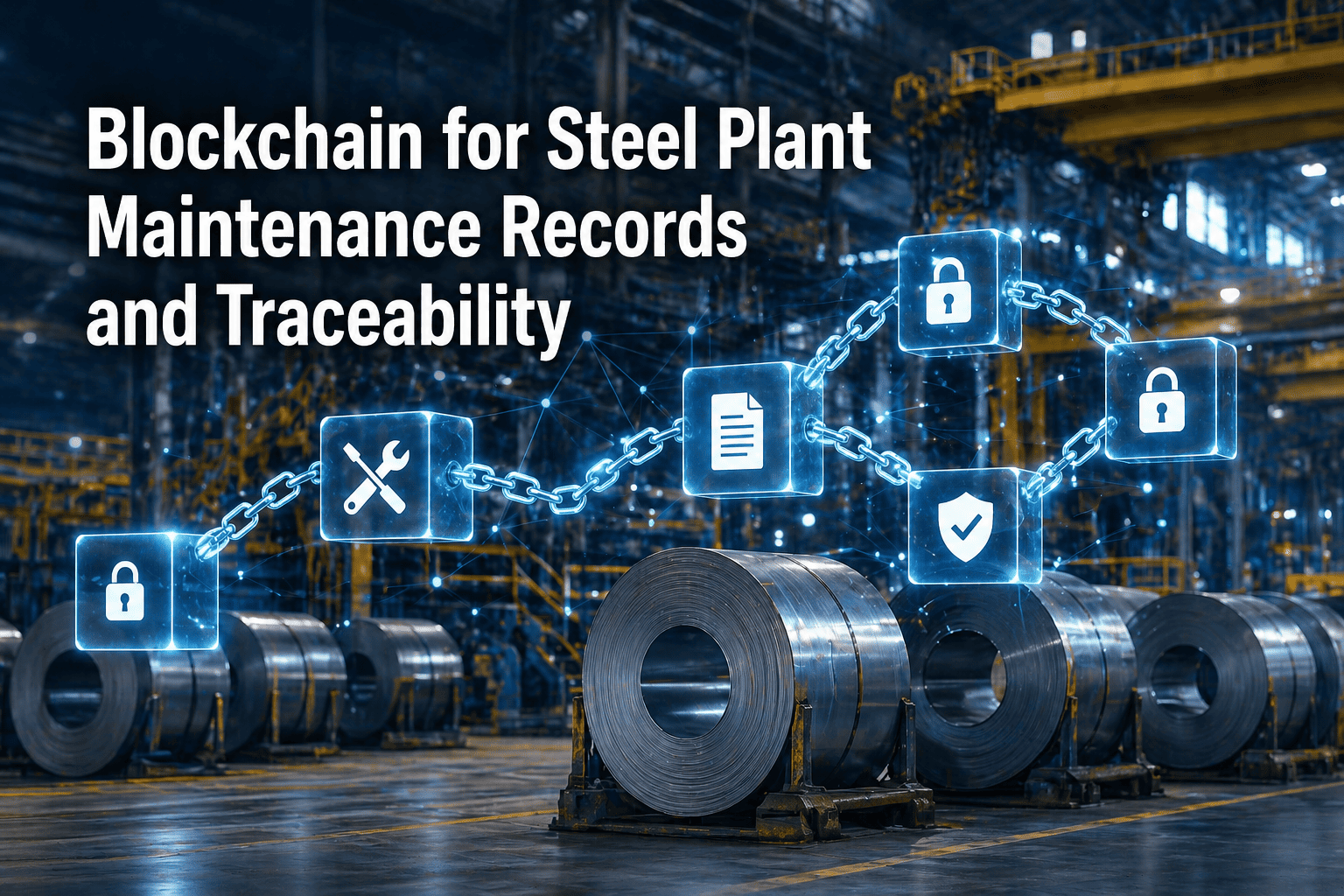
Blockchain for Steel Plant Maintenance Records and Traceability
By james smith on April 28, 2026
When ArcelorMittal, Tata Steel, and POSCO independently began deploying blockchain platforms for supply chain transparency in the early 2020s, the initial use case was not maintenance records — it was raw material provenance and sustainability certification. The discovery they made in implementation was more significant than the original objective: the same distributed ledger architecture that makes product origin claims tamper-proof also makes maintenance documentation tamper-proof. In a heavily regulated, multi-stakeholder industry where the integrity of mill certificates, heat treatment records, inspection reports, and equipment qualification documents determines both commercial value and regulatory compliance, the inability to alter historical records after the fact is not a feature. It is a competitive and compliance requirement. The European Union's Carbon Border Adjustment Mechanism, digital product passport initiatives under the EU Battery Regulation framework, and CBAM reporting obligations are already driving steel producers to demonstrate verifiable lifecycle data — a technical challenge that blockchain-secured maintenance and production records are architecturally designed to address. Book a demo to see how OxMaint's Cloud CMMS Platform provides the tamper-evident maintenance record infrastructure that steel plants need for audit compliance, supply chain traceability, and emerging digital product passport requirements.
Industry 4.0 · Steel Production · Cloud CMMS Platform
Blockchain for Steel Plant Maintenance Records & Traceability
How distributed ledger technology creates tamper-proof maintenance histories, enables supply chain provenance claims, and positions steel producers for digital product passport compliance — with OxMaint Cloud CMMS as the data source layer.
Raw material provenance tracking, environmental compliance data, supply chain transparency for sustainability reporting
POSCO
Digitised documentation, automated data verification, logistics streamlining across global supply chain
Tata Steel
Sustainability practice verification — energy consumption, emissions, waste management on auditable ledger
Komgo Platform
Blockchain-based trade finance — digitised documents reducing steel trade transaction time and cost
Why Blockchain
How It Works
Maintenance Records
Supply Chain Use Cases
CMMS Integration
Implementation
Why Conventional CMMS Records Are Not Tamper-Proof — And Why It Matters in Steel
Standard CMMS platforms store maintenance records in relational databases where authorised users — or compromised system administrators — can edit, delete, or backdate records without leaving a detectable audit trail. In most operational contexts, this is a theoretical concern. In steel manufacturing, it is a documented source of regulatory and commercial risk.
Mill Certificate Integrity
A steel mill certificate — documenting chemical composition, mechanical properties, and heat treatment — is only as valuable as its verifiability. In a conventional database, a certificate that was modified after an out-of-spec heat is indistinguishable from the original. On a blockchain, any post-issue modification produces a cryptographic mismatch that is immediately detectable. For automotive and aerospace steel customers requiring certifiable material traceability, this is the difference between a certification dispute and a criminal fraud case.
Regulatory Audit Vulnerability
Regulatory agencies — FDA for pharmaceutical manufacturing equipment, DNV for pressure vessel and structural inspections, and national labour regulators for worker safety equipment — conduct audits that compare current maintenance records against historical patterns. A blockchain audit trail is forensically verifiable: the investigator does not need to trust the database administrator's assertion that records are unmodified. The mathematical proof is in the hash chain itself. This distinction determined the outcome in the $34M FDA consent decree case where maintenance completion dates were retroactively altered in a CMMS — an impossibility under blockchain architecture.
Digital Product Passport Compliance
The European Union's emerging digital product passport (DPP) requirements — initially targeting batteries under the EU Battery Regulation, but with steel and construction products in the regulatory pipeline — mandate verifiable lifecycle data that cannot be generated retrospectively. A steel product's DPP must demonstrate material origin, processing conditions, maintenance history of critical production equipment, and carbon footprint across the value chain. Blockchain-secured CMMS data is the technical foundation for generating DPP-compliant records, because the immutability requirement cannot be met by conventional database exports.
CBAM & ESG Verification
The EU Carbon Border Adjustment Mechanism requires importers to declare the embedded carbon emissions of steel products entering the European market. For steel producers exporting to the EU, the ability to provide verifiable, auditor-confirmed emissions data — including the emissions profile of the maintenance and production equipment — is directly linked to CBAM liability calculations. Blockchain-secured production and maintenance data provides the audit trail that third-party CBAM verifiers require to certify declared emissions values.
How Blockchain Secures a Maintenance Record — Technical Architecture
Blockchain does not replace a CMMS — it adds an immutability layer beneath it. Technicians continue using the same mobile app, work order screens, and inspection checklists in OxMaint. The blockchain layer operates transparently in the background, converting each completed record into a cryptographic fingerprint that is permanently verifiable.
01
Record Created in OxMaint CMMS
Technician closes a work order, submits an inspection, records a calibration, or applies an approval signature in OxMaint. The system captures: who performed the action (user identity with credentials), what was done (work order detail), when it occurred (device timestamp + server timestamp), and any attached data or photographs.
02
Cryptographic Hash Generated
The complete record is converted into a unique SHA-256 cryptographic fingerprint (hash). Any change to any element of the original record — a single character, a timestamp digit, an attached photo — produces a completely different hash, making tampering mathematically detectable without any human judgment required.
03
Block Added to Chain
The hash is linked to the previous block's hash, creating an unbreakable chain. Altering any historical record breaks all subsequent blocks — the modification is immediately detectable across all nodes in the distributed network, regardless of the access level of the person who made it.
04
Distributed Across Nodes
Blocks are distributed across multiple nodes (private permissioned blockchain for industrial use — not public). No single party can alter the ledger without consensus from the network. For steel plants using a consortium blockchain with customers, insurers, or regulators as network participants, the record is verifiable by any authorised party without requiring access to the original CMMS database.
05
Verifiable by Any Authorised Party
An auditor, customer, regulator, or certification body can verify the integrity of any maintenance record by comparing the current hash against the blockchain entry — without needing access to the CMMS database, without relying on the plant's administrator to confirm the record is unmodified, and without any possibility of the plant operator presenting a different version than what was originally recorded.
OxMaint Cloud CMMS provides the maintenance data layer — structured work orders, timestamped completions, technician credentials, and asset histories — that blockchain immutability protects. The two technologies are complementary, not competitive.
Steel Plant Maintenance Records Most Valuable on Blockchain
Not every maintenance record in a steel plant has equal value from a blockchain traceability perspective. The records that are most commercially and regulatorily sensitive — those where falsification would carry legal, financial, or safety consequences — are the highest-priority candidates for blockchain-secured storage.
Record Type
Why Integrity Is Critical
Stakeholder Who May Verify
Consequence of Falsification
OxMaint Data Source
Mill certificates & heat treatment records
Certification basis for customer quality contracts; required by EN 10204, ASTM A6
Labour regulator, HSE inspector, insurance liability assessor
Criminal liability in fatality investigation; insurance claim rejection
LOTO permit-to-work completion records
Refractory & furnace campaign records
Production quality continuity; blast furnace / BF campaign length basis for financial planning
Production director, financial auditor, asset valuation assessor
Inaccurate asset value reporting; campaign termination liability
Furnace PM and condition monitoring records
Calibration records for quality instruments
ISO 9001 quality system basis; customer product certification
ISO auditor, customer quality team, third-party certification body
ISO certification withdrawal; product quality dispute
Calibration work orders per instrument asset
Supply Chain Traceability Use Cases — From Mine to Market
The steel supply chain involves miners, concentrators, pellet plants, integrated mills, service centres, and end-user fabricators — each generating maintenance and quality documentation that collectively describes the provenance and production conditions of the final product. Blockchain connects these documentation layers across the chain without requiring any participant to share raw database access.
01
Recycled Steel Verification
Blockchain enables accurate tracking of recycled scrap through the Electric Arc Furnace process — verifying the scrap source, charge composition, and processing conditions that determine the recycled content percentage. For automotive customers with recycled content commitments and for EU CBAM declarants where recycled steel has a different emissions profile, the blockchain-verified recycled content certificate has tangible commercial value.
02
Responsible Sourcing Compliance
ArcelorMittal's blockchain initiative demonstrates the use case: tracking raw material provenance from mining origin through to the finished steel product, enabling compliance verification for conflict minerals regulations, OECD Responsible Business Conduct guidelines, and customer responsible sourcing requirements. The MARCO Track & Trace platform used in steel manufacturing creates digital product passports linking material origin claims to verifiable chain-of-custody data.
03
Trade Finance Acceleration
The Komgo blockchain trade finance platform demonstrates the commercial value of digitised, tamper-proof steel trade documentation: letter of credit processing, bill of lading verification, and compliance certificate authentication that previously took days of manual document exchange now execute in hours. The same document integrity principle applies to maintenance certification packages for imported steel equipment requiring commissioning documentation in the receiving country.
04
Equipment Lifecycle Passport
A blockchain-secured equipment lifecycle passport — recording every PM event, inspection, repair, component replacement, and condition measurement for a critical asset from installation through decommissioning — creates the documented history that determines residual asset value, informs remaining service life estimates, and provides the evidence base for insurance claims when equipment failure occurs. For high-value assets (blast furnaces, continuous casters, large rotating equipment), the lifecycle passport is both a maintenance management tool and a financial asset documentation system.
Blockchain Architecture Choices for Steel Plant Maintenance
The "garbage in, garbage forever" principle identified by MD Metals in their analysis of steel blockchain implementations is the most important architectural consideration: blockchain guarantees the integrity of data after it is recorded, but it cannot guarantee the quality of data at the point of recording. The architecture decision that determines programme success is not blockchain protocol selection — it is the data entry discipline enforced by the CMMS that feeds the chain.
Private / Permissioned Blockchain
Recommended for Steel Plants
Controlled access — only authorised participants (plant, customers, auditors, regulators) can read or write. Faster transaction processing than public blockchains. Governance by consortium rather than anonymous mining. Hyperledger Fabric is the dominant enterprise standard. Best for maintenance records where data privacy from competitors must coexist with selective transparency to auditors.
Consortium Blockchain
For Supply Chain Traceability
Shared governance across multiple organisations (steel mill + customer + certification body + regulator). Each participant maintains a node. Decisions on network rules require multi-party consensus. Appropriate for multi-stakeholder supply chain traceability where no single party should control the ledger. The ArcelorMittal and Tata Steel implementations operate on this model.
Hybrid Architecture
For Large Portfolios
Private chain for internal maintenance records (full detail, restricted access) combined with a consortium or public chain for external-facing certifications (hash only — not raw data — shared externally). Allows plants to share cryptographic proof of record integrity without exposing commercially sensitive maintenance data to external network participants. The preferred model for plants with both internal compliance needs and customer-facing traceability requirements.
OxMaint Cloud CMMS — The Data Quality Layer That Blockchain Depends On
A blockchain-secured maintenance programme is only as valuable as the completeness and accuracy of the data recorded in the CMMS. OxMaint Cloud CMMS provides the structured data entry, credential-linked records, and automated work order workflows that ensure every blockchain-secured record is worth verifying.
Data Integrity
Structured Work Order Completion
Every work order completion in OxMaint requires structured field completion — technician identity, task-by-task sign-off, measurement values, and photo evidence — before the record is closed. This structured data is the input the blockchain hashes. A free-text note in an unstructured maintenance log has no blockchain value. A structured OxMaint work order record does.
Credential Tracking
Technician Qualification Linkage
OxMaint's Workforce Management module tracks technician certifications, competency qualifications, and training records. When a work order is completed, the completing technician's credential status at that date is recorded alongside the work — providing a blockchain-verifiable record that not only proves the work was done, but proves it was done by a qualified person at the time.
Timestamp Integrity
Multi-Source Timestamp Verification
OxMaint records device timestamp, server timestamp, and GPS location at work order completion. For blockchain-secured records, the multi-source timestamp eliminates device-clock manipulation as a falsification vector. An auditor verifying the blockchain record can confirm the completion occurred at the recorded time and location — not days later when the technician updated a paper log.
Asset Hierarchy
Equipment Lifecycle Context
OxMaint's asset hierarchy registers each piece of equipment with its full technical specification, installation history, and maintenance record chain. The blockchain-secured version of this asset record creates an equipment lifecycle passport that travels with the asset — verifiable by any subsequent owner, operator, or regulatory inspector without access to the original database.
"
The question I am asked most often about blockchain in steel plant maintenance is whether it is "worth the complexity." The answer depends entirely on what the plant's maintenance records are used for. If the records exist only for internal scheduling purposes, conventional CMMS is sufficient. But the moment maintenance records become evidence — in an insurance claim, a regulatory audit, a customer quality dispute, or an ESG verification — the question changes from "are these records accurate?" to "can you prove these records have not been modified?" Blockchain answers the second question in a way that no conventional database can. For the steel industry, where CBAM verification, digital product passport requirements, and customer traceability demands are converging simultaneously, the complexity calculus is shifting rapidly. The plants that have already built the data infrastructure will not be scrambling to comply with requirements that their competitors are still trying to understand.
Marcus Eidenschink, B.Eng, CRL · Digital Asset Management Specialist, voestalpine · 21 Years Steel Plant Operations Technology · Specialist in Industry 4.0 adoption, CMMS architecture, and blockchain-based asset lifecycle management for integrated steelmaking operations
Implementation
Implementation Roadmap — From CMMS Data Quality to Blockchain-Secured Records
Phase 1 · Months 1–3
CMMS Data Quality Foundation
Before any blockchain layer is deployed, the CMMS data must be structured and complete. Audit OxMaint work order completion rates, structured field completion percentages, and technician credential linkage. Identify the record types with highest regulatory and commercial sensitivity — these become the first blockchain-secured record classes. Unstructured or incomplete work order records entering a blockchain ledger have no additional value over a conventional database. Fix the data quality first.
Phase 2 · Months 4–6
Blockchain Protocol Selection & Pilot
Select blockchain architecture based on stakeholder map: private permissioned (Hyperledger Fabric) for internal compliance records; consortium blockchain for supply chain traceability applications involving customers or certification bodies. Deploy a pilot on one record class — typically calibration records or pressure vessel inspection records, where the audit verification use case is clearest and the data volume is manageable. Measure verification request response time and auditor feedback before scaling.
Phase 3 · Months 7–12
Scale to Priority Record Classes
Expand blockchain-secured record coverage to mill certificates, heat treatment records, environmental equipment PM, and LOTO records — the records with the highest falsification risk and regulatory consequence. Configure OxMaint API to automatically push completed work order hashes to the blockchain at record closure, eliminating manual export steps that introduce latency and potential manipulation windows between CMMS record and blockchain entry.
Phase 4 · Ongoing
Digital Product Passport Readiness
As EU digital product passport requirements mature (currently defined for batteries; steel products expected in subsequent regulation cycles), the OxMaint + blockchain architecture provides the technical foundation: structured lifecycle records, blockchain-verified integrity, and API-accessible data for DPP generation. Plants that have already built this infrastructure will generate DPP-compliant records as a by-product of their normal maintenance operations rather than as a compliance retrofit project.
FAQs
Frequently Asked Questions
Does blockchain replace OxMaint or other CMMS platforms in a steel plant?
Blockchain does not replace a CMMS — it adds an immutability layer beneath it. Technicians continue working in OxMaint exactly as before: creating work orders, completing checklists, recording measurements, and attaching photos. The blockchain layer operates automatically in the background, converting each completed record into a cryptographic hash that is permanently stored on a distributed ledger. The CMMS provides the maintenance workflow, data structure, and user interface; blockchain provides the tamper-proof audit trail. The two are complementary technologies, not alternatives. Book a demo to see OxMaint's CMMS data architecture and blockchain integration approach.
What is the "garbage in, garbage forever" problem and how does OxMaint address it?
The "garbage in, garbage forever" principle — identified in MD Metals' analysis of steel blockchain implementations — refers to blockchain's fundamental limitation: it can guarantee the integrity of data after recording, but it cannot improve the quality of data at the point of recording. If a technician enters incorrect measurement values, records the wrong component, or marks a task complete without performing it, the blockchain will preserve that inaccurate record with the same tamper-proof certainty as a correct one. OxMaint addresses this through structured work order completion (required fields, measurement bounds, photo evidence mandates), technician credential linkage (only qualified personnel assigned to qualified tasks), and multi-source timestamping that prevents backdated entries. The CMMS data quality programme is the prerequisite for meaningful blockchain implementation. See OxMaint's data quality controls and structured work order architecture.
How does blockchain-secured maintenance data support EU CBAM compliance for steel exports?
EU CBAM requires steel importers to declare the embedded carbon emissions of their products and provide verifiable evidence to third-party verifiers. The carbon footprint of steel production is directly influenced by the operational efficiency of production equipment — and that efficiency is documented in maintenance records. A blast furnace or BOF converter operating at degraded efficiency due to missed maintenance has higher carbon intensity than a well-maintained unit. Blockchain-secured maintenance records provide the audit trail that CBAM verifiers require to certify the declared emissions values: they can verify that the environmental control equipment (FGD systems, bag filters) was maintained on schedule, that the process equipment operated within specification, and that the records are genuine rather than retrospectively prepared for compliance purposes.
Cloud CMMS Platform · OxMaint · Industry 4.0
The Maintenance Records You Create Today Will Be Verified Tomorrow. Make Them Verifiable.
OxMaint Cloud CMMS provides the structured maintenance data — timestamped, credential-linked, photo-evidenced, and asset-hierarchied — that blockchain immutability depends on. For steel plants building toward CBAM compliance, digital product passport readiness, and customer traceability demands, OxMaint is the data foundation that makes blockchain implementation meaningful rather than merely architectural.
.png)
.png)