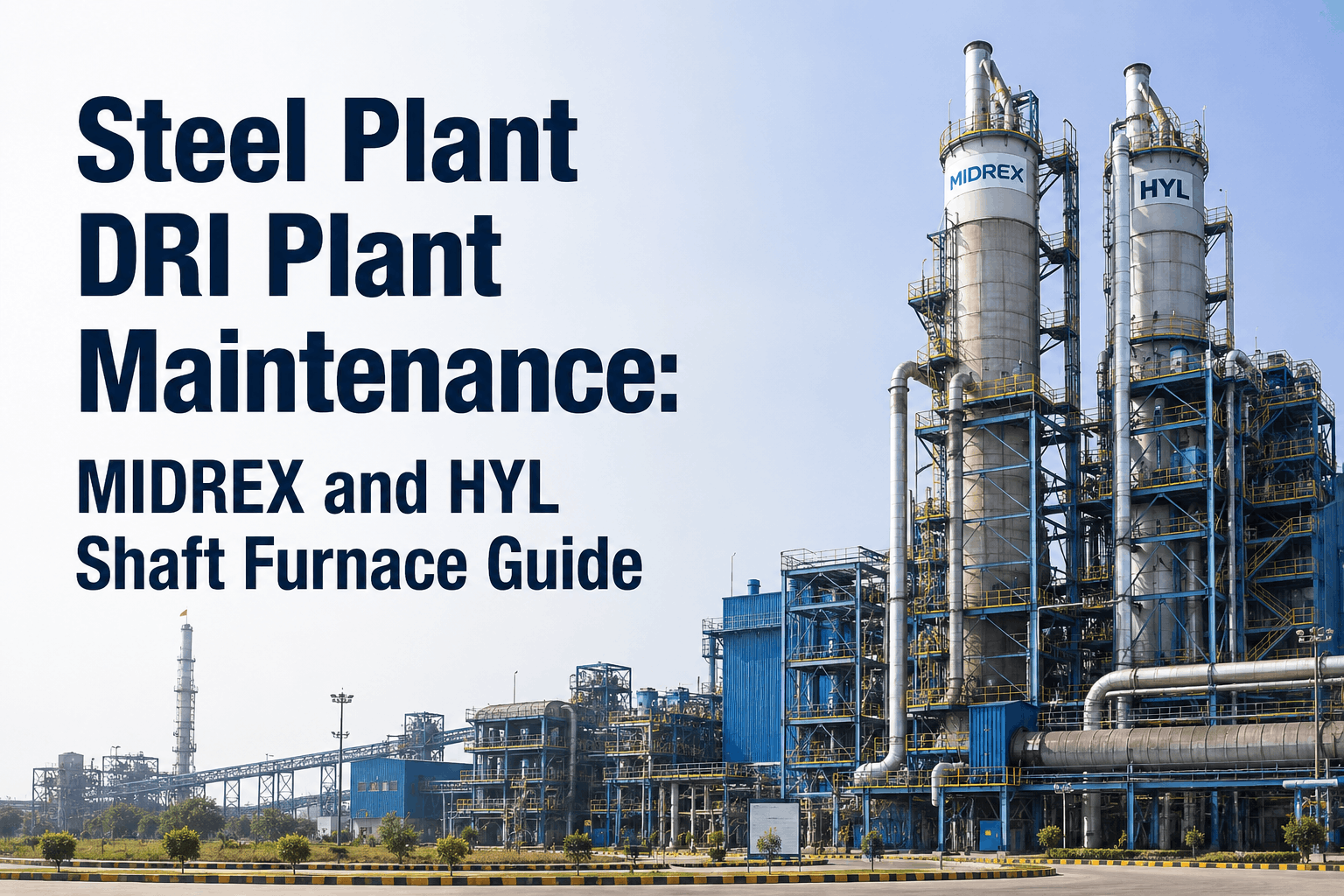
A MIDREX shaft furnace operating at 950°C with slightly above-atmospheric pressure, producing over 275 tonnes of DRI per hour on a Super Megamod module, does not fail catastrophically — it degrades incrementally. Reformer tube pressure drop climbs week by week as carbon deposits build on the Ni/Al₂O₃ catalyst. Refractory lining thickness decreases millimetre by millimetre as thermal cycling and reducing gas erosion advance between planned shutdown windows. Bustle gas temperature drifts from the 900–925°C operating range as thermocouple calibration error accumulates. Every one of these degradation signals is measurable, trendable, and actionable before it becomes a forced outage — if the maintenance system is structured to capture the right process parameters at the right frequency and compare them against the engineering baselines the OEM defined for that specific furnace configuration. MIDREX and HyL/Energiron together account for approximately 79% of global DRI production (ScienceDirect), and both technology platforms are now operating under commercial pressure to push availability above 8,000 hours per year while integrating hydrogen blending and CO₂ capture modifications that change the failure mode landscape their maintenance programmes were originally designed for. Book a 30-minute demo to see how Oxmaint's Predictive Maintenance AI tracks DRI plant process parameters, reformer tube health, and shaft furnace refractory condition across MIDREX and HyL/Energiron configurations — or start a free trial and connect your first DRI process data stream today.
Predictive Maintenance AI · Steel Production Processes · DRI
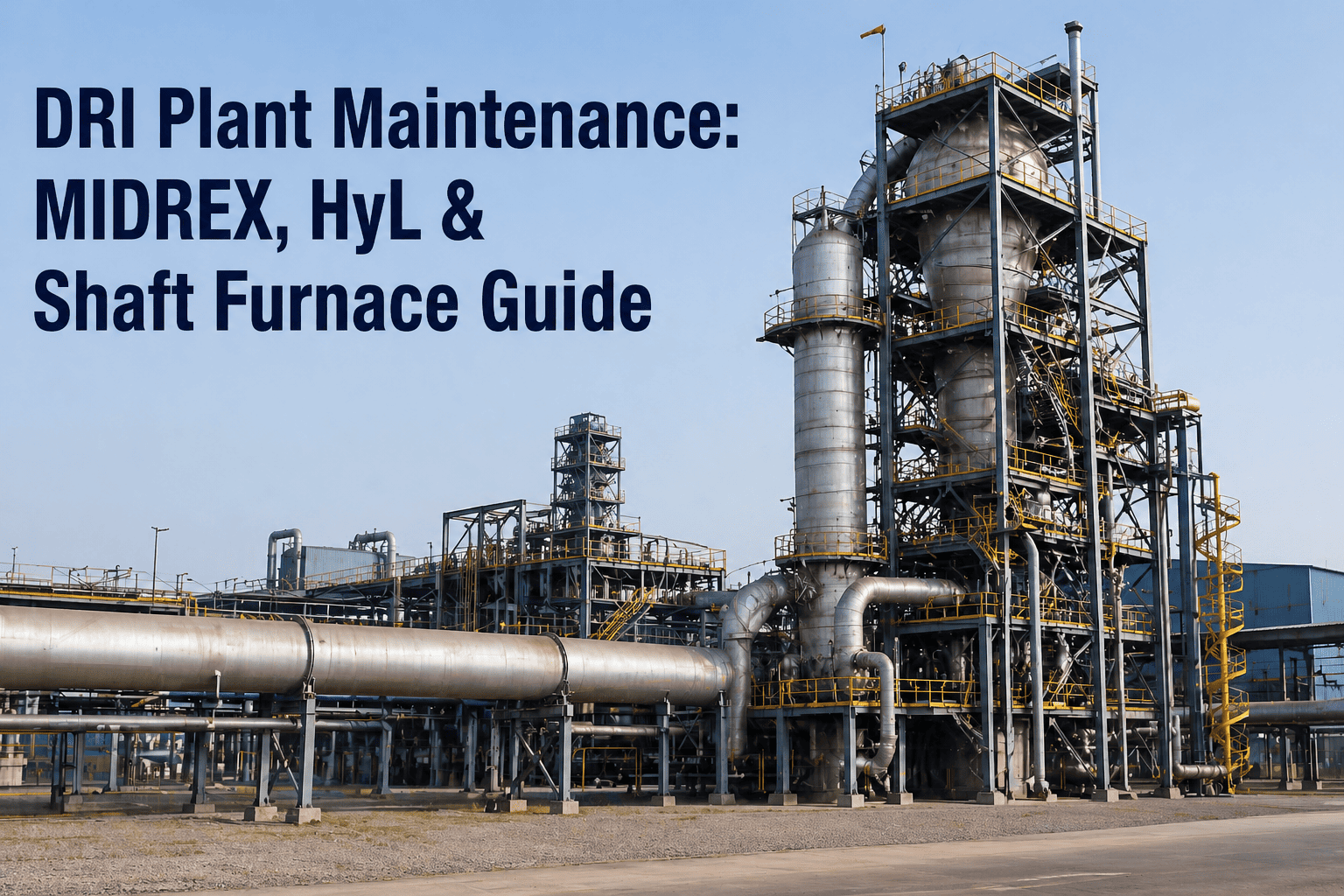
DRI Plant Maintenance: MIDREX, HyL & Shaft Furnace Guide
Process-specific maintenance strategies for MIDREX and HyL/Energiron direct reduction plants — covering gas reformer monitoring, refractory inspection protocols, catalyst management, and the predictive maintenance KPIs that determine whether your DRI plant achieves 8,000+ hours of annual availability.
79%
Global DRI production from MIDREX and HyL/Energiron shaft furnace processes
8,000+ hrs
Annual availability target — shaft furnace availability determines plant profitability
950°C
Shaft furnace operating temperature — slightly above atmospheric pressure
4–6 hrs
Lost DRI production per reformer carbon burnout event — preventable with AI trend monitoring
MIDREX vs HyL/Energiron — Process Architecture and What It Means for Maintenance
The two platforms share a shaft furnace core but differ in their reforming configuration, gas recycling architecture, and pressure regime in ways that produce distinct maintenance priorities. Understanding the process difference is the foundation for building the right PM programme for each technology.
MIDREX Process
60%+ of world DRI since 1984
ReformerExternal catalytic reformer — refractory-lined box with alloy tubes (200/250 mm ID, ~8 m heated length)
Reducing gas90–92% H₂ + CO (syngas); typically 55% H₂ and 35% CO — fed hot directly to shaft
PressureSlightly above atmospheric — simpler seal and valve maintenance
CatalystNi/Al₂O₃ in external reformer tubes — carbon deposition is primary deactivation mechanism
CO₂ captureNot integrated in standard configuration — flue gas emitted
H₂ capabilityCan operate 100% H₂ — changes thermal and condensation profiles
Maintenance focusReformer tube integrity, catalyst pressure drop monitoring, expansion seal condition
HyL/Energiron Process
~12% of world DRI — CO₂ capture integrated
ReformerInternal reformer (ZR — zero-reformer variant available) — reforming occurs inside shaft furnace
Reducing gasHigher H₂ content, higher operating temperature — more water vapour produced per tonne of DRI
PressureHigher operating pressure (6–8 bar) — seal integrity, valve cycling, pressure vessel inspection
CatalystReformer catalyst within shaft — access more restricted; catalyst life monitoring critical
CO₂ captureIntegrated CO₂ capture in flue gas before reinjection — additional equipment to maintain
H₂ capabilityTested at 90% H₂ — 100% H₂ pathway claimed; water scrubbing system maintenance intensifies
Maintenance focusWater scrubbing system, pressure seal integrity, CO₂ capture amine circuit, gas analysis instruments
The Six Critical Failure Modes in DRI Plants — And What Catches Each One Early
DRI plant failures are not random events. Each of the six failure modes below follows a measurable degradation curve that predictive monitoring can intercept weeks or months before forced outage. The difference between a planned repair and an emergency shutdown in a MIDREX or HyL plant is almost always the presence or absence of the right trending data.
01
Reformer System
Catalyst deactivation — carbon deposition on Ni/Al₂O₃ tubes
Carbon deposition on reformer catalyst is the dominant failure mode in MIDREX plants. As carbon builds on the Ni/Al₂O₃ catalyst, tube pressure drop increases measurably — the leading indicator of approaching performance loss. Left unmanaged, carbon burnouts become weekly events (versus the normal monthly cadence at fresh catalyst life), each burning 4–6 hours of DRI production and thermally cycling the alloy tubes in ways that shorten their structural life. Carbon-forming reactions are temperature-sensitive: CO reduction and Boudouard carbon deposition are favoured below 860°C, methane cracking above 1,000°C — meaning reformer temperature uniformity is as important as absolute temperature.
AI Trigger
Tube pressure drop trend + H₂/CO ratio deviation from baseline
02
Shaft Furnace
Refractory lining wear — silent degradation between shutdowns
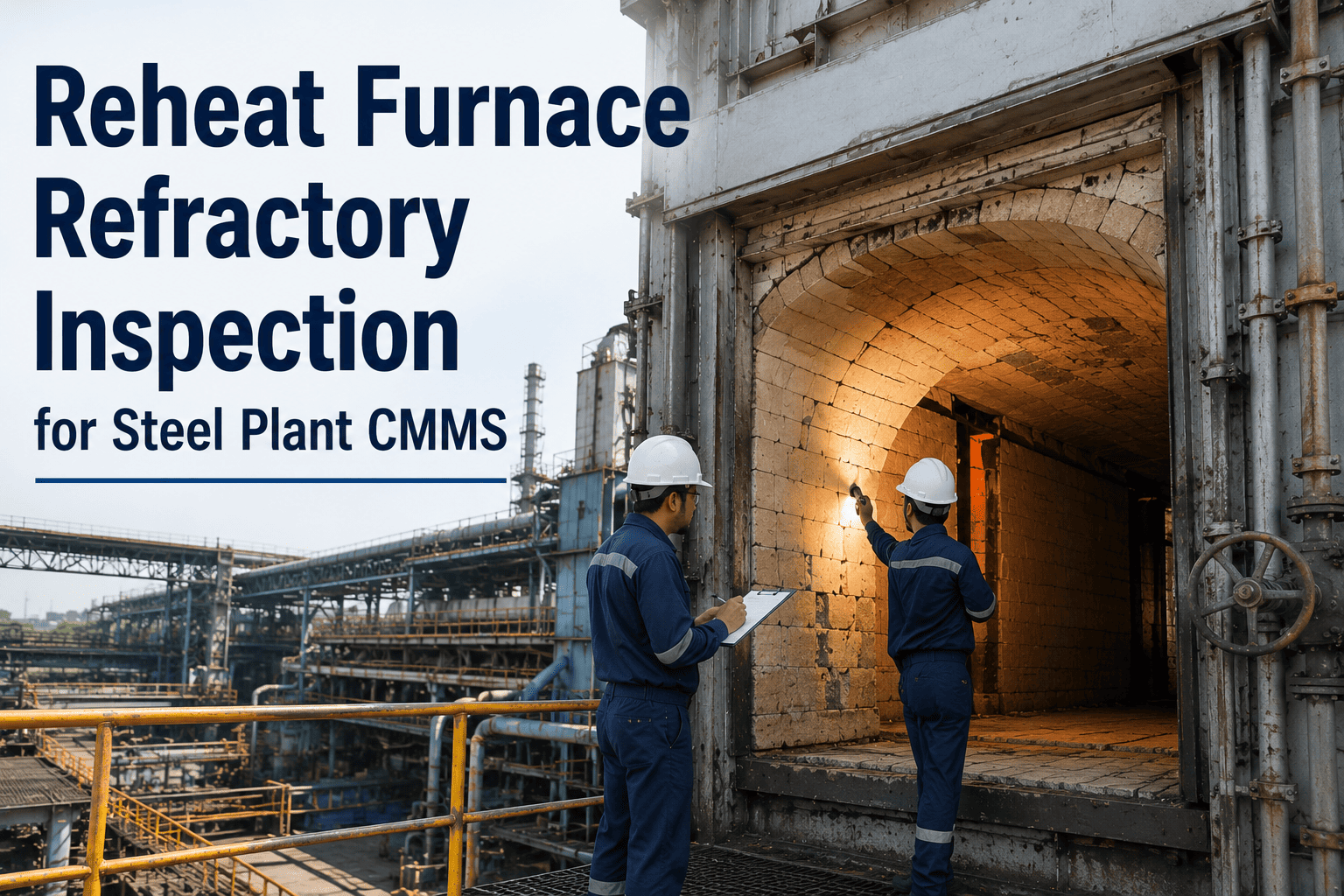
The shaft furnace refractory lining operates continuously at ~950°C in a reducing atmosphere — conditions that promote silica dissolution, spalling, and thermal shock damage at every transition. The MIDREX shaft furnace design eliminates hearth refractory erosion as a failure mode, and lining lifespan routinely exceeds 10 years (some plants over 40 years). But bustle tuyere brickwork, cone section lining, and upper transition zone refractory require inspection at each planned outage window. Wall temperature thermocouples trending upward over months indicate lining thinning before any visual crack is accessible.
AI Trigger
Shell thermocouple temperature trending + bustle zone delta-T deviation
03
Gas Seals & Valves
Seal degradation — ore entry and DRI discharge sealing failure
Rotary valves and gas seals at the ore feed hopper and DRI discharge are under continuous mechanical stress in a hot, abrasive, reducing-gas environment. Seal gas pressure differential monitoring is the primary early-warning indicator — a declining differential across the discharge seal precedes DRI oxidation and gas leakage events. On HyL/Energiron at 6–8 bar operating pressure, seal integrity is a higher-consequence maintenance obligation than on atmospheric MIDREX configurations, and inspection intervals are correspondingly shorter.
AI Trigger
Seal gas differential pressure trending + DRI oxidation index correlation
04
Water Systems
Scrubber and condensation system — water management as a process limit
In hydrogen-enriched DRI operation, the reduction reaction produces large volumes of water vapour — up to 540 kg per tonne of DRI in high-H₂ operation. The water scrubbing and condensation system must remove this moisture from recycled gas continuously; any reduction in scrubbing efficiency directly reduces metallization rate. Heat exchanger fouling in the gas cooling loop is the most common early symptom — approaching at temperature transition zones where condensation creates corrosive conditions. Midrex data shows water system downtime reduction of 50–75% is achievable with predictive monitoring.
AI Trigger
Gas moisture content trending + heat exchanger delta-T divergence
05
Gas Analysis
Instrument drift — the silent process quality failure
Gas analysis instrumentation monitoring H₂ purity, CO content, moisture, and residual oxygen is the measurement foundation for every process control decision in a DRI plant. Calibration drift in any single analyser can cause a process deviation within hours — metallization rate drops, carbon content shifts out of spec, and the problem may not surface until laboratory analysis of discharged DRI. Continuous comparison of online analyser readings against independent reference measurements, with automated calibration scheduling triggered by deviation thresholds, is the only system that reliably prevents this failure mode.
AI Trigger
Cross-analyser agreement monitoring + calibration interval tracking
06
Rotating Equipment
Blowers and compressors — high-cycle, high-consequence
Gas recirculation blowers and reducing gas compressors in DRI plants operate at higher volumetric flows than comparable industrial fans — particularly in high-H₂ operation where lower gas density requires greater volumetric throughput to deliver equivalent molar reducing power. Bearing temperature and vibration trending is the standard predictive approach, but seal gas consumption monitoring adds a plant-specific leading indicator: increasing seal gas usage precedes seal failure by weeks and provides a shutdown-avoidable repair window that vibration alone cannot reliably identify.
AI Trigger
Bearing vibration + seal gas consumption rate trending
Connect DRI Process Parameters to Predictive Maintenance Triggers in One Platform
Oxmaint's Predictive Maintenance AI ingests reformer tube temperatures, bustle gas H₂/CO ratios, shaft furnace wall thermocouples, and blower vibration data — generating work orders automatically when parameter trends cross defined thresholds, before the process deviation becomes a forced outage.
DRI Plant PM Schedule — Maintenance Intervals by System and Technology
The table below synthesises MIDREX and HyL/Energiron maintenance intervals across the critical systems. Where intervals differ by technology, both are shown. All intervals should be treated as minimum starting points — plants operating at higher production rates or with hydrogen blending should apply conservative multipliers.
| System / Task |
MIDREX Interval |
HyL/Energiron Interval |
Who Performs |
Oxmaint Trigger |
| Reformer tube pressure drop measurement |
Weekly — per tube row |
N/A (internal reformer) |
Process engineer |
Weekly work order + deviation alert |
| Gas analyser calibration check |
Daily |
Daily |
Instrument tech |
Daily checklist + drift alert |
| Bustle gas temperature and composition |
Continuous (trend weekly) |
Continuous (trend weekly) |
Process engineer |
AI trend monitoring, threshold alert |
| Shaft furnace wall thermocouple survey |
Monthly |
Monthly |
Maintenance tech |
Monthly PM + temperature trend log |
| Seal gas differential pressure check |
Daily |
Daily (higher pressure — critical) |
Operator / tech |
Daily inspection WO + low-DP alert |
| Blower / compressor vibration + bearing temp |
Weekly (vibration); Daily (temp) |
Weekly (vibration); Daily (temp) |
Maintenance tech |
AI vibration trend + bearing alert |
| Water scrubber and condensate system inspection |
Monthly |
Bi-weekly (higher H₂O load) |
Maintenance tech |
Calendar PM + moisture deviation alert |
| Expansion seal (reformer tube base) inspection |
At planned shutdown |
N/A |
Specialist contractor |
Shutdown-triggered work order |
| Refractory visual inspection and thickness survey |
Annual (planned outage) |
Annual (planned outage) |
OEM-certified refractory team |
Annual shutdown PM + wall temp trend |
| Catalyst performance assessment (pressure drop + H₂/CO) |
Quarterly (MIDREX RPS protocol) |
Quarterly |
Process engineer |
Quarterly WO + degradation trend alert |
| CO₂ capture amine circuit inspection |
N/A (standard MIDREX) |
Quarterly |
Chemical engineer / specialist |
Quarterly PM — HyL/Energiron only |
| DRI product sampling — metallization + carbon |
Per shift (minimum) |
Per shift (minimum) |
Laboratory / process |
Shift-end quality WO |
The Predictive Maintenance Stack — Four Layers That Keep DRI Plants Above 8,000 Hours
Achieving and sustaining 8,000+ hours of annual availability requires more than a PM schedule. It requires a layered approach where process parameter monitoring, equipment condition monitoring, and planned shutdown intelligence work together — with each layer feeding the next. These four layers are the operational architecture of DRI plant reliability.
L1
Process parameter trending — the first signal layer
Continuous monitoring of bustle gas H₂/CO ratio, reformer outlet temperature uniformity, shaft furnace wall thermocouples, and gas moisture content provides the earliest indication of equipment condition deterioration — often weeks before any physical inspection could find a visible defect. MIDREX's DRIpax optimisation system demonstrates this approach: the Superdata Model tracks reduction furnace utilisation, bustle gas quality, reformer performance, and heat recovery simultaneously, using process data as a proxy for equipment condition.
Earliest signal — days to weeks before physical failure indicators
L2
Equipment condition monitoring — rotating and static assets
Vibration analysis on blowers, compressors, and ore-handling drives. Infrared thermography on reformer tube roof and expansion seal zones at defined inspection intervals. Ultrasonic thickness measurement on refractory lining during planned outages. Catalyst tube pressure drop profiling per reformer row. Each of these techniques generates a data point that is only meaningful as part of a trend — which is why CMMS-stored historical readings per asset are essential to the value of each new measurement.
Equipment layer — confirms and localises L1 signal; triggers repair scoping
L3
Planned shutdown intelligence — making outage windows count
Every DRI plant planned outage is a finite window — typically 10 to 21 days — in which every deferred corrective action, refractory repair, expansion seal replacement, and catalyst assessment must be completed. The maintenance team that enters a shutdown with a ranked, parts-confirmed, contractor-coordinated work scope based on 6 to 12 months of accumulated condition data recovers the full equipment life budget from the outage. The team that assembles the scope during the first days of the shutdown loses 20 to 30% of that recovery window to planning it should have done before lights-out.
Shutdown layer — converts condition data into recovery actions
L4
Feedback and model refinement — the availability improvement loop
The predictive maintenance model improves every time a predicted failure is confirmed or a false positive is investigated. Comparing AI-generated work orders against actual failure findings closes the loop that converts historical plant data into progressively more accurate failure predictions. MIDREX data shows that systematic reformer tube life tracking — correlating tube pressure drop history, thermal cycling events, and carbon burnout frequency — extends catalyst life and reduces unplanned tube failures. This compounding benefit requires a CMMS that stores the full parameter history per asset from day one of monitoring.
Feedback layer — compounds availability improvement over operating years
Expert Review — What Separates 8,000-Hour DRI Plants from 6,500-Hour Plants
"The DRI plants I have audited that consistently achieve 8,000 or more operating hours per year share one characteristic that has nothing to do with the age or model of their equipment: their maintenance teams treat process parameters as maintenance signals, not just operating data. In a MIDREX plant, reformer tube pressure drop is not a process optimisation number — it is a catalyst life meter. Bustle gas H₂/CO ratio trending below the design envelope is not a shift supervisor problem — it is a reformer condition problem that a maintenance engineer needs to own. The plants that achieve the highest availability have eliminated the organisational boundary between process control and maintenance. Their CMMS receives process data from the DCS, generates work orders when parameter trends cross defined thresholds, and closes the loop with physical inspection findings that validate or refine the trigger. The plants running at 6,500 hours per year are the ones where process data sits in the DCS historian and maintenance data sits in a spreadsheet, and the two systems never speak to each other."
Kenji Watanabe
Reliability & Maintenance Engineering Specialist — POSCO Technical Research · 17 years in DRI plant maintenance across MIDREX and HyL/Energiron configurations · Former technical lead for shaft furnace availability improvement programme, Arabian Gulf operations
Frequently Asked Questions
What is the primary maintenance difference between MIDREX and HyL/Energiron DRI plants?
The most significant difference is the
reformer configuration. MIDREX uses an external reformer with hundreds of accessible alloy catalyst tubes — enabling weekly tube pressure drop monitoring per row and targeted maintenance intervention before full catalyst replacement. HyL/Energiron uses an internal reformer with more restricted access, placing greater emphasis on gas analysis instrument calibration and ZR (zero-reformer) configurations that shift maintenance focus to the shaft furnace itself. HyL/Energiron also operates at higher pressure (6–8 bar), making seal integrity a higher-consequence daily check than in atmospheric MIDREX.
Book a demo to see MIDREX and HyL-specific PM templates in Oxmaint.
How often should MIDREX reformer catalyst be replaced?
MIDREX reformer Ni/Al₂O₃ catalyst life depends on operating conditions, gas quality (particularly heavy hydrocarbon content), and carbon burnout frequency. Catalyst deactivation accelerates as carbon deposition increases — plants requiring weekly carbon burnouts are approaching end-of-catalyst-life, having typically started at monthly burnout cadence at fresh load. The MIDREX Reformer Performance Service (RPS) protocol uses real-time tube pressure drop, thermocouple data, and H₂/CO ratio to create a continuous catalyst life profile — the same data structure Oxmaint's predictive AI uses to generate replacement timing alerts before forced performance loss.
What are the main refractory inspection points in a MIDREX shaft furnace?
The primary inspection zones are the
bustle tuyere brickwork (highest erosion risk from reducing gas introduction), the cone section transition zone between reduction and cooling sections, and the upper furnace lining at the ore feed zone. MIDREX's design eliminates hearth floor erosion (no hearth refractory in the traditional sense), allowing 10-year-plus lining life on well-managed plants. Between major outages, shell thermocouple trending is the primary early-warning tool — a consistent upward trend in shell temperature at a specific elevation indicates lining thinning before visual access is possible.
Start a free trial to configure thermocouple trend monitoring per furnace zone.
How does hydrogen blending change DRI plant maintenance requirements?
Higher hydrogen content in reducing gas increases water vapour production per tonne of DRI — up to 540 kg H₂O per tonne in high-H₂ operation. This intensifies maintenance requirements on the water scrubbing and condensation system, where heat exchanger fouling at temperature transition zones accelerates under higher water loads. Thermal profiles inside the shaft furnace also change — H₂ reduction is endothermic, requiring adjustments to bustle gas temperature setpoints. Seal systems face different permeation characteristics with H₂ vs natural gas, and instruments calibrated for natural gas-based operation may require recalibration when H₂ content changes significantly.
What DRI plant KPIs should be tracked in a CMMS for predictive maintenance?
The core predictive KPIs for DRI plants are: reformer tube pressure drop by row (MIDREX — catalyst health meter); bustle gas H₂/CO ratio vs design envelope (process and reformer performance); shaft furnace wall thermocouple delta-T vs baseline (refractory condition); gas moisture content in recycle loop (scrubber performance); seal gas consumption rate (rotary valve and shaft seal condition); and carbon burnout frequency (catalyst life indicator). Each of these is a trend metric — its value lies in comparison to the asset's own history, not against an industry average. The CMMS that stores per-asset parameter history from commissioning provides the baseline every comparison requires.
The DRI Plant That Monitors Its Process Parameters Is the One That Achieves 8,000+ Hours
Oxmaint Predictive Maintenance AI connects DRI process data streams — reformer tube pressure drop, bustle gas composition, furnace wall thermocouples, blower vibration — to automated work order generation when parameter trends cross defined thresholds. Every maintenance action is stored against the asset it was performed on, building the trend baseline that makes each subsequent prediction more accurate.